-

House of the Dragon Fatigue: Can We Just Get to Game of Thrones Already? (An Antifanfic Solution)
Sixteen minutes into episode eight of season three of House of the Dragon, I realized I was tired. Not sleepy tired—tired of Westeros finding new people to declare king, new factions to form, and new reasons to keep this story going.
And tired of how humorless it all is. Game of Thrones had humor everywhere—intentional humor, accidental humor, straight-up jokes, even slapstick. House of the Dragon has taken all of that humor, wrung it out like dirty laundry, and apparently thrown it away with the wash water.
So I gave myself a writing challenge: find a faster way to get from House of the Dragon to Game of Thrones.
This is my solution.
I suppose technically it’s fanfic. But considering how I was feeling about the show when I wrote it, I prefer antifanfic.
Sheepstealer brooded, licking his wounds.
He surveyed the cave he was in.
Grumble grumble grumble grumble.
Which basically meant: Goddammit, I hate those people.
After ten days, he managed to kill a sheep and eat it.
After fifteen days, he got two more.
Testing his strength, he flew for maybe a mile. Then he found a cow.
Well. That was new.
He ate that too.
Unfortunately, some guys with pointy things chased him.
He didn’t like that.
Sheepstealer was still a little too weak to do much about them, so he took the cow and flew back to his cave.
Grumble grumble grumble grumble.
Which basically meant: Oh, man. That cow gave me heartburn. I don’t want to do that again.
Still, once the indigestion ended, he felt stronger.
Maybe he should cook the next one first.
That had been a lot of fur.
Grumble.
Go with me.
Sheepstealer flew to another patch of land where he knew there were cows. This time he saw the guys with pointy things and the cows in the same place.
Well.
Cook it.
He flamed.
The guys with the pointy things fell down.
The cows fell down.
And they smelled pretty good.
Sheepstealer picked up the cows and flew back to his cave.
Grumble grumble grumble.
Yeah.
That was better.
After thirty days of this, Sheepstealer had learned something.
He didn’t like guys with pointy things.
He didn’t like other dragons that tried to kill him.
That was it.
He was going to do something about this.
Grumble.
Sheepstealer was Sheepstealer no more.
Cowstealer flew from his cave toward an area where he knew there were lots of guys with pointy things and maybe some cows and goats.
There was also a big kind of cave thing with jagged edges.
Grumble grumble grumble.
Somebody called it a castle.
Is that what it was?
The guys with pointy things rushed toward him.
Cowstealer made barbecue out of them.
Not the kind you eat.
The kind that makes the land smell good.
Then he ate some cows and goats.
Something interesting happened while he was using his fire.
Part of the big stone cave fell down.
Cowstealer stared at it.
Grumble?
That was interesting.
Cowstealer slumbered.
Then he woke to a weird sound outside.
“Arooga! Arooga! Arooga!”
Grumble grumble grumble.
Go away. I’ve got a stomachache.
“Arooga! Arooga! Arooga!”
Grumble.
Sigh.
What do you guys want?
Cowstealer looked outside.
Oh, goody.
Lots of guys with pointy things. Some were mounted on those horsey things. They had big pointy things.
And they were charging at him.
Here we go again.
Cowstealer let out the biggest stream of fire he’d managed in months.
They all fell down.
That worked pretty well.
But Cowstealer had a thought.
Maybe more would come.
And he wanted to sleep.
Grumble grumble grumble grumble.
Find a new place?
No.
Why should he move?
This was his cave.
They had to move.
Cowstealer traced the passage of the latest band of pointy things. There was a lot of mud, so that was easy.
Eventually he found another one of the big stone caves.
That was a very big cave.
People were running along the top of it.
Cowstealer didn’t care.
He roared.
And roared.
And roared.
His strength was back.
He was happy about that.
Cowstealer looked at the stone cave.
Grumble.
Cave fall down.
Cowstealer tried to sleep a little more.
More noise outside.
More arooga.
Grum.
Here we go again.
I should’ve moved.
Outside were more guys with pointy things.
But this time they had some kind of wooden thing with a big arrow in it.
A really big arrow.
Grumble?
What the heck is—
The arrow came toward Cowstealer.
Surprised, he let out a roar.
The arrow burned up in the air.
Cowstealer stared.
That was fun.
More big arrows came.
He kept roaring until all the pointy sticks hit the ground.
The guys hit the ground too.
So did some of the horses.
They didn’t smell quite as pleasant with the horses mixed in, but still.
Cowstealer turned toward his cave.
He was going to have to move.
Grumble grumble grumble!
No.
I will not move.
This is my cave.
They have to move.
Cowstealer followed the muddy trail left by the pointy-stick people.
Another enormous stone cave appeared.
Grumble.
Cave fall down.
And it did.
Seventeen cows later, along with several goats and a few sheep for dessert, Cowstealer had a nice long nap.
Then more men with pointy things appeared outside his cave.
More than ever before.
Cowstealer was almost bored when he roared them out of existence.
Unfortunately, the ground wasn’t as easy to trace this time.
Cowstealer was tired of having his sleep interrupted.
Grumble grumble grumble.
Fly around.
Find pointy-thing caves.
Roast all.
Maybe then sleep.
Cowstealer flew.
He burned several of those caves.
The pointy-stick people didn’t seem to like it.
What did he care?
He wanted his sleep.
Eventually he saw an odd pointy-thing cave. Its stones were darker than the others, almost black. Nothing grew properly around it.
Cowstealer did not know why.
I did.
It was Blightkeep, the Withered Castle.
People had once lived there.
They stopped.
Those who remained too long grew weak. Their stomachs emptied themselves. Their hair sometimes fell out. Their skin reddened without flame touching it.
Children were born strangely.
Some never lived at all.
Cows birthed twisted calves. Sheep delivered lambs that could not stand. Animals around the castle sometimes grew in ways animals should not grow.
People who left sometimes became well.
People who returned became sick again.
There could be only one explanation.
Blightkeep was cursed.
Cowstealer knew none of this.
He knew it was another big cave.
Grumble.
Cave fall down.
He rampaged.
He burned.
Walls fell.
Cowstealer was hungry, so he ate whatever he had roasted.
Then he flew home and took a nap.
Cowstealer woke slowly.
That had been a good nap.
No noises outside.
Good.
Something bothered his nose.
Cowstealer snorted.
It didn’t help.
Then he sneezed.
A tremendous bellowing sneeze shook him.
No fire came out. Cowstealer had learned to control that a long time ago.
But the cave lit up.
Cowstealer blinked.
Grumble?
The light wasn’t yellow.
It was blue.
Cowstealer knew colors.
He was a good dragon.
Grumble.
Blue.
Another tickle.
Another mighty sneeze shook him.
This time some fire did shoot out.
It hit the mouth of the cave.
Not only did the cave light up, but it lit up more.
And stayed lit up.
Cowstealer stared.
The stone seemed to…
Melt?
Stone wasn’t supposed to melt.
Grumble.
New fire.
Then Cowstealer heard sounds in the air.
I know them as trumpets.
Cowstealer knew them as annoying.
He stepped outside, avoiding the hot side of the cave wall.
There stood the biggest group of pointy-stick people he’d ever seen.
This might be beyond a simple roar.
Cowstealer was up to it.
Arrows flew at him.
Then came the big pointy flying arrows.
Cowstealer roared at them.
They exploded in midair.
That was fun.
More came.
More exploded.
Very fun.
Then Cowstealer turned his roars toward all the pointy-stick people.
Their horses were already running away, so the people mounted on them had little choice but to go too.
Good.
He didn’t need to smell burning horse again.
Cowstealer roared.
His fire came out in a lovely new shade of blue.
The people lit up like little torches.
They ran around for a second.
Then they fell down.
Grumble.
New fire good.
Cowstealer decided to be stealthy.
As stealthy as a very large dragon could be.
He flew high while the horses kept running. The guys who managed to stay mounted didn’t try so much to control them as hold on and see where they went.
Cowstealer followed.
They stopped every now and again to camp and eat.
Cowstealer had to find food elsewhere.
He didn’t want them to know he was around.
Grumble.
Stealthy.
Three days of this, and finally they reached the biggest pointy-stick cave Cowstealer had ever seen.
It stood along the coast.
The pointy-stick people called it Casterly Rock.
Cowstealer called it big cave.
He didn’t care about water one way or another, although he was curious whether his new fire could burn it.
He’d have to try that later.
First:
Big pointy-stick cave.
Cowstealer roared.
And roared.
And roared.
Cave fall down.
Towers melted. Walls collapsed.
The pointy-stick people ran.
Then Cowstealer landed.
There were openings in the rock.
He stuck his head inside one.
Cave.
He went farther.
More cave.
Then more cave.
Caves everywhere.
Grumble.
Big cave have caves.
There were shiny yellow rocks in the walls.
Cowstealer tried his blue fire on them.
The yellow rocks shone.
Pretty.
He liked that.
New cave good.
Cowstealer tried his fire on the water.
Water did not burn.
Darn.
It bubbled a lot.
Some of the people from the big cave ran away.
They didn’t have pointy sticks.
Cowstealer didn’t follow them.
No pointy sticks.
No problem.
He went into his new cave and napped.
Then a whole bunch of pointy-stick people showed up.
That was annoying.
When are you going to let me nap, stupid pointy-stick people?
Cowstealer launched himself almost vertically.
He could do that now.
He was strong.
The pointy-shooting things fired.
They couldn’t reach him.
He was fast too.
At the top of his climb, Cowstealer rolled over and came back down.
He roared.
Blue fire raked the entire mile in front of his new cave.
It left a great gash in the earth.
Cowstealer circled above it.
Grumble grumble grumble.
People with sticks were really getting on his nerves.
Then Cowstealer had a thought.
People without pointy sticks could get pointy sticks.
No people.
No pointy sticks.
No problem.
Grumble.
Nap first.
When he awoke, Cowstealer was Cowstealer no more.
He was Pointy-Stick Killer.
PSK decided to plan.
Fly up in sky.
Fly all over.
Find all caves.
Some places, he noticed, weren’t really caves, but they had people on them.
Some had pointy sticks.
Some didn’t.
Didn’t matter.
People without sticks could get big sticks.
No people.
No problem.
PSK flew.
And flew.
He roared.
And roared.
Big caves fell.
Smaller caves fell.
Little caves fell.
Little patches of land with no caves on them fell too.
PSK ate when he wanted.
He discovered kebab when one of those big pointy flying sticks skewered a cow while he was roasting it.
That was fun.
He flew and roared and flew and roared.
For two weeks.
Until almost all of Westeros was glass.
Pointy-Stick Killer was tired.
Very tired.
He had eaten his own weight in cow during his two-week mission.
There had been sheep.
There had been goats.
There had been another kebab.
But now PSK wanted one thing.
Sleep.
He returned to his cave with the shiny yellow walls.
He curled up.
Grumble.
Good cave.
Good nap.
And Pointy-Stick Killer slept.
He slept while rain fell on the glass.
He slept while wind and weather slowly broke it.
He slept while earth returned.
He slept while plants returned.
He slept while tiny things lived in the water and took whatever they needed from the land that had been destroyed.
And among those tiny things, life began doing some very strange things.
Years passed.
Fish appeared.
Among them appeared a face.
A face I recognized, though Pointy-Stick Killer would not have.
It was Aegon II.
Unfortunately, Aegon’s face appeared on a very ugly bottom-feeding fish.
The other fish took one look at him.
They ate him.
Years passed.
The fish continued to breed, taking whatever they needed from the land.
Eventually came lizards.
Among the lizards appeared another face I recognized.
Aemond.
The other lizards looked at him.
Not on my watch.
They ate him.
Years passed.
Small mammals appeared.
Some had fur.
Some did not.
A few appeared without skin.
They died immediately.
Never mind those.
Eventually appeared something you or I might recognize as a rat.
Most had ordinary rat faces.
One looked like Daemon.
The other rats agreed:
Not this guy.
He was killed and eaten.
Years passed.
Small monkey-like creatures appeared.
Their faces seemed normal.
Then one appeared whose face I recognized.
Oh my God.
Rhaenyra.
The other primates had developed something of a society by now.
They communicated.
They lived together.
They had rituals.
Unfortunately for Rhaenyra, they had also apparently developed a ritual for this.
There was gathering.
There was noise.
There was eating.
Too bad.
Evolution continued.
After the monkeys came creatures that walked on two feet most of the time.
They were still hunched over, but they walked.
They picked up sticks.
They picked up rocks.
They rubbed rocks against sticks.
Not to any effect, but whatever.
Then one was born with a face I still recognized.
Jacaerys Targaryen.
Jace.
The other two-footed primates looked at him.
They had eaten the fish.
They had eaten the lizard.
They had eaten the rat.
They had ritualistically eaten the monkey.
They looked at Jace.
Meh.
They left him alone.
Very alone.
None of the females would breed with him.
Years passed.
The hunched-over walking people bred.
Their children stood a little straighter.
Their children’s children stood straighter still.
Then one was born with the face of Aegon III.
I recognized him.
His peers recognized something too.
They felt threatened.
Or afraid.
They closed in for the kill.
Jace stepped between them.
They attacked.
Jace protected Aegon with his own life.
When it was over, Jace was dead.
The others looked at him.
Then they looked at Aegon.
If someone would sacrifice himself for this one, perhaps this one was worthy.
They let Aegon live.
The first mistake of evolution had been made.
Remarkably, Pointy-Stick Killer had slept through all of this.
PSK might have continued sleeping, but eventually the rumbling in his stomach woke him.
Grumble grumble grumble.
Good nap.
He poked his head out of his cave.
He looked around.
Huh.
People again.
Pointy-stick people without pointy sticks.
Maybe it was okay.
He sniffed the air.
Then he listened carefully.
No trumpets either.
Grumble.
Maybe okay.
His stomach rumbled.
There were cows.
Definitely maybe okay.
PSK ate a few.
He surveyed the land.
Farms appeared.
The not-caves became larger.
People gathered into settlements.
Still no pointy sticks.
Good.
PSK flew around.
People saw him.
They didn’t know what he was.
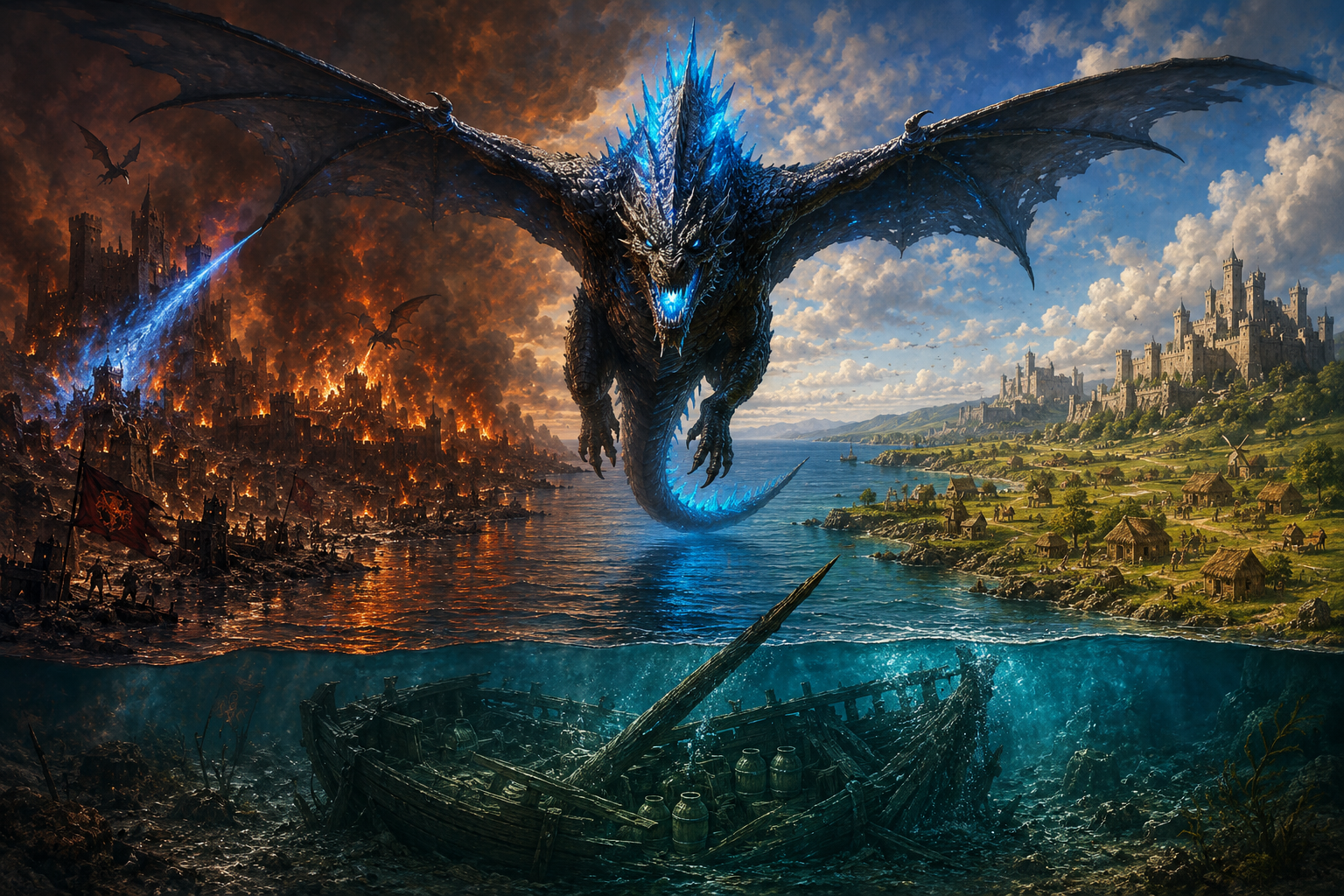
There were stories, perhaps, of an enormous flying creature from long ago. A creature whose back shone blue and whose roar could melt stone.
Some thought him a god.
PSK didn’t care.
They weren’t bothering him.
He flew west toward the islands.
Maybe fish today.
PSK discovered that blue fire was excellent for roasting fish.
He liked fish.
Not as much as cow.
But fish was good.
Eventually PSK returned to Casterly Rock.
People were rebuilding on top of his cave.
There were pointy sticks again.
Grumble.
But nobody attacked him.
PSK went back into his cave.
Maybe okay.
Then one day came trumpets.
PSK opened his eyes.
Grumble.
Trumpets.
People approached his cave.
They carried pointy sticks.
They knelt.
They chanted.
They brought offerings.
They intended to worship him.
PSK did not know that.
He knew:
Trumpets.
Pointy sticks.
People approaching cave.
PSK roasted them.
The survivors fled.
The people decided the great creature beneath Casterly Rock was a vengeful god.
His cave was sacred.
No one should enter.
PSK went back to sleep.
Grumble.
Finally.
People learned.
Years passed.
Farms became villages.
Villages became towns.
Pointy sticks became better pointy sticks.
Stone caves rose again.
PSK occasionally emerged.
People bowed.
PSK ignored them.
Sometimes he ate a cow.
Sometimes he flew west for fish.
The people left his cave alone.
PSK left the people mostly alone.
It worked.
For a while.
Then, one day, PSK wanted fish.
He flew west.
He found a large school swimming in water that looked shallow.
PSK circled.
Grumble.
Fish good.
His back began to glow blue.
PSK roared into the water.
The water boiled.
Fish cooked.
Far below them lay something PSK could not see.
An old ship.
It had sunk many years before.
And it carried something extremely unpleasant.
Wildfire.
PSK’s blue fire reached it.
The sea exploded.
The old ship shattered.
Timbers shot upward with tremendous force.
PSK had survived dragons.
He had survived arrows.
He had survived enormous pointy flying arrows.
He had survived armies.
He had survived the destruction of Westeros.
One piece of timber pierced his wing.
Another struck his chest.
Another his belly.
Then another.
And another.
And another.
PSK fell into the sea.
For a moment, blue light glowed beneath the water.
Then it faded.
Pointy-Stick Killer had finally been killed.
By pointy sticks.

Ohh, Roast fish for dinner! No comments on House of the Dragon Fatigue: Can We Just Get to Game of Thrones Already? (An Antifanfic Solution) -
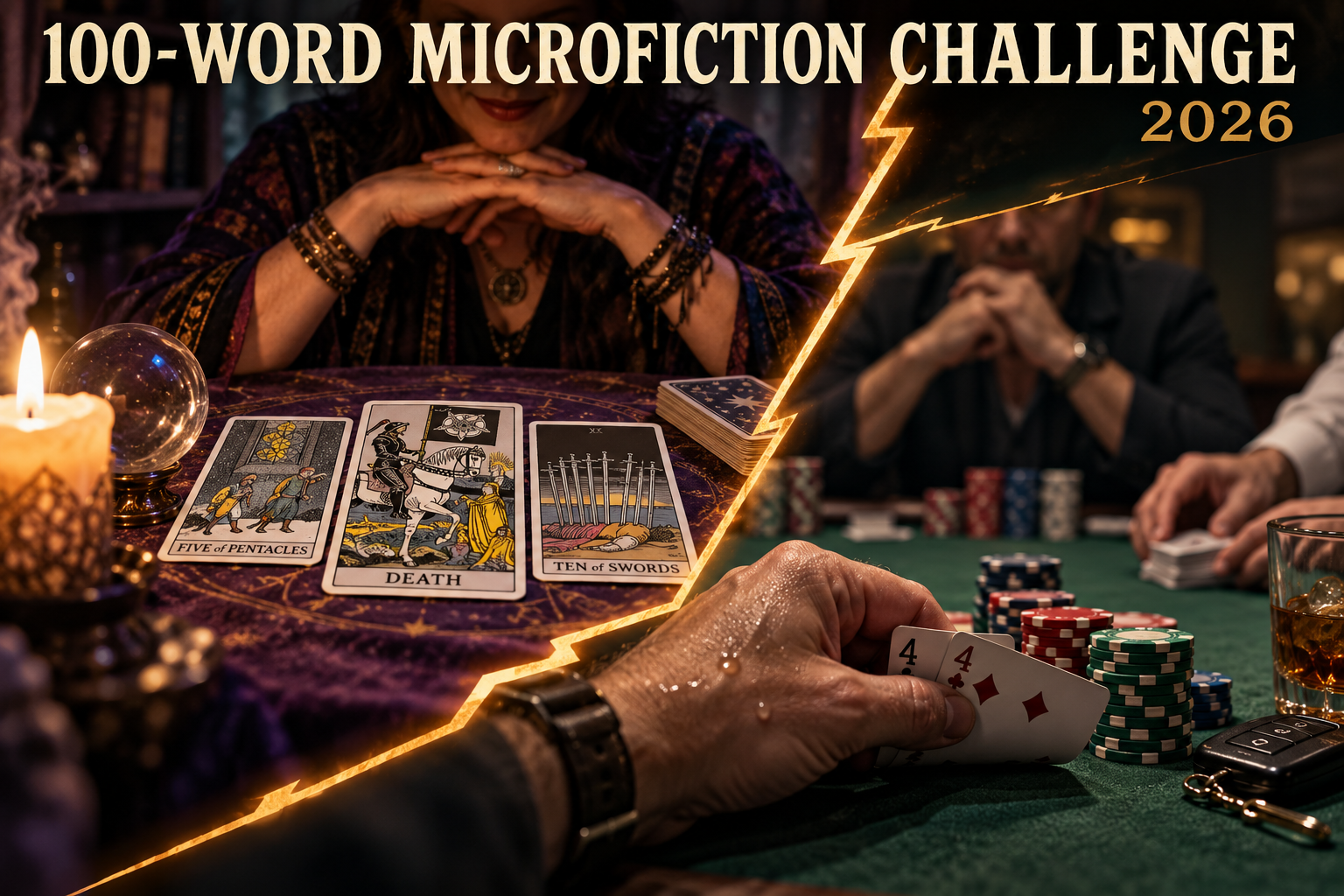
100-Word Microfiction Challenge 2026
My first attempt at an NYC Midnight challenge did not go exactly according to plan.
I signed up for the 100-word Microfiction Challenge 2026. The challenge was scheduled to start on March 20, and once it did, I would have 24 hours to write and submit a story of no more than 100 words.
When March 20 arrived, so did my assignment. I was placed in Group 7. My genre was Drama, my required action was dealing cards, and the word somehow had to appear somewhere in the story. I had until 11:59 p.m. the following night, March 21, to figure out what I was going to do with them.
I spent most of those 24 hours trying to come up with the right idea. Nothing quite worked for me. I dithered, I mulled, and eventually the deadline passed without my submitting anything.
Then something annoying happened. Once the deadline was gone and there was no longer any pressure to come up with the right idea, I came up with one almost immediately. How about poker?
That became All In.
ALL IN
Somehow, I was roped into a card game against my will. But it wasn’t the fun, neighborhood kind I was used to, more like life or death, in a way.
I am staring at a pair of fours, so asked for three, the dealer dealt out my cards. He took one. Trying for a straight, or he had the nut and was just covering.
The guy across from me was gambling with his new car. I know his wife, and she would kill him if he lost it.
If I go all in, one of us is done.Exactly 100 words. Not 99. Not 101. Exactly 100.
Apparently, once the pressure was off, my brain had no problem coming up with ideas, because after I finished All In, I came up with another one. The assignment said dealing cards. It didn’t say they had to be playing cards. How about tarot cards?
That became Waite for the Rules.
WAITE FOR THE RULES
The medium dealt out the tarot cards.
I wasn’t worried if Death showed up. It just means change, alteration. I’d actually look forward to that. It would be very good.
But if the Five of Pentacles and the Ten of Swords land in the same spread… that’s different.
Even if one showed up in the past and the other in the present, I could live with that.
But if it showed up in the future…
I couldn’t face years more of this.
The medium looked at me and smiled.And that one is exactly 100 words too. Once the deadline was over and I could no longer win anything, I had somehow managed to write two complete 100-word stories. Go figure.
I liked Waite for the Rules, including the title, but I decided All In was the better story to submit. The title is a reference to the Rider-Waite tarot deck, one of the best-known tarot decks, named in part for Arthur Edward Waite. That was also part of the problem. To really understand the story, you needed to know what Rider-Waite meant, what those particular cards meant and why it mattered whether they appeared in the past, present or future positions of a spread.
I knew all of that when I wrote it, but I had no idea whether three random judges would. I had only 100 words, so I certainly couldn’t spend them explaining tarot. Poker was much simpler. You don’t need specialized knowledge to understand that somebody has a hand, somebody has something valuable on the line and somebody is about to lose.
So I went through NYC Midnight’s process for submitting All In late. They have links on their website specifically for late submissions, and I got confirmation that it had been accepted. It was too late to advance in the competition, but I would still receive feedback.
The feedback arrived on May 14, almost two months after the deadline. There were three judges, each identified by a number. I don’t know whether there is anything confidential about those numbers, but there isn’t any reason for me to publish them, so I’m just going to call them Judges A, B and C.
Judge A started with what they liked:
“There were some funny moments in the story, which work well as counterpoints to the drama. The “life or death” moment is the most notable instance of this balancing of the seriousness, and also allows for a rebuilding of tension toward the climax. Despite being primarily rising action, the story had highs and lows that created moments of growing tension that were offset by moments of calm. This worked well to make the writing feel more natural and entertaining. There isn’t much room for descriptions of setting, but that single word, “neighborhood” is doing a lot of work here. It places the story into a space the reader can imagine based on their own experiences, and makes it feel more full and complete, as a result.”
Great. You got my point. You liked exactly what I wanted you to like. Yay.
Then I read what Judge A thought needed work:
“Consider revising the opening to have a bit more precision of word choice. The card game was, “life or death, in a way,” and the protagonist was roped into a card game…” “somehow.” Consider choosing words that make the intended meaning perfectly clear. The joke about the car being on the line is clear, even without the addition of, “in a way.” The story is told in past tense, but slips into present on occasion. For example, “I am staring at a pair of fours.” Reading your story aloud while editing can help you find these little common slips of the pen. The ending happens just as the climax is mounting. The reader may feel a bit disappointed by the story’s end happening just before we find out what happens. We can get away with this to a degree, but here, the entire story is building to the moment that happens just after the story ends.”
OK, they were definitely right about my mixing tenses. That’s something I’ve worked on since then and something I now look for much more carefully.
But somehow? I had to use the word somehow. That was part of the assignment. Where else did you want me to put it?
“In a way,” I have to give them. That was padding on my part. It doesn’t really add anything, and in a story limited to 100 words, that’s important. If I have room to add something, it should add information. It shouldn’t just be another adjective or a few extra words that don’t tell the reader anything they didn’t already know.
The ending, though, was a choice. I liked ending it there, and I still like ending it there. I don’t think the reader needs to know what cards came out or who eventually won. The story gets the narrator to the decision: if I go all in, one of us is done. What happens after that can belong to the reader. I’m not going to make it plain just because the story could have continued for another sentence.
Judge B liked the connections between the characters:
“The ways in which the characters were connected amused the reader, especially since the narrator knew his opponent’s wife. Depending on the outcome, it could lead to very uncomfortable walks in the neighborhood. The narrator’s concern was deeply felt by the reader as the intensity of the game grew. Additionally, the cliffhanger worked well, enticing the reader to wonder how far the narrator would go.”
OK, this judge got the ending. The cliffhanger was intentional, and I liked that they were wondering what would happen afterward instead of wishing I had told them.
Then came what Judge B thought needed work:
“While the game was engrossing, the story could emphasize what each of the characters want more. First, why is the man gambling with his car? Does he need money that badly or is he eager to play the costliest game of his life? Secondly, for the narrator, what would it mean for him to win this impromptu game? It could be that he’s struggling too and wants the car to sell. Once he’s in, there’s a chance of a reward, and it’d be good to stress what he wants. Brief phrases could highlight their desires (i.e. gambling with his new car, which I’d salivated over for months). This would raise the stakes and the plot would be more potent. “All In” has an intriguing duo and enticing ending. Once the author shares more about the characters’ individual desires, it will be in great condition.”
I understand what Judge B wanted, and if this were the beginning of a longer story, I would agree. In fact, I can answer some of those questions now. Maybe the narrator got roped into the game because his buddy needed a partner and bringing somebody was a requirement for getting into the game. Why was the other guy willing to gamble his car? What did the narrator have at stake? Those are all things I could explore.
But this was a 100-word story. Take out “in a way,” as Judge A suggested, and I’ve bought myself three words. What am I going to do with them? “My buddy asked me”? That answers one question, barely, while leaving all the others untouched. To give these characters the motivations Judge B wanted would require a longer story, and I think I put about as much information into these 100 words as I reasonably could without sacrificing the card game itself.
Judge C liked the basic situation:
“I like the concept of a high stakes card game pitting acquaintances against one another. It’s hard to enjoy a victory knowing it means someone you know’s downfall.”
Then came a familiar concern:
“I like the concept of the story, but I think there is some crucial contextual information missing here. How did the narrator end up in this game? Who is running it and how have they coerced everyone in participating? We know the opponent’s car is on the line, but what does the narrator have at stake? I feel like we need more of an indication of the answers to these questions and I think the opening paragraph could be rewritten to do that.”
Judge C was looking for much the same thing Judge B was: more backstory. How did the narrator get there? Who was running the game? Why were they playing? What did the narrator stand to lose?
Again, I don’t think those are bad questions. I just don’t think answering them was as important as what I chose to spend my 100 words doing. I wanted the tension of the card game to be paramount. If I took words away from that tension to explain how everybody got into the room, I could provide more backstory, but something else would have to disappear.
It was a balancing act, and I still prefer the balance I chose. If this had been a 500-word challenge, absolutely. Give me another 400 words and I could tell you why they’re there, what each person wants, who arranged the game and what the narrator has on the line while still preserving the tension of the hand. At 100 words, I had to decide which story I was actually telling.
To me, the feedback was very useful even when I disagreed with it. Judge A made me look much more carefully at mixing tenses and at being precise with the few words I have available. If I’m going to add something, I want it to add information rather than simply adding adjectives or padding out something I’ve already said. Judges B and C made me think about motivation and context, even though in this particular story I still think the 100-word limit justified leaving much of that outside the frame.
I took the feedback seriously enough that I went back and revised All In. I fixed the tense, took out the equivocation of “in a way,” and used the words I freed up for a couple of connecting words that actually helped the story. I wasn’t going to get another round of feedback on the new version, of course, but I could at least address the problems the judges had pointed out.
Looking at it again now, I see another problem that none of them mentioned. I wasn’t definite enough about who was sitting at the table. When I say “he” did something, I know who I mean, but the reader could reasonably wonder whether I mean my opponent or the dealer. That’s my note now. Being economical with words is important when you only have 100 of them, but not if being economical makes the reader stop and figure out who you’re talking about.
Here is All In after I revised it:
ALL IN (REVISED)
Somehow, I was roped into a card game against my will. But it wasn’t the fun, neighborhood kind I was used to, this seemed more like life or death.
The guy across from me was gambling with his new car. I know his wife, and she would kill him if he lost it.
I was staring at a pair of fours, so asked for three, and the dealer dealt out my cards. He took one. Either trying for a straight, or he had the nut and was just covering.
If I go all in, one of us is done.Still exactly 100 words.
Based on all of this feedback, I don’t think I would have advanced to the next round even if I had submitted All In on time. Everyone who writes wants to think they’re the best writer all the time, but that’s not really true. This was my first full contest entry, and I kind of whiffed it. I missed the deadline, I mixed tenses, and I used some of my very limited word count for padding instead of information. It was grammatically correct and it told the story I wanted to tell, but if I were grading it, I’d probably give it a B, maybe even a C. It wasn’t a great contest entry, but it was a great introduction to writing contests.
I didn’t get any feedback on Waite for the Rules because I never submitted it. I still like it, though, and I hope you like it too.
The entire process was so positive for me that I decided I was going to enter every contest I could and hope for the best.
-

How Are You Going to End It?
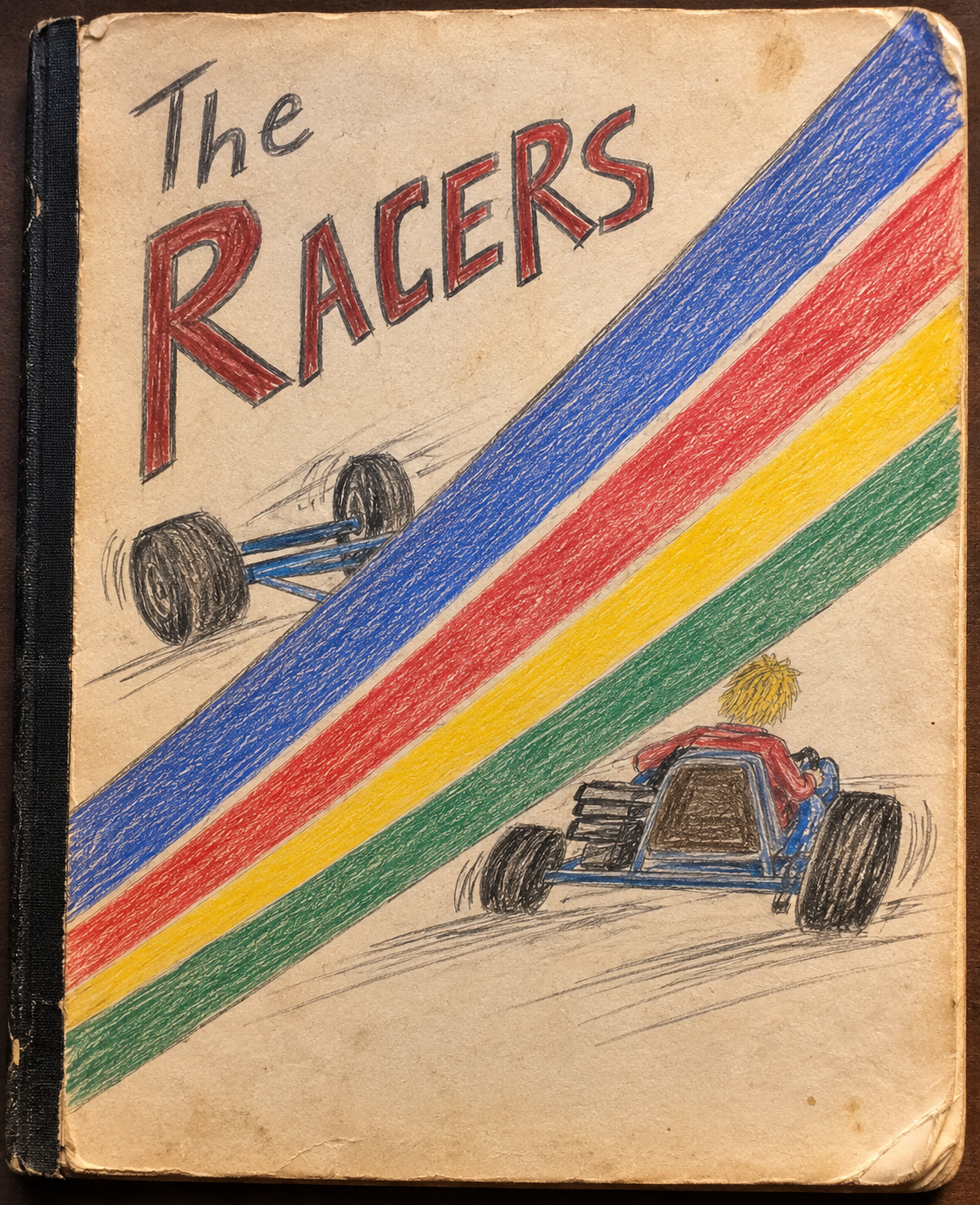
I’m confident in my writing. I’ve been doing it since I first wrote “The Racers” in Creative Writing short-term at Wayland Academy in 9th grade.
What? Are you saying you don’t know short-term? I’ll be honest, I’m not sure that’s the name. It’s what we called it, then. You had fall session, then a couple weeks off for Christmas and New Years, then when you returned, you had this little period of basically auditing a class.

Two weeks of required school for no credit, but all the stress. I picked creative writing, and the other one I remember was a building class. It was something like shop, but with kits and glue. Not saws and lost fingers. I remember only a little of that class, and it’s not the name. When we got to fly the kites we built the first day, that was pretty cool! Then I pulled a Rick, and my next project was way beyond my abilities. Just a thing I did.
But in creative writing, we had daily exercises, every couple days we had a quiz or something else that was graded. But the main thing was the Journal. We had to write like 6 pages a day in that thing, and the teacher would check, make a mark, and hand it back, to most folks.
I’m sure there were some that cheated, no one was really trying too hard. Just copying the same line over and over to fill a page or three. Even bribing someone else to do that. I didn’t do that. I wasn’t either rich or rude enough, I guess.
These classes were long, over two hours every day, each. and we all did 4 classes, though I can’t, for the life of me, remember anything about the other two I signed up for.
What I wrote, I just stole from my fantasies. I always wanted a go-cart. I’d poured through the classifieds in Boys Life, sent away for plans, found out I’d need to save for months to afford the parts. (I considered selling a kidney, but in pre-Internet days, that didn’t go far.)
So, I wrote the story of a family that raced go-carts together, and solved crime, as you do. I had scenes where they rode their go-carts on a highway and zoomed under the tail sections of semi-trucks, because why not? They chased bad guys, were chased by the same, and always won in about 5 pages. It was called “The Racers”.
I even adorned the cover of my journal with a logo. Multi-colored stripes going diagonally across the front, and a person on a go-cart driving under it, so you only see the front wheels poking out on one side, and on the other the back of some blonde guy (of course) just going under the stripe. Back then, I had the confidence all kids have with art. If you don’t think you will be judged, you just draw. (I miss those days.)
My teacher even read mine, didn’t just check and mark, she’d take it to her desk for a little while. Not just mine, I’m not that special. She’d do it with a few. But the marks I got were editor’s marks. Missing words, punctuation that could be better, a different verb here, a crossed-out adjective there.

The original journal disappeared decades ago, so this isn’t it. It’s an AI approximation based on what I remember. The impossible go-kart geometry, though, is authentic.And I just kept writing. At the end of the two weeks, I got my A, and the teacher asked me, “How are you going to end it?”
I had not considered that. It was just a thing I had been doing, not something I meant to keep doing, but her question made me think hard.
I had become a big reader there. In free period, I tackled Dune by Frank Herbert, and if you didn’t know this already, that’s a tough hard science fiction novel for a 14-year old to tackle as his first non-comic book. A lot of glossary terms that you NEED to understand to get to the next chapter.
By Christmas I had finished it, and moved on to the sequel, Dune Messiah. Ooof. But from that I intuited story structure, and when I was asked how I’d end my story, which has ended up being a good 45 pages of hand-written text. (Probably a good tweet) and I could see that in all the episodic nature, there was an ongoing story that developed.
So, I kept thinking of this as I went to all my classes, on my runs with Cross Country practice, even when practicing banjo.
One study period, I didn’t read, I had my journal with me, and I started writing. It was considerably easier this time. I had thought so much about it that last month or so, that it was all prewritten, in a way. This has become my pattern, I do ruminate a lot about something, then, in a burst of writing, I finish what I have been thinking about on the page.
Well, usually, I’m literally writing this on the fly. I haven’t thought about that period for any length of time in ages. But I knew I needed to write something, and here I am. Writing something.
Well, that session, I finished about 10 pages, then I left, and on the way to my next class, I entered that teacher’s room, and left it on her desk.
At the end of the day, walking back to the dorms, I saw her sitting on a bench outside. She had my journal on her lap and I went over to her. She told me that was a good ending, but it seemed unsupported by previous action, plus there were quite a few grammar issues to address. But she said it all with a smile, and I felt great about it.
I wish I could remember her name. She wasn’t one of my regular teachers, just someone brought in initially to teach Creative Writing during Short Term. I only knew her for those two weeks, but forty years later I still remember the question she asked me.
I didn’t do much more writing after that, I did correct what she mentioned needed attention, but just for me. I didn’t see her again. Hey, I was at a boarding school and on my own for the first time ever! I had to rebel and follow a lot of passions, not just writing!
But I do look back at those days, and though I don’t have that journal any longer, I know that’s when I gained the confidence in my writing.
So that’s where it started. Not with a contest, or a publication, or even a grade. It started because one teacher asked me how I was going to end a story I hadn’t planned to finish. Ever since then, I’ve been ending stories, writing songs, outlining novels, and occasionally throwing myself into writing contests just to see where they take me.
This page is where all of that ends up. Contest entries, parody lyrics, stories, unfinished ideas that eventually became finished ones. They won’t necessarily appear in the order I publish them. They’ll appear where they belong in the timeline of my writing life.
I hope you enjoy the journey.