Reviews, reactions, and longer thoughts about movies, television, books, music, games, and other media.
-
Fall 2: Deadpoint — A Movie Review
Better Than Its Predecessor, but Still Falling Short
Rating: ★★½☆☆
Fall 2: Deadpoint is better than its predecessor, but it still has problems with characterization.
When I sat down to watch the movie, one of the first things I saw was the BuzzFeed Studios logo. If you know anything about BuzzFeed, you know they’re all about lists: “The Top 10 Most Dangerous Things to Do in Your Bathroom,” or something like that. Knowing that this was one of the studios behind the film braced me not to expect very much.
It cleared that very low bar, and I enjoyed myself. I’m not going to give it a particularly high rating, though, because the characters are only barely three-dimensional.
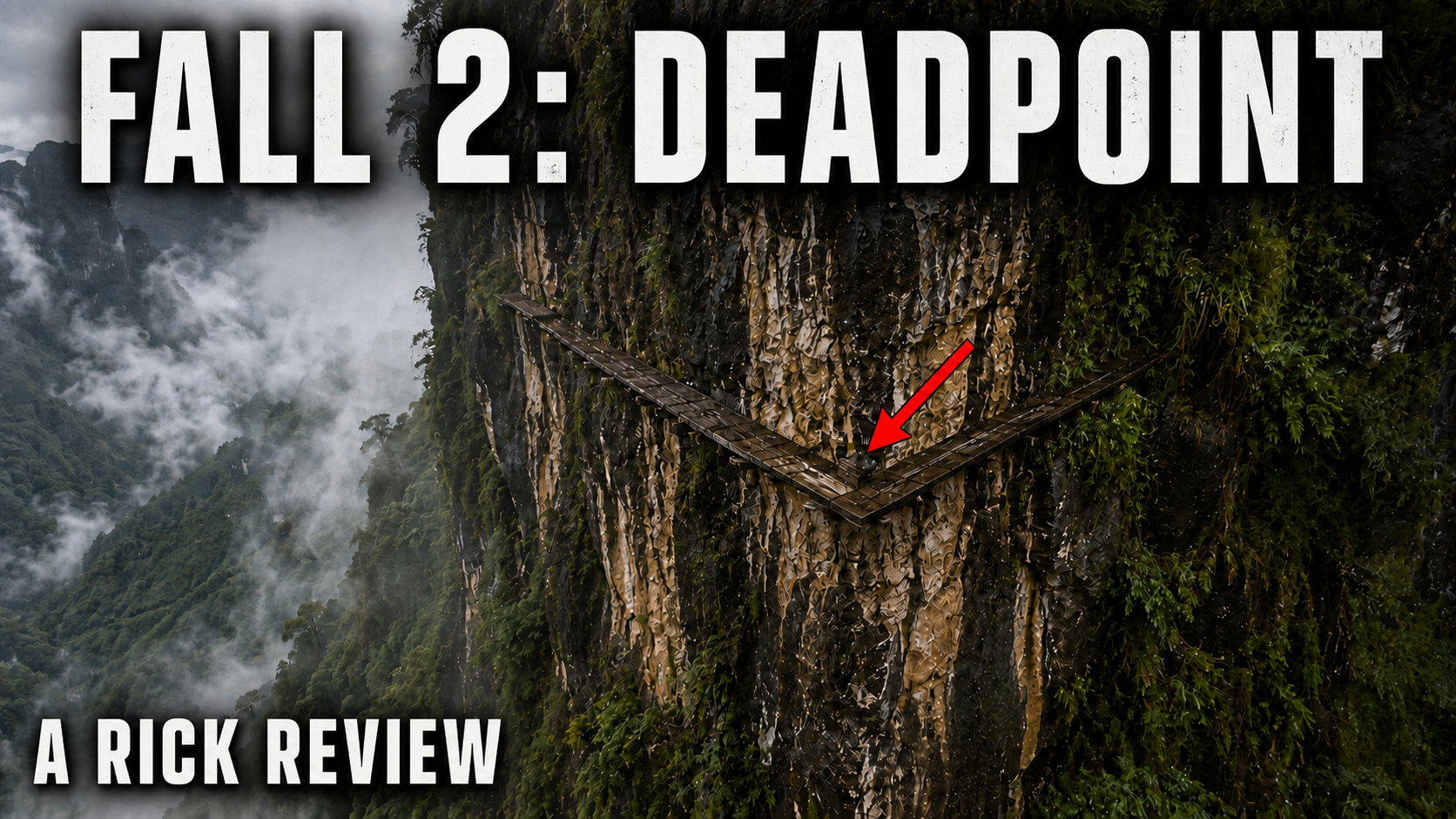
The movie opens in the middle of a rainstorm, apparently on the side of a mountain. One man, held at gunpoint by another, is prodded forward along a very rickety-looking series of planks. Then an earthquake strikes, and both men fall to their deaths.
From there, the movie cuts to a young woman named Jax. She turns out to be the younger sister of Shiloh Hunter, the woman who died in the first movie and used the social-media handle “Danger D.” Jax has received her sister’s Ford Bronco from the police and is trying to figure out what to do with it. With her is Luce, who was apparently one of Shiloh’s friends from college.
From this exchange, we learn that Jax is considerably more timid than her sister—and that there is evidently a story behind their strained relationship.
Luce finds a journal that is essentially Shiloh’s bucket list. Looking through it, they discover that Shiloh completed only about half of the entries. Luce asks whether she can photograph the unfinished pages, but after giving her permission, Jax tells her to keep the entire book. She doesn’t want it.
Once they go inside the house, Luce gives it back and suggests that Jax complete the challenges Shiloh never got around to. She argues that doing so might help Jax feel closer to her sister. Jax’s response is basically, “Why would I want that? She was a better friend to Becky than she was a sister to me.”
We then see a flashback in which a young Jax is hanging from what I think is some sort of monkey-bar apparatus, repeatedly trying to get her older sister’s attention. Shiloh, however, is too busy talking with Becky to pay any attention to her. From that brief little scene, we’re apparently supposed to go, “Oh, I get it now.”
I will tell you that this moment is telegraphed so heavily that you just know it will become important later—and you would be right.
After some hemming and hawing, Luce manages to prod the timid Jax into attempting the next item on Shiloh’s list: the infamous plank walk of Mount Kwan in Thailand
Evidently, if you reach the end and “meet the dragon,” it will devour all your fear. I don’t know whether the mountain or the trail exists in real life, but the movie presents them as real, and that’s good enough for me.
Jax and Luce travel to Thailand, where a secret phrase written in Shiloh’s journal helps them identify the right man to smuggle them onto the mountain. The trail is closed, and climbing it is illegal.
They also arrive during the rainy season, so climbing the mountain isn’t merely illegal—it is contraindicated by basic common sense. Lots of rain means lots of slippery surfaces. You go onto a mountain with lots of slippery surfaces, you fall down.
Luce, however, is far too invested in boosting Jax’s spirits to let a little thing like mortal danger stop them. The guide warns them that smuggling them onto the mountain will cost a great deal of money, but apparently Luce is loaded, so off they go.
Evidently, Shiloh compiled her list only after doing a considerable amount of research. Jax and Luce, meanwhile, simply take advantage of that research without bothering to investigate the climb for themselves.
They make their way up the mountain and out along its increasingly precarious planks. Then, of course, disaster strikes. Jax and Luce become stranded on a couple of isolated sections of plank with no apparent way down. That is the central premise of the movie.
It is handled better than the predicament in the first film, simply because everything feels more real. This seems like something people might actually attempt. The danger feels genuine, and the views are terrific.
The movie also relies heavily on flashbacks, not just the monkey-bar scene. Each one is triggered by something Jax notices in her surroundings, although I wouldn’t call the transitions natural. The clunkiest example has a ceiling fan prompting her to remember a skydiving experience with Shiloh. Yes, a ceiling fan reminds her of skydiving.
The flashbacks are clearly intended to give the sisters’ relationship more depth, but they never quite manage it.
There are also some identity-related shenanigans. Luce may not be who you think she is, the guide may be up to something nefarious, and eventually we get the obligatory final fight for survival.
Shiloh—or, rather, Virginia Gardner, the actress who plays her—makes several appearances in flashbacks throughout the movie. Becky also appears, first in a photograph and then in person as she checks her old-fashioned, rounded-top mailbox. Inside, she finds an invitation to celebrate Shiloh’s life.
That makes it fairly obvious that we’re getting a third movie. There is nothing after the credits, however.
I’m giving Fall 2: Deadpoint a straight-down-the-middle 2½ stars. You will probably be entertained, but the movie is also easily forgotten.
Cast
- Harriet Slater as Jax Hunter
- Arsema Thomas as Luce
- Tom Brittney as the mountain guide
- Virginia Gardner as Shiloh Hunter
- Grace Caroline Currey as Becky Connor
- Juju Journey Brener as Teen Jax
- Evie Mann as Young Jax
- London Nuovo as Young Becky
- Einar Haraldsson as Joe
- Andrey Kasushkin as the smuggler
No comments on Fall 2: Deadpoint — A Movie Review -

Coyote vs. Acme Review
Rating: ★★★☆☆
I went to see Coyote vs. Acme today. It was OK.
I’m not going to give it a particularly high rating, but I’m not going to give it a low one either. We’re going straight down the middle with three stars.
Before discussing the movie itself, we probably need to discuss how we are able to watch it at all.
Warner Bros. Discovery completed Coyote vs. Acme and then shelved it, reportedly planning to write down approximately $30 million of its roughly $70–72 million production cost. That did not mean the government handed Warner $30 million or purchased the movie. It meant Warner could report $30 million as a business loss, reducing the amount of its income subject to tax.
Nor was the write-down necessarily a permanent death sentence. If Warner later recovered money from the movie, it would have to report that transaction and adjust its taxes accordingly. That is essentially what happened when Ketchup Entertainment purchased the completed film for a reported $50 million. Warner recovered about $50 million of the $70–72 million it had spent, ultimately leaving it with a loss of roughly $20–22 million. Any earlier tax treatment could then be balanced against the newly recovered value.
Ketchup did not have to reconstruct an abandoned production. Coyote vs. Acme was already complete. It needed a distributor willing to buy, market and release it.
That gives me at least a little hope that Batgirl might someday escape the same vault. Warner canceled that approximately $90 million movie in 2022 under broadly similar circumstances, but there is an important difference: Batgirl was not finished. Principal photography had wrapped, but it still required effects work, editing and possibly additional filming. Any company attempting the same rescue would therefore need more than distribution rights. It would need access to the production materials, permission to complete a movie using Warner’s DC characters and agreements with whichever original filmmakers, actors and effects artists were still available.
I doubt that rescue will happen. Coyote vs. Acme was already finished, received encouraging test-screening reactions and still required an extraordinary campaign to reach theaters. Batgirl would require considerably more work, and reports about its test screenings were much less encouraging.
Still, the release of this movie proves that a tax write-down does not make a film legally unreleasable forever. The money can be reported and the accounting adjusted if someone eventually makes an offer worth accepting.
I’m not going to argue over whether Coyote vs. Acme deserved to be released or should have remained on the shelf. It’s out there now, and arguing that it should have stayed buried would just seem mean-spirited.
The movie is based on Ian Frazier’s 1990 New Yorker humor piece “Coyote v. Acme.” Written as an attorney’s opening statement in a product-liability lawsuit, it argues that Acme should compensate Wile E. Coyote for the innumerable injuries caused by its defective products and inadequate warnings. It is an excellent premise for a movie. (Readers without a New Yorker subscription can read the authorized reprint published by the Texas Bar Journal.)
Calling the movie “based on” Ian Frazier’s article is generous. It borrows the title and the central idea of Wile E. Coyote filing a product-liability lawsuit against Acme, but very little else could transfer because the original is not really a story. It is a mock opening statement whose humor comes from describing cartoon catastrophes in perfectly straight legal language. The movie had to invent nearly everything required to turn that joke into a feature—and that is where most of its problems began.
I will say that the resulting movie wasn’t particularly well written. There were plot holes you could drive a cartoon through. The judge, played by Luis Guzmán, was practically a cartoon himself, dismissing arguments whenever the story needed him to. The movie attempts to explain this early on by telling us that Acme had essentially written the laws, so of course those laws favored Acme.
The writers then prevented themselves from using the best part of their source material. Kevin Avery is introduced as a nearly incompetent lawyer who avoids court and settles everything as quickly as possible. That gives him room for an underdog character arc, but it also means he could never convincingly deliver the sharp, meticulously reasoned argument from Frazier’s original piece. A capable product-liability attorney presenting that opening statement might have provided the movie with a genuinely great courtroom scene. Instead, the screenplay makes its lawyer too ineffectual to translate its best piece of legal writing to the screen.
I recently read about how difficult it was for the British government to dismantle the East India Company during the nineteenth century. That company had accumulated so much power that it governed territory, collected taxes and prosecuted its own wars. By the early nineteenth century, its private army contained approximately 250,000 soldiers—larger than Britain’s own army at times—and it repeatedly defeated forces much larger than itself. Britain required legislation after legislation to strip away its powers before finally dissolving it.
The parallel with Acme is surprisingly strong. Acme is not merely a manufacturer defending itself against a product-liability lawsuit. It has accumulated enough political, economic and military power to function like a sovereign state. It writes the laws, influences the courts and ultimately makes war against Wile E. Coyote. That is what the story is really about.
If Acme genuinely possesses East India Company levels of power over both the human and cartoon worlds, defeating it should require more than one favorable court verdict. It should require dismantling an entire corporate government. The movie gestures toward that much more interesting idea, but never really develops it.
Will Forte plays Wile E. Coyote’s lawyer, Kevin Avery. The surname is an obvious nod to legendary animation director Tex Avery, but the reference goes further than that. His law firm is Avery, Jones & Maltese: Tex Avery, Chuck Jones and Michael Maltese, three giants of Warner Bros. animation. Jones and Maltese were the director-and-writer team most closely associated with creating Wile E. Coyote and the Road Runner in the first place.
Kevin’s legal aide is his niece, Paige Avery, played by Lana Condor. She provides both the legal and moral center of the film, and Condor does a very good job with the role. The other two people working in the nearly bankrupt law office are Sal Maltese, played by Tone Bell, and Dottie Jones, played by Martha Kelly. They are two-dimensional at best—which is particularly unfortunate because they are both live-action.
That historical knowledge is one of the movie’s genuine pleasures. Even when its story doesn’t quite hold together, it was clearly made by people who know the cartoons and understand the history behind them.
I’m not going to say that the voice work is spot-on, but it comes pretty close. The mixture of live action and animation is less successful. It isn’t as smooth or convincing as Who Framed Roger Rabbit, although that remains an extraordinarily high standard nearly forty years later.
Will Forte does have exactly the right voice to sound like a cartoon character himself. I found that interesting once I noticed it. He can share a scene with an animated coyote without seeming as though he belongs to an entirely different movie.
Here Come the Spoilers
Kevin Avery ultimately loses the lawsuit, largely because the judge dismisses the case after another round of animated courtroom shenanigans. Then, through narrative magic, Avery and Wile E. are summoned to testify before Congress.
That may provide a bigger stage for the climax, but it does nothing to solve the problem established by the lawsuit. Congress is not another court. Even if a congressional committee ruled entirely in Wile E.’s favor, it could not award him damages. It could investigate Acme, expose its conduct, rewrite the laws or refer possible crimes for prosecution, but it could not simply order Acme to give Wile E. a million dollars.
That distinction matters because Avery, Jones & Maltese is out of money and preparing to close while Avery is in Washington. Winning the moral argument before Congress would not save the law firm or compensate its client.
Naturally, the hearing does not initially go their way either. Acme has written the laws governing its own conduct, including a particularly grotesque rule allowing cartoons to be tortured because they always recover and therefore supposedly suffer no permanent injury. Acme has not merely found loopholes in the law. It has constructed an entire legal system in which making war against cartoons is perfectly lawful.
But the movie does have a happy ending, and plenty of guest stars show up along the way. Most of your Warner Bros. cartoon favorites make at least an appearance.
One thing the movie happily keeps consistent is that Wile E. never speaks. He communicates entirely through his familiar signs.
The funny conceit is that he has only a limited collection of signs, yet he still manages to say quite a lot with them. Sometimes another character has to interpret what he means, but the movie never gives in and allows him to speak merely because dialogue would be easier.
His reunion with the Road Runner at the very end is somehow both unexpected and inevitable.
Stay through the credits, at least until the main credit scroll begins. Some amusing cardboard-style animated sequences play during the earlier portion.
Ultimately, Coyote vs. Acme is not a bad movie. It is an adequate movie built around a very good premise. If the screenplay had been given another two or three serious passes through a strong writers’ room, it might have become something genuinely good. Instead, it was completed as it was, nearly disappeared forever and has now been released as it is.
Three stars feels exactly right.
Principal Cast
- Will Forte — Kevin Avery
- Lana Condor — Paige Avery
- John Cena — Buddy Crane
- Tone Bell — Sal Maltese
- Martha Kelly — Dottie Jones
- P. J. Byrne — Bill Pellicano
- Luis Guzmán — the judge
- Eric Bauza — Daffy Duck, Foghorn Leghorn, Porky Pig and Elmer Fudd
- Jeff Bergman — Bugs Bunny, Sylvester and Yosemite Sam
- Bob Bergen — Tweety
- Fred Tatasciore — the Tasmanian Devil
-

Teenage Sex and Death at Camp Miasma — A Movie Review
I ended up going to Teenage Sex and Death at Camp Miasma during its second week. (Or, if I were to run the title unnecessarily through a thesaurus, as I do, Post-Adolescent Copulation and Demise at Bivouac Pestilential Effluvium.) The only showing available was after dark, which is probably appropriate for this type of movie. That, of course, led to some shenanigans getting home, but that’s not part of this review.
The movie starts with a writer-director, played by Hannah Einbinder, talking with her agent about an upcoming meeting with Billy, played by Gillian Anderson. Billy was the star of the very first Camp Miasma movie, but she never committed to any of the sequels. She did a few small acting roles in other movies afterward, but then basically retired to Camp Tivoli, the original camp where Camp Miasma was filmed. She has become something of a recluse, but she’s not the “get off my lawn” type of recluse. She welcomes people who come to visit her; she just doesn’t want anyone trying to drag her away from the life she has chosen.
Meanwhile, the Camp Miasma movies continued without her. The first one was great. The second one was great. Then they started going downhill. Different writers came in, different people became involved in the production, there were delays, production problems and studio notes, and somehow they eventually ended up with something like 15 movies. They went everywhere: space, a ship, underground, all sorts of increasingly crazy variations. It’s basically an analog of the Friday the 13th franchise, particularly the increasingly ridiculous Jason sequels, where eventually the franchise itself became more important than whatever sensible reason there might be to make another movie.
The two leads also bring very different kinds of acting to the movie. Gillian Anderson is old school, and she is terrific. She’s the kind of actor who can disappear into a role until the character becomes more important than the actress playing her. Billy is a Southern belle, a faded glory, and I completely buy her as that person. Hannah Einbinder is a different type of performer. She brings much more of her own established persona into the character. Rather than disappearing into the writer-director, she feels like exactly the sort of person you would cast because her particular personality fits this particular role. And it does. She is absolutely the right person for this character.
At one point, though, another movie temporarily jumped into my head: Scream. Scream did a wonderful job of defining the rules of the traditional slasher movie while simultaneously making fun of them. You can’t be the single woman alone at home. You can’t have sex. You can’t be the quirky couple. These people are going to die. There is a scene in Camp Miasma showing Billy as a young woman, played by Amanda Fix, and she is about to have sex for the first time. Immediately, Scream started shouting inside my head: Oh, you’re going to die.
Except, of course, I already knew she wasn’t going to die. I had already met Billy decades later, played by Gillian Anderson. So Scream jumped back out of my head, and I kept watching. That may have affected how strongly some of what Camp Miasma was doing worked for me. Horror movies have been examining, violating and making fun of their own rules for a long time now. Simply turning one of those rules upside down doesn’t automatically surprise me anymore.
Teenage Sex and Death at Camp Miasma is very much another attempt to take horror from a different perspective and turn the genre on its head by introducing a new reality. At first, I didn’t really understand what it was doing. As the movie went along, though, it taught me how to watch it. Once I understood the rules it was operating under, I got it. I just didn’t particularly appreciate it.
I won’t give away the conceit of the movie because not everything deserves to be spoiled, even a week after release. I will say that the movie has a very particular twist on what reality is, and I think they carry it off. That’s important. My problem isn’t that the idea doesn’t work or that the movie cheats in order to make it work. Once you understand what it’s doing, it follows through. I just didn’t care for the idea very much. I didn’t walk out of the theater thinking, “Well, that was an interesting conceit.” Instead, my reaction was basically, “Okay. They carried it off. Next.”
But I did enjoy the movie. It didn’t give me any form of nightmare, and I don’t have any particular need to discuss it endlessly afterward. It was entertaining, Gillian Anderson was terrific, the idea worked on its own terms, and I had a good time watching it. Sometimes that’s enough.
★★★½☆ — 3½ out of 5 stars
- Jane Schoenbrun — Writer/Director
- Gillian Anderson — Billy
- Amanda Fix — Young Billy
- Hannah Einbinder — Kris, the writer-director
-

Spider-Man: Brand New Day — A Movie Review
Rating: ★★★★★ (5/5)
I’ve seen this movie three times. I could have written this review after the first viewing. I didn’t. I could have written it after the second. I didn’t. It has been three weeks now, so I think it is safe to say that this review is going to contain spoilers. It has been three weeks, after all. Even Marvel won’t come after me now.
A Disclaimer
I’m not a professional reviewer—and by that, I just mean I don’t get paid for it—but I feel I’m a competent one. It was hard for me to write this review after the first viewing, or even the second, simply because I have such true affection for the subject matter.
I grew up with Spider-Man. I collected the comics throughout the ’80s and ’90s, and even into the 2000s, before they eventually dropped out of my consciousness. But I still have very fond memories of the Peter Parker I loved. While watching this movie, I kept saying things to myself such as, “That is my Peter. That’s exactly how I could imagine him.”
Then came the third viewing. That happened not just because I wanted to make sure I got a quote right, but because Regal was offering a lovely poster—which I now have hanging right here:

Slightly askew, figures I like this character, and I like the writers’ take on him. The studio may have made a few missteps with previous incarnations—probably with very different writers, but still under the same studio. Spider-Man 3 with Tobey Maguire comes to mind. It was very hard to remain affectionate toward that character when he went emo. That simply was not the same Peter Parker. Fortunately, he was redeemed in Spider-Man: No Way Home.
You could tell Andrew Garfield loved making his two movies, but they were not as well received as the others, and I honestly couldn’t tell you why. I loved them. Still, his Peter was not quite the super-chirpy, super-quippy guy I remembered, and neither was Maguire’s.
Reviews of this movie have described Tom Holland’s Peter as a very sad person—a down-in-the-dumps kind of fellow. The truth is, I didn’t initially see him that way. I think that is part and parcel of how I view Spider-Man. He still quipped. He still made jokes. He made fun of the awful situation he was in at every opportunity. For me, that is Spider-Man. That is the Peter Parker I grew up with: No matter what was going on in his life, he would still wisecrack his way through it.
That is how this movie truly succeeds. You can see him as sad. You can see him as jealous. You can see him as angry, and you can see him as truly depressed. Yet he is still unmistakably Peter Parker. That is a success right off the top.
Peter Parker, Alone
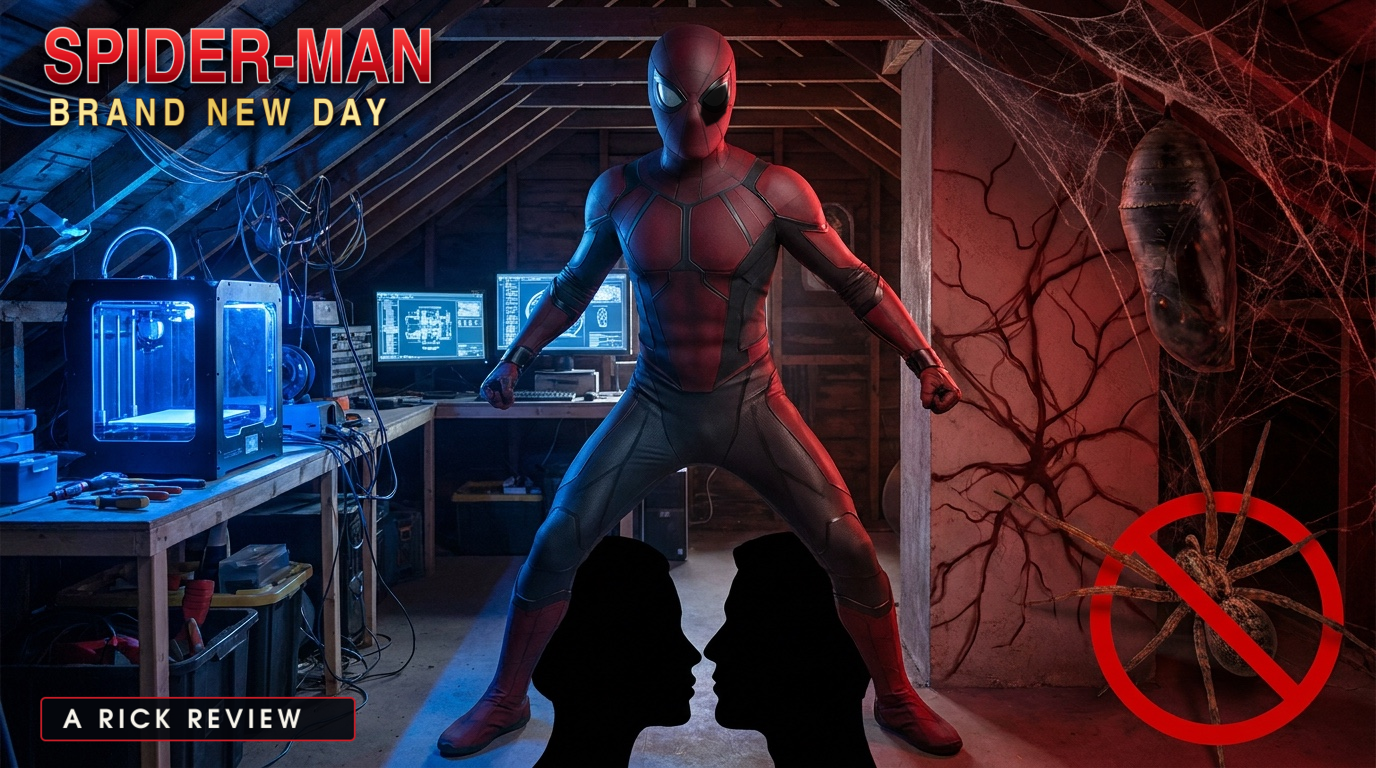
The movie opens with Peter working on his suit using a 3-D printer—and, frankly, I would love to own that thing. It prints fabric. It prints circuits. It performs fine soldering. It is a pretty awesome machine.
The printer is operated by an AI named Eve, and she is not merely a large language model. She appears to be a true artificial intelligence. Eve is also integrated into Peter’s suit, primarily through the eyepieces, although the circuitry is evidently diffused throughout the entire costume.
Most importantly, Peter makes the suit himself. He is no longer dependent upon Tony Stark.
But I do wonder how he affords all of this. The movie hand-waves that question completely. The equipment in his upstairs apartment would easily have cost a hundred thousand dollars—probably much more. There is no evidence that Peter has any kind of paying job. He calls himself a volunteer for the police, but that does not pay for an attic laboratory.
Perhaps he sells one-off inventions. Maybe he makes deliveries for DoorDash; Spider-Man could certainly deliver an order quickly, although the food might be a little jumbled by the time it arrived. That probably wouldn’t be workable.
My best guess is that Tony Stark established a trust fund for Peter before he died. Otherwise, there is simply no way a barely employed Spider-Man could afford all that equipment.
Yet we repeatedly see him at the local bodega buying flowers. I think the movie takes place over perhaps three days, and he buys flowers three or four times—although he eventually gives one bouquet away. We’ll get to that.
I don’t know whether you have ever tried to buy flowers from a bodega or a 7-Eleven-type store, but they are not cheap. The first time I tried buying flowers from that kind of shop, they cost about $35. If Peter is buying a bouquet every day, he is spending roughly $1,000 a month just to put flowers on his aunt’s grave.
Peter is living alone and isolating himself almost completely. It has been about four years since the events of No Way Home. He follows Ned Leeds on Instagram under the name @TheGratefulNed42, and Ned posts regularly. One post says they are graduating next month, which fits with four years at MIT.
Ned is still very close to MJ, so Peter often sees her in the background of Ned’s videos. Naturally, that makes him sad. You can see a little moroseness on his face—but then the movie immediately shifts to a cheerful Peter capturing a group of thugs, stringing them up and being both quippy and funny about it.
Detective DeWolff, Peter’s contact within the police department, smiles happily when she sees the criminals webbed together and hanging from a lamppost. The expression on her face is pure: “What a rascal. He did it again. Thanks.”
Peter has DeWolff’s phone number, and she presumably has some anonymous number through which she can reach him. But he knows nothing about her personal life. He never asks her questions. She has never seen his face, and he never answers her questions about himself. The movie keeps piling up evidence of his isolation, and it is supposedly that isolation that triggers the physical change everyone else dreads—and Peter dreads most of all.
The Cold Open, the Tank and Director Metzger
The movie’s cold open shows Spider-Man capturing a collection of criminals, including Tombstone, The Scorpion, and the Hand (in their striking red outfits). It also gives us an early action montage full of the Peter Parker personality I love.
The first major set piece involves a tank rolling through the streets toward the Department of Damage Control. This is also Peter’s first interaction in the movie with the Punisher. Frank wants to handle everything lethally, and Spider-Man keeps preventing him from doing so. Their conflict is quite comical.
They repeatedly mention that Spider-Man once saved the Punisher’s life on Staten Island. It did not happen in any previous movie; it was an off-screen incident created for this one. Peter insists he saved Frank from a drug dealer, while Frank disputes his version of events. That disagreement becomes a running joke.
The tank is extremely difficult to stop. Peter does not stop it until it has broken through Damage Control’s outer gates and reached the building. He rips open the hatch and finds an elderly woman inside. She turns out to be a janitor and has no idea how she got there.
At this point, the antagonist is hopping from one body to another, and there is a distinct physicality whenever the transfer occurs. Sometimes a person’s head merely nods. Sometimes the abandoned body collapses like a puppet whose strings have been cut. In one instance, a possessed person thrusts his arm toward someone else, slumps over, and then the other person’s posture subtly changes.
The movie may intend for us to believe Spider-Man’s enhanced senses allow him to detect these transfers. Frankly, though, I simply saw the subtle movements of each affected person. Later, the movie says Peter’s transformation is interfering with his ability to sense the entity inside its host. That is where I wonder whether communication broke down somewhere between the writers and the director. I could identify the possessed person merely by watching the performers’ physical movements, and I do not have superpowers.
After the tank attack, Peter meets William Metzger, the director of Damage Control. Metzger initially appears helpful and friendly, and the two discuss how Spider-Man and Damage Control might help each other.
When Peter arrives for the appointment, there is a funny security scene. He is subjected to a full-body scan, and security tells him he must remove his mask. Metzger intervenes and makes it clear that Spider-Man is absolutely not going to do that.
As they walk down the hallway, Peter sees members of the Hand. Metzger explains that, after Spider-Man brought them in, Damage Control discovered they were essentially just kids who lacked leadership. Now, somehow, they have become an integral part of the facility’s security team. Peter is understandably astounded.
He also sees a technician examining the Shocker’s gauntlets. Peter taps on the glass and says, “Be careful with those.” It is an obvious and unnecessary line, but it is also completely consistent with Peter’s personality, so I cannot really hate it.
Peter and Metzger then have this exchange:
Metzger: “We’re on our heels right now. God forbid, if it were to get in here and find whatever it is that it’s looking for, the consequences could be… unimaginable.”
Spider-Man: “Well, let me guess: Is whatever it’s looking for in that giant vault?”
Metzger: “There are some things, because of the nature of my job, I cannot tell you. But I believe you are our best defense against this. You’re the only one who can sense it. You’re the only one who’s immune to it. I’m counting on you to defeat it.”
Spider-Man: “That’s a pretty good speech, Director. I’ll do everything that I can. Oh, by the way, what do you know about ‘MacGuffin’?”
Metzger: “MacGuffin? I don’t know. Where did you hear that term?”
Spider-Man: “It’s just, you know, the nature of being a superhero… there are some things I just can’t tell ya. Anyway, I’ll see you later. You guys are doing great. Keep it up.”The entire exchange hit me particularly hard because I spent almost all of my post-adolescence in the Army with a security clearance. That was an extremely common sentiment among people working within different compartments:
“I can’t tell you that unless you already know it.”
“I can’t tell you that because of my job.”
“You’re not cleared for that.”
I heard Spider-Man turn that language back on Metzger, and I laughed so loudly that the people around me probably thought I was a little crazy. But that joke spoke directly to me.
The Party and the First Real Crack
During one of Peter’s visits to the bodega, he sees Ned come in to purchase two mini-kegs. As a side note, I am old enough that I do not remember mini-kegs being a thing. I remember full-sized kegs, which are massive and hold about fifteen and a half gallons of beer, and pony kegs, which were roughly half that size. These shiny chrome mini-kegs can be carried in one hand. I don’t drink beer, so I had no idea they existed or that you could simply pick one up. That was a cool detail.
Ned also buys a fictional energy drink called SharkFire because, evidently, that is what everyone at MIT uses to survive final exams. He tells the clerk that the stuff will absolutely kill him and instructs him never to sell it to him again—except for the two cans he is buying right now. After those, never again.
Peter follows Ned home and discovers that Ned and MJ are holding a housewarming party. Since Peter saw the mini-kegs, he could reasonably infer that a party was happening. I don’t think he was creeping so much as seizing an unexpected opportunity.
Peter goes upstairs, encounters MJ and calls himself “Maynard,” which is very funny. He is still carrying the flowers he bought for May’s grave, but he gives them to MJ as a “housewarming gift.” She replies, “Most people bring beer or chips.” And I think she’s charmed, but maybe not. Then he sees another man kiss MJ—and, to be technically accurate, sees MJ kiss him back. That breaks Peter’s heart.
The man is played by Eman Esfandi and is credited simply as “the Boyfriend.” Some open-caption screenings reportedly identify him as Paul, leading viewers to interpret him as a reference to Paul Rabin, MJ’s controversial romantic partner from the comics. The movie itself never gives us enough information to confirm that he is meant to be the same character.
This may be the first point at which I genuinely begin to see the sadness everyone else keeps describing in Peter—not profoundly sad, perhaps, but unmistakably a little sad.
The Metamorphosis That Wasn’t
I remember a storyline in which Peter became Man-Spider. He sprouted four additional limbs—not the mechanical appendages used by the Superior Spider-Man when Doctor Octopus controlled Peter’s body, but actual hairy, spiderlike limbs. It was genuinely grotesque and Gothic.
That is honestly what I expected here, particularly because the characters keep talking about Peter’s metamorphosis. Even the Regal poster I scanned and placed in this article suggests that imagery. The shapes behind him look somewhat like flowing red sashes, but you can absolutely interpret them as four additional legs emerging from his back. I am certain the movie was marketed with that possibility in mind.
But it never happens. Peter does not grow extra legs. His eyes turn black, his senses become extraordinarily sensitive, and he develops organic webbing much like Tobey Maguire’s Spider-Man—but the transformation goes no further.
The movie gets some comedy out of the webbing. Peter has to give himself a psychological pep talk: “Okay, Peter 2 has organic webs. He’s cool. I have organic webs, so I’m cool.” Then he winces as some of the webbing comes out. If the webbing is not deliberately made to resemble a male bodily fluid in those moments, I’m a monkey’s uncle.
How Eve determines that Peter’s senses are being enhanced and overloaded is slightly hand-wavy. Perhaps she monitors his hormone levels and detects the stress response. Blood pressure rises, heart rate accelerates? Maybe I just talked myself into an explanation.
Peter’s organic webbing is not entirely compatible with his mechanical web-shooters. At first, he cannot activate it at all. Once he does, he cannot control it. His out-of-control powers even cause him to nearly kill a police officer, which terrifies him.
He ends up swinging across New York very inexpertly, firing strands in apparently random directions and somehow surviving long enough to fire another. The sequence reminded me enormously of trying to play a Spider-Man game on the PlayStation 3. That is exactly how I crossed New York: completely at random. His chaotic journey looked so much like my own gameplay that I am absolutely certain the director was going for that effect.
Peter also watches a video about spiders undergoing metamorphosis, reinforcing the expectation that he is about to sprout additional legs. The detail viewers really need to notice is not dynamic at all. It is simply an article bearing the headline, “Why Are Spiders’ Eyes Black?” That is the real clue, so watch for it.
Yelena, Bruce and the Inhibitor
Peter meets Yelena Belova, the new Black Widow, played by Florence Pugh. She is charming in the role and serves primarily as an adviser, helping Peter investigate the mystery and interpret clues. Her “office” is inside a sauna, and the movie gets considerable comedy out of that fact. Near the end, Detective DeWolff mentions having spent time in “her office,” producing a wonderful callback.
Yelena also says outright that Peter is “a sad boy” and terribly lonely. Again, the dialogue explicitly tells us he is sad. Perhaps it is my own personal failing that I do not see him that way. Peter is still maintaining the cheerful front, and I completely believe it. So let’s accept what the movie tells us: Peter must be sad.
Peter later consults Dr. Bruce Banner, who is teaching physics at Empire State University to an audience primarily interested in his Avengers extracurricular activities. Peter asks about the inhibitor Bruce uses to keep the Hulk at bay. The explanation involves mRNA, RNA strands and interfering with the process before something can be transcribed. I barely understood it—and I have actually studied some of this material.
Peter develops an inhibitor for himself to suppress the overexpression of his spider DNA. He then expands the concept into an essentially universal inhibitor. Bruce correctly points out how terrifying that could be. In theory, such a device could suppress selected genetic traits and make everyone conform to some monstrous ideal—making everyone Aryan, for example. It is an extremely dangerous idea.
There was reportedly a scene featuring Claire Temple from Daredevil, but it was removed. I suspect this is where she would have entered the story. She might have referred Peter to Matt Murdock—or perhaps Stick—for help adjusting to heightened senses. But that was a long process for Matt, and following it could have added another hour and a half to the movie. Cutting it probably made sense.
Jean Grey
During the first action sequence, Jean Grey attempts to take over Spider-Man’s consciousness and is roundly rejected. She cannot possess him. The experience confuses her as much as it confuses Peter, but it gives him his first clue about what is happening.
The telepathy is necessarily somewhat hand-wavy. Telepathy does not exist, so the writers can establish any rules they want. At least the rules remain reasonably consistent. They are aiming for verisimilitude, if not actual veracity.
Jean eventually discovers Peter’s apartment and finds the letter he wrote to MJ. That letter is practically fetishized throughout the movie. Peter recites it in voice-over at the beginning. He keeps it inside the coffee cup from the doughnut shop, takes it out to read it and returns it to the cup. Jean finds it there, reads it and learns both his identity and whom he loves.
Jean takes the letter with her. Sitting in the back seat of a car driven by someone she controls, she confronts Peter. He essentially surrenders and asks her only to leave him and MJ alone. As the car pulls away, Eve captures an image of Jean’s face. Facial-recognition tracking reveals her name, although much of her information has been scrubbed by Damage Control.
Eve also analyzes the body movements associated with Jean’s jumps and determines that her ability has a limited range. Peter exploits that limitation and believes he has saved MJ. Ultimately, he has not.
The movie does not explicitly explain why his plan fails, but the mechanics suggest an answer. Jean may be able to jump only between nearby hosts, but she can always disconnect, return to her own mind and begin again from her physical body. Peter isolates one node; Jean simply resets herself at the source. That evidently leads to one of the movie’s most tragic emotional moments.
Frank’s Boat and MJ’s Letter
Peter takes MJ to Frank’s “house,” although it appears to be a massive boat sitting in an enormous boneyard of abandoned vessels near the docks. The imagery is terrific, and Frank has installed some very funny traps.
There is excellent banter about whether Frank could possibly have all the necessary equipment: an antistatic mat, precision tools and various specialized items. Frank insists, “Of course I have those things,” and then MJ supplies the explanation. It is absolutely hilarious.
Peter attempts to solder the inhibitor chip aboard the boat, but the iron does not have a fine tip. He merely hovers it over the electronics and taps at them. I spent approximately eight months working in a soldering job, and he was not soldering. That scene did not pass the accuracy test for me.
MJ’s equally brilliant mind helps him solve a niggling problem with the inhibitor. But the clearest evidence of Peter’s sadness comes when she finds the letter.
Consider its journey: Jean took it from the coffee cup, gave it to the man driving her car, and he returned it to Peter. Peter has it on Frank’s boat and falls asleep reading it while working. He fails to secure it. MJ finds it and reads the entire thing.
She asks, “Did you want me to find this?”
Peter, you and I—and everyone else watching—know the answer is yes. Of course, he says no, and somehow makes the denial believable.
MJ tells Peter she remembers none of what the letter describes. She has absolutely no memory of him. She does not love him. She does not even know him.
That is when you can finally see the sadness on Peter’s face.
Hulk, Capture and Betrayal
Peter intends to use his “universal” inhibitor to stop Jean. A facial-recognition alert spots her at Damage Control’s Manhattan facility. He rushes there, leaving MJ in Frank’s care. But she essentially guilts Frank into going along—even though Frank is supposed to remain behind and protect her.
When Peter arrives, he hears tremendous pounding and discovers the Hulk demolishing the building. But Bruce Banner is not in control. Neither is the Hulk. Jean has destroyed Bruce’s inhibitor, forced him to transform and then taken control.
What follows is an enormous set piece involving Spider-Man, the Hulk and the Punisher, and it looks genuinely gorgeous. There is absolute chaos when the Hulk expels Jean from his consciousness. Unfortunately, that means the Hulk is now truly the Hulk—and he very nearly kills Spider-Man.
This raises another point. Spider-Man is not usually presented as having a Wolverine-level healing factor, but he clearly heals faster than an ordinary human. That is worth remembering when considering the extraordinary amount of damage inflicted upon him. Everything Peter endures here would have killed me sixty times over. Easily.
Peter eventually defeats Jean, and she is captured.
End of the movie?
Not even close.
Before losing consciousness, Jean says a single name: “Sara.” Peter questions Metzger, who claims Jean must have pulled the name of a deceased coworker from his mind when she briefly took him over. Peter accepts the explanation.
After Peter takes MJ home, however, she invites him inside. The letter told her Peter and Ned were once close, and she thinks it would be fair to let him meet Ned again. Peter keeps his costume on, so Ned believes he is simply meeting Spider-Man.
The two build Lego together—a funny callback to the earlier movies. Their friendship comes easily and naturally. MJ sketches them, leaves Spider-Man’s mask off and draws Peter’s face from memory. She remarks that they really do look like best friends.
Peter apologizes to MJ for kissing her while Jean controlled her. MJ says it is okay because she remembers absolutely nothing. As far as she is concerned, she was standing in her apartment—and then suddenly lying outside with Spider-Man holding her.
That is when Peter realizes: Holy crap. (My curse, not his) Metzger lied to me.
Peter investigates further with Yelena and discovers Sara was not Metzger’s deceased colleague. Sara was Jean Grey’s sister.
Hard cut to an exhausted Jean restrained in a chair while Metzger tells her she will be very useful to him.
It is a complete heel turn.
The Greatest MacGuffin
This movie may contain the greatest example of a MacGuffin I have ever seen.
Jean is absolutely convinced that “MacGuffin” exists, and obtaining it is her sole objective. Yet nobody who should know about it—not Metzger, Yelena or anyone else in authority—has any idea what it is. Nevertheless, everyone treats it as real because Jean treats it as real.
Through flashbacks, we learn what drove Jean’s search. She believed MacGuffin would lead her to Sara. In reality, Sara was what she had been searching for all along.
I do not want to reveal every last detail, but Jean is never going to find what she seeks—whether it is real or imagined. When the truth is revealed, it is absolutely tragic and completely satisfying.
Metzger begins experimenting on Jean and forcibly activating her abilities. I think his objective is to map them well enough for Damage Control to induce telepathy in ordinary people, although his plan is somewhat unclear and a little mustache-twirling.
Jean finally hits bottom. Her anger and grief cause her powers to expand dramatically, increasing her previously limited range to approximately one kilometer. Her abilities are no longer restricted to telepathy; she develops telekinesis as well, freezing everyone within range and locking them in place.
Fortunately, Frank is just outside the perimeter. He sees something is terribly wrong and begins preparing to solve the problem, his way.
Roosevelt Island
Spider-Man is already inside the Roosevelt Island facility. He warms up by beating up the guards—nonlethally, of course—to gain access. Once inside, Jean activates her amplified telepathy, freezing everyone within range. Peter remains unaffected because, for whatever reason, he is still immune.
He walks among people frozen in place and encounters an entire contingent of the Hand guarding an entrance. Jean’s attention may be divided among thousands of eyes, but she notices the one person moving who should not be.
Jean activates the Hand. Her control here appears to operate more through suggestion than direct puppetry. She presumably does not possess their extensive martial-arts training herself; she unleashes their existing abilities.
And, oh my God, these people absolutely kill it. The choreography is magnificent, and the grace with which they move is genuinely beautiful.
During the fight, Peter exclaims, “That’s so cool!” That is why I love this version of Spider-Man. Even while people are trying to beat him senseless, he can appreciate how impressive they are.
Damage Control has developed weapons specifically designed to defeat Spider-Man. The revelation briefly stuns him, before his reaction becomes, essentially, “Of course they did.” Both of his mechanical web-shooters are torn from his arms. He is battered, beaten and almost defenseless.
Peter removes his inhibitor, allows his eyes to turn black and surrenders to his spider instincts. He defeats the entire Hand without killing anyone. He comes dangerously close to killing one man—but then saves his life. The man’s face shows unmistakable appreciation for that mercy.
Peter finally reaches Jean, who is holding Metzger in an extremely precarious position. He tries to persuade her not to become a killer. It does not matter whether the potential victim is Metzger or a puppy: Once she crosses that line, she must live with having killed someone.
Jean tells Peter she is now powerful enough to enter his mind despite his previous immunity. Peter has just learned the value of surrendering to the spider within him. Now, instead of resisting Jean, he surrenders again and allows her inside.
Grey Meets May
Inside Peter’s mind, Grey meets May.
Aunt May is speaking to Peter, but her message reaches Jean just as powerfully:
“And sometimes, because you’re special, people can do dark, monstrous things to you. But this is what I want you to know: You’re beautiful, and the people who love you—we love you not because you’re special. We love you because you’re you. I want you to remember that.”
Jean hears exactly what she needs to hear: People may treat her like a monster because she is different, but the people who truly love her do not love her because of what she can do. They love her because of who she is.
Jean says, “I don’t have anyone.”
Peter tells her, “You have me.”
It is a simple exchange, but it completes May’s message. Peter does not merely tell Jean she deserves connection; he immediately offers it.
I had to pause my writing there because I was actually tearing up. I saw the movie in a theater; there was certainly no pause button.
It is a very good scene with a very good message. I never felt as though the movie was emotionally manipulating me, but I absolutely felt that moment.
A Very Large Bullet
Unfortunately, Frank has prepared his own solution. He has an enormous sniper rifle. The kind that uses BIG bullets and has long range. He sees the woman holding approximately a kilometer’s worth of people hostage and prepares to solve the problem by shooting her.
That would definitely work.
Peter’s enhanced senses somehow warn him, and he jumps in front of the bullet.
This is where the movie becomes a little hand-wavy. A projectile of that size, even from nearly a kilometer away, should tear an enormous amount of flesh from Peter’s body. Instead, it strikes him in the shoulder. It still causes tremendous bleeding, and Peter appears very likely to die.
We next see him in the hospital while throngs of New Yorkers gather outside, cheering for his safe return. A skyscraper is even illuminated in Spider-Man’s colors.
Peter finally receives the affirmation he has studiously avoided: People care about him. He belongs to this community, and he cannot survive by cutting everyone out of his life.
A Brand-New Ending
We see Jean Grey riding away on a bus.
We see MJ sitting alone on a rooftop she once shared with Peter. Is she trying to remember him? I don’t know.
We see Peter at May’s grave, telling her he is not going to go through life alone anymore.
Then Peter sees Ned in the bodega. Ned recognizes him and says, “You’re the guy from the party.”
Peter replies, “I’m Peter,” and extends his hand.
Peter slowly begins performing the elaborate handshake he and Ned once shared. Ned responds automatically, as though his conscious mind has no idea what he is doing but his body remembers every movement.
When the handshake reaches its final position, a look of wonder appears on Ned’s face.
That moment is priceless.
Elsewhere, Metzger is in the wind, while Yelena works with another government official to uncover everything he concealed, including all the legitimate information he had been redacting. That may become important later.
One Gorgeous but Slightly Hairy Quibble
There is a beautiful shot of Spider-Man sitting on a girder, with the New York skyline upside down behind him. Then you realize he is the one sitting upside down when he turns and launches into the next scene.
But if you think about it for a moment, it gets weird.
In the first movie, we saw tiny, clawlike hairs emerge from his fingertips, allowing him to cling to things. We hand-wave the fact that he wears shoes and his feet still stick, but we can at least imagine those tiny hairs beneath them.
Sitting upside down on a girder with only his butt making contact? I cannot help imagining tiny, spiked hairs growing out of his derrière—and that is just a bit weird, isn’t it?
Still, it is a gorgeous scene.
The Comic Digest I Cannot Recommend
Before finishing, I need to discuss the Spider-Man: Brand New Day comic digest Marvel marketed before this movie came out—and that I willingly paid for. This is not a positive review.
There was indeed an Amazing Spider-Man era known as “Brand New Day,” encompassing roughly 100 issues published from 2008 through 2010, plus specials and spin-offs. Marvel selected a handful of stories from that enormous run, apparently featuring characters we might see in the movie. At least, that was the impression I was left with.
The digest starts with Doctor Strange during a harsh winter. Did Doctor Strange appear in the movie? Nope.
Wolverine appears in the digest. Did he appear in the movie? Nope.
The Punisher? Yes, he appears in both—but the comic has nothing whatsoever to do with his role in the movie. I liked the movie’s version, though.
Jean Grey is in the movie but not the digest. Perhaps including her would have been considered too much of a spoiler. Damage Control is not in the digest either.
The book collects a handful of loosely related stories from a run spanning several years, and the result is disjointed. It has nothing to do with the movie outside the main character’s name and the movie’s subtitle.
If you haven’t picked it up yet, I recommend that you don’t. If you already own the original run, definitely don’t. It wasn’t worth even the $9.99 I paid for it.
Final Rating and the Very Final Tag
I know I had some quibbles with this movie, but I am giving it six out of five stars.
Okay, okay—five out of five.
I love this movie. I saw it three times in three different formats. The first was in 3-D. The movie was not egregious in staging stunts merely to exploit the format, but the 3-D was effective when used. The second was standard. The third was RPX, where the seat occasionally shakes and performs other little tricks. That experience was not worth the added price, but I still watched without complaint.
Admittedly, I chose the third showing primarily because Regal was giving away the poster. But I could have collected it and left. Instead, I sat through the entire movie again.
Well, everything except the end-credits tag.
The tag comes after every single minute of the credits—even after the union logos. You must wait through absolutely everything, and it is not worth watching three times. I left when the credits began during my second and third viewings.
It is simply an animated sequence featuring the Spider-Tracker developed by Ned—because, of course, Ned developed a Spider-Tracker. It appears to locate Spider-Man, somewhere in space.
That seems a little strange. We have already seen Peter Parker go into space during the Avengers movies, so perhaps this is pointing toward Miles Morales or another Spider-Man. I genuinely do not know.
The tag is fine, I suppose, but it is extremely simple and definitely not worth sitting through multiple times.
The movie itself, however, was worth every viewing.
Selected Cast and Crew
- Director: Destin Daniel Cretton
- Writers: Chris McKenna and Erik Sommers
- Tom Holland — Peter Parker / Spider-Man
- Zendaya — MJ
- Jacob Batalon — Ned Leeds
- Sadie Sink — Jean Grey
- Jon Bernthal — Frank Castle / Punisher
- Florence Pugh — Yelena Belova / Black Widow
- Mark Ruffalo — Bruce Banner / Hulk
- Tramell Tillman — William “Bill” Metzger
- Liza Colón-Zayas — Detective Jean DeWolff
- Marisa Tomei — May Parker
- Naomi Watts — E.V. (voice)
- Eman Esfandi — The Boyfriend
- Olivia Booth-Ford — Sara
- Marvin Jones III — Lonnie Lincoln / Tombstone
- Michael Mando — Mac Gargan / Scorpion
-

The Finale of the Acorn-Bearer’s Pathway: A Movie Review
(Just my way of being cute, thesaurus version of the title of the movie.)
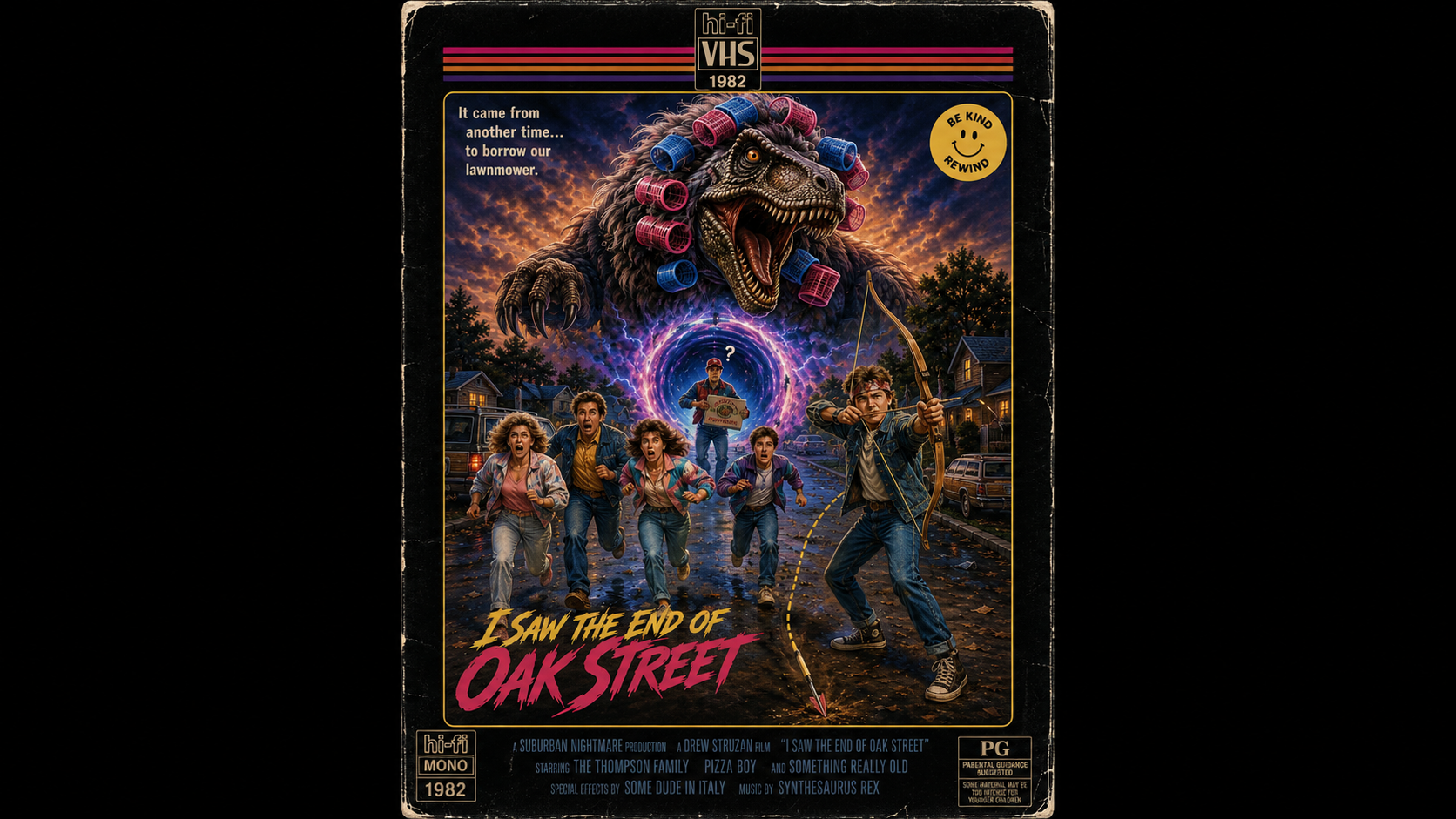
I went to see The End of Oak Street today, Sunday opening weekend. I’m not a paid reviewer, so I don’t go opening hours; I go when I find it will be best for my schedule.
I sat down, sat through a few of the previews—there are far too many these days—but then it started with the director’s name, David Robert Mitchell, and I will be honest I looked up some of the other things that he’s done and I didn’t like most of them so I went in after this a little guarded.
Anyway, Anne Hathaway is our female lead. Ewan McGregor is the male lead, her husband, and they are shown to have a tense marriage. He is taking gig work during a neighborhood party when he’s supposed to be spending time with the family. There’s a reasoning for that from his point of view, but he’s not telling her what that is, so that’s part of the tension in the marriage. She is in the basement most nights writing a novel. She just calls it a story, but a neighbor who happens to have edited her own husband’s books for thirty years—as pointed out in the text—loves it and sees the parallels between her and the writer, the character and the writer. And she just says, ‘No, it’s just a story, it’s just a story,’ very defensively. But there is imagery in the book about a constantly packed suitcase, and she is ready to leave her family any day now, type of thing from the book, and that comes up later.
There is a teenage boy, played by Christian Convery, and his dog, and he is, of course, acting out because of the tenseness between the mother and father. There is also an older sister to this boy, played by Maisy Stella, who is very intelligent, has read a lot of Carl Sagan’s books, including Cosmos, so she’s going to be the brain reserve, you can tell that right from that.
And then stuff happens: flashing lights, weird stuff. It is something that is definitely handwaved, but basically, wormholes are opening up and it swallowed this entire neighborhood and transported it to, I guess, the Mesozoic era. Because despite everything you’ve been told about Jurassic Park, none of the dinosaurs in those movies were from that era; they were more likely from the Cretaceous era. But anyway, I think these are Mesozoic, funnily enough—or no, “funnily” is not the right word. This director is listening very carefully to his science advisors and the current belief that dinosaurs are feather-covered instead of just bald lizard-skinned, because they have the same dinosaurs as that other franchise, but they have feathers or hair-like feathers on some of them, and that’s pretty fascinating to look at, to be honest.
It’s a tense little thriller where they’re running away from things, they’re dodging things, they’re watching their neighbor get eaten by the flying things. All of that was really well done. The CGI was solid, and the drama behind it all was well written. They are boarded up in their house, tearing down cabinets to board up windows because, of course, glass is easy to get through from all these lizard beings. He is relentlessly optimistic, which makes her mad. He points out that he’s read her novel, and so that is another source of resentment—now he was keeping that secret as well. Turns out he has lost his job, and so he was just doing gig work to keep money going; that’s why he left during the party. It turns out well, anyway.
Then the young boy finally sees his dog, and the dog runs off because he’s being chased. He goes tracking after it. He has a very ineffective recurve bow that he… it’s kind of hilarious. It’s kind of led to think that that is going to be useful, but of course it is not. He’s like a fourteen-year-old, and it’s a recurve bow—it has no power against the skin of these things. But still, he is still being a man at fourteen, and it’s kind of great. He looks for his dog.
There is a sub-thing, a sub-story, another teenager is holding a grudge against our main young boy hero, and catches him and beat him up a little bit. It’s not really a big story, but it leads to one of the funniest lines. He is lying there all beat up, and his sister finds him and she just says, “What happened to you? Your face looks like a pepperoni pizza,” and I chuckled.
The parents are also looking for the kids, and it’s very much a lived-in neighborhood feel. They aren’t looking aimlessly; they are in the neighborhood they’ve lived in for several years, so of course they would go to where they think things are. They know the pathways through this way, through that way; that all felt very real.
And then chaos ensues, they get chased, there’s just lots of action going on, and stakes are real: a neighbor dies, they see other people die, there are a lot of dead bodies on the ground in various scenes. And then the husband dies—his leg is chopped off, and he has died. But because these are wormholes, which transport people through time and space a little bit, they managed to rescue him before he goes through. So it’s high stakes with no stakes ending, which is hilarious.
And if you look at that final scene on the back patio, you will see something truly fun: one of the girls had to go back and rescue her parents, and she rescued herself, so there are two of them. Trust me, it is the height of verisimilitude. I loved it.
I give this movie four out of five stars, and the one star missing is simply because they handwaved the science. Yes, wormholes are theoretically proposed, but why the hell they are there nobody knows; they didn’t try to explain it. I’m okay with it, but at the same time, I’m not okay with it. I enjoyed the movie, and I’ll go again. -

In-N-Out Burger — NE Evergreen Parkway & 185th, Hillsboro
I finally made it out to the new In-N-Out — not sure exactly when it opened, but it’s been a few weeks. They’ve still got traffic cones blocking off part of the street, a security guard directing drive-through traffic, and it’s still pretty crowded inside. No line out the door anymore, though the stanchions and fabric channelways are still set up out front, so it clearly had that energy not too long ago.
I ordered a Double-Double, fries, and a strawberry shake — figured that was a good trio for a first visit. Got ticket number 14. While I waited I heard them call 82, 83, 90, 84, 85 — no rhyme or reason to the order, but I liked that they don’t bother padding the numbers with letters or extra digits. They’re confident they’ll get to you before it gets confusing. They’re not running 100 people deep. Says something about how they’ve got their turnover dialed in.
My number came up eventually. Burger and fries were ready, but the shake needed another 30 seconds or so. I grabbed a seat and started eating — didn’t grab any ketchup packets, which I’d normally do for dipping, but the place felt a little too chaotic to bother asking. Broke my own rule of eating fries first (Taco Bell: hard shell first, McDonald’s: fries before they go cold) because the burger looked too good to wait. And it was good. Didn’t even miss the ketchup, which is saying something.
The fries were bare-bones — just a packet of salt on the side, add it or don’t. I salted them up and ate the whole batch, no ketchup, no complaints.
The shake was the one letdown. A little too sweet for my taste. I know enough about the relationship between temperature and sugar perception from making my own ice cream — my guess is it wasn’t cold enough, maybe from too much liquid in the mix or from sitting out a bit too long, and that threw off the balance. Still drank all of it.
The whole place is decked out in classic red-and-white retro diner style, with artwork all over the walls. Staff outfits were a nice touch — the guys wear those little paper envelope-style hats, the women wear ball caps. Good food-safety call keeping hair up either way, though I did wonder if there’s ever been any pushback over the gendered uniform split. Also noticed the aprons are tied off with an oversized safety pin — three inches, easy — which felt like a deliberate retro costume choice rather than a functional necessity, and I thought it was a nice detail.
They had T-shirts for sale too. Didn’t buy one, but there was a design I liked — a Corvette driving under a sign that says “Entering Portland,” playing into the fact that this location is brand new to the area. $20 though, so maybe next time.
Prices were genuinely reasonable. You can’t walk out of Five Guys with a burger, fries, and a shake for under $15 — this was $11.30, and it was a double patty burger. No bacon, no mushrooms, no signs they’re chasing any menu trend anytime soon. Turns out I didn’t need any of that. It was just a very good burger.
Next time: animal style.
-

Christopher Nolan’s The Odyssey Review
Rating: 4½ out of 5 stars (9/10)
Walking into this movie, I had heard a lot of people talking about how heavily Nolan used the gods. After watching it, I do not really agree with that assessment. Athena appears throughout much of the movie as a beautiful woman whom Odysseus speaks to and calls by name, but she never tells him anything he could not already know. She points him toward decisions that, somewhere inside himself, he has already made. For the first two thirds of the movie, I was willing to accept that she might simply be Athena, although I was already beginning to suspect that something else was happening.
That interpretation finally came together for me while Odysseus was with Calypso. She is portrayed as a lone Lotus Eater, caring for Odysseus after his shipwreck. The lotus flower serves as an analogue for opiates. It soothes pain while keeping memory cloaked from conscious awareness. She had fallen in love with him, but she also understood that loving him meant eventually helping him remember who he was and allowing him to leave. As she encouraged him to tell her about his life, he experienced the sack of Troy again as a flashback. He remembered watching Greek soldiers behead a young Trojan girl while other soldiers toppled the head from Athena’s statue. He did not kill the girl or desecrate the statue himself. He simply witnessed both acts and carried them with him. The young girl had the same face as the Athena who had been appearing to him throughout the movie.
That was the point where my interpretation of Athena as a manifestation of PTSD became much more than a vague possibility. Odysseus had taken the face of an atrocity he witnessed and given it to the goddess he prayed to for wisdom and guidance. Athena became the person through whom he explained his own choices to himself. She could still be the literal goddess, appearing in the form that would affect him most deeply, but the psychological reading no longer felt accidental.
The word that kept coming back to me while watching was verisimilitude. Nolan changes quite a bit from Homer, but once he establishes the rules of his version of the story, he never cheats them. Everything fits together. The gods, the monsters, the symbolism, and the emotional beats all belong to the same world. Whether you agree with every change is almost beside the point because the movie remains true to itself.
One of the biggest surprises was the expanded role of Sinon. Rather than simply being the man left behind with the Trojan Horse, he becomes a tragic figure whose fate weighs heavily on Odysseus throughout the film. It gives the story an emotional thread that carries all the way to the end and reinforces the idea that Odysseus is haunted as much by the people he could not save as by the enemies he defeated.
The Trojan Horse sequence was probably my favorite part of the movie. It felt far more believable than the version most people have in their heads. The Greeks spend what feels like days trapped inside the horse. There are moments where discovery seems inevitable. A soldier probing between the planks even wounds one of the hidden Greeks, who has to be physically restrained to keep from crying out. The tension never lets up. It turns a famous legend into something that feels like an actual military operation.
The last scene between Odysseus and Athena also worked well for me. After Odysseus finally spoke openly about his trauma with Penelope, who listened from behind a screen, he sat separated from Athena on the stoop and reached out his hand. Athena took it. Then he blinked, and she was gone, while his hand remained suspended in the air. I read that as the moment he realized he no longer needed her to exist outside himself. Not that every wound had suddenly vanished, but that he had finally begun to understand and accept what his mind had been doing to keep him alive.
The climax in Ithaca is just as satisfying. Penelope’s bow challenge feels earned, and when the disguised beggar finally strings the bow and sends an arrow cleanly through the line of axe heads, everyone in the hall realizes exactly who is standing before them. From that point forward, the fight is brutal without ever feeling like empty spectacle. I also appreciated Telemachus’s arc. He spends much of the film learning how to become a man, and when the fighting finally begins, he has to put those lessons into practice. His duel in the armory and the moment where he throws his father a sword are some of the most satisfying moments in the film because they complete his journey.
The ending also worked for me. Rather than pretending everything is magically fixed once Odysseus gets home, the film acknowledges that twenty years of war and loss leave scars. He survives, he reconciles with Penelope, and Telemachus is ready to inherit the kingdom, but Odysseus still has one final obligation to fulfill in honor of the men who never made it home. It felt like an honest ending instead of a fairy tale.
My biggest criticism is the design of the Cyclops. I understand what Nolan was trying to do by giving Polyphemus a twisted face with a single eye instead of the classic giant with one eye in the middle of his forehead, but it never quite worked for me. Rather than making Polyphemus more believable, it made the face visually confusing. That is one of the few moments where I felt the movie overthought something that did not need to be reinvented.
Overall, I think Christopher Nolan accomplished something difficult. He did not make a literal adaptation of Homer, and he never seemed interested in doing so. Instead, he made a film about trauma, duty, promises, survival, and finally coming home after becoming someone you barely recognize. Whether you choose to see the gods as real or as reflections of Odysseus’s inner life, the movie supports both readings without contradicting itself.
That is why I walked out of the theater giving it a 4½ out of 5 stars. It is not perfect, but it is one of the most thoughtful and emotionally satisfying adaptations of a classic myth that I have seen in a long time.
The Odyssey (2026)
Written and directed by Christopher Nolan
Based on The Odyssey by HomerOdysseus: Matt Damon
Athena: Zendaya
Calypso: Charlize Theron
Sinon: Elliot Page
Penelope: Anne Hathaway
Telemachus: Tom Holland
Polyphemus: Bill Irwin