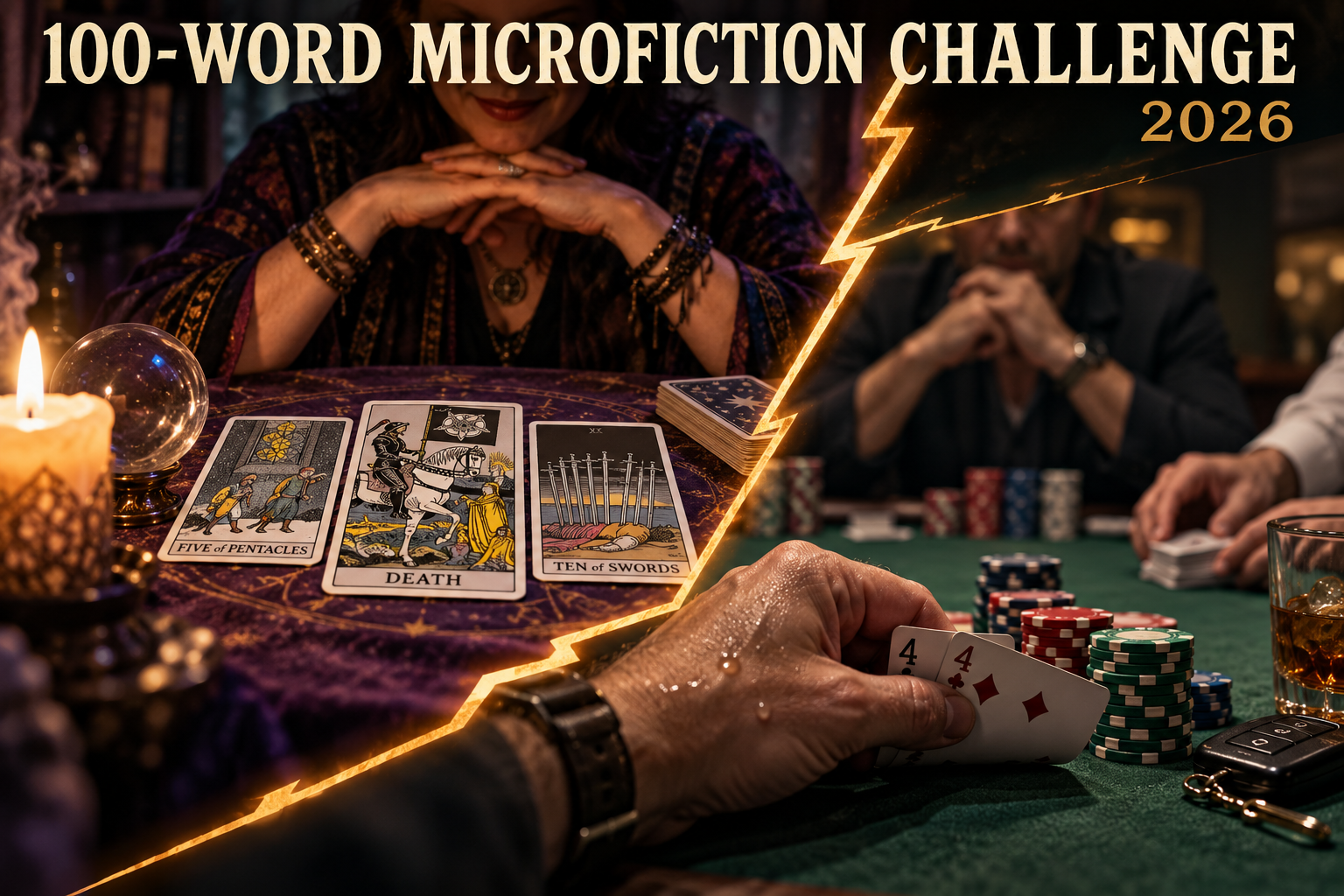
My first attempt at an NYC Midnight challenge did not go exactly according to plan.
I signed up for the 100-word Microfiction Challenge 2026. The challenge was scheduled to start on March 20, and once it did, I would have 24 hours to write and submit a story of no more than 100 words.
When March 20 arrived, so did my assignment. I was placed in Group 7. My genre was Drama, my required action was dealing cards, and the word somehow had to appear somewhere in the story. I had until 11:59 p.m. the following night, March 21, to figure out what I was going to do with them.
I spent most of those 24 hours trying to come up with the right idea. Nothing quite worked for me. I dithered, I mulled, and eventually the deadline passed without my submitting anything.
Then something annoying happened. Once the deadline was gone and there was no longer any pressure to come up with the right idea, I came up with one almost immediately. How about poker?
That became All In.
ALL IN
Somehow, I was roped into a card game against my will. But it wasn’t the fun, neighborhood kind I was used to, more like life or death, in a way.

I am staring at a pair of fours, so asked for three, the dealer dealt out my cards. He took one. Trying for a straight, or he had the nut and was just covering.

The guy across from me was gambling with his new car. I know his wife, and she would kill him if he lost it.

If I go all in, one of us is done.
Exactly 100 words. Not 99. Not 101. Exactly 100.
Apparently, once the pressure was off, my brain had no problem coming up with ideas, because after I finished All In, I came up with another one. The assignment said dealing cards. It didn’t say they had to be playing cards. How about tarot cards?
That became Waite for the Rules.
WAITE FOR THE RULES
The medium dealt out the tarot cards.

I wasn’t worried if Death showed up. It just means change, alteration. I’d actually look forward to that. It would be very good.

But if the Five of Pentacles and the Ten of Swords land in the same spread… that’s different.

Even if one showed up in the past and the other in the present, I could live with that.

But if it showed up in the future…

I couldn’t face years more of this.

The medium looked at me and smiled.
And that one is exactly 100 words too. Once the deadline was over and I could no longer win anything, I had somehow managed to write two complete 100-word stories. Go figure.
I liked Waite for the Rules, including the title, but I decided All In was the better story to submit. The title is a reference to the Rider-Waite tarot deck, one of the best-known tarot decks, named in part for Arthur Edward Waite. That was also part of the problem. To really understand the story, you needed to know what Rider-Waite meant, what those particular cards meant and why it mattered whether they appeared in the past, present or future positions of a spread.
I knew all of that when I wrote it, but I had no idea whether three random judges would. I had only 100 words, so I certainly couldn’t spend them explaining tarot. Poker was much simpler. You don’t need specialized knowledge to understand that somebody has a hand, somebody has something valuable on the line and somebody is about to lose.
So I went through NYC Midnight’s process for submitting All In late. They have links on their website specifically for late submissions, and I got confirmation that it had been accepted. It was too late to advance in the competition, but I would still receive feedback.
The feedback arrived on May 14, almost two months after the deadline. There were three judges, each identified by a number. I don’t know whether there is anything confidential about those numbers, but there isn’t any reason for me to publish them, so I’m just going to call them Judges A, B and C.
Judge A started with what they liked:
“There were some funny moments in the story, which work well as counterpoints to the drama. The “life or death” moment is the most notable instance of this balancing of the seriousness, and also allows for a rebuilding of tension toward the climax. Despite being primarily rising action, the story had highs and lows that created moments of growing tension that were offset by moments of calm. This worked well to make the writing feel more natural and entertaining. There isn’t much room for descriptions of setting, but that single word, “neighborhood” is doing a lot of work here. It places the story into a space the reader can imagine based on their own experiences, and makes it feel more full and complete, as a result.”
Great. You got my point. You liked exactly what I wanted you to like. Yay.
Then I read what Judge A thought needed work:
“Consider revising the opening to have a bit more precision of word choice. The card game was, “life or death, in a way,” and the protagonist was roped into a card game…” “somehow.” Consider choosing words that make the intended meaning perfectly clear. The joke about the car being on the line is clear, even without the addition of, “in a way.” The story is told in past tense, but slips into present on occasion. For example, “I am staring at a pair of fours.” Reading your story aloud while editing can help you find these little common slips of the pen. The ending happens just as the climax is mounting. The reader may feel a bit disappointed by the story’s end happening just before we find out what happens. We can get away with this to a degree, but here, the entire story is building to the moment that happens just after the story ends.”
OK, they were definitely right about my mixing tenses. That’s something I’ve worked on since then and something I now look for much more carefully.
But somehow? I had to use the word somehow. That was part of the assignment. Where else did you want me to put it?
“In a way,” I have to give them. That was padding on my part. It doesn’t really add anything, and in a story limited to 100 words, that’s important. If I have room to add something, it should add information. It shouldn’t just be another adjective or a few extra words that don’t tell the reader anything they didn’t already know.
The ending, though, was a choice. I liked ending it there, and I still like ending it there. I don’t think the reader needs to know what cards came out or who eventually won. The story gets the narrator to the decision: if I go all in, one of us is done. What happens after that can belong to the reader. I’m not going to make it plain just because the story could have continued for another sentence.
Judge B liked the connections between the characters:
“The ways in which the characters were connected amused the reader, especially since the narrator knew his opponent’s wife. Depending on the outcome, it could lead to very uncomfortable walks in the neighborhood. The narrator’s concern was deeply felt by the reader as the intensity of the game grew. Additionally, the cliffhanger worked well, enticing the reader to wonder how far the narrator would go.”
OK, this judge got the ending. The cliffhanger was intentional, and I liked that they were wondering what would happen afterward instead of wishing I had told them.
Then came what Judge B thought needed work:
“While the game was engrossing, the story could emphasize what each of the characters want more. First, why is the man gambling with his car? Does he need money that badly or is he eager to play the costliest game of his life? Secondly, for the narrator, what would it mean for him to win this impromptu game? It could be that he’s struggling too and wants the car to sell. Once he’s in, there’s a chance of a reward, and it’d be good to stress what he wants. Brief phrases could highlight their desires (i.e. gambling with his new car, which I’d salivated over for months). This would raise the stakes and the plot would be more potent. “All In” has an intriguing duo and enticing ending. Once the author shares more about the characters’ individual desires, it will be in great condition.”
I understand what Judge B wanted, and if this were the beginning of a longer story, I would agree. In fact, I can answer some of those questions now. Maybe the narrator got roped into the game because his buddy needed a partner and bringing somebody was a requirement for getting into the game. Why was the other guy willing to gamble his car? What did the narrator have at stake? Those are all things I could explore.
But this was a 100-word story. Take out “in a way,” as Judge A suggested, and I’ve bought myself three words. What am I going to do with them? “My buddy asked me”? That answers one question, barely, while leaving all the others untouched. To give these characters the motivations Judge B wanted would require a longer story, and I think I put about as much information into these 100 words as I reasonably could without sacrificing the card game itself.
Judge C liked the basic situation:
“I like the concept of a high stakes card game pitting acquaintances against one another. It’s hard to enjoy a victory knowing it means someone you know’s downfall.”
Then came a familiar concern:
“I like the concept of the story, but I think there is some crucial contextual information missing here. How did the narrator end up in this game? Who is running it and how have they coerced everyone in participating? We know the opponent’s car is on the line, but what does the narrator have at stake? I feel like we need more of an indication of the answers to these questions and I think the opening paragraph could be rewritten to do that.”
Judge C was looking for much the same thing Judge B was: more backstory. How did the narrator get there? Who was running the game? Why were they playing? What did the narrator stand to lose?
Again, I don’t think those are bad questions. I just don’t think answering them was as important as what I chose to spend my 100 words doing. I wanted the tension of the card game to be paramount. If I took words away from that tension to explain how everybody got into the room, I could provide more backstory, but something else would have to disappear.
It was a balancing act, and I still prefer the balance I chose. If this had been a 500-word challenge, absolutely. Give me another 400 words and I could tell you why they’re there, what each person wants, who arranged the game and what the narrator has on the line while still preserving the tension of the hand. At 100 words, I had to decide which story I was actually telling.
To me, the feedback was very useful even when I disagreed with it. Judge A made me look much more carefully at mixing tenses and at being precise with the few words I have available. If I’m going to add something, I want it to add information rather than simply adding adjectives or padding out something I’ve already said. Judges B and C made me think about motivation and context, even though in this particular story I still think the 100-word limit justified leaving much of that outside the frame.
I took the feedback seriously enough that I went back and revised All In. I fixed the tense, took out the equivocation of “in a way,” and used the words I freed up for a couple of connecting words that actually helped the story. I wasn’t going to get another round of feedback on the new version, of course, but I could at least address the problems the judges had pointed out.
Looking at it again now, I see another problem that none of them mentioned. I wasn’t definite enough about who was sitting at the table. When I say “he” did something, I know who I mean, but the reader could reasonably wonder whether I mean my opponent or the dealer. That’s my note now. Being economical with words is important when you only have 100 of them, but not if being economical makes the reader stop and figure out who you’re talking about.
Here is All In after I revised it:
ALL IN (REVISED)
Somehow, I was roped into a card game against my will. But it wasn’t the fun, neighborhood kind I was used to, this seemed more like life or death.

The guy across from me was gambling with his new car. I know his wife, and she would kill him if he lost it.

I was staring at a pair of fours, so asked for three, and the dealer dealt out my cards. He took one. Either trying for a straight, or he had the nut and was just covering.

If I go all in, one of us is done.
Still exactly 100 words.
Based on all of this feedback, I don’t think I would have advanced to the next round even if I had submitted All In on time. Everyone who writes wants to think they’re the best writer all the time, but that’s not really true. This was my first full contest entry, and I kind of whiffed it. I missed the deadline, I mixed tenses, and I used some of my very limited word count for padding instead of information. It was grammatically correct and it told the story I wanted to tell, but if I were grading it, I’d probably give it a B, maybe even a C. It wasn’t a great contest entry, but it was a great introduction to writing contests.
I didn’t get any feedback on Waite for the Rules because I never submitted it. I still like it, though, and I hope you like it too.
The entire process was so positive for me that I decided I was going to enter every contest I could and hope for the best.