
A Treatment for a Series That Doesn’t Exist
I’ve loved television for almost as long as I can remember, although my family got a rather late start. I think I was about nine years old when we finally got a television that could receive broadcasts. My initial addiction to Saturday morning cartoons eventually grew into an appreciation for episodic television, and that appreciation has never really gone away. There’s something wonderful about good storytelling that unfolds over multiple episodes, allowing characters and their relationships to develop over time. To this day, I love a well-told television series.
Over the years, I’ve also developed a habit of acquiring the shows I particularly enjoy whenever they become available, whether on DVD, Blu-ray, or through digital purchases. I want to be able to revisit those stories whenever I choose, without depending on the vagaries of streaming licenses and the possibility that a favorite series might suddenly disappear from a service. If I love a show enough to watch it again, I would rather have my own copy.
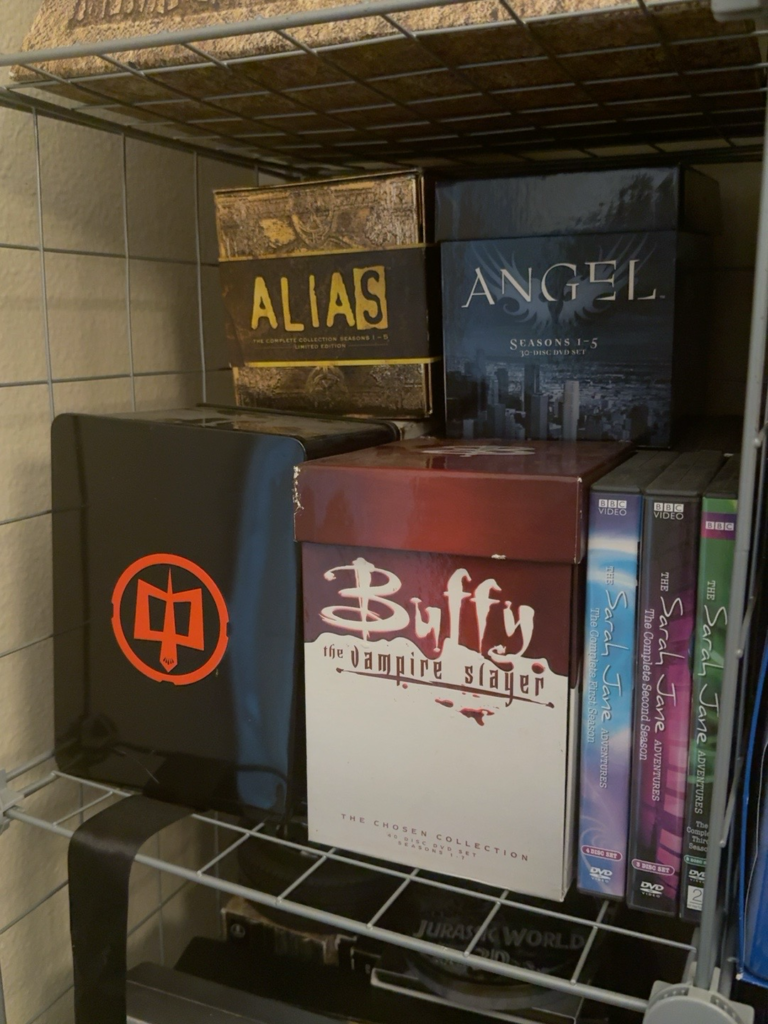
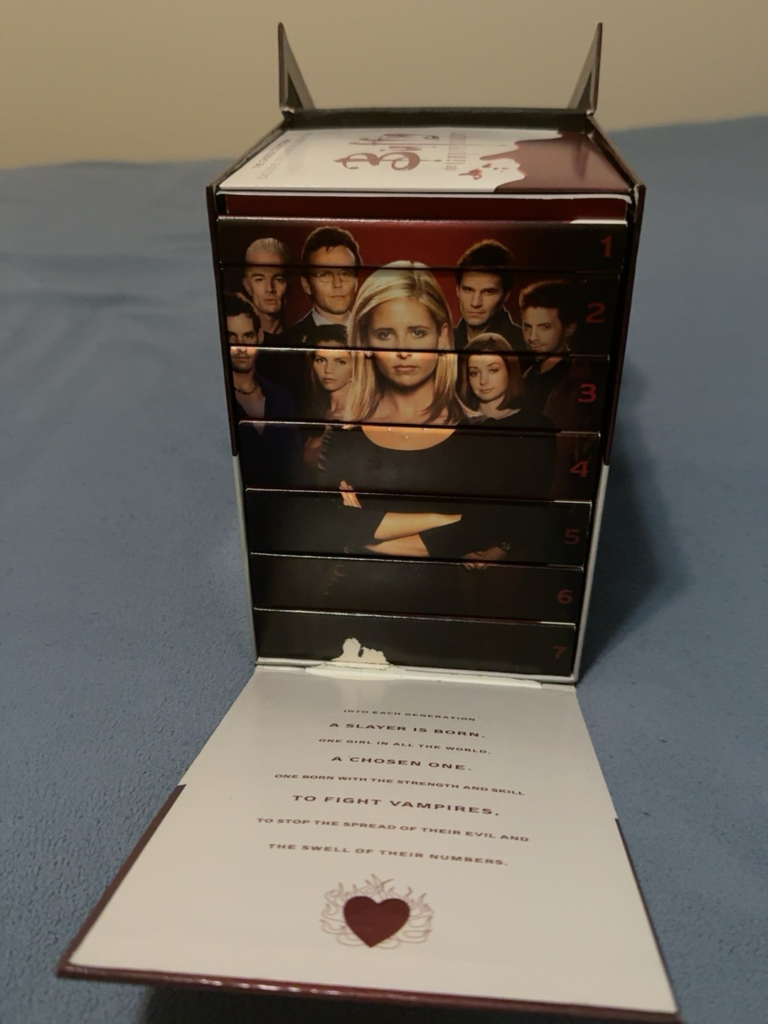
I’ve been a fan of Buffy the Vampire Slayer for a very long time. I even managed to get my hands on the big red DVD box set, the Chosen Collection, with its elaborate packaging and seven individually boxed seasons that stack together to form a single cast portrait. It’s gorgeous. I found it on eBay for a reasonable price while I was living in Maine, and I’ve treasured it ever since.

Naturally, I watched the entire series, and I enjoyed it immensely. But I didn’t necessarily pick up on all the messages and deeper meanings that other people found in the show. What I saw was a well-developed story about a very pretty, very strong young woman, her friends, and the extraordinary circumstances of their lives. I was particularly attracted to Willow, although her romantic interests seemed to change rather dramatically over the course of the series. And then she ripped the skin off a guy. Yeah, that was something.
Some years later, I discovered a rewatch podcast called Buffering the Vampire Slayer, hosted by Jenny Owen Youngs and Kristin Russo.
I’ve written about Jenny and Kristin before, in The Feedback That Had Nowhere to Go, an article about their wider podcast network and how it led me to watch a television series I might otherwise never have considered.
By the time I found that podcast, they had already completed their journey through the series, but I decided to follow their process anyway. I would watch an episode of Buffy, listen to the corresponding podcast episode, watch the next episode, listen to the next discussion, and so on. I probably moved through the material faster than they originally released it, but the entire process still took me about a year and a half.
Along the way, Vudu had a sale on the complete series, and I bought the digital edition. That made the whole exercise considerably more convenient than pulling out the DVDs every time. I still have those DVDs, of course. Some things you just don’t get rid of.

What made the experience so valuable was hearing the series interpreted through perspectives I had never really considered. Jenny and Kristin are two queer women who brought their own experiences and understanding to the stories, finding parallels and associations that had completely escaped me during my original viewing.
One example stands out in particular. Near the end of the second season, Buffy finally reveals to her mother that she is the Slayer. Joyce doesn’t understand, doesn’t accept what Buffy is telling her, and eventually delivers an ultimatum: if Buffy walks out of the house, she shouldn’t bother coming back.
When I originally watched that scene, I saw a mother struggling to comprehend an impossible revelation about her daughter. It was a dramatic moment, certainly, but it was entirely contained within the supernatural circumstances of the story.
Jenny and Kristin saw something else, and once they explained it, I couldn’t unsee it.
The entire exchange parallels the experience of a young person coming out to a parent who refuses to accept their identity. Joyce even asks Buffy whether she has ever tried not being a Slayer. Substitute “gay” for “a Slayer,” and suddenly the dialogue takes on an entirely different meaning. The rejection, the ultimatum, the demand that someone stop being what they fundamentally are—it was all there.
And they were right. At least, I certainly think they were.
That interpretation became part of my own understanding of the series. It didn’t replace what I had seen before; it added another dimension to it. Through their discussions, I discovered layers of meaning that I had missed, and I came away loving Buffy the Vampire Slayer even more than I already had.
My interest in the Buffyverse wasn’t limited to television, either. I read some of the associated novels, some of the “canon” comics, and listened to Slayers: A Buffyverse Story, an Audible Original audio drama written by Amber Benson and Christopher Golden, (featuring several performers from the original series reprising their roles). It was an interesting enough story, using alternate-dimensional possibilities to bring back characters who were no longer around. I wouldn’t necessarily have written it that way myself, but it worked well enough within its own premise. It was another opportunity to spend time with characters and a fictional universe I had grown to appreciate.
Then came word that Buffy might be returning to television.
The proposed continuation, Buffy: New Sunnydale, generated considerable excitement. Sarah Michelle Gellar was confirmed to be returning, and a significant number of familiar characters and performers from the original series were discussed as possible participants. Exactly how many would have returned, and in what capacity, was never publicly established. The new series was intended to introduce a new Slayer, played by Ryan Kiera Armstrong, while maintaining a connection to the world and characters that made the original so memorable.
The project was developed by sisters Nora and Lilla Zuckerman, with Academy Award-winning director Chloé Zhao attached to direct the pilot. Hulu approved the production, and anticipation grew throughout what I suppose we can call the Buffyverse.
The pilot was filmed and presented to Hulu executives, but the initial response was apparently less enthusiastic than everyone had hoped. Reports indicated that executives felt the material was too young in tone and too small in scope. Revisions were requested and made, but ultimately the project still didn’t pass muster. Hulu declined to move forward with the series.
Sarah Michelle Gellar later expressed her frustration with the process, suggesting that one of the executives involved wasn’t even a fan of Buffy the Vampire Slayer. She questioned why someone who didn’t appreciate the original property was in a position to make decisions about its continuation. Whether that executive’s personal feelings actually influenced the outcome is something we can’t know, but it certainly raises questions about how the project was evaluated.
Naturally, fans were disappointed. Some were furious. I was disappointed myself, but I also found myself wondering what had happened behind the scenes.
Television production is a business, and Hulu had already invested in developing the project. There was an established audience, a recognizable property, and considerable enthusiasm for its return. Those are meaningful advantages. So why walk away?
I can’t know exactly what convinced Hulu to pass, but I suspect the problem wasn’t simply whether the series could attract viewers. Perhaps the revisions didn’t address the executives’ concerns. Perhaps the story wasn’t strong enough, or the direction of the proposed series didn’t justify the investment. Whatever the reason, something apparently failed to convince the people making the decision that the project should move forward.
There is also the matter of Rupert Giles. Anthony Stewart Head was still alive during the development of the proposed continuation, and I would imagine that the creative team at least considered bringing him back in some capacity. Giles was far too important to the original series to be ignored casually, although I have seen no confirmation that Head was actually attached to the project or that Giles appeared in the proposed scripts. Sadly, with Head’s passing in June 2026, any future continuation would have to approach the character differently.
And that got me thinking.
I’m not going to claim that I’m a better writer than Nora and Lilla Zuckerman. I haven’t seen their scripts, and I don’t know precisely what they intended to do. But I do know the original series, I love its characters, and I’ve spent a considerable amount of time thinking about what made it work.
More importantly, I have an idea of my own.
My version would embrace the legacy of Buffy the Vampire Slayer, rather than simply attempt to recreate it. It would make room for the surviving original characters, acknowledge the passage of time, and build something new upon the foundation of what came before.
And it would have a particularly important place for Rupert Giles, even though Anthony Stewart Head is no longer with us. In fact, his absence could become one of the most meaningful elements of the entire story.
So, with all due respect to the people who tried to bring Buffy back, here’s how I would approach it.
BUFFY THE VAMPIRE SLAYER: LEGACY
A Television Series Treatment
Genre: Supernatural Drama, Action, Mystery, and Dark Comedy
Format: One-hour serialized television drama
Setting: Approximately twenty-three years after the original series finale
Continuity: An alternate continuation of the original television series
SERIES LOGLINE
More than twenty years after Willow Rosenberg activated every Potential Slayer in the world, Buffy Summers is one of only a handful of surviving Slayers. The spell that was supposed to liberate an entire generation instead divided a finite source of supernatural power among thousands of inexperienced young women. Most died, and as their numbers dwindled, their power returned to the survivors.
Willow’s spell also had another consequence, one nobody understood at the time. A trace of Buffy’s blood, accidentally left on the Scythe during training, caused the spell to draw upon supernatural essences accumulated throughout Buffy’s years of fighting vampires and demons. The magic created a new Slayer inheritance, separate from the ancient succession that continued through Faith Lehane.
The Shadow Men had created the original Slayer by infusing a human being with demonic power and binding protective magic into that infusion. Willow had unknowingly repeated their work, but she had omitted the protections. Buffy now possesses extraordinary strength from two supernatural sources, and the unprotected power is destroying her body.
Her only hope lies in transferring the new inheritance to its rightful successor. Willow must discover how to remove the power from Buffy and infuse it into another young woman, this time incorporating the protections that should have accompanied it from the beginning. If she succeeds, Buffy will survive, but she will lose her supernatural abilities forever.
For the first time in her adult life, Buffy Summers will no longer be the Slayer. She will become the Watcher.
THE FOUNDATION: THE SLAYER LINE
The original series established an unusual sequence of supernatural events. When Buffy Summers died briefly at the end of the first season, the ancient succession mechanism activated another Slayer, Kendra Young. Buffy was subsequently revived through ordinary resuscitation, but the supernatural calling had already passed to Kendra. When Kendra died, Faith Lehane was activated.
Buffy remained alive and retained her supernatural powers, even though the traditional succession mechanism had moved elsewhere. This created an unprecedented condition: two active Slayers existed simultaneously. The Watchers understood the immediate consequences but never fully investigated what Buffy’s resurrection meant for the underlying magic.
In this continuation, Buffy’s first death did not create a second lineage. It simply allowed the original power to remain active in two women. The source of that power was immense, and dividing it between Buffy and Kendra, and later between Buffy and Faith, produced no noticeable reduction in either Slayer’s abilities.
The ancient succession continued through Kendra and Faith. Buffy retained her powers, but another death would not activate another Slayer through her. That distinction became crucial years later, when Buffy died at the end of the fifth season and no additional Slayer was called. Faith remained the bearer of the active succession, while Buffy remained a Slayer without being the mechanism through which the next Slayer would be chosen.
For years, this unusual arrangement caused no significant problems. Then Willow performed her activation spell.
WILLOW’S SPELL
In the original series finale, Chosen, Willow performed a spell intended to eliminate the ancient injustice of having one young woman bear the responsibility of protecting the world. Using the Scythe, she activated every living Potential Slayer, giving thousands of young women supernatural abilities.
Willow believed she was extending the Slayer’s calling to everyone who had the potential to receive it. She was correct about the immediate result, but she did not fully understand the underlying magical mechanism. Her spell was remarkably similar to the ancient ritual performed by the Shadow Men when they created the First Slayer.
The Shadow Men had used that mechanism to concentrate demonic power within a single human being. Willow independently discovered the same fundamental principles and applied them toward an entirely different purpose. Where the Shadow Men had sought to create one extraordinarily powerful warrior, Willow sought to activate as many Slayers as possible.
Her spell was designed for maximum reach, but she did not realize that the original demonic power was finite. Nor did she realize that the Scythe contained something that would fundamentally alter the result.
THE BLOOD ON THE SCYTHE
In the days before the final battle against the First Evil, Buffy trained with the Scythe. It was an unfamiliar weapon, combining the properties of an axe, a stake, and a blade. Like anyone learning to handle a dangerous edged weapon, Buffy occasionally nicked herself. She healed quickly, as Slayers do, and the injuries were insignificant. However, a tiny amount of her blood remained trapped in the joint where the blade met the haft. Nobody noticed it or thought to look.
When Willow used the Scythe to perform her spell, that trace of blood became part of the magical conduit. Throughout her career, Buffy had been bitten, clawed, stabbed, and wounded by vampires, demons, werewolves, and other supernatural creatures. She had recovered from those encounters, but traces of their supernatural essences had become bound to her blood. Ordinarily, those traces were harmless, too small and too scattered to produce any meaningful effect.
Willow’s spell changed that. The magic encountered Buffy’s blood and followed its supernatural connections, drawing upon those accumulated essences and gathering fragments of demonic power into a new inheritance. Without knowing it, Willow had repeated the essential act that created the First Slayer.
The Shadow Men had deliberately bound demonic essence to a young woman. Willow accidentally bound a collection of supernatural essences to Buffy Summers. The result was the creation of a second Slayer lineage, permanently anchored to Buffy, while the original Slayer Line continued through Faith.
Unlike the original Slayer Line, however, this new Chosen Line had no protective enchantment.
THE FINITE POWER OF THE SLAYER
The original Slayer’s abilities came from a demonic essence infused into a young woman by the Shadow Men. That power was inherited through the Slayer lineage and, for thousands of years, was concentrated in a single active Slayer, with rare exceptions. Willow’s spell changed the distribution of that power without increasing its total quantity.
The result was thousands of Slayers who possessed only a fraction of the strength traditionally associated with the calling. They were stronger than ordinary humans, but not nearly as strong as Buffy or Faith had been. A young woman who had previously possessed physical abilities equivalent to an eight on a scale of ten might suddenly become a nine. She could run faster, hit harder, and withstand more punishment, but she could not necessarily survive an encounter with a vampire.
Unfortunately, many believed they could. Stories about Buffy Summers had circulated among the surviving Watchers and the newly activated Slayers. They knew about her extraordinary strength, her battles against powerful demons, and her repeated victories against seemingly impossible odds. They believed they now possessed the same abilities.
They were wrong.
Willow’s spell had activated the Potentials, but it had not created an infinite supply of supernatural energy. Instead, it had divided the existing Slayer power among thousands of recipients. The ancient protections created by the Shadow Men accompanied that original power, but those protections could not compensate for the enormous reduction in strength experienced by the newly activated Slayers.
The consequences were catastrophic.
THE GREAT SLAYER CATASTROPHE
The first years following Willow’s spell were chaotic. Thousands of young women suddenly found themselves possessing supernatural abilities without training or guidance. The Watchers’ Council had been destroyed, the surviving Watchers were scattered, and there were nowhere near enough experienced instructors to train the newly activated Slayers.
Buffy and her allies attempted to establish an international organization, creating training facilities, support networks, and teams. Experienced Slayers were assigned to work with inexperienced ones, while ordinary humans with knowledge of supernatural threats became researchers, instructors, and coordinators.
Xander Harris became particularly valuable. Having survived years of fighting alongside Buffy without supernatural abilities, he understood something that many newly activated Slayers did not: strength was never a substitute for preparation.
Despite these efforts, the losses continued. Many new Slayers went hunting alone, overestimating their strength and underestimating their enemies. The casualties were staggering. Within a few years, more than half of the original activated Slayers were gone, and over the following decade, their numbers continued to decline.
By the beginning of the new series, only six remained, including Buffy and Faith. One of the others had begun to see those deaths not as tragedies, but as opportunities.
THE REDISTRIBUTION OF POWER
As the surviving Slayers became fewer, something unexpected happened: they grew stronger. Willow eventually discovered that the supernatural energy did not disappear when its bearer died. Instead, it returned to the remaining Slayers.
The effect resembled the power redistribution depicted in The One, where the death of one version of an individual increases the strength of the survivors. In the Slayer universe, the effect was magical rather than physical. The original demonic energy remained finite; only its distribution changed.
When thousands of Slayers existed, each possessed only a small portion. When hundreds remained, their abilities increased. When only a handful survived, their strength became extraordinary. Buffy and Faith eventually possessed abilities exceeding those of traditional Slayers.
But Buffy was experiencing something different from the others. Her power was not simply increasing. Something inside her was changing.
THE SHADOW MEN’S SAFEGUARD
The Shadow Men did not simply infuse the First Slayer with demonic energy. They also incorporated a supernatural protection that allowed the demonic essence to coexist with human physiology. This protection was not an independent spell placed upon the Slayer afterward. It was woven into the infusion itself, making the demonic essence and its protective enchantment inseparable parts of the same magical process.
That distinction had remained largely forgotten. When Willow performed her activation spell, the original Slayer power was divided among the Potentials, and the protections created by the Shadow Men followed that power.
The new Chosen Line was different. The supernatural essences drawn through Buffy’s blood were gathered and bound to her without those protections. Willow had successfully recreated the infusion process, but she had not recreated the safeguard.
For more than twenty years, Buffy had carried an unstable mixture of supernatural energies that were never meant to coexist within an unprotected human body. The resulting corruption developed slowly. At first, her extraordinary healing abilities concealed the damage, but as the years passed, the corruption became more aggressive.
The physical manifestation resembled cancer, although ordinary cancer treatments could not eliminate the underlying cause. The malignancy was being sustained by the supernatural energy itself.
Buffy was stronger than she had ever been, and that strength was killing her.
TWENTY-THREE YEARS LATER
Buffy Summers is no longer a young woman reluctantly accepting her calling. She is a veteran of decades of supernatural warfare who has led teams, trained Slayers, buried friends, and witnessed the collapse of much of the organization she helped create. She has survived nearly everything the supernatural world could throw at her, but she is exhausted, and her physical condition is deteriorating.
At first, she dismisses the symptoms as the natural consequences of aging and years of injuries. Then she collapses during a routine mission. Medical examinations reveal a rapidly developing malignancy whose unusual behavior doctors cannot explain. Willow begins investigating the possibility of a supernatural cause.
At nearly the same time, Buffy receives an unexpected inheritance. Rupert Giles has died, not in battle or while confronting a vampire or attempting to prevent another apocalypse, but from a prolonged illness associated with a disease that had devastated millions of people around the world. After a lifetime of surviving supernatural dangers, Giles was taken by something entirely ordinary.
His estate has finally been settled, and Buffy receives the collection of books, research, journals, and personal effects he had accumulated over a lifetime of studying the supernatural world. Among them are volumes she remembers from the Sunnydale High library, along with handwritten notes, obscure references, and research materials Giles continued collecting long after the destruction of the original Watchers’ Council.
There is also his familiar green mug. Buffy unwraps it from the packing material and holds it for a moment. The man who taught her how to survive is gone, but his knowledge remains.
Neither Buffy nor Willow yet realizes how important that inheritance will become.
THE TWO SLAYER LINEAGES
Willow’s investigation begins with the original Slayer succession. Buffy’s first death activated Kendra, Kendra’s death activated Faith, and Buffy’s later death did not activate another Slayer. For years, the Watchers had treated this as an unusual but manageable consequence of Buffy’s resurrection. Now Willow begins to suspect that the distinction became far more important when she performed her activation spell.
Her research leads her back to the Shadow Men’s original ritual. Using Giles’s surviving notes and research, she compares the ancient magical principles with the spell she performed using the Scythe. The similarities are extraordinary. Willow realizes that she had independently discovered the same fundamental magical mechanism the Shadow Men used to create the First Slayer, but where their ritual concentrated power, hers distributed it.
Then she discovers evidence of a second infusion, one that was never part of her original intention. She eventually traces the anomaly to the Scythe itself. Buffy’s blood had been present during the spell, carrying supernatural connections accumulated throughout her years of fighting demons.
Willow finally understands what happened. The spell did not merely divide the original Slayer power; it created a new inheritance from the supernatural essences connected to Buffy. The original Slayer Line continued through Faith, while the new Chosen Line became bound to Buffy. Because Willow had not known she was creating a second infusion, she had not included the Shadow Men’s protections.
The Chosen Line had been created without the safeguard that made the original Slayer power safe.
THE NEXT CHOSEN ONE
Willow’s spell activated every Potential Slayer alive at the time, but it was a single magical event. It did not permanently rewrite the process by which future generations of Slayers would be called, and girls born afterward were unaffected.
The traditional Slayer succession continued to exist through Faith. The Chosen Line also developed its own succession mechanism, created when Willow’s spell permanently anchored the new inheritance to Buffy. That inheritance, however, had never passed to another person, and Buffy remained its sole bearer.
Willow discovers that a young woman born after the activation spell has become the designated successor to the Chosen Line. She has never been activated, possesses no supernatural abilities, and has lived an ordinary life. She is approaching the traditional age at which a Slayer might receive her calling, but she cannot awaken naturally while Buffy continues to carry the Chosen power.
If Buffy dies, the new inheritance will pass to its successor. Unfortunately, it will pass without the missing protections, leaving the young woman vulnerable to the same dangerous supernatural condition that is killing Buffy. Willow realizes that simply allowing the succession to occur would repeat the original mistake.
She must find another way.
THE NEW SLAYER
The young woman is approaching adulthood, with ambitions, friendships, relationships, and ordinary responsibilities. She knows nothing about the supernatural world, has never met a vampire, and has never heard of the Shadow Men. She certainly has no desire to inherit the responsibilities of Buffy Summers.
When Buffy approaches her, the young woman initially assumes the entire story is absurd. She has no special abilities and no reason to believe she is destined for anything extraordinary. Buffy, however, recognizes something familiar in her resistance.
When Buffy herself was young, she wanted nothing more than a normal life. She remembers what it felt like to be told that her future had already been decided. This time, however, Buffy is not the reluctant teenager. She is the experienced adult, and she must learn how to explain the calling without repeating the mistakes of the old Watchers’ Council.
THE REMAINING SLAYERS
At the beginning of the series, only six Slayers remain. Their relationships are complicated by a shared history of extraordinary loss and deep disagreements about what those losses mean. Some believe Willow’s spell was a mistake that should never have happened, while others maintain that it was morally justified despite its consequences.
One of the surviving Slayers has reached a particularly dangerous conclusion. She believes the original Slayer power must be concentrated in a single individual. Having noticed that every Slayer death makes the survivors stronger, she has begun to believe that eliminating the remaining Slayers is necessary to restore the ancient balance.
She does not initially consider herself evil. Instead, she believes she is making a terrible sacrifice for the greater good, but her conviction gradually becomes an obsession. When another Slayer dies early in the season, leaving only five survivors, the resulting increase in power reinforces her belief.
When she learns about Buffy’s illness, she reaches the wrong conclusion, believing that acquiring enough power will allow her to overcome any weakness or corruption. Her objective becomes to kill the remaining Slayers, absorb their power, and become the strongest Slayer who has ever lived.
Buffy refuses to accept that murder is the solution. Their conflict becomes the principal external threat of the first season.
WILLOW’S SECOND SPELL
Willow refuses to accept that Buffy must die to activate the next Chosen One. Her research into the Shadow Men’s original ritual reveals a critical distinction: the protective enchantment was not something that could simply be applied to a Slayer after the infusion. It had to be incorporated while the demonic essence was being bound to the human body. Protection and infusion were inseparable parts of the original magical process.
That explains why Buffy cannot simply be cured by adding the missing safeguard. The Chosen power is already bound to her, and the damage has been progressing for more than twenty years.
Willow eventually discovers another possibility. Rather than attempting to repair the existing infusion, she may be able to reverse it. She must remove the Chosen inheritance from Buffy completely, separate it from the original Slayer power, and transfer it to the young woman destined to receive it. During that transfer, Willow can incorporate the protections that should have accompanied the new inheritance from the beginning.
The new Chosen One would receive the supernatural abilities without inheriting the corruption. Buffy would be left without supernatural powers and, for the first time since her original calling, would be fully human.
The operation carries extraordinary risks. If Willow fails, Buffy could die. An incomplete transfer might cause the new Slayer to inherit the corruption, while disturbing the original Slayer power could damage the ancient succession itself. If the new inheritance rejects the transfer, the Chosen Line could be lost.
Willow is terrified of repeating her previous mistake. For more than twenty years, she has lived with the consequences of her first spell, and now she must risk performing another. This time, however, she refuses to act until she understands precisely what she is changing.
The first spell was about giving power. The second must be about giving power safely.
BUFFY’S CHARACTER ARC
Buffy’s greatest challenge is not accepting that she may die. She has faced death repeatedly. Her greatest challenge is imagining herself without supernatural abilities.
For most of her life, being the Slayer has defined her identity. She has been the strongest person in almost every room, responsible for protecting others and stepping forward when everyone else stepped back. Now Willow is proposing that she surrender all of it.
Buffy initially resists. Without her powers, how can she protect anyone or continue fighting? What purpose would her life have?
Xander provides an answer. He has spent decades helping protect the world without supernatural strength, and he reminds Buffy that being useful has never required being the strongest person in the room. Willow reminds her that knowledge and experience can be as valuable as magical abilities. Giles remains the example of what a Watcher can accomplish.
His death has forced Buffy to confront the passage of time in a way that even her own illness initially could not. His books and research now occupy her shelves, his handwritten notes guide Willow’s investigation, and his familiar green mug has found a place in Buffy’s home.
Gradually, Buffy realizes that she has already begun performing the duties of a Watcher. She is training the next Chosen One, preparing her for the supernatural world, and teaching her how to survive. She occasionally catches herself repeating something Giles once told her.
Buffy’s greatest transformation is not losing her power. It is discovering that her power was never the only thing that made her extraordinary. She is becoming the mentor she once needed.
WILLOW’S CHARACTER ARC
Willow’s story centers on responsibility. Her original spell was intended to correct an injustice, but its consequences were catastrophic. For more than twenty years, she has attempted to repair the damage, studying the Slayer lineage, the original demonic infusion, and the ancient protections created by the Shadow Men. She has become a more cautious and disciplined practitioner of magic, but she has also become burdened by guilt.
The discovery of the blood on the Scythe changes her understanding of everything that happened. She had not performed the spell incorrectly; she had performed it successfully without fully understanding the magical principles she was using. She had independently recreated the essential mechanism of the Shadow Men’s ritual and accidentally created an entirely new Slayer inheritance without the protections that should have accompanied it.
The proposed transfer forces her to confront her past. Once again, she is preparing to alter the fundamental nature of the Slayer, and once again, the consequences could be enormous. The difference is that this time she understands the danger and refuses to proceed until she has investigated every possible outcome.
Her ultimate victory is not simply saving Buffy. It is demonstrating that she has learned to use her power responsibly.
XANDER’S CHARACTER ARC
Xander has become one of the most experienced human members of the Slayer organization. He coordinates operations, trains support personnel, and helps inexperienced Slayers understand the importance of preparation. He remains sarcastic, occasionally inappropriate, and frequently exasperated by the supernatural world’s tendency to ignore practical considerations, but beneath the humor is decades of experience.
He has watched Slayers die because they believed strength made them invincible, and he has seen ordinary humans survive because they understood teamwork. He has learned that courage is not the absence of fear, but knowing exactly how dangerous something is and choosing to act anyway.
Xander becomes particularly important during Buffy’s transition. When she fears becoming powerless, he reminds her that he has never possessed supernatural abilities, and he has never stopped fighting.
GILES’S LEGACY
Rupert Giles is no longer alive when the series begins. His death was not supernatural. After surviving years of battles against vampires, demons, and apocalyptic threats, he succumbed to a prolonged ordinary illness associated with a disease that had devastated millions. The irony is not lost on Buffy.
His role in the story, however, does not end with his death. His books, research, and personal effects arrive early in the first season, providing both a tangible connection to Buffy’s past and an important source of information for Willow’s investigation.
Giles spent his life studying the ancient Slayer mythology. Some of his notes contain references to magical principles that the modern Watchers had largely forgotten. Those materials help Willow understand the relationship between the Shadow Men’s original ritual and her own activation spell, making his research part of the solution that saves Buffy.
More importantly, his influence shapes Buffy’s future. For decades, Giles served as her teacher, researcher, mentor, and friend. He taught her that understanding an enemy could be as important as defeating it, demonstrated the value of preparation, and showed that an ordinary human being could make an extraordinary difference.
Buffy gradually realizes that the most important inheritance Giles left her was not his collection of books. It was the knowledge and judgment he spent years teaching her. By the end of the season, she is ready to pass that inheritance to someone else.
SEASON ONE: THE CHOSEN LEGACY
Proposed length: Ten episodes
Episode 1: Twenty-Three Years Later
Buffy leads a mission against a supernatural threat, demonstrating extraordinary strength before collapsing afterward. Medical examinations reveal an aggressive illness, prompting Willow to investigate a possible supernatural cause.
Buffy also receives word that Rupert Giles’s estate has finally been settled. His books, research, and personal effects arrive, including his familiar green mug. Meanwhile, the death of another Slayer reduces the surviving number from six to five and produces an unexpected increase in the powers of the survivors.
Episode 2: The Divided
Flashbacks reveal the chaotic aftermath of Willow’s activation spell, when thousands of young women received weakened Slayer powers without adequate training. The casualties were enormous, and the surviving organization struggled to respond.
In the present, Willow confirms that the power of deceased Slayers is redistributed among the survivors. She begins questioning whether her spell created power or merely divided what already existed.
Episode 3: The Shadow Men’s Gift
Willow discovers that the original demonic infusion included supernatural protections incorporated into the infusion itself, rather than added afterward. These safeguards cannot simply be applied to someone who has already received the power.
Research from Giles’s collection helps Willow recognize striking similarities between the Shadow Men’s ritual and her own activation spell. She realizes that she independently recreated the same fundamental magical mechanism.
Episode 4: Two Lines
Research into the original Slayer succession reveals the distinction between Buffy and Faith. Buffy’s first death activated Kendra, Kendra’s death activated Faith, and Buffy’s later death did not activate another Slayer.
Willow discovers that her activation spell did more than divide the original power. A trace of Buffy’s blood trapped in the Scythe drew upon supernatural essences accumulated throughout Buffy’s career, accidentally creating a new Chosen Line. Unlike the original Slayer inheritance, this new lineage never received the Shadow Men’s protections.
Episode 5: The Unchosen
Willow discovers that her activation spell was a single event, leaving girls born afterward unaffected. She also learns that the Chosen Line has a designated successor who has not yet been activated, and Buffy decides to find her.
Unfortunately, allowing Buffy to die would pass the unprotected inheritance to that successor, repeating the original danger. Meanwhile, evidence emerges that one of the surviving Slayers is deliberately hunting the others.
Episode 6: The Next One
Buffy locates the young woman destined to inherit her power, but the girl refuses to believe the story. She has no supernatural abilities and no interest in becoming a Slayer.
Buffy begins teaching her about the supernatural world without revealing the full extent of her own illness. Their relationship begins awkwardly, as Buffy discovers that being a mentor requires a very different kind of patience from being a Slayer.
Episode 7: The One
The antagonist attempts to eliminate another surviving Slayer. Her increasing strength reinforces her belief that the power should be concentrated in one individual.
Willow discovers that the Chosen Line can potentially be transferred without requiring Buffy’s death. However, the procedure would permanently remove Buffy’s supernatural abilities, and the protective enchantment must be incorporated during the transfer itself.
Episode 8: The Watcher
Buffy begins training the young woman in earnest. Because the girl has no supernatural strength, Buffy must teach her awareness, discipline, strategy, and teamwork. Xander demonstrates the importance of ordinary human abilities, reinforcing lessons that supernatural power alone cannot provide.
Buffy increasingly relies on Giles’s books and research as she prepares her successor. Gradually, she realizes that she is already becoming a Watcher, even as her own condition continues to worsen.
Episode 9: The Last Chosen
The antagonist attempts to kill Buffy and absorb her power. Their confrontation reveals the dangers of concentrating unprotected demonic energy in a human body.
Buffy survives, but her illness becomes critical, and Willow determines that the transfer must happen immediately. Buffy must decide whether she is willing to surrender the supernatural abilities that have defined her life.
She chooses to live.
Episode 10: Legacy
The antagonist makes one final attempt to seize the Chosen power, but Buffy and her allies defeat her. The victory comes at a terrible moment: Buffy is dying, and Willow must perform the transfer before it is too late.
Willow extracts the Chosen inheritance from Buffy and incorporates the missing protective enchantment as the power is infused into the young woman destined to receive it. The new Slayer awakens, but Buffy collapses, and for several moments nobody knows whether the transfer succeeded.
Then Buffy opens her eyes. She is alive, but the Slayer is gone. Buffy Summers is now an ordinary human being. Her illness remains a medical concern, but the supernatural source feeding it has been removed, giving her a genuine chance to recover.
The episode concludes with the new Slayer preparing for her first patrol. Buffy sits nearby, drinking tea from Giles’s green mug. The girl is nervous and asks whether Buffy is coming along. Buffy explains that she can no longer fight the way she once did, prompting the girl to ask whether that means Buffy is leaving.
Buffy smiles and explains that the Slayer has always needed someone to help her understand the calling, research the monsters, prepare her for what she will face, and recognize when to fight and when to run.
The girl asks what that person is called.
Buffy answers:
“A Watcher.”
FUTURE SEASONS
The first season establishes the new Chosen One and resolves Buffy’s personal struggle. Subsequent seasons follow their evolving relationship, with the new Slayer possessing extraordinary abilities but lacking experience, while Buffy possesses decades of experience but no supernatural powers. Their partnership becomes the foundation of the series.
Willow continues studying the nature of the Slayer Line and Chosen Line. Faith’s place in the traditional succession remains important, providing opportunities to explore the relationship between the two supernatural inheritances. Xander helps rebuild a smaller, more responsible organization devoted to training and supporting Slayers, while the remaining Slayers present ongoing questions about the distribution of supernatural power.
Buffy also faces an entirely new challenge: learning to let someone else fight. For decades, she was the person who stepped forward when danger appeared. Now she must sometimes remain behind, and that may prove more difficult than fighting vampires ever was.
THEMATIC FOUNDATION
Power and Responsibility
Power without preparation is dangerous. The activation spell gave thousands of young women abilities they did not understand, and their overconfidence contributed to catastrophic losses. The new series explores the importance of training, judgment, and responsibility.
The Consequences of Good Intentions
Willow’s spell was performed for morally compelling reasons, but good intentions did not prevent terrible consequences. She successfully activated thousands of Potentials without understanding that she was dividing finite power and accidentally creating a second, unprotected inheritance. The series explores the responsibility people bear for the unintended results of their decisions.
Aging and Identity
Buffy’s supernatural strength has defined her life, and losing that strength forces her to reconsider who she is. Her eventual transition into becoming a Watcher demonstrates that identity can evolve without losing its essential meaning.
Mentorship
The original series explored a young woman’s relationship with the adults who guided her. The revival reverses that perspective, making Buffy the mentor. Her greatest challenge is preparing someone else to face dangers she can no longer confront directly.
Legacy
A person’s legacy is not simply the abilities they possess, but the knowledge, values, and experience they pass to others. Giles’s legacy survives through Buffy, and Buffy’s legacy will survive through the young woman she trains. Her greatest contribution may ultimately be teaching the next Slayer how to live.
TONE AND PRODUCTION
The series should retain the balance of supernatural action, character-driven drama, humor, and emotional relationships that distinguished the original. It must not become relentlessly grim. Although the story deals with illness, death, and the consequences of past decisions, its central message remains hopeful. Buffy is not being punished for surviving; she is being given the opportunity to begin another chapter of her life.
The series should also remain practical from a production standpoint. The mythology may involve ancient demonic forces and worldwide consequences, but the storytelling should focus on a manageable group of characters. There is no need for giant transformations, international magical armies, or elaborate visual-effects sequences in every episode.
The emphasis remains on people: their relationships, mistakes, humor, and the decisions they make when confronted with extraordinary circumstances. The new Slayer’s personal life provides opportunities to explore the same themes of friendship, romance, growing up, and responsibility that made the original series successful.
THE DEFINING IDEA
The original Buffy the Vampire Slayer began with a young woman who did not want to be chosen. She wanted an ordinary life, with friendships, romance, and the freedom to make her own decisions. Instead, she inherited an ancient responsibility and spent years fighting against it before ultimately embracing it.
At the end of the original series, Buffy attempted to change the rules so that no one else would have to carry the burden alone. More than twenty years later, she discovers that the change came at a terrible cost. But Buffy Summers has never been someone who simply accepts that a terrible situation cannot be changed.
She finds another way.
Buffy does not need to die to complete her destiny, remain superhuman to protect others, or be the Chosen One forever. The Slayer Line continued through Kendra and Faith, Willow’s spell divided its power among thousands, and Buffy’s blood on the Scythe accidentally created the Chosen Line. Now Buffy can finally pass that inheritance to someone else, safely.
Her destiny does not end when she loses her powers. It changes. The young woman who once needed a Watcher has become the woman who can guide the next generation.
BUFFY THE VAMPIRE SLAYER: LEGACY
The Slayer becomes the Watcher.
Or, we can go another way…

Buffy and the Slayers Rock the Bronze