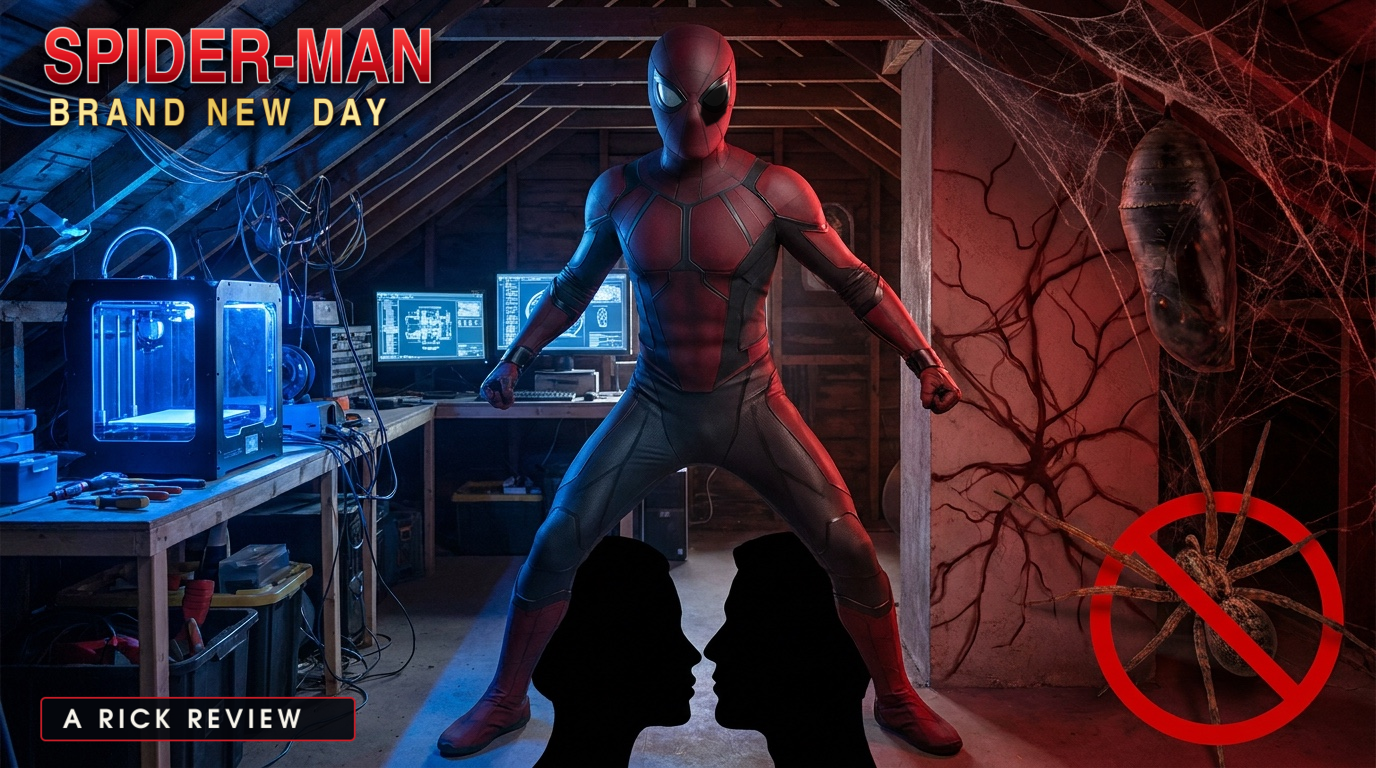
Rating: ★★★★★ (5/5)
I’ve seen this movie three times. I could have written this review after the first viewing. I didn’t. I could have written it after the second. I didn’t. It has been three weeks now, so I think it is safe to say that this review is going to contain spoilers. It has been three weeks, after all. Even Marvel won’t come after me now.
A Disclaimer
I’m not a professional reviewer—and by that, I just mean I don’t get paid for it—but I feel I’m a competent one. It was hard for me to write this review after the first viewing, or even the second, simply because I have such true affection for the subject matter.
I grew up with Spider-Man. I collected the comics throughout the ’80s and ’90s, and even into the 2000s, before they eventually dropped out of my consciousness. But I still have very fond memories of the Peter Parker I loved. While watching this movie, I kept saying things to myself such as, “That is my Peter. That’s exactly how I could imagine him.”
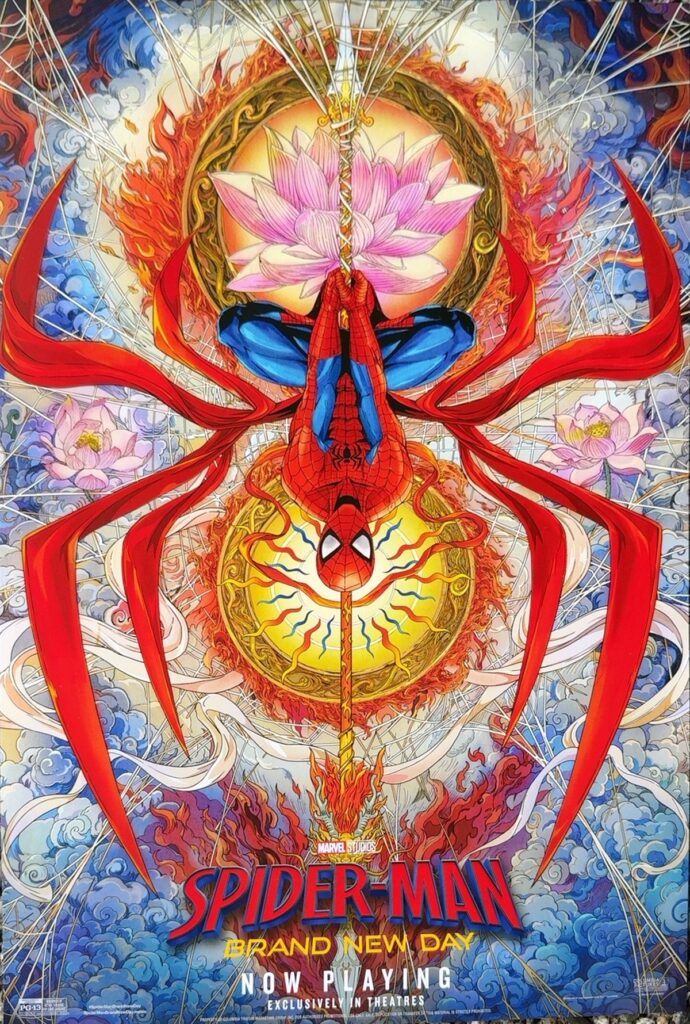
Then came the third viewing. That happened not just because I wanted to make sure I got a quote right, but because Regal was offering a lovely poster—which I now have hanging right here:
I like this character, and I like the writers’ take on him. The studio may have made a few missteps with previous incarnations—probably with very different writers, but still under the same studio. Spider-Man 3 with Tobey Maguire comes to mind. It was very hard to remain affectionate toward that character when he went emo. That simply was not the same Peter Parker. Fortunately, he was redeemed in Spider-Man: No Way Home.
You could tell Andrew Garfield loved making his two movies, but they were not as well received as the others, and I honestly couldn’t tell you why. I loved them. Still, his Peter was not quite the super-chirpy, super-quippy guy I remembered, and neither was Maguire’s.
Reviews of this movie have described Tom Holland’s Peter as a very sad person—a down-in-the-dumps kind of fellow. The truth is, I didn’t initially see him that way. I think that is part and parcel of how I view Spider-Man. He still quipped. He still made jokes. He made fun of the awful situation he was in at every opportunity. For me, that is Spider-Man. That is the Peter Parker I grew up with: No matter what was going on in his life, he would still wisecrack his way through it.
That is how this movie truly succeeds. You can see him as sad. You can see him as jealous. You can see him as angry, and you can see him as truly depressed. Yet he is still unmistakably Peter Parker. That is a success right off the top.
Peter Parker, Alone
The movie opens with Peter working on his suit using a 3-D printer—and, frankly, I would love to own that thing. It prints fabric. It prints circuits. It performs fine soldering. It is a pretty awesome machine.
The printer is operated by an AI named Eve, and she is not merely a large language model. She appears to be a true artificial intelligence. Eve is also integrated into Peter’s suit, primarily through the eyepieces, although the circuitry is evidently diffused throughout the entire costume.
Most importantly, Peter makes the suit himself. He is no longer dependent upon Tony Stark.
But I do wonder how he affords all of this. The movie hand-waves that question completely. The equipment in his upstairs apartment would easily have cost a hundred thousand dollars—probably much more. There is no evidence that Peter has any kind of paying job. He calls himself a volunteer for the police, but that does not pay for an attic laboratory.
Perhaps he sells one-off inventions. Maybe he makes deliveries for DoorDash; Spider-Man could certainly deliver an order quickly, although the food might be a little jumbled by the time it arrived. That probably wouldn’t be workable.
My best guess is that Tony Stark established a trust fund for Peter before he died. Otherwise, there is simply no way a barely employed Spider-Man could afford all that equipment.
Yet we repeatedly see him at the local bodega buying flowers. I think the movie takes place over perhaps three days, and he buys flowers three or four times—although he eventually gives one bouquet away. We’ll get to that.
I don’t know whether you have ever tried to buy flowers from a bodega or a 7-Eleven-type store, but they are not cheap. The first time I tried buying flowers from that kind of shop, they cost about $35. If Peter is buying a bouquet every day, he is spending roughly $1,000 a month just to put flowers on his aunt’s grave.
Peter is living alone and isolating himself almost completely. It has been about four years since the events of No Way Home. He follows Ned Leeds on Instagram under the name @TheGratefulNed42, and Ned posts regularly. One post says they are graduating next month, which fits with four years at MIT.
Ned is still very close to MJ, so Peter often sees her in the background of Ned’s videos. Naturally, that makes him sad. You can see a little moroseness on his face—but then the movie immediately shifts to a cheerful Peter capturing a group of thugs, stringing them up and being both quippy and funny about it.
Detective DeWolff, Peter’s contact within the police department, smiles happily when she sees the criminals webbed together and hanging from a lamppost. The expression on her face is pure: “What a rascal. He did it again. Thanks.”
Peter has DeWolff’s phone number, and she presumably has some anonymous number through which she can reach him. But he knows nothing about her personal life. He never asks her questions. She has never seen his face, and he never answers her questions about himself. The movie keeps piling up evidence of his isolation, and it is supposedly that isolation that triggers the physical change everyone else dreads—and Peter dreads most of all.
The Cold Open, the Tank and Director Metzger
The movie’s cold open shows Spider-Man capturing a collection of criminals, including Tombstone, The Scorpion, and the Hand (in their striking red outfits). It also gives us an early action montage full of the Peter Parker personality I love.
The first major set piece involves a tank rolling through the streets toward the Department of Damage Control. This is also Peter’s first interaction in the movie with the Punisher. Frank wants to handle everything lethally, and Spider-Man keeps preventing him from doing so. Their conflict is quite comical.
They repeatedly mention that Spider-Man once saved the Punisher’s life on Staten Island. It did not happen in any previous movie; it was an off-screen incident created for this one. Peter insists he saved Frank from a drug dealer, while Frank disputes his version of events. That disagreement becomes a running joke.
The tank is extremely difficult to stop. Peter does not stop it until it has broken through Damage Control’s outer gates and reached the building. He rips open the hatch and finds an elderly woman inside. She turns out to be a janitor and has no idea how she got there.
At this point, the antagonist is hopping from one body to another, and there is a distinct physicality whenever the transfer occurs. Sometimes a person’s head merely nods. Sometimes the abandoned body collapses like a puppet whose strings have been cut. In one instance, a possessed person thrusts his arm toward someone else, slumps over, and then the other person’s posture subtly changes.
The movie may intend for us to believe Spider-Man’s enhanced senses allow him to detect these transfers. Frankly, though, I simply saw the subtle movements of each affected person. Later, the movie says Peter’s transformation is interfering with his ability to sense the entity inside its host. That is where I wonder whether communication broke down somewhere between the writers and the director. I could identify the possessed person merely by watching the performers’ physical movements, and I do not have superpowers.
After the tank attack, Peter meets William Metzger, the director of Damage Control. Metzger initially appears helpful and friendly, and the two discuss how Spider-Man and Damage Control might help each other.
When Peter arrives for the appointment, there is a funny security scene. He is subjected to a full-body scan, and security tells him he must remove his mask. Metzger intervenes and makes it clear that Spider-Man is absolutely not going to do that.
As they walk down the hallway, Peter sees members of the Hand. Metzger explains that, after Spider-Man brought them in, Damage Control discovered they were essentially just kids who lacked leadership. Now, somehow, they have become an integral part of the facility’s security team. Peter is understandably astounded.
He also sees a technician examining the Shocker’s gauntlets. Peter taps on the glass and says, “Be careful with those.” It is an obvious and unnecessary line, but it is also completely consistent with Peter’s personality, so I cannot really hate it.
Peter and Metzger then have this exchange:
Metzger: “We’re on our heels right now. God forbid, if it were to get in here and find whatever it is that it’s looking for, the consequences could be… unimaginable.”
Spider-Man: “Well, let me guess: Is whatever it’s looking for in that giant vault?”
Metzger: “There are some things, because of the nature of my job, I cannot tell you. But I believe you are our best defense against this. You’re the only one who can sense it. You’re the only one who’s immune to it. I’m counting on you to defeat it.”
Spider-Man: “That’s a pretty good speech, Director. I’ll do everything that I can. Oh, by the way, what do you know about ‘MacGuffin’?”
Metzger: “MacGuffin? I don’t know. Where did you hear that term?”
Spider-Man: “It’s just, you know, the nature of being a superhero… there are some things I just can’t tell ya. Anyway, I’ll see you later. You guys are doing great. Keep it up.”
The entire exchange hit me particularly hard because I spent almost all of my post-adolescence in the Army with a security clearance. That was an extremely common sentiment among people working within different compartments:
“I can’t tell you that unless you already know it.”
“I can’t tell you that because of my job.”
“You’re not cleared for that.”
I heard Spider-Man turn that language back on Metzger, and I laughed so loudly that the people around me probably thought I was a little crazy. But that joke spoke directly to me.
The Party and the First Real Crack
During one of Peter’s visits to the bodega, he sees Ned come in to purchase two mini-kegs. As a side note, I am old enough that I do not remember mini-kegs being a thing. I remember full-sized kegs, which are massive and hold about fifteen and a half gallons of beer, and pony kegs, which were roughly half that size. These shiny chrome mini-kegs can be carried in one hand. I don’t drink beer, so I had no idea they existed or that you could simply pick one up. That was a cool detail.
Ned also buys a fictional energy drink called SharkFire because, evidently, that is what everyone at MIT uses to survive final exams. He tells the clerk that the stuff will absolutely kill him and instructs him never to sell it to him again—except for the two cans he is buying right now. After those, never again.
Peter follows Ned home and discovers that Ned and MJ are holding a housewarming party. Since Peter saw the mini-kegs, he could reasonably infer that a party was happening. I don’t think he was creeping so much as seizing an unexpected opportunity.
Peter goes upstairs, encounters MJ and calls himself “Maynard,” which is very funny. He is still carrying the flowers he bought for May’s grave, but he gives them to MJ as a “housewarming gift.” She replies, “Most people bring beer or chips.” And I think she’s charmed, but maybe not. Then he sees another man kiss MJ—and, to be technically accurate, sees MJ kiss him back. That breaks Peter’s heart.
The man is played by Eman Esfandi and is credited simply as “the Boyfriend.” Some open-caption screenings reportedly identify him as Paul, leading viewers to interpret him as a reference to Paul Rabin, MJ’s controversial romantic partner from the comics. The movie itself never gives us enough information to confirm that he is meant to be the same character.
This may be the first point at which I genuinely begin to see the sadness everyone else keeps describing in Peter—not profoundly sad, perhaps, but unmistakably a little sad.
The Metamorphosis That Wasn’t
I remember a storyline in which Peter became Man-Spider. He sprouted four additional limbs—not the mechanical appendages used by the Superior Spider-Man when Doctor Octopus controlled Peter’s body, but actual hairy, spiderlike limbs. It was genuinely grotesque and Gothic.
That is honestly what I expected here, particularly because the characters keep talking about Peter’s metamorphosis. Even the Regal poster I scanned and placed in this article suggests that imagery. The shapes behind him look somewhat like flowing red sashes, but you can absolutely interpret them as four additional legs emerging from his back. I am certain the movie was marketed with that possibility in mind.
But it never happens. Peter does not grow extra legs. His eyes turn black, his senses become extraordinarily sensitive, and he develops organic webbing much like Tobey Maguire’s Spider-Man—but the transformation goes no further.
The movie gets some comedy out of the webbing. Peter has to give himself a psychological pep talk: “Okay, Peter 2 has organic webs. He’s cool. I have organic webs, so I’m cool.” Then he winces as some of the webbing comes out. If the webbing is not deliberately made to resemble a male bodily fluid in those moments, I’m a monkey’s uncle.
How Eve determines that Peter’s senses are being enhanced and overloaded is slightly hand-wavy. Perhaps she monitors his hormone levels and detects the stress response. Blood pressure rises, heart rate accelerates? Maybe I just talked myself into an explanation.
Peter’s organic webbing is not entirely compatible with his mechanical web-shooters. At first, he cannot activate it at all. Once he does, he cannot control it. His out-of-control powers even cause him to nearly kill a police officer, which terrifies him.
He ends up swinging across New York very inexpertly, firing strands in apparently random directions and somehow surviving long enough to fire another. The sequence reminded me enormously of trying to play a Spider-Man game on the PlayStation 3. That is exactly how I crossed New York: completely at random. His chaotic journey looked so much like my own gameplay that I am absolutely certain the director was going for that effect.
Peter also watches a video about spiders undergoing metamorphosis, reinforcing the expectation that he is about to sprout additional legs. The detail viewers really need to notice is not dynamic at all. It is simply an article bearing the headline, “Why Are Spiders’ Eyes Black?” That is the real clue, so watch for it.
Yelena, Bruce and the Inhibitor
Peter meets Yelena Belova, the new Black Widow, played by Florence Pugh. She is charming in the role and serves primarily as an adviser, helping Peter investigate the mystery and interpret clues. Her “office” is inside a sauna, and the movie gets considerable comedy out of that fact. Near the end, Detective DeWolff mentions having spent time in “her office,” producing a wonderful callback.
Yelena also says outright that Peter is “a sad boy” and terribly lonely. Again, the dialogue explicitly tells us he is sad. Perhaps it is my own personal failing that I do not see him that way. Peter is still maintaining the cheerful front, and I completely believe it. So let’s accept what the movie tells us: Peter must be sad.
Peter later consults Dr. Bruce Banner, who is teaching physics at Empire State University to an audience primarily interested in his Avengers extracurricular activities. Peter asks about the inhibitor Bruce uses to keep the Hulk at bay. The explanation involves mRNA, RNA strands and interfering with the process before something can be transcribed. I barely understood it—and I have actually studied some of this material.
Peter develops an inhibitor for himself to suppress the overexpression of his spider DNA. He then expands the concept into an essentially universal inhibitor. Bruce correctly points out how terrifying that could be. In theory, such a device could suppress selected genetic traits and make everyone conform to some monstrous ideal—making everyone Aryan, for example. It is an extremely dangerous idea.
There was reportedly a scene featuring Claire Temple from Daredevil, but it was removed. I suspect this is where she would have entered the story. She might have referred Peter to Matt Murdock—or perhaps Stick—for help adjusting to heightened senses. But that was a long process for Matt, and following it could have added another hour and a half to the movie. Cutting it probably made sense.
Jean Grey
During the first action sequence, Jean Grey attempts to take over Spider-Man’s consciousness and is roundly rejected. She cannot possess him. The experience confuses her as much as it confuses Peter, but it gives him his first clue about what is happening.
The telepathy is necessarily somewhat hand-wavy. Telepathy does not exist, so the writers can establish any rules they want. At least the rules remain reasonably consistent. They are aiming for verisimilitude, if not actual veracity.
Jean eventually discovers Peter’s apartment and finds the letter he wrote to MJ. That letter is practically fetishized throughout the movie. Peter recites it in voice-over at the beginning. He keeps it inside the coffee cup from the doughnut shop, takes it out to read it and returns it to the cup. Jean finds it there, reads it and learns both his identity and whom he loves.
Jean takes the letter with her. Sitting in the back seat of a car driven by someone she controls, she confronts Peter. He essentially surrenders and asks her only to leave him and MJ alone. As the car pulls away, Eve captures an image of Jean’s face. Facial-recognition tracking reveals her name, although much of her information has been scrubbed by Damage Control.
Eve also analyzes the body movements associated with Jean’s jumps and determines that her ability has a limited range. Peter exploits that limitation and believes he has saved MJ. Ultimately, he has not.
The movie does not explicitly explain why his plan fails, but the mechanics suggest an answer. Jean may be able to jump only between nearby hosts, but she can always disconnect, return to her own mind and begin again from her physical body. Peter isolates one node; Jean simply resets herself at the source. That evidently leads to one of the movie’s most tragic emotional moments.
Frank’s Boat and MJ’s Letter
Peter takes MJ to Frank’s “house,” although it appears to be a massive boat sitting in an enormous boneyard of abandoned vessels near the docks. The imagery is terrific, and Frank has installed some very funny traps.
There is excellent banter about whether Frank could possibly have all the necessary equipment: an antistatic mat, precision tools and various specialized items. Frank insists, “Of course I have those things,” and then MJ supplies the explanation. It is absolutely hilarious.
Peter attempts to solder the inhibitor chip aboard the boat, but the iron does not have a fine tip. He merely hovers it over the electronics and taps at them. I spent approximately eight months working in a soldering job, and he was not soldering. That scene did not pass the accuracy test for me.
MJ’s equally brilliant mind helps him solve a niggling problem with the inhibitor. But the clearest evidence of Peter’s sadness comes when she finds the letter.
Consider its journey: Jean took it from the coffee cup, gave it to the man driving her car, and he returned it to Peter. Peter has it on Frank’s boat and falls asleep reading it while working. He fails to secure it. MJ finds it and reads the entire thing.
She asks, “Did you want me to find this?”
Peter, you and I—and everyone else watching—know the answer is yes. Of course, he says no, and somehow makes the denial believable.
MJ tells Peter she remembers none of what the letter describes. She has absolutely no memory of him. She does not love him. She does not even know him.
That is when you can finally see the sadness on Peter’s face.
Hulk, Capture and Betrayal
Peter intends to use his “universal” inhibitor to stop Jean. A facial-recognition alert spots her at Damage Control’s Manhattan facility. He rushes there, leaving MJ in Frank’s care. But she essentially guilts Frank into going along—even though Frank is supposed to remain behind and protect her.
When Peter arrives, he hears tremendous pounding and discovers the Hulk demolishing the building. But Bruce Banner is not in control. Neither is the Hulk. Jean has destroyed Bruce’s inhibitor, forced him to transform and then taken control.
What follows is an enormous set piece involving Spider-Man, the Hulk and the Punisher, and it looks genuinely gorgeous. There is absolute chaos when the Hulk expels Jean from his consciousness. Unfortunately, that means the Hulk is now truly the Hulk—and he very nearly kills Spider-Man.
This raises another point. Spider-Man is not usually presented as having a Wolverine-level healing factor, but he clearly heals faster than an ordinary human. That is worth remembering when considering the extraordinary amount of damage inflicted upon him. Everything Peter endures here would have killed me sixty times over. Easily.
Peter eventually defeats Jean, and she is captured.
End of the movie?
Not even close.
Before losing consciousness, Jean says a single name: “Sara.” Peter questions Metzger, who claims Jean must have pulled the name of a deceased coworker from his mind when she briefly took him over. Peter accepts the explanation.
After Peter takes MJ home, however, she invites him inside. The letter told her Peter and Ned were once close, and she thinks it would be fair to let him meet Ned again. Peter keeps his costume on, so Ned believes he is simply meeting Spider-Man.
The two build Lego together—a funny callback to the earlier movies. Their friendship comes easily and naturally. MJ sketches them, leaves Spider-Man’s mask off and draws Peter’s face from memory. She remarks that they really do look like best friends.
Peter apologizes to MJ for kissing her while Jean controlled her. MJ says it is okay because she remembers absolutely nothing. As far as she is concerned, she was standing in her apartment—and then suddenly lying outside with Spider-Man holding her.
That is when Peter realizes: Holy crap. (My curse, not his) Metzger lied to me.
Peter investigates further with Yelena and discovers Sara was not Metzger’s deceased colleague. Sara was Jean Grey’s sister.
Hard cut to an exhausted Jean restrained in a chair while Metzger tells her she will be very useful to him.
It is a complete heel turn.
The Greatest MacGuffin
This movie may contain the greatest example of a MacGuffin I have ever seen.
Jean is absolutely convinced that “MacGuffin” exists, and obtaining it is her sole objective. Yet nobody who should know about it—not Metzger, Yelena or anyone else in authority—has any idea what it is. Nevertheless, everyone treats it as real because Jean treats it as real.
Through flashbacks, we learn what drove Jean’s search. She believed MacGuffin would lead her to Sara. In reality, Sara was what she had been searching for all along.
I do not want to reveal every last detail, but Jean is never going to find what she seeks—whether it is real or imagined. When the truth is revealed, it is absolutely tragic and completely satisfying.
Metzger begins experimenting on Jean and forcibly activating her abilities. I think his objective is to map them well enough for Damage Control to induce telepathy in ordinary people, although his plan is somewhat unclear and a little mustache-twirling.
Jean finally hits bottom. Her anger and grief cause her powers to expand dramatically, increasing her previously limited range to approximately one kilometer. Her abilities are no longer restricted to telepathy; she develops telekinesis as well, freezing everyone within range and locking them in place.
Fortunately, Frank is just outside the perimeter. He sees something is terribly wrong and begins preparing to solve the problem, his way.
Roosevelt Island
Spider-Man is already inside the Roosevelt Island facility. He warms up by beating up the guards—nonlethally, of course—to gain access. Once inside, Jean activates her amplified telepathy, freezing everyone within range. Peter remains unaffected because, for whatever reason, he is still immune.
He walks among people frozen in place and encounters an entire contingent of the Hand guarding an entrance. Jean’s attention may be divided among thousands of eyes, but she notices the one person moving who should not be.
Jean activates the Hand. Her control here appears to operate more through suggestion than direct puppetry. She presumably does not possess their extensive martial-arts training herself; she unleashes their existing abilities.
And, oh my God, these people absolutely kill it. The choreography is magnificent, and the grace with which they move is genuinely beautiful.
During the fight, Peter exclaims, “That’s so cool!” That is why I love this version of Spider-Man. Even while people are trying to beat him senseless, he can appreciate how impressive they are.
Damage Control has developed weapons specifically designed to defeat Spider-Man. The revelation briefly stuns him, before his reaction becomes, essentially, “Of course they did.” Both of his mechanical web-shooters are torn from his arms. He is battered, beaten and almost defenseless.
Peter removes his inhibitor, allows his eyes to turn black and surrenders to his spider instincts. He defeats the entire Hand without killing anyone. He comes dangerously close to killing one man—but then saves his life. The man’s face shows unmistakable appreciation for that mercy.
Peter finally reaches Jean, who is holding Metzger in an extremely precarious position. He tries to persuade her not to become a killer. It does not matter whether the potential victim is Metzger or a puppy: Once she crosses that line, she must live with having killed someone.
Jean tells Peter she is now powerful enough to enter his mind despite his previous immunity. Peter has just learned the value of surrendering to the spider within him. Now, instead of resisting Jean, he surrenders again and allows her inside.
Grey Meets May
Inside Peter’s mind, Grey meets May.
Aunt May is speaking to Peter, but her message reaches Jean just as powerfully:
“And sometimes, because you’re special, people can do dark, monstrous things to you. But this is what I want you to know: You’re beautiful, and the people who love you—we love you not because you’re special. We love you because you’re you. I want you to remember that.”
Jean hears exactly what she needs to hear: People may treat her like a monster because she is different, but the people who truly love her do not love her because of what she can do. They love her because of who she is.
Jean says, “I don’t have anyone.”
Peter tells her, “You have me.”
It is a simple exchange, but it completes May’s message. Peter does not merely tell Jean she deserves connection; he immediately offers it.
I had to pause my writing there because I was actually tearing up. I saw the movie in a theater; there was certainly no pause button.
It is a very good scene with a very good message. I never felt as though the movie was emotionally manipulating me, but I absolutely felt that moment.
A Very Large Bullet
Unfortunately, Frank has prepared his own solution. He has an enormous sniper rifle. The kind that uses BIG bullets and has long range. He sees the woman holding approximately a kilometer’s worth of people hostage and prepares to solve the problem by shooting her.
That would definitely work.
Peter’s enhanced senses somehow warn him, and he jumps in front of the bullet.
This is where the movie becomes a little hand-wavy. A projectile of that size, even from nearly a kilometer away, should tear an enormous amount of flesh from Peter’s body. Instead, it strikes him in the shoulder. It still causes tremendous bleeding, and Peter appears very likely to die.
We next see him in the hospital while throngs of New Yorkers gather outside, cheering for his safe return. A skyscraper is even illuminated in Spider-Man’s colors.
Peter finally receives the affirmation he has studiously avoided: People care about him. He belongs to this community, and he cannot survive by cutting everyone out of his life.
A Brand-New Ending
We see Jean Grey riding away on a bus.
We see MJ sitting alone on a rooftop she once shared with Peter. Is she trying to remember him? I don’t know.
We see Peter at May’s grave, telling her he is not going to go through life alone anymore.
Then Peter sees Ned in the bodega. Ned recognizes him and says, “You’re the guy from the party.”
Peter replies, “I’m Peter,” and extends his hand.
Peter slowly begins performing the elaborate handshake he and Ned once shared. Ned responds automatically, as though his conscious mind has no idea what he is doing but his body remembers every movement.
When the handshake reaches its final position, a look of wonder appears on Ned’s face.
That moment is priceless.
Elsewhere, Metzger is in the wind, while Yelena works with another government official to uncover everything he concealed, including all the legitimate information he had been redacting. That may become important later.
One Gorgeous but Slightly Hairy Quibble
There is a beautiful shot of Spider-Man sitting on a girder, with the New York skyline upside down behind him. Then you realize he is the one sitting upside down when he turns and launches into the next scene.
But if you think about it for a moment, it gets weird.
In the first movie, we saw tiny, clawlike hairs emerge from his fingertips, allowing him to cling to things. We hand-wave the fact that he wears shoes and his feet still stick, but we can at least imagine those tiny hairs beneath them.
Sitting upside down on a girder with only his butt making contact? I cannot help imagining tiny, spiked hairs growing out of his derrière—and that is just a bit weird, isn’t it?
Still, it is a gorgeous scene.
The Comic Digest I Cannot Recommend
Before finishing, I need to discuss the Spider-Man: Brand New Day comic digest Marvel marketed before this movie came out—and that I willingly paid for. This is not a positive review.
There was indeed an Amazing Spider-Man era known as “Brand New Day,” encompassing roughly 100 issues published from 2008 through 2010, plus specials and spin-offs. Marvel selected a handful of stories from that enormous run, apparently featuring characters we might see in the movie. At least, that was the impression I was left with.
The digest starts with Doctor Strange during a harsh winter. Did Doctor Strange appear in the movie? Nope.
Wolverine appears in the digest. Did he appear in the movie? Nope.
The Punisher? Yes, he appears in both—but the comic has nothing whatsoever to do with his role in the movie. I liked the movie’s version, though.
Jean Grey is in the movie but not the digest. Perhaps including her would have been considered too much of a spoiler. Damage Control is not in the digest either.
The book collects a handful of loosely related stories from a run spanning several years, and the result is disjointed. It has nothing to do with the movie outside the main character’s name and the movie’s subtitle.
If you haven’t picked it up yet, I recommend that you don’t. If you already own the original run, definitely don’t. It wasn’t worth even the $9.99 I paid for it.
Final Rating and the Very Final Tag
I know I had some quibbles with this movie, but I am giving it six out of five stars.
Okay, okay—five out of five.
I love this movie. I saw it three times in three different formats. The first was in 3-D. The movie was not egregious in staging stunts merely to exploit the format, but the 3-D was effective when used. The second was standard. The third was RPX, where the seat occasionally shakes and performs other little tricks. That experience was not worth the added price, but I still watched without complaint.
Admittedly, I chose the third showing primarily because Regal was giving away the poster. But I could have collected it and left. Instead, I sat through the entire movie again.
Well, everything except the end-credits tag.
The tag comes after every single minute of the credits—even after the union logos. You must wait through absolutely everything, and it is not worth watching three times. I left when the credits began during my second and third viewings.
It is simply an animated sequence featuring the Spider-Tracker developed by Ned—because, of course, Ned developed a Spider-Tracker. It appears to locate Spider-Man, somewhere in space.
That seems a little strange. We have already seen Peter Parker go into space during the Avengers movies, so perhaps this is pointing toward Miles Morales or another Spider-Man. I genuinely do not know.
The tag is fine, I suppose, but it is extremely simple and definitely not worth sitting through multiple times.
The movie itself, however, was worth every viewing.
Selected Cast and Crew
- Director: Destin Daniel Cretton
- Writers: Chris McKenna and Erik Sommers
- Tom Holland — Peter Parker / Spider-Man
- Zendaya — MJ
- Jacob Batalon — Ned Leeds
- Sadie Sink — Jean Grey
- Jon Bernthal — Frank Castle / Punisher
- Florence Pugh — Yelena Belova / Black Widow
- Mark Ruffalo — Bruce Banner / Hulk
- Tramell Tillman — William “Bill” Metzger
- Liza Colón-Zayas — Detective Jean DeWolff
- Marisa Tomei — May Parker
- Naomi Watts — E.V. (voice)
- Eman Esfandi — The Boyfriend
- Olivia Booth-Ford — Sara
- Marvin Jones III — Lonnie Lincoln / Tombstone
- Michael Mando — Mac Gargan / Scorpion