Rating: 4½ out of 5 stars (9/10)
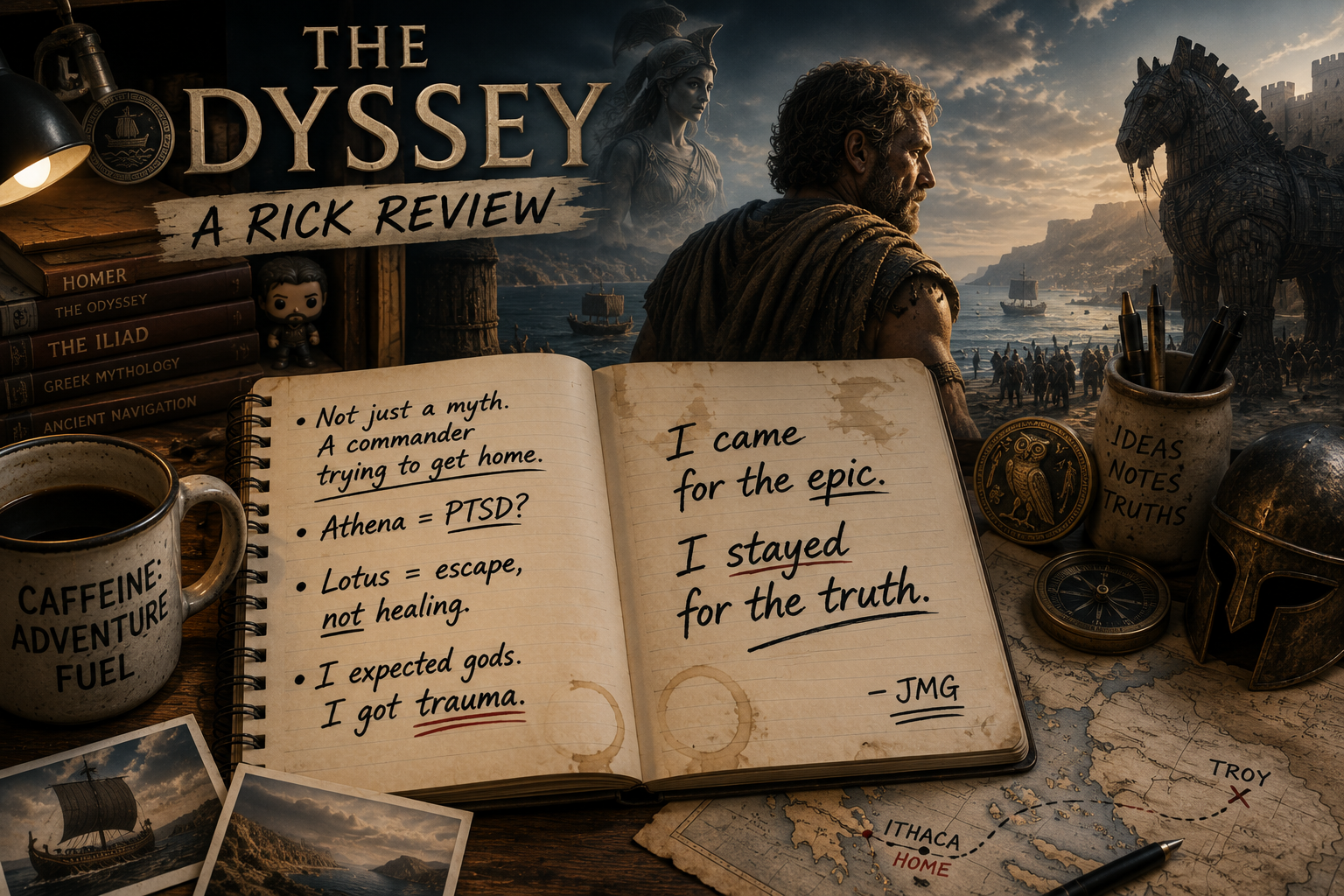
Walking into this movie, I had heard a lot of people talking about how heavily Nolan used the gods. After watching it, I do not really agree with that assessment. Athena appears throughout much of the movie as a beautiful woman whom Odysseus speaks to and calls by name, but she never tells him anything he could not already know. She points him toward decisions that, somewhere inside himself, he has already made. For the first two thirds of the movie, I was willing to accept that she might simply be Athena, although I was already beginning to suspect that something else was happening.
That interpretation finally came together for me while Odysseus was with Calypso. She is portrayed as a lone Lotus Eater, caring for Odysseus after his shipwreck. The lotus flower serves as an analogue for opiates. It soothes pain while keeping memory cloaked from conscious awareness. She had fallen in love with him, but she also understood that loving him meant eventually helping him remember who he was and allowing him to leave. As she encouraged him to tell her about his life, he experienced the sack of Troy again as a flashback. He remembered watching Greek soldiers behead a young Trojan girl while other soldiers toppled the head from Athena’s statue. He did not kill the girl or desecrate the statue himself. He simply witnessed both acts and carried them with him. The young girl had the same face as the Athena who had been appearing to him throughout the movie.
That was the point where my interpretation of Athena as a manifestation of PTSD became much more than a vague possibility. Odysseus had taken the face of an atrocity he witnessed and given it to the goddess he prayed to for wisdom and guidance. Athena became the person through whom he explained his own choices to himself. She could still be the literal goddess, appearing in the form that would affect him most deeply, but the psychological reading no longer felt accidental.
The word that kept coming back to me while watching was verisimilitude. Nolan changes quite a bit from Homer, but once he establishes the rules of his version of the story, he never cheats them. Everything fits together. The gods, the monsters, the symbolism, and the emotional beats all belong to the same world. Whether you agree with every change is almost beside the point because the movie remains true to itself.
One of the biggest surprises was the expanded role of Sinon. Rather than simply being the man left behind with the Trojan Horse, he becomes a tragic figure whose fate weighs heavily on Odysseus throughout the film. It gives the story an emotional thread that carries all the way to the end and reinforces the idea that Odysseus is haunted as much by the people he could not save as by the enemies he defeated.
The Trojan Horse sequence was probably my favorite part of the movie. It felt far more believable than the version most people have in their heads. The Greeks spend what feels like days trapped inside the horse. There are moments where discovery seems inevitable. A soldier probing between the planks even wounds one of the hidden Greeks, who has to be physically restrained to keep from crying out. The tension never lets up. It turns a famous legend into something that feels like an actual military operation.
The last scene between Odysseus and Athena also worked well for me. After Odysseus finally spoke openly about his trauma with Penelope, who listened from behind a screen, he sat separated from Athena on the stoop and reached out his hand. Athena took it. Then he blinked, and she was gone, while his hand remained suspended in the air. I read that as the moment he realized he no longer needed her to exist outside himself. Not that every wound had suddenly vanished, but that he had finally begun to understand and accept what his mind had been doing to keep him alive.
The climax in Ithaca is just as satisfying. Penelope’s bow challenge feels earned, and when the disguised beggar finally strings the bow and sends an arrow cleanly through the line of axe heads, everyone in the hall realizes exactly who is standing before them. From that point forward, the fight is brutal without ever feeling like empty spectacle. I also appreciated Telemachus’s arc. He spends much of the film learning how to become a man, and when the fighting finally begins, he has to put those lessons into practice. His duel in the armory and the moment where he throws his father a sword are some of the most satisfying moments in the film because they complete his journey.
The ending also worked for me. Rather than pretending everything is magically fixed once Odysseus gets home, the film acknowledges that twenty years of war and loss leave scars. He survives, he reconciles with Penelope, and Telemachus is ready to inherit the kingdom, but Odysseus still has one final obligation to fulfill in honor of the men who never made it home. It felt like an honest ending instead of a fairy tale.
My biggest criticism is the design of the Cyclops. I understand what Nolan was trying to do by giving Polyphemus a twisted face with a single eye instead of the classic giant with one eye in the middle of his forehead, but it never quite worked for me. Rather than making Polyphemus more believable, it made the face visually confusing. That is one of the few moments where I felt the movie overthought something that did not need to be reinvented.
Overall, I think Christopher Nolan accomplished something difficult. He did not make a literal adaptation of Homer, and he never seemed interested in doing so. Instead, he made a film about trauma, duty, promises, survival, and finally coming home after becoming someone you barely recognize. Whether you choose to see the gods as real or as reflections of Odysseus’s inner life, the movie supports both readings without contradicting itself.
That is why I walked out of the theater giving it a 4½ out of 5 stars. It is not perfect, but it is one of the most thoughtful and emotionally satisfying adaptations of a classic myth that I have seen in a long time.
The Odyssey (2026)
Written and directed by Christopher Nolan
Based on The Odyssey by Homer
Odysseus: Matt Damon
Athena: Zendaya
Calypso: Charlize Theron
Sinon: Elliot Page
Penelope: Anne Hathaway
Telemachus: Tom Holland
Polyphemus: Bill Irwin