I thought Godzilla Minus Zero was pretty good. Not perfect, certainly, and there were moments when I had to remind myself that I wasn’t watching a family drama about trauma. Yes, it was a story about trauma, and I understand that, but my God, it’s supposed to be a Godzilla movie! And Godzilla himself doesn’t even make a proper appearance until about an hour into this two-hour-and-fifteen-minute movie. I did enjoy the monster action, when we finally got to it. The mythology did take some interesting turns. And there was a political undercurrent that I found particularly interesting because I spent a couple of years living in Japan.
The movie continues the story from Godzilla Minus One, bringing back the surviving characters and picking up on some of the rather disturbing implications of that movie’s ending. In particular, there were people who had apparently been infected with something from Godzilla. Some of them developed miraculous regenerative abilities, but they also started growing Godzilla-like scales and eventually died. Our hero’s wife survived her own miraculous recovery, but she now has a yellow right eye that she hides beneath an eyepatch and some light scaling on her right shoulder.
That’s going to become important later.
The new monster is Ghidorah, although the movie takes a rather different approach to his origins. He arrives from outer space in a meteorite, but he doesn’t arrive looking like the three-headed dragon we’re familiar with. Instead, there’s footage of something that looks like silly foam spreading out from the meteorite, grabbing nearby animals and unfortunate people who get too close, and consuming them. Eventually, this thing develops into Ghidorah.
I rather liked that idea. It gives the creature a genuinely alien origin instead of simply having another giant monster show up.
The scientists also introduce a new explanation for his name, drawing on the Hydra and Chimera of Greek mythology. And they practically telegraph what’s going to happen to him by invoking the Hydra in the first place.
Initially, Ghidorah has one head and one tail, along with a yellow energy bolt that he can fire at his enemies. The humans decide they need to destroy him, and their first attempt involves something called an air bomb. Yeah, whatever. That doesn’t work, so their backup plan is to launch a lightning rod into his body during a thunderstorm and electrocute him.
That seems to work. He goes down.
Except, of course, it doesn’t kill him. He regenerates. A lot.
Ghidorah grows two additional heads and another tail, leaving him with three heads and two tails. He also develops an entirely new power, a blue anti-gravity ray. And he doesn’t lose his original yellow energy bolt. He gets to choose between the two.
It’s at this point that the media and the public start calling him King Ghidorah. The scientists continue referring to him simply as Ghidorah, but apparently three heads and two tails are enough to earn a monster a royal title in the popular imagination.
What makes this particularly interesting is that Ghidorah is intelligent enough to figure out how to use these powers together almost immediately. At one point, he lifts an enormous building into the air with his blue ray and then blasts it apart with the yellow one, creating a thunderstorm of falling rocks and debris.
That’s not just a monster randomly smashing things. That’s a monster coming up with a strategy.
There’s also a rather grotesque demonstration of his regenerative abilities later in the movie. After Godzilla severs one of Ghidorah’s heads, Ghidorah lowers the stump of the severed neck toward the head lying on the ground. Strange tendrils, almost like something out of The Last of Us, grow out of the stump and reach down to reconnect with the detached head. Before long, the head is attached and functioning again.
So when the movie eventually disposes of Ghidorah without showing us much of anything afterward, I have to wonder just how disposed of he really is.
Meanwhile, the humans have come up with another wonderfully improbable scientific invention.
The older scientist from the first movie has developed a machine that amplifies the natural homing abilities of animals. He demonstrates it using crows, attracting a whole flock to a building. Now, I can understand certain animals having remarkable navigational abilities. Starlings, for example, perform those extraordinary murmurations where thousands of birds move together in what looks like a single coordinated organism.
But how the heck do they know Godzilla has some kind of homing beacon built into him? And even if he does, why would a human carrying some of his biological material have the same ability?
That’s a whole lot of hand waving.
Nevertheless, the scientist decides that our hero’s wife, with her yellow eye and Godzilla-like scales, might be just the thing to summon Godzilla. She has been insisting that she wants to help, so naturally she volunteers to become their living monster beacon.
Her husband decides that if she’s going to do this, he’s going to pilot the aircraft carrying her.
Which means they have to leave their little girl behind.
And that brings me to one of the movie’s recurring emotional devices. Early on, the little girl is taught that telling someone to “Have a safe trip” is almost like casting a magic spell. It’s a promise, a kind of contract that obligates the person to return.
The movie uses that phrase repeatedly, almost talismanically.
I understood what they were trying to accomplish, but I thought they leaned on it a little too heavily. When the parents leave their daughter at an orphanage, there’s even a scene where some of the other girls essentially tell her that parents always say things like that and don’t really mean them. Naturally, she insists that her parents are different.
I thought that scene was unnecessary. The emotional stakes were already perfectly clear without having a bunch of little girls behaving like mean girls.
Anyway, our heroes climb aboard an enormous Japanese flying boat, which I believe was a Kawanishi H8K, and head out to summon Godzilla.
And summon him they do.
Godzilla comes swimming after the airplane like crazy, somehow managing to keep pace with a four-engine flying boat. Now, I’m willing to suspend disbelief for a giant radioactive monster, but have you looked at the spikes on that fellow’s back? Imagine the drag those things must create in the water. Now, just imagine how fast he could swim if he didn’t have them! (America’s Cup: Kaiju Edition)
The plan is to lure Godzilla to Ghidorah, let the two monsters beat the heck out of each other, and then kill whichever one survives because he’ll presumably be exhausted from the fight.
It’s not the worst plan anyone has ever come up with, but it certainly depends on a lot of things going exactly right.
And apparently every step of that plan requires somebody to agonize over making another terrible sacrifice for the greater good. After a while, the constant “Oh, woe is me, I have to make another terrible decision for victory” starts getting a little tiresome. I get it, the stakes are high, but could we please get back to the giant monsters beating the heck out of each other?
Weather plays an enormous role in this movie, too. There’s a young woman who seems capable of predicting meteorological events with astonishing accuracy. Remember, this is 1949. She’s predicting where and when major thunderstorms are going to develop like nobody’s business. She was instrumental in finding the lightning storm that transformed Ghidorah, and now she’s helping arrange the conditions for the final confrontation.
And wouldn’t you know it, the place where everything comes together is Ginza, the very same Tokyo neighborhood that Godzilla devastated in Minus One. It had not been rebuilt yet, so some mercy there.
The humans manage to keep Ghidorah occupied until Godzilla arrives, and then the two monsters go at it.
Ghidorah initially gets the better of Godzilla, even ripping off one of his arms. Godzilla manages to swing his tail around and slice off one of Ghidorah’s heads, but Ghidorah retaliates by lifting Godzilla into the air and dropping him. Then he raises a building and blasts it apart, burying Godzilla beneath the rubble.
The humans try to take advantage of the situation by attacking Ghidorah themselves, which doesn’t go particularly well.
Eventually, they decide they need Godzilla back in the fight, so they fly over him with the homing amplifier turned up like crazy.
Godzilla wakes up, regenerates his missing arm, and begins powering up. His dorsal spikes glow blue, Ghidorah prepares his own energy attack, and the two monsters are apparently about to have the mother of all beam battles.
Except Godzilla fires first.
He hits Ghidorah square in the chest before Ghidorah can properly aim, sending the three beams from Ghidorah’s heads shooting harmlessly into the sky. Godzilla powers up even further and unleashes one final enormous blast.
And that’s apparently the end of Ghidorah.
I say apparently because, considering everything we’ve just learned about his regenerative abilities, the movie is remarkably casual about what happened to him afterward.
Then the military starts unloading on Godzilla with artillery from ships offshore and tanks on land. Just when it looks like they’re going to try to finish him off, orders arrive telling them not to kill him and to preserve any evidence they can recover.
The implication is pretty obvious. Somebody, presumably the Americans, wants to study this creature.
And that brings me to what I found to be one of the more interesting themes in the movie.
Japan surrendered unconditionally in 1945, and these films take place during the American occupation. From the American perspective, that occupation is often presented as a benevolent effort to rebuild Japan. But there’s another perspective, one that I recognized from having lived among Japanese people.
It’s essentially, “I wish these guys would get off my lawn. I can do this myself.” And “You aren’t the boss of me.”
That attitude runs through this movie.
The Americans provide the Japanese with several advanced aircraft, including a bomber, but because Japan isn’t supposed to have a standing military, the Americans have to disavow their involvement. So the American stars get painted over with Japanese rising suns, and everybody pretends these aren’t American airplanes.
There’s this constant tension between accepting American assistance and resenting the fact that they need it. The Japanese characters want to demonstrate that they can solve their own problems, that their plans are better, and that they don’t need the Americans telling them what to do.
Having served in Japan myself, I found that aspect of the movie particularly interesting.
But the most revealing example comes from the older scientist.
In the first movie, he witnessed the burned bodies of his family after their home was destroyed. His grief was overwhelming, and his hatred of Godzilla is entirely understandable. But in this movie, we get a glimpse of something much deeper.
He imagines Godzilla attacking New York City.
And this isn’t some vague suggestion of destruction. We actually see Godzilla casually knocking over the Statue of Liberty as he passes, then unleashing his radioactive breath into downtown Manhattan. We see people burning, their faces beginning to melt away.
It’s an extraordinarily brutal sequence, especially considering that none of it is actually happening. It’s all in the scientist’s imagination.
And that tells us something important about him.
He doesn’t simply hate Godzilla for killing his family. His resentment extends to the United States and the American occupation. He imagines the same kind of devastation being inflicted upon Americans that he has already witnessed in Japan.
The symbolism is about as subtle as being hit over the head with a big stick.
Godzilla is the nuclear bomb that he hates.
And yet, in his fantasy, Godzilla becomes the instrument of his revenge against the people he holds responsible for Japan’s suffering.
That contradiction gives the character considerably more depth than simply being an angry scientist who wants to kill a monster.
Of course, the original Godzilla from 1954 was itself a powerful expression of Japan’s experience with nuclear destruction, so this isn’t entirely new territory for the franchise. But I found the way this movie ties that symbolism to the occupation, national pride, and personal resentment particularly effective.
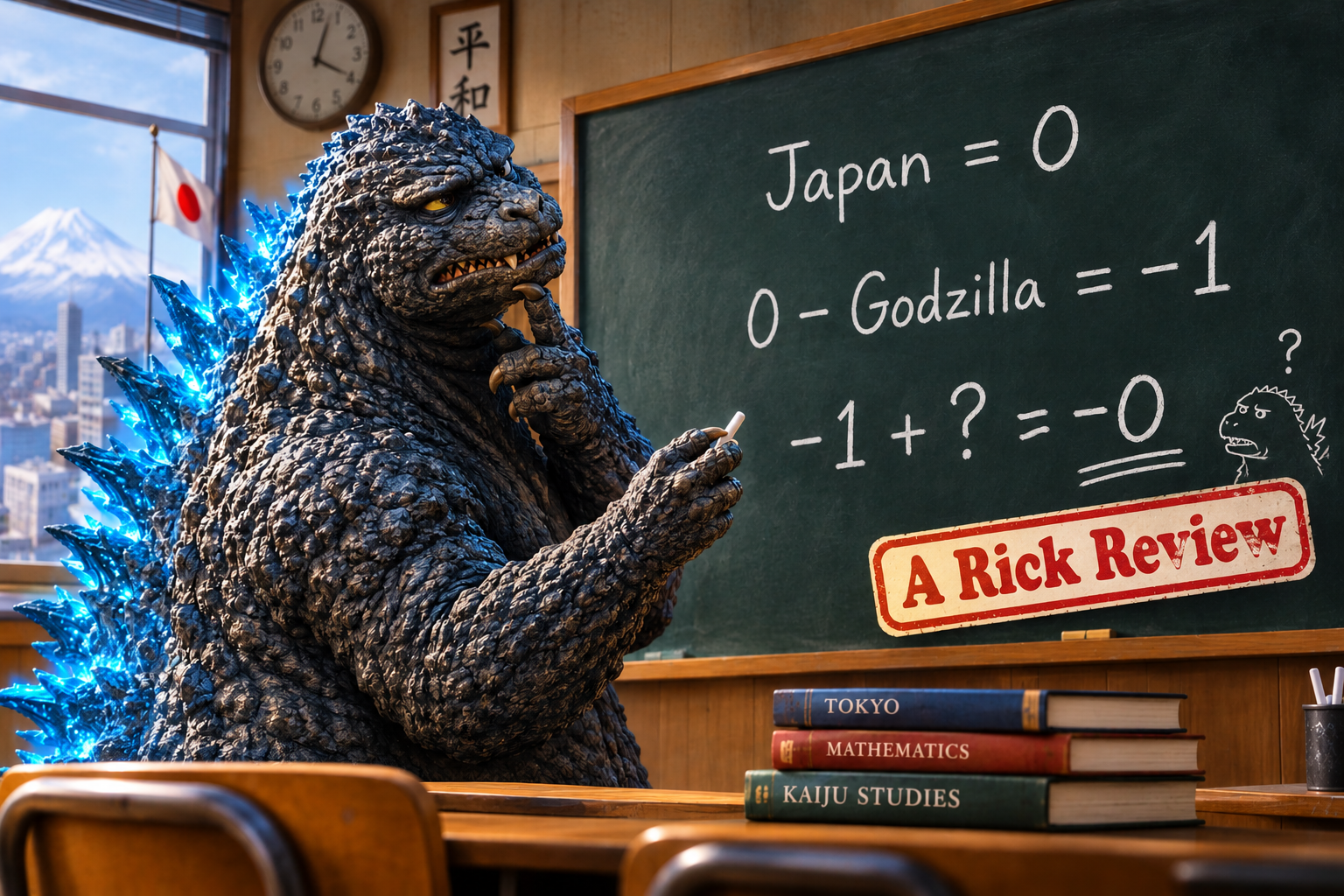
I actually had to do a little investigating to understand the naming convention behind Godzilla Minus One and Godzilla Minus Zero. The way I understand it, Japan was already at zero after the devastation of World War II, and Godzilla’s arrival knocked the country down another notch, to minus one. Now, with Minus Zero, we’re apparently working our way back toward zero. It’s an interesting way of looking at things, and while I’m not entirely convinced it’s a great naming convention for a movie franchise, it strikes me as a very Japanese way of expressing the idea. I don’t think an American, British, or Polish filmmaker would naturally approach the title quite that way. Maybe that’s part of what makes it interesting.
I also found myself wondering where this series goes next.
There have been dozens of Godzilla movies since 1954, and the filmmakers certainly aren’t running out of monsters. But they might be running out of names. What comes after Godzilla Minus Zero? Godzilla Minus Minus One?
My prediction is Mothra. (No, not Godzilla Minus Mothra.)
I’d give pretty good odds that if they make another movie, Mothra will show up. And given the direction this series is taking with Godzilla’s regenerative biology, Ghidorah’s extraterrestrial origins, and the growing interest in collecting and studying monster tissue, I wouldn’t be surprised if they make her a scientific creation.
Set the next movie in 1951 or 1953, have somebody experimenting with moths, throw in some Godzilla DNA and radiation, and boom, Mothra.
Maybe she’s originally intended as a weapon against Godzilla, only for the two of them to develop the kind of relationship we’ve seen in the MonsterVerse films.
That would certainly fit the pattern of human beings trying to control things they don’t understand and discovering they’ve created an even bigger problem.
Ultimately, I enjoyed Godzilla Minus Zero. I liked the new interpretation of Ghidorah, particularly his intelligence and his ability to adapt. The monster battles were entertaining, even when the science required me to turn off a fairly substantial portion of my brain.
The human drama occasionally became a little too insistent, particularly with the repeated “Have a safe trip” business, but the underlying political themes gave me considerably more to think about than I expected.
It’s a monster movie, and it delivers the monsters. But underneath all the roaring, radiation, collapsing buildings, and improbable scientific inventions, there’s a story about a country trying to reclaim its independence and people struggling with grief, resentment, and the consequences of war.
And sometimes that story is delivered with all the subtlety of Godzilla stepping on a building.
Writer/Director: Takashi Yamazaki
Principal Cast: Ryunosuke Kamiki, Minami Hamabe, Hidetaka Yoshioka, Min Tanaka, Masami Nagasawa, Jun Kunimura, Yuki Yamada, and Kuranosuke Sasaki.
My Rating: ★★★½☆ (3.5/5)
By the way, even Godzilla noticed the Blue Tsunami, and he wanted to let you all know he’s got blue scales, too!