There are projects you plan.
Then there are projects that begin with listening to a podcast, thinking “Huh, that’s weird,” and somehow end with your printer begging for mercy while you tape together twelve sheets of paper on a piece of cardboard that used to protect your television.
This is the second kind.
I had been listening to a podcast (The Move: The Indianapolis Colts) about one of the stranger episodes in professional football history, and it reminded me just how little sense the geography of the NFL makes if you start digging backward.
I went down a rabbit-hole on the whole subject, then fell into a gopher hole, then a vole hole. It was a very strange trip. And I came to this realization.
Teams move. Teams almost move. Teams move away and come back. Cities lose a team and eventually get a completely different one with a suspiciously familiar name. Owners trade franchises. Leagues merge. Other leagues collapse. During World War II, teams temporarily merged with each other because there simply weren’t enough players.
And then there are the Raiders.
Oakland → Los Angeles → Oakland → Las Vegas.
Gotta go. We’re here. We’re back. We gamble.
Seattle, meanwhile, managed an equally strange story without actually moving anywhere. In 1996, the Seahawks came alarmingly close to becoming an Anaheim team before the whole thing collapsed.
That was when I started thinking this history really needed a map.
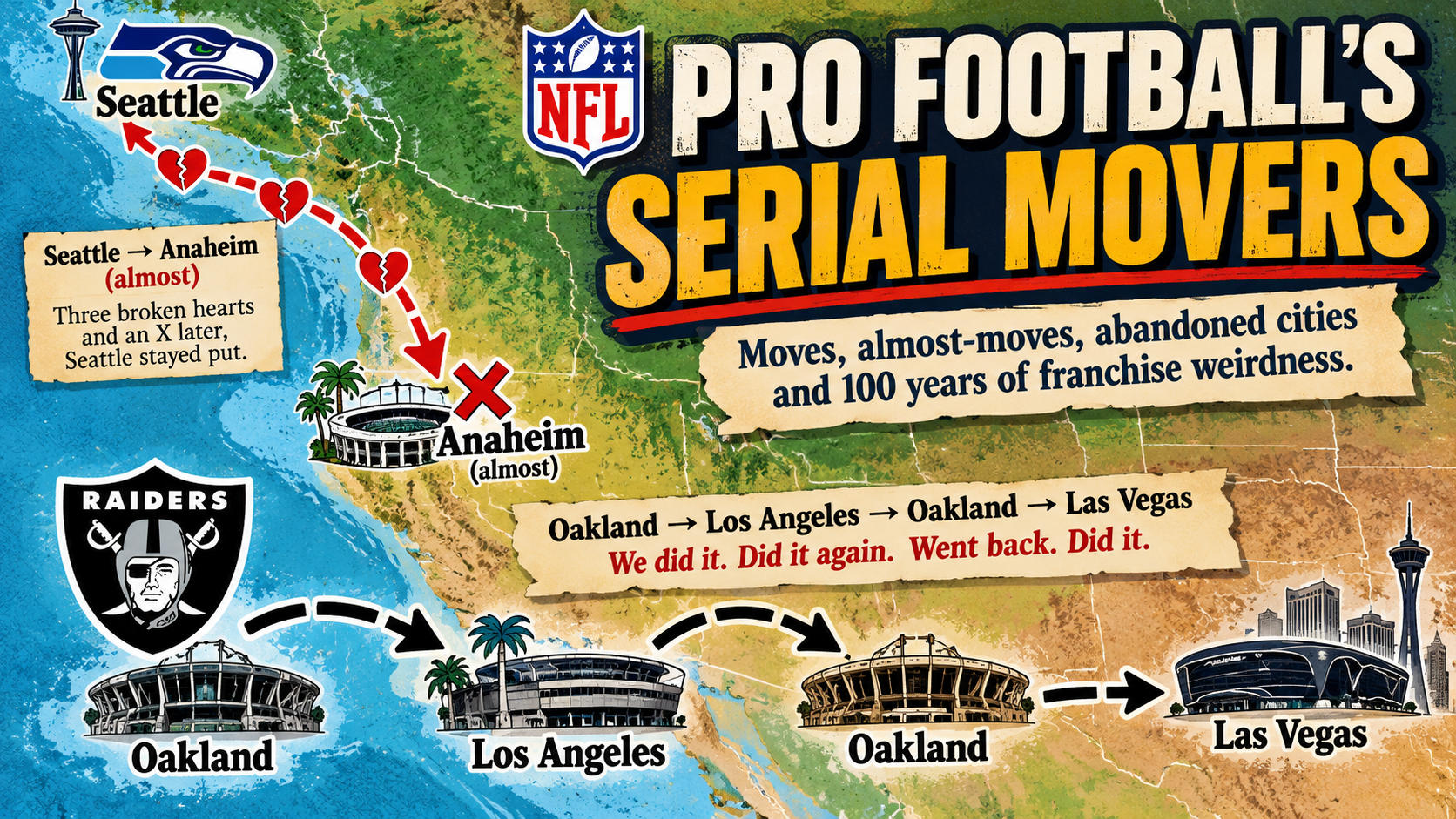
This seemed simpler in my head
My original idea was basically, “Put the franchise moves on a map.”
That sounds manageable.
It was not.
Once I started looking at actual franchise histories, a simple relocation map stopped being enough. The Browns/Ravens story isn’t a normal relocation. The Dallas Texans of 1952 are not the Dallas Texans who became the Kansas City Chiefs. The Houston Oilers became the Tennessee Titans, while the current Houston Texans are an entirely separate franchise.
Then I started adding serious moves that almost happened.
Then temporary stadiums.
Then former stadiums.
Then the AFL.
Then the AAFC.
Then the USFL.
At some point I had 34 separate historical stories that deserved numbered notes, eight NFL divisions that needed their own boundary patterns, current stadiums, historic stadiums, franchise routes, abandoned routes, near-moves, mergers, ownership swaps and one extremely specific trail of broken hearts between Seattle and Anaheim.
This had stopped being a map.
It was becoming evidence.
The part where I remembered vectors exist
The project became much easier once I stopped treating the thing like one giant picture.
I found a very good vector map of the United States, and that changed everything.
I had somehow forgotten an old graphics lesson I learned years ago: for something like this, you don’t really want to be moving pixels around. You want objects.
A stadium should be an object.
A route should be an object.
A team logo should be an object.
An inset should be a group of objects that can be picked up and moved as one piece.
That distinction turned out to matter almost more than the fact that vector graphics can be scaled indefinitely.
When the New York/New Jersey, Pennsylvania and California insets were covering too much of the East Coast, I could simply move the entire groups out over the Atlantic. When three information panels at the top looked randomly scattered, they could be resized and snapped together into one intentional row.
Current stadiums could stay locked while historical ones were reduced.
Nothing underneath needed to be repainted.
Nothing had to be reconstructed from a flattened image.
I should have done it that way from the beginning.
The stadium problem
The stadiums created another problem I hadn’t really anticipated.
There are a lot of them.
The current NFL has 32 teams sharing 30 stadiums. (Jets/Giants, and Rams/Chargers literally share stadiums) That part was straightforward enough. The current stadiums became the primary visual layer and stayed relatively large.
Historical stadiums were another matter.
If I gave every old stadium the same visual weight as a current one, the map turned into a convention of tiny buildings.
So I ended up creating a hierarchy.
Current stadiums stayed full size.
Older stadiums that still exist were reduced.
Demolished stadiums were reduced even further.
I also stopped trying to show every historical stadium just because I had artwork for it. The legend now explicitly says that historic stadiums are selectively shown — significant franchise homes, relocation sites, temporary venues and story-relevant stadiums are included, but not every venue ever used by every team.
That decision made the map much better.
Complete is not always the same thing as useful.
And then I printed the thing
The finished map is 36 by 24 inches.
My printer uses ordinary letter-size paper.
You can probably see where this is going.
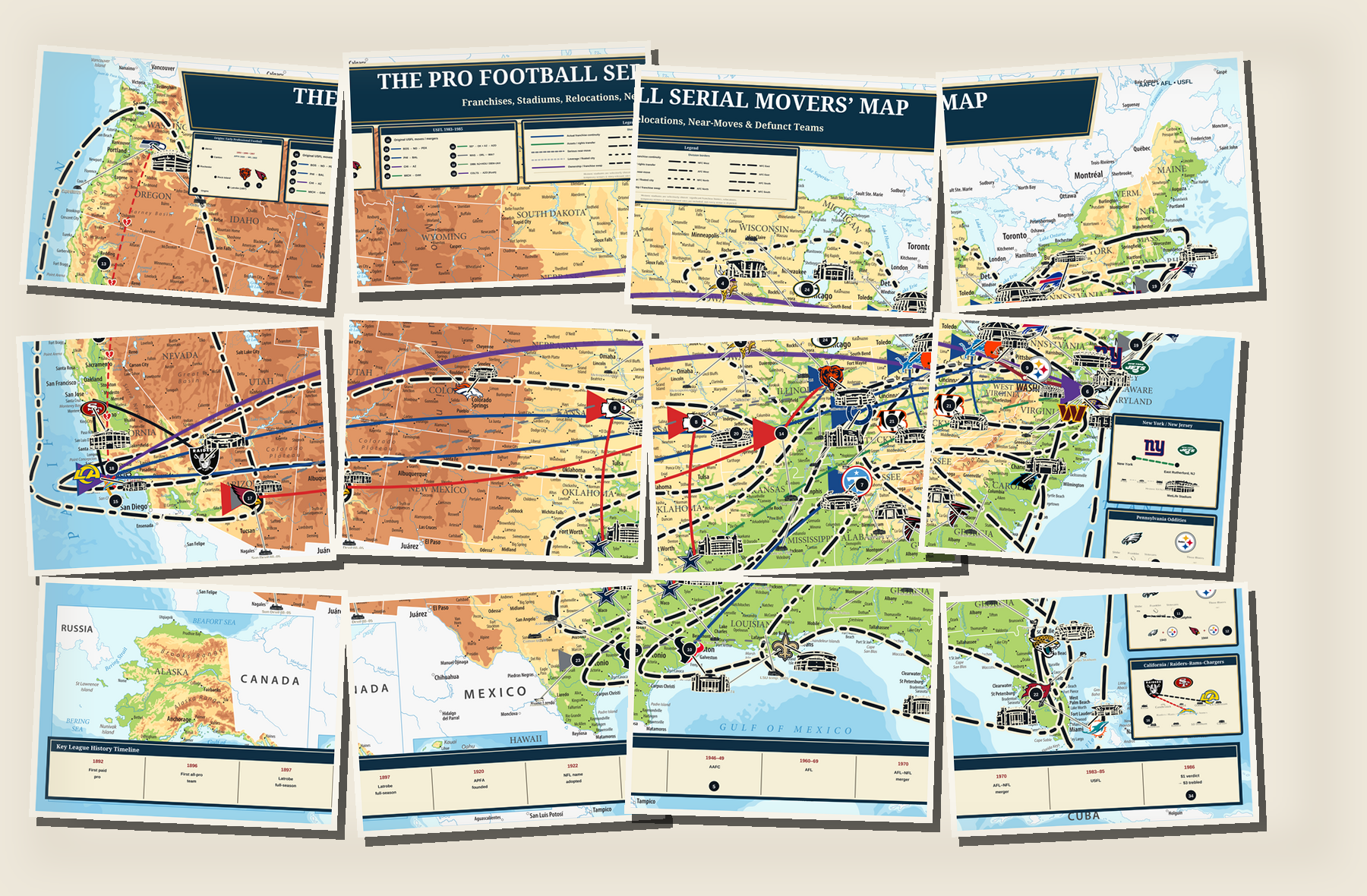
The first solution was to divide the poster into twelve pages, four across and three down.
That worked.
Technically.
It also introduced far more scissor work than I wanted.
Then I remembered that my printer can print edge-to-edge.
Or rather, it can print edge-to-edge under extremely specific circumstances that apparently must be discovered through ritual.
Printing a PDF as a document? Margins.
Printing an image as a photo? Borderless.
Selecting plain paper? Borderless disabled.
Telling the printer that the exact same sheet of plain paper was “other photo paper”?
Suddenly borderless printing was available.
The printer and I reached an understanding.
I also selected Best quality, at which point the printer apparently decided every sheet deserved individual contemplation.
By the end, it had printed twelve pages, then another 24 pages during an ill-fated experiment with duplex instructions, and then twelve more pages at Best quality.
Printy wanted a nap.
Assembly required
There was one more surprise.
Borderless printing is not precision engineering.
Each sheet can feed slightly differently, and borderless mode overscans the image a little so it doesn’t leave white slivers around the edges. That meant two neighboring sheets could have the artwork perfectly aligned while the physical edges of the paper were a millimeter or two apart.
So I stopped trusting the paper.
I aligned the picture.
The twelve pages overlap, and I ended up using matte Scotch tape across the joins. It is not archival mounting. It is not museum conservation.
It is a giant homemade football-history poster.
I can live with that.
The mounting board, incidentally, is a huge shaped piece of corrugated cardboard that I had been using as a puzzle table. I had completely forgotten where it came from until I noticed the shipping markings on it.
It came with my new television. I have a post about that; I’ll put that up soon.
When I unpacked the TV, I apparently looked at this enormous flat piece of cardboard and thought, “That is worth saving.”
Past me was correct.
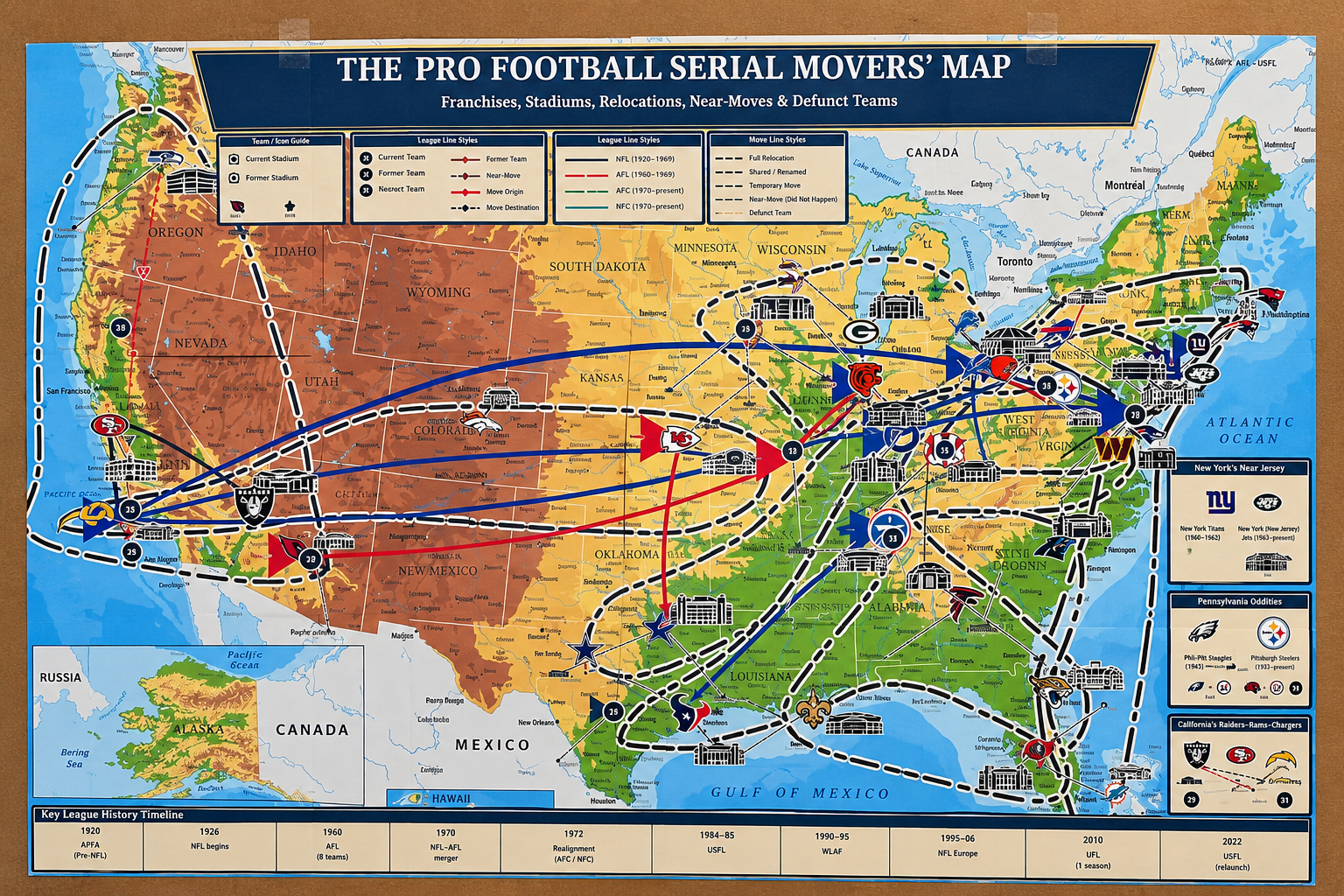
The actual map
And after all of that, here it is.
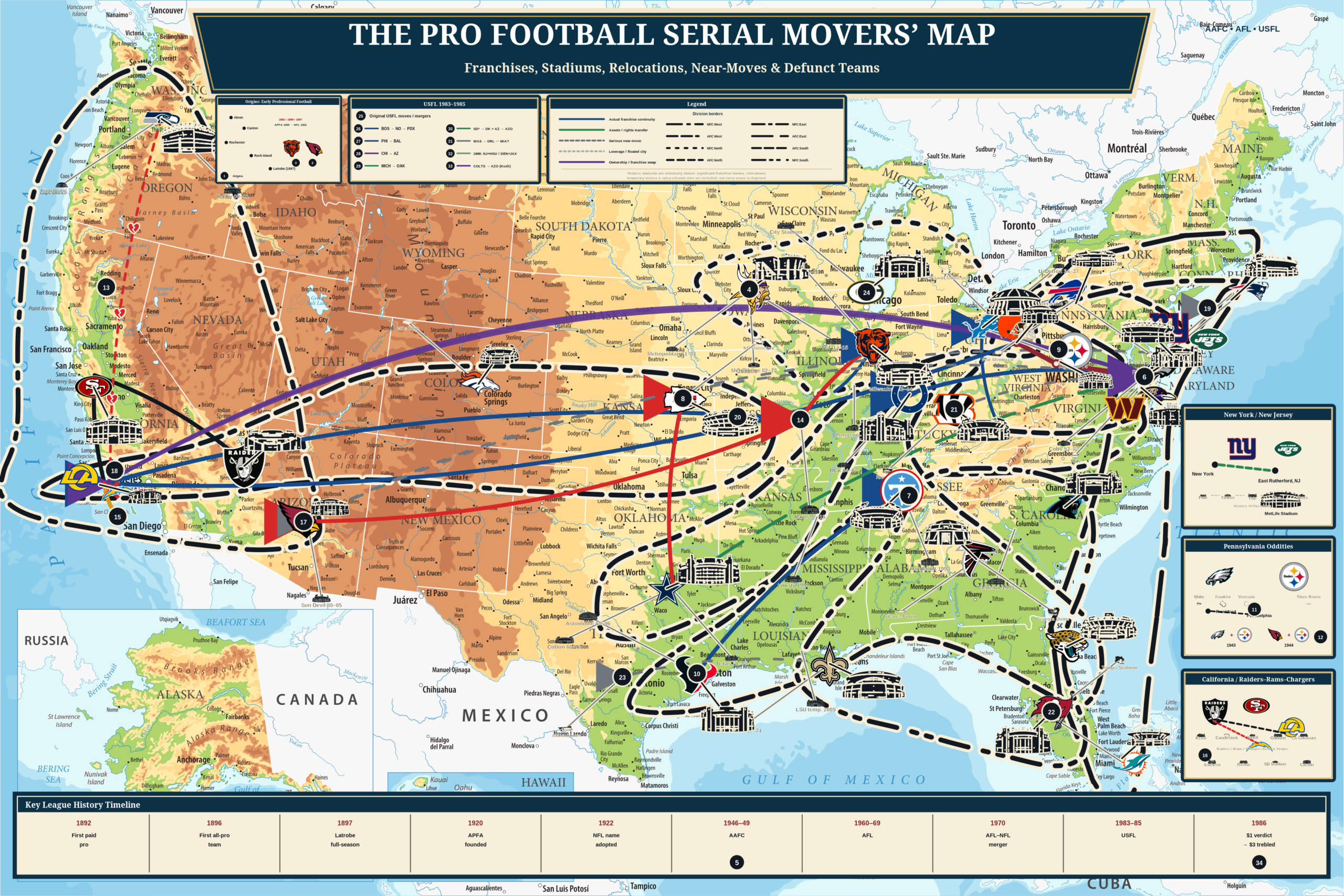
The numbered markers correspond to the notes below. Some are major franchise relocations. Others are near-moves, league mergers, temporary arrangements or wonderfully strange pieces of football history that didn’t fit neatly into a normal relocation arrow.
Early pro football / league origins
① Where pro football starts
William “Pudge” Heffelfinger was paid $500 to play in 1892, the Allegheny Athletic Association fielded the first entirely professional team for a short season in 1896, and Latrobe became the first club to play a full season using only professionals in 1897. The APFA—the direct ancestor of the NFL—was organized in 1920 and renamed the NFL in 1922. Pro Football Hall of Fame chronology
② The Cardinals are older than the NFL
The Cardinals trace their continuous history to Chris O’Brien’s Morgan Athletic Club in Chicago in 1898. They became the Chicago Cardinals, moved to St. Louis in 1960, moved to Arizona in 1988 as the Phoenix Cardinals, and adopted “Arizona Cardinals” in 1994. The Hall of Fame calls them the oldest continuously operating team in professional football. Cardinals team history — Pro Football Hall of Fame
③ Only two charter-era survivors remain
Of the clubs represented at the APFA’s 1920 organizational meeting, the two surviving franchise lines are the Decatur Staleys/Chicago Bears and the Racine/Chicago Cardinals, now the Arizona Cardinals. Founding of the NFL — Pro Football Hall of Fame
④ Minnesota chose the NFL over the AFL before playing a game
A Minnesota ownership group was awarded an AFL franchise in 1959, then forfeited that AFL membership five months later and accepted the NFL’s 14th franchise instead. The Vikings began play in 1961. The AFL filled the abandoned Minneapolis slot with the new Oakland Raiders. Vikings team history — Pro Football Hall of Fame
⑤ The AAFC sent three teams into the NFL
When the All-America Football Conference folded after 1949, the Cleveland Browns, San Francisco 49ers and original Baltimore Colts entered the NFL for 1950. Cleveland and San Francisco survived; that first Baltimore Colts franchise did not. AAFC history — Pro Football Hall of Fame
Franchise continuity oddities
⑥ There were two completely different Baltimore Colts
The first Colts played in the AAFC from 1947–49 and one NFL season in 1950 before folding. The Baltimore Colts established in 1953 were a new franchise and are the franchise that eventually moved to Indianapolis. NFL history 1940–1959 — Pro Football Hall of Fame
⑦ The strangest ancestry of the modern Colts begins in New York and Dallas
The NFL took back the New York Yanks franchise in 1952. Dallas investors purchased Yanks assets and received a new Dallas Texans franchise, which went 1–11 and folded after a single season. In 1953, Baltimore was awarded another new franchise plus the holdings of the dead Dallas organization. That is why the map shows a tombstone at the 1952 Texans and a green assets line emerging from the grave toward the 1953 Colts. 1953 franchise history — Pro Football Hall of Fame
⑧ The other Dallas Texans became the Chiefs
Lamar Hunt’s unrelated AFL Dallas Texans began play in 1960, won the 1962 AFL championship, moved to Kansas City in 1963 and became the Chiefs. Same city, same “Texans” name, entirely different franchise from the one-season NFL Texans of 1952. Chiefs ownership and franchise history
⑨ The Browns moved—but the Browns did not
The 1996 settlement allowed Art Modell’s football operation to move to Baltimore and become the Ravens, while Cleveland retained the Browns’ name, logo, colors, history, records, trophies and memorabilia. The Browns were dormant for three seasons and resumed play in 1999. 1996 NFL history — Pro Football Hall of Fame
⑩ Houston lost the Oilers but later got a completely different Texans franchise
The Oilers were founded in Houston in 1960, moved to Tennessee in 1997, played two seasons as the Tennessee Oilers, and became the Tennessee Titans in 1999. The Houston Texans, who began play in 2002 through expansion, are a separate franchise with no continuity from the Oilers. Titans franchise history
Swaps, wartime weirdness, and ownership oddities
⑪ The 1941 Pennsylvania Polka may be the strangest franchise shuffle in NFL history
Art Rooney sold the Pittsburgh organization to Alexis Thompson, then joined Bert Bell’s Eagles. When Thompson’s intended move to Boston failed, the groups traded territories: the Rooney-Bell Eagles organization went to Pittsburgh and played as the Steelers, while Thompson’s Pittsburgh organization moved to Philadelphia and played as the Eagles. The Pennsylvania Polka — Pro Football Hall of Fame
⑫ Then World War II made Pennsylvania even stranger
Player shortages caused the Steelers and Eagles to combine for the 1943 Phil-Pitt “Steagles” season; the joint team dissolved afterward. In 1944 the Steelers instead combined with the Chicago Cardinals as Card-Pitt. These were temporary wartime combinations, not franchise relocations. Pennsylvania Polka and wartime teams — Pro Football Hall of Fame
⑬ In 1972, the Colts and Rams literally traded owners
Robert Irsay bought the Los Angeles Rams, then exchanged the Rams franchise with Carroll Rosenbloom for the Baltimore Colts. No teams changed cities and no players had to relocate—the owners effectively swapped entire franchises, histories and operations. NFL history of the 1972 Colts–Rams franchise swap
Major movers and near-moves
⑭ The Rams have crossed the country repeatedly
The franchise began as the Cleveland Rams in 1937, suspended operations for 1943 because of wartime manpower shortages, moved to Los Angeles in 1946, moved to St. Louis in 1995, then returned to Los Angeles in 2016. Rams team history — Pro Football Hall of Fame
⑮ The Chargers did an out-and-back of their own
The AFL Chargers played their first season in Los Angeles in 1960, moved to San Diego in 1961, remained there through 2016, and returned to the Los Angeles market in 2017. Chargers team history — Pro Football Hall of Fame
⑯ The Raiders are the map’s true serial movers
Oakland joined the AFL in 1960 after Minneapolis abandoned its AFL membership. The Raiders later went Oakland → Los Angeles → Oakland → Las Vegas, which is why they alone get the permanently defeated/broken padlock. Their earliest years included games across the Bay at Kezar Stadium and Candlestick Park before the Oakland Coliseum opened. Raiders team history — Pro Football Hall of Fame
⑰ Before Indianapolis, the Colts were briefly headed for Phoenix
In January 1984, Colts executives were told that the club was moving to Phoenix; the proposed Arizona deal ultimately collapsed. A few months later the Baltimore situation deteriorated rapidly, and the Colts were moved to Indianapolis in the famous overnight Mayflower-truck operation of March 1984. Colts history of the 1984 move
⑱ Seattle actually started moving before the move collapsed
In 1996 owner Ken Behring moved Seahawks equipment to Anaheim and held offseason workouts there, intending to use Southern California while a new stadium was pursued. League pressure and litigation forced the operation back to Washington. ESPN history of NFL relocation threats
⑲ New England came surprisingly close to Hartford
In 1998 Robert Kraft announced an agreement under which Connecticut would build a 68,000-seat Hartford stadium and the Patriots would relocate there. The deal survived into 1999 before Kraft formally terminated it when the stadium timetable became uncertain. Patriots terminate Hartford stadium agreement
⑳ The Eagles nearly became the Phoenix Eagles
In 1984 an Arizona deal was being negotiated in which owner Leonard Tose would sell a minority share of the team while retaining control and move the Eagles to Phoenix. Reports at the time said only final details remained before the plan fell apart and Philadelphia concessions kept the team home. Los Angeles Times history of the Phoenix Eagles plan
㉑ Cincinnati explored Baltimore before Cleveland actually went there
During the Bengals’ 1995 stadium fight, team president Mike Brown seriously explored a move to Baltimore while maintaining that he preferred to stay in Cincinnati. Local stadium financing ultimately kept the Bengals home. Bengals stadium history
㉒ The Buccaneers produced a whole spray of bargaining-chip cities
During Tampa Bay’s mid-1990s stadium fight, ownership warned that relocation might be necessary and Los Angeles, Baltimore, Cleveland, Hartford and Orlando were reported as possibilities. These are faint leverage lines rather than full relocation routes. ABC News history of NFL relocation threats
㉓ Katrina temporarily made the Saints a nomadic team—and San Antonio became a real relocation concern
The 2005 Saints practiced in San Antonio and split designated home games among San Antonio and Baton Rouge while the Superdome was repaired. During the post-Katrina uncertainty, permanent relocation became a genuine concern. NFL history of the Saints after Katrina
㉔ Green Bay gets the only gold lock
The Packers have been a publicly owned corporation since 1923. Their community-shareholder structure is unique in major American professional sports, making Green Bay the clearest symbolic opposite of the poster’s serial movers. Green Bay Packers shareholders
USFL
㉕ The original USFL was only three seasons long, but its franchise map was chaos
The league debuted in 1983, expanded in 1984, then announced a switch from spring football to a fall schedule. That decision triggered relocations, mergers, shutdowns and attempts to escape direct NFL competition. Original USFL history
㉖ The Breakers were the USFL’s true nomads
They played as the Boston Breakers in 1983, New Orleans Breakers in 1984 and Portland Breakers in 1985—three cities in three seasons. Breakers franchise history
㉗ The USFL champion Stars moved from Philadelphia to Baltimore
With the league planning to compete head-to-head with the NFL in the fall, the Philadelphia Stars left rather than battle the Eagles. Because lingering Colts lease provisions kept Memorial Stadium unavailable in 1985, the renamed Baltimore Stars played at Byrd Stadium in College Park while still practicing in Philadelphia. Stars franchise history
㉘ The Arizona Wranglers and Chicago Blitz essentially swapped teams
After 1983, the strong Blitz operation and roster effectively became the 1984 Arizona Wranglers, while the weaker 1983 Wranglers personnel became the new Chicago Blitz. This was far stranger than a conventional trade or relocation. Arizona Wranglers history
㉙ The Michigan Panthers were absorbed into Oakland
Michigan won the first USFL championship in 1983, but after 1984 the Panthers merged into the Oakland Invaders, bringing players such as Bobby Hebert and Anthony Carter into the combined club. Michigan Panthers history
㉚ The Oklahoma Outlaws were supposed to be in San Diego
The expansion franchise originally targeted San Diego, but a stadium lease could not be secured, so the team landed in Tulsa for 1984. After that season Oklahoma merged with the Arizona Wranglers to create the Arizona Outlaws for 1985. Oklahoma Outlaws history
㉛ The Washington Federals almost became a Miami team before becoming Orlando’s
A buyer initially planned to move the struggling Federals to Miami, but backed out after the USFL announced its coming move to the fall. Donald Dizney then bought the franchise and moved it to Orlando, where it became the Orlando Renegades in 1985. Orlando Renegades history
㉜ The USFL even had mergers lined up for a 1986 season that never happened
The New Jersey Generals had merged with the Houston Gamblers, which would have put Jim Kelly and the Gamblers’ offense on the same planned team as New Jersey. Jacksonville also absorbed Denver talent for 1986. Those combinations appear as faint-green “approved but never played” lines because the league canceled the season before any of them took the field. USFL 1986 preview and planned mergers
㉝ Frank Kush creates a neat NFL–USFL crossover
Kush coached the Colts through their final Baltimore years and their first season in Indianapolis, then resigned in December 1984 to coach the Arizona Outlaws of the USFL. UPI report on Frank Kush leaving Indianapolis
㉞ And the USFL’s epitaph writes itself
In 1986 a jury found the NFL liable on one antitrust claim and awarded the USFL $1 in damages, automatically trebled to $3 under antitrust law. The league suspended its planned fall season and never played again. Washington Post report on the USFL antitrust verdict
Was this necessary?
Absolutely not.
That was never the standard.
I wanted to know how all of these teams ended up where they are, and somewhere along the way the answer became a 36×24 vector map, 34 footnotes, dozens of stadium drawings, twelve sheets of paper, one exhausted printer and a piece of cardboard from a television.
Which, now that I think about it, seems entirely appropriate for professional football history.