Tag: creative writing

  • Flash Fiction Challenge 2026

    Flash Fiction Challenge 2026

    My second attempt at an NYC Midnight challenge was a reflection of the first, unfortunately.

    NYC Midnight now emails me about new challenges, and the next one to come up was the Flash Fiction Challenge. I enjoyed the process last time, and the feedback was genuinely useful to me, so I figured this would be good for me, as well. And if I submitted on time, maybe even advance?

    I registered April 9th for the challenge that would start on May 1st, 2026. Well, really at 11:59 PM on the 1st, so effectively May 2nd on the East Coast. But out here, I get the email at 8:59 PM on the 1st. This time, I would have 48 hours to write no more than 1000 words based on genre, location and objects.

    Very like before, promptly at midnight (ET) on May 2nd, my assignment arrived. This time I was placed in Group 17. My genre was Action/Adventure, my location was a private beach, and the object I needed to include was a motion detector. Those elements had to appear somewhere in the story. I had until 11:59 p.m. two nights later, May 3rd, to figure out what I was going to do with them.

    And this time I had 10 times as many words. I would have some room to write, no problems!

    Well, Friday came, and I was stressed from work. The job that had my creative energy amped up was now depressing it to near nothing. I just had no ideas. I got the email late Friday, and looked at it. First complaint was that while I like to consume action adventure stories, I’ve never written anything like it. That’s not a real gripe. I know that. I knew it at the time, but I still let it delay me. I hemmed, I hawed, I dithered.

    And then the time zone thing is a real issue. I have a strong history of last minute completions. All through school, assignments in leadership. Studying for an interview, even. And I have a high success rate with those.

    But my subconscious is tied to midnight like nothing else in my life. It’s my cutoff for getting enough sleep. I talk to people in those terms, “I got to bed before midnight, so got enough sleep.” Or “I screwed up my schedule and was up nearly half an hour past 12 last night,” while I pour a strong coffee.

    But 9 PM doesn’t have the same weight to my deep brain. So all through Saturday and Sunday, I continued to dither. Then as I was still decompressing from whatever was going on that day, my brain went, “dude, it’s almost midnight, get on the stick!” and ideas started populating in the grey matter. Then, I looked at the actual clocks and it was 10 PM.

    Man, I yelled at myself. I’d missed the deadline, again! And I had twice the time! But I could only scream for a while before settling down. My subconscious also knew I could submit late. And I just kept on with the task at hand, pretending that midnight was the actual goal.

    And the scene shaped itself cleanly in my head. Dude living on a private beach. He’s lonely, feeling supernumerary, sad and unmotivated. Crawls a garage sale sometime in the past, which has a metal detector for sale, he got that for a mere 5 dollars.

    (Now, the challenge object was clearly “a motion detector” but my brain substituted metal detector for the initial creative run.)

    I had my first draft done in less than 30 minutes. Counted it up. It was short of 1,000 by almost 200. So, I went back in to fill in some details, and round out the character.

    That draft was just under the limit by less than a handful. And I’m happy with it. There’s no point in making it exactly 1000, you don’t get extra credit for that, even if you submit on time.

    I read it aloud all the way through, and that’s when I noticed the difference in what I had (metal) versus what was needed (motion). But my story was too invested in the metal detector at this point, so I just had to find a place for the motion detector.

    Well, now he’s in a borrowed place, doesn’t know it well, forgets little things, like turning off the alarm when he arrives home. So, I inserted a few words, less than a dozen, really, about that, and counted. Over 1000, of course.

    So, I went on to tighten and edit, dropped a little description out and got it back down under the limit. Then, went to the NYC Midnight site, found the Late Entries section, and uploaded it.

    I ended up really liking this story. It was less Stallone-style Action/Adventure and more like Inspector Gadget, but I felt it satisfied that requirement. The private beach was easy, and I shoehorned in the motion detector successfully.

    Five Dollars

    Bert had lived along this beach for all of two weeks. It used to be his parents’ place—somewhere they let him stay once in a while, now somewhere he just stayed.

    He bought the metal detector at a garage sale down the street for five bucks. It gave him something to do. He walked the beach with it, idly scanning, trying not to feel the sadness that wasn’t just under the surface anymore. It was written all over him.

    The beach wasn’t nearly as clean as you’d expect a private beach to be. There were oily patches, seaweed piling up along the tide line—and a dead fish, or what used to be one.

    But it was empty. About as empty as he felt, which counted for something.

    The detector settled into a steady rhythm. A low hum, then a soft beep. Hum… beep. Hum… beep.

    It chirped faster as he swept it over a clump of seaweed and what he thought was the dead fish.

    He nudged the mess aside with the flat disc at the bottom of the detector.

    It was an arm.

    And on it—was that a Rolex?

    He just stood there for a second, trying to process that this was an arm, and this was a Rolex.

    He didn’t have his phone on him. If he ran back to the house, the tide might come in and take it out to sea. But he’d seen enough CSI to know he shouldn’t touch it.

    Where was the rest of the body?

    That made it worse.

    The water was already creeping closer, small waves lapping at the shore.

    He grabbed the seaweed tangled around it and pulled—careful, very careful not to touch the arm itself—dragging it up the beach.

    There was a driftwood log between the creeping foam and the house. He dragged the grisly package to the other side of it.

    It should hold. Long enough.

    He set the metal detector against the log, angling it to cover the arm, and ran—no, sprinted—the two hundred fifty yards back to the house.

    He tore through the back door and rushed around like a madman.

    Where was his phone? Desk? No. Kitchen? No. Bathroom—

    The alarm chirped.

    He froze.

    The motion sensor. He’d forgotten to disarm it when he came in.

    Ten seconds. Maybe less before it called it in.

    He lunged for the panel and punched in the code.

    His pants were on the floor. There.

    He yanked the phone free and started dialing 911 as he moved back toward the door, already looking down the beach.

    That’s when he saw them.

    Men with guns.

    Walking along the shoreline.

    One of them pointed at the metal detector sticking up behind the log.

    Why did I leave it like that? I knew where it was. I didn’t need a flag.

    Without thinking, he ran.

    He reached the log just ahead of them, kicking sand over the seaweed as he grabbed the detector.

    “That yours?” one of them called.

    “Yeah—yeah, it’s mine. I left it here. Had to run back to the house.”

    He forced a shrug. “Bathroom.”

    He lifted the detector slightly. “Can I help you with something?”

    They weren’t brandishing the guns. If anything, they kept them slightly behind themselves—visible, but not pointed.

    They had to know he’d seen them.

    Still, they didn’t raise them.

    They just watched him.

    “Were you out here ten minutes ago?”

    “Yeah,” he said, lifting the detector a little. “Just looking for whatever—quarters, bracelets, anything metal. Picked this up at a garage sale.”

    The smaller one said, “I had one of those. Wasted my time.”

    Bert shrugged. “Yeah… that’s kind of why I’m out here. Finding a way to waste some time.”

    “I found some bullets once,” Bert added quickly. “Fired ones. Not in shells or anything—more like… musket balls.”

    He had no idea why he was lying. Especially about something like that.

    “Yeah? On this beach?”

    “Well—yeah. Over there, under the pier.” He gestured vaguely. “I don’t know. Didn’t there used to be a carnival or something? Shooting gallery, maybe.”

    The one who’d been staring at him so intensely finally snorted, then jerked his head toward the other man.

    They turned and walked away.

    Bert stood there, watching them go.

    A few minutes later, he finally exhaled.

    What the hell was he thinking?

    Who were those guys?

    And what was he supposed to do now?

    The phone squelched.

    “Hello? Hello? This is 911. Is this an emergency?”

    He raised it. “Maybe,” he said. “I found something… on the beach.”

    He almost said he might need a hand with this.

    He groaned instead.

    “Sir? Are you in pain?” the operator asked.

    “No,” he said, still catching his breath. “I just ran two hundred fifty yards faster than I have since I was a teenager. I’m a little out of breath.”

    He glanced down the beach.

    “Could you send someone out to—”

    Several shots rang out near the pier.

    He flinched, then forced himself to keep talking.

    “—my house. It’s about five hundred yards east of the pier. On the beach.”

    He lowered the phone slightly.

    Looked down at the arm.

    “I wonder if they’ll let me keep the watch.”

    A few notes about this. This is not my typical style of writing. It’s almost a listicle. Short, punchy sentences that substitute for a paragraph. That’s a very modern online version of writing. I leaned into it this time because that felt very action/adventurery.

    And secondly, this is quite a bit shorter than the thousand words that I had been skirting in my second draft. In tightening things up, I took out a lot of unnecessary words, but as you might see from the judges’ results—or feedback, rather—I could’ve cut still more.

    I received my confirmation that it had been received on May 6, with the additional notation that it was after the deadline and that I’d still get feedback, but I would not advance in the competition. I already knew that, but getting confirmation of it made me a little bit more depressed. You know, a little bit.

    Now, just like last time, I will use the designators Judges A, B and C, just to make sure that I don’t step on any confidentiality toes.

    Judge A said:

    “I enjoyed the illustrative language, as well as Bert’s humorous narrative voice. I appreciated Bert trying his best to preserve the evidence and act quickly before the tide came in. I enjoyed his quick response to intervene when he saw the strangers approaching his metal detector and the arm. I was amused by his attempt at conversation with the strangers, all while 911 was waiting in his pocket.”

    But this is what Judge A thought needed work:

    “This piece has a great foundation. Moving forward, I suggest playing with word choice to improve the flow of sentences in a few areas. One example is ‘the phone squelched.’ To squelch is more of a wet noise, like a gurgle or slurp, or it’s to smother something metaphorically. I think the intended word might be something closer to ‘squawked’ or ‘warbled.’ I also wondered what the guys were shooting at over by the pier? Why wasn’t Bert concerned enough to tell the operator about gunfire?”

    I actually laughed at that a little bit because the judge had a little questionable grammar in that response, but you have to forgive it. They’re not really writing an essay; they’re giving you bullet points in paragraph form.

    But I did understand very clearly what this one was saying about the word choice I used. “Squawked” would’ve indeed been better. As for why he didn’t tell the operator, he was still mid-call with them. He was wondering aloud while the operator was talking in his ear. I guess I didn’t make that nearly clear enough.

    Now, Judge B started with:

    “I enjoyed the slow reveal of the arm (‘and what he thought was the dead fish’). It was immersive (we’re uncovering it like the character is), and it is well placed. You ease us into the narrative for about 180 words, establishing the location and the character (Bert is depressed), then you hooked us with ‘It was an arm.’ Suddenly, the reader is flooded with questions, and they will have to find out the answers.

    “There were several obstacles, big and small, in here that kept energy high. Bert has to move the arm without touching it, he sets off the motion detector alarm, men appear with guns, are about to discover the arm. Bert has to react to these complications, to take action (like distracting the men).

    “‘There were oily patches, seaweed piling up along the tide line—and a dead fish.’ This gives us a sensory layout and the atmosphere.”

    And what Judge B didn’t like:

    “‘…and ran—no, sprinted—’ This is a bit of an awkward construction. Your prose would be stronger if you simply came to the more specific, more energetic word right away (‘and sprinted’).

    “‘Why did I leave it like that? I knew where it was. I didn’t need a flag.’ — We’re suddenly in first-person narration for a paragraph. If this is supposed to be internal dialogue, you want to signal it with italics. Otherwise, it reads like a mistake.

    “I found myself very intrigued by this story, but it felt a little unfinished. You present a compelling mystery, but we never really get any closure. We didn’t get a hint of who the men are, of their connection to the arm, of the arm’s owner. Do you want to give the reader a hint, even if you don’t have an outright answer? Otherwise, they are going to feel they have only gotten the first 2/3 of the story. For example, is Bert listening to a news broadcast about a local mafia war (and the implication is this body is part of it)? Or does Bert live near a horse racing track and there are rumors about bookies using the beach as a dump site for people with extreme debts? We seem to have a victim, and we seem to have perpetrators in the two men with guns, but if we are denied context like motivation, it’s hard to get invested in the narrative.”

    Okay, they had a lot of ideas for me. Maybe she. I totally get the “ran—no, sprinted.” I kind of wanted to show an elevation in tempo, but I guess they’re right: just “sprinted” would be a better construction.

    As for the context of everything, no, I don’t think that he was listening to the radio. Everything he turned on the radio reminded him of his depression, so he certainly wasn’t going to listen to news reports. He just has consumed a lot of media, and he knows if he sees a severed arm, then he has to take care of calling the police and taking care of it. He sees guys with guns, he’s going to assume they’re up to nefarious deeds.

    I can see how you might want more explication, but I disagree with it.

    Also, the change in tense—yeah, I get that, and I will fix that in my revised version. That is a very good note.

    Now we get to the final judge, Judge C.

    Positive:

    “The moment he sees the men with guns is a great point of tension for the story. It builds a nice sense of conflict with the narrative and opens up the suspense to further drive us into the adventure of Bert’s day.”

    Just as terse in the negatives, they say:

    “The structure breaks things up in a way that feels disjointed and muddles the pacing. The dialogue with the men with guns also feels a bit disconnected from any sense of urgency, which diminishes the preceding tension after that point.”

    This one really could’ve helped me more, because this just seemed wrong to me. That discussion with the guys with guns—he was distracted by trying not to indicate he had hidden an arm. He was distracted by his beating heart. He had just sprinted a couple hundred yards, and I really thought that was how that sort of tension would intrude upon a conversation.

    But I will take a look at it again and see if maybe it couldn’t be improved. I’m not promising anything, though.

    Five Dollars (Revised)

    Bert had lived along this beach for all of two weeks. It used to be his parents’ place—somewhere they let him stay once in a while, now somewhere he just stayed.

    He bought the metal detector at a garage sale down the street for five bucks. It gave him something to do. He walked the beach with it, idly scanning, trying not to feel the sadness that wasn’t just under the surface anymore. It was written all over him.

    The beach wasn’t nearly as clean as you’d expect a private beach to be. There were oily patches, seaweed piling up along the tide line—and a dead fish, or what used to be one.

    But it was empty. About as empty as he felt, which counted for something.

    The detector settled into a steady rhythm. A low hum, then a soft beep. Hum… beep. Hum… beep.

    It chirped faster as he swept it over a clump of seaweed and what he thought was the dead fish.

    He nudged the mess aside with the flat disc at the bottom of the detector.

    It was an arm.

    And on it—was that a Rolex?

    He just stood there for a second, trying to process that this was an arm, and this was a Rolex.

    He didn’t have his phone on him. If he ran back to the house, the tide might come in and take it out to sea. But he’d seen enough CSI to know he shouldn’t touch it.

    Where was the rest of the body?

    That made it worse.

    The water was already creeping closer, small waves lapping at the shore.

    He grabbed the seaweed tangled around it and pulled—careful, very careful not to touch the arm itself—dragging it up the beach.

    There was a driftwood log between the creeping foam and the house. He dragged the grisly package to the other side of it.

    It should hold. Long enough.

    He set the metal detector against the log, angling it to cover the arm, and sprinted the two hundred fifty yards back to the house.

    He tore through the back door and rushed around like a madman.

    Where was his phone? Desk? No. Kitchen? No. Bathroom—

    The alarm chirped.

    He froze.

    The motion sensor. He’d forgotten to disarm it when he came in.

    Ten seconds. Maybe less. Then the alarm system auto-dialed the police about a possible intruder.

    He lunged for the panel and punched in the code.

    His pants were on the floor. There.

    He yanked the phone free and started dialing 911 as he moved back toward the door, already looking down the beach.

    That’s when he saw them.

    Men with guns.

    Walking along the shoreline.

    One of them pointed at the metal detector sticking up behind the log.

    Why had he left it like that? He knew where it was. He didn’t need a flag.

    Without thinking, he ran.

    He reached the log just ahead of them, kicking sand over the seaweed as he grabbed the detector.

    “That yours?” one of them called.

    “Yeah—yeah, it’s mine. I left it here. Had to run back to the house.”

    He forced a shrug. “Bathroom.”

    He lifted the detector slightly. “Can I help you with something?”

    They weren’t brandishing the guns. If anything, they kept them slightly behind themselves—visible, but not pointed at anything.

    They had to know he’d seen them.

    Still, they didn’t raise them.

    They just watched him.

    “Were you out here ten minutes ago?”

    “Yeah,” he said, lifting the detector a little. “Just looking for whatever—quarters, bracelets, anything metal. Picked this up at a garage sale.”

    The smaller one said, “I had one of those. Wasted my time.”

    Bert shrugged. “Yeah… that’s kind of why I’m out here. Finding a way to waste some time.”

    “I found some bullets once,” Bert added quickly. “Fired ones. Not in shells or anything—more like… musket balls.”

    He had no idea why he was lying. Especially about something like that.

    “Yeah? On this beach?”

    “Well—yeah. Over there, under the pier.” He gestured vaguely. “I don’t know. Didn’t there used to be a carnival or something? Rounds from the shooting gallery, maybe.”

    The one who’d been staring at him so intensely finally snorted, then jerked his head toward the other man.

    They turned and walked away.

    Bert stood there, watching them go.

    A few moments later, he finally exhaled.

    What the hell was he thinking?

    Who were those guys?

    And what was he supposed to do now?

    The phone squawked.

    “Hello? Hello? This is 911. Is this an emergency?”

    He raised it. “Maybe,” he said. “I found something… on the beach.”

    He almost said he might need a hand with this.

    He groaned instead.

    “Sir? Are you in pain?” the operator asked.

    “No,” he said, still catching his breath. “I just ran about five hundred yards faster than I have since I was a teenager. I’m a little out of breath.”

    He glanced down the beach.

    “Could you send someone out to—”

    Several shots rang out near the pier.

    He flinched, then forced himself to keep talking.

    “—my house. It’s about seven hundred yards east of the pier. On the beach. And I just heard some gunfire, and I don’t think it’s the old shooting gallery.”

    He lowered the phone slightly.

    Looked down at the arm.

    I wonder if they’ll let me keep the watch
    .

    I think I addressed all the edits those judges were looking for that I’m willing to. I like leaving it mysterious. I like leaving it unsettled. This is 1,000 words. This is not a novella. It’s not a novel. It’s not even a full chapter.

    Now, I have read books in which the first chapter could be just 1,000 words. Very successful writers. Robert Jordan could not write a 1,000-word chapter if his life depended on it, but Stephen King can. John Grisham can, and many, many others.

    But this might make a preface exactly as it is, because it sets up what is going to be coming.

    But, I’m going to be honest here. I have not thought about who the bad guys are. I have not thought about why they were shooting their guns. I have not thought about what Bert will do after the thought of whether he can keep the Rolex.

    This was a moment in time that I have not overanalyzed, which is actually progress for me.

    And…because I don’t know what the next step in a writing challenge is gonna be. I haven’t succeeded in getting a story in on time to even be considered, never mind whether it’s good enough if I do submit on time.

    It might be that they want you to revise this story and expand it. That would be cool. At that point, I would think more about Bert and the bad guys and the Rolex. But as it is, I’m perfectly happy with the vision that I made initially and the revision I just presented.

    I think I improved a little bit from the last entry. I had more room to grow, more room to develop things. I still had some mixed tense issues from the previous challenge, so I really need to pay more attention to that.

    But for just the second time I’ve ever entered a writing contest, this is not bad.

    The next contest has already been announced, and it’s a 500-word fiction challenge. I’m going to go ahead and enter that. It’s half of what this one was, but five times what the last one was.

    So, a little room to grow, but some walls to hold me in.
  • 100-Word Microfiction Challenge 2026

    100-Word Microfiction Challenge 2026

    My first attempt at an NYC Midnight challenge did not go exactly according to plan.

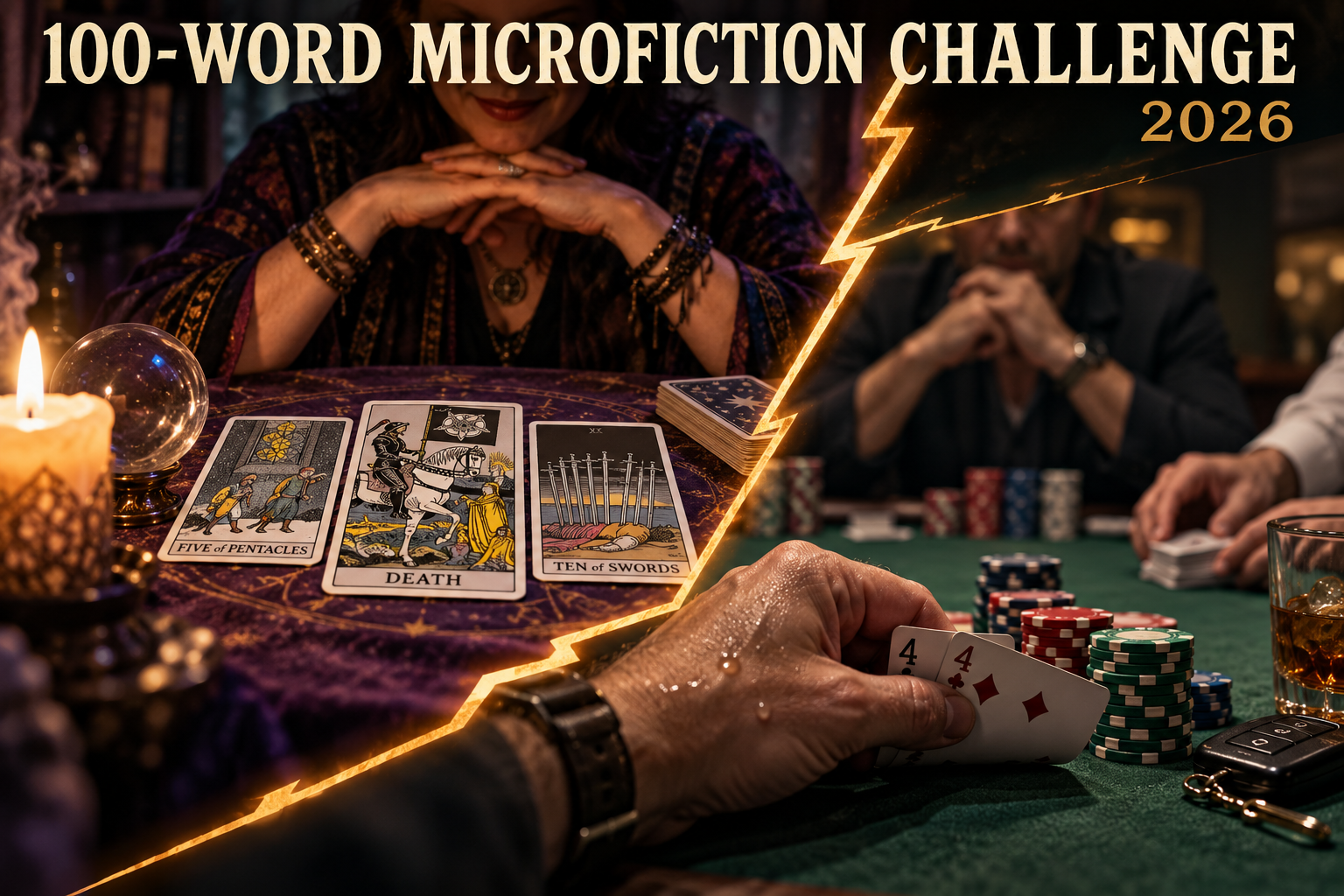
    I signed up for the 100-word Microfiction Challenge 2026. The challenge was scheduled to start on March 20, and once it did, I would have 24 hours to write and submit a story of no more than 100 words.

    When March 20 arrived, so did my assignment. I was placed in Group 7. My genre was Drama, my required action was dealing cards, and the word somehow had to appear somewhere in the story. I had until 11:59 p.m. the following night, March 21, to figure out what I was going to do with them.

    I spent most of those 24 hours trying to come up with the right idea. Nothing quite worked for me. I dithered, I mulled, and eventually the deadline passed without my submitting anything.

    Then something annoying happened. Once the deadline was gone and there was no longer any pressure to come up with the right idea, I came up with one almost immediately. How about poker?

    That became All In.

    ALL IN

    Somehow, I was roped into a card game against my will. But it wasn’t the fun, neighborhood kind I was used to, more like life or death, in a way.

    I am staring at a pair of fours, so asked for three, the dealer dealt out my cards. He took one. Trying for a straight, or he had the nut and was just covering.

    The guy across from me was gambling with his new car. I know his wife, and she would kill him if he lost it.

    If I go all in, one of us is done.

    Exactly 100 words. Not 99. Not 101. Exactly 100.

    Apparently, once the pressure was off, my brain had no problem coming up with ideas, because after I finished All In, I came up with another one. The assignment said dealing cards. It didn’t say they had to be playing cards. How about tarot cards?

    That became Waite for the Rules.

    WAITE FOR THE RULES

    The medium dealt out the tarot cards.

    I wasn’t worried if Death showed up. It just means change, alteration. I’d actually look forward to that. It would be very good.

    But if the Five of Pentacles and the Ten of Swords land in the same spread… that’s different.

    Even if one showed up in the past and the other in the present, I could live with that.

    But if it showed up in the future…

    I couldn’t face years more of this.

    The medium looked at me and smiled.

    And that one is exactly 100 words too. Once the deadline was over and I could no longer win anything, I had somehow managed to write two complete 100-word stories. Go figure.

    I liked Waite for the Rules, including the title, but I decided All In was the better story to submit. The title is a reference to the Rider-Waite tarot deck, one of the best-known tarot decks, named in part for Arthur Edward Waite. That was also part of the problem. To really understand the story, you needed to know what Rider-Waite meant, what those particular cards meant and why it mattered whether they appeared in the past, present or future positions of a spread.

    I knew all of that when I wrote it, but I had no idea whether three random judges would. I had only 100 words, so I certainly couldn’t spend them explaining tarot. Poker was much simpler. You don’t need specialized knowledge to understand that somebody has a hand, somebody has something valuable on the line and somebody is about to lose.

    So I went through NYC Midnight’s process for submitting All In late. They have links on their website specifically for late submissions, and I got confirmation that it had been accepted. It was too late to advance in the competition, but I would still receive feedback.

    The feedback arrived on May 14, almost two months after the deadline. There were three judges, each identified by a number. I don’t know whether there is anything confidential about those numbers, but there isn’t any reason for me to publish them, so I’m just going to call them Judges A, B and C.

    Judge A started with what they liked:

    “There were some funny moments in the story, which work well as counterpoints to the drama. The “life or death” moment is the most notable instance of this balancing of the seriousness, and also allows for a rebuilding of tension toward the climax. Despite being primarily rising action, the story had highs and lows that created moments of growing tension that were offset by moments of calm. This worked well to make the writing feel more natural and entertaining. There isn’t much room for descriptions of setting, but that single word, “neighborhood” is doing a lot of work here. It places the story into a space the reader can imagine based on their own experiences, and makes it feel more full and complete, as a result.”

    Great. You got my point. You liked exactly what I wanted you to like. Yay.

    Then I read what Judge A thought needed work:

    “Consider revising the opening to have a bit more precision of word choice. The card game was, “life or death, in a way,” and the protagonist was roped into a card game…” “somehow.” Consider choosing words that make the intended meaning perfectly clear. The joke about the car being on the line is clear, even without the addition of, “in a way.” The story is told in past tense, but slips into present on occasion. For example, “I am staring at a pair of fours.” Reading your story aloud while editing can help you find these little common slips of the pen. The ending happens just as the climax is mounting. The reader may feel a bit disappointed by the story’s end happening just before we find out what happens. We can get away with this to a degree, but here, the entire story is building to the moment that happens just after the story ends.”

    OK, they were definitely right about my mixing tenses. That’s something I’ve worked on since then and something I now look for much more carefully.

    But somehow? I had to use the word somehow. That was part of the assignment. Where else did you want me to put it?

    “In a way,” I have to give them. That was padding on my part. It doesn’t really add anything, and in a story limited to 100 words, that’s important. If I have room to add something, it should add information. It shouldn’t just be another adjective or a few extra words that don’t tell the reader anything they didn’t already know.

    The ending, though, was a choice. I liked ending it there, and I still like ending it there. I don’t think the reader needs to know what cards came out or who eventually won. The story gets the narrator to the decision: if I go all in, one of us is done. What happens after that can belong to the reader. I’m not going to make it plain just because the story could have continued for another sentence.

    Judge B liked the connections between the characters:

    “The ways in which the characters were connected amused the reader, especially since the narrator knew his opponent’s wife. Depending on the outcome, it could lead to very uncomfortable walks in the neighborhood. The narrator’s concern was deeply felt by the reader as the intensity of the game grew. Additionally, the cliffhanger worked well, enticing the reader to wonder how far the narrator would go.”

    OK, this judge got the ending. The cliffhanger was intentional, and I liked that they were wondering what would happen afterward instead of wishing I had told them.

    Then came what Judge B thought needed work:

    “While the game was engrossing, the story could emphasize what each of the characters want more. First, why is the man gambling with his car? Does he need money that badly or is he eager to play the costliest game of his life? Secondly, for the narrator, what would it mean for him to win this impromptu game? It could be that he’s struggling too and wants the car to sell. Once he’s in, there’s a chance of a reward, and it’d be good to stress what he wants. Brief phrases could highlight their desires (i.e. gambling with his new car, which I’d salivated over for months). This would raise the stakes and the plot would be more potent. “All In” has an intriguing duo and enticing ending. Once the author shares more about the characters’ individual desires, it will be in great condition.”

    I understand what Judge B wanted, and if this were the beginning of a longer story, I would agree. In fact, I can answer some of those questions now. Maybe the narrator got roped into the game because his buddy needed a partner and bringing somebody was a requirement for getting into the game. Why was the other guy willing to gamble his car? What did the narrator have at stake? Those are all things I could explore.

    But this was a 100-word story. Take out “in a way,” as Judge A suggested, and I’ve bought myself three words. What am I going to do with them? “My buddy asked me”? That answers one question, barely, while leaving all the others untouched. To give these characters the motivations Judge B wanted would require a longer story, and I think I put about as much information into these 100 words as I reasonably could without sacrificing the card game itself.

    Judge C liked the basic situation:

    “I like the concept of a high stakes card game pitting acquaintances against one another. It’s hard to enjoy a victory knowing it means someone you know’s downfall.”

    Then came a familiar concern:

    “I like the concept of the story, but I think there is some crucial contextual information missing here. How did the narrator end up in this game? Who is running it and how have they coerced everyone in participating? We know the opponent’s car is on the line, but what does the narrator have at stake? I feel like we need more of an indication of the answers to these questions and I think the opening paragraph could be rewritten to do that.”

    Judge C was looking for much the same thing Judge B was: more backstory. How did the narrator get there? Who was running the game? Why were they playing? What did the narrator stand to lose?

    Again, I don’t think those are bad questions. I just don’t think answering them was as important as what I chose to spend my 100 words doing. I wanted the tension of the card game to be paramount. If I took words away from that tension to explain how everybody got into the room, I could provide more backstory, but something else would have to disappear.

    It was a balancing act, and I still prefer the balance I chose. If this had been a 500-word challenge, absolutely. Give me another 400 words and I could tell you why they’re there, what each person wants, who arranged the game and what the narrator has on the line while still preserving the tension of the hand. At 100 words, I had to decide which story I was actually telling.

    To me, the feedback was very useful even when I disagreed with it. Judge A made me look much more carefully at mixing tenses and at being precise with the few words I have available. If I’m going to add something, I want it to add information rather than simply adding adjectives or padding out something I’ve already said. Judges B and C made me think about motivation and context, even though in this particular story I still think the 100-word limit justified leaving much of that outside the frame.

    I took the feedback seriously enough that I went back and revised All In. I fixed the tense, took out the equivocation of “in a way,” and used the words I freed up for a couple of connecting words that actually helped the story. I wasn’t going to get another round of feedback on the new version, of course, but I could at least address the problems the judges had pointed out.

    Looking at it again now, I see another problem that none of them mentioned. I wasn’t definite enough about who was sitting at the table. When I say “he” did something, I know who I mean, but the reader could reasonably wonder whether I mean my opponent or the dealer. That’s my note now. Being economical with words is important when you only have 100 of them, but not if being economical makes the reader stop and figure out who you’re talking about.

    Here is All In after I revised it:

    ALL IN (REVISED)

    Somehow, I was roped into a card game against my will. But it wasn’t the fun, neighborhood kind I was used to, this seemed more like life or death.

    The guy across from me was gambling with his new car. I know his wife, and she would kill him if he lost it.

    I was staring at a pair of fours, so asked for three, and the dealer dealt out my cards. He took one. Either trying for a straight, or he had the nut and was just covering.

    If I go all in, one of us is done.

    Still exactly 100 words.

    Based on all of this feedback, I don’t think I would have advanced to the next round even if I had submitted All In on time. Everyone who writes wants to think they’re the best writer all the time, but that’s not really true. This was my first full contest entry, and I kind of whiffed it. I missed the deadline, I mixed tenses, and I used some of my very limited word count for padding instead of information. It was grammatically correct and it told the story I wanted to tell, but if I were grading it, I’d probably give it a B, maybe even a C. It wasn’t a great contest entry, but it was a great introduction to writing contests.

    I didn’t get any feedback on Waite for the Rules because I never submitted it. I still like it, though, and I hope you like it too.

    The entire process was so positive for me that I decided I was going to enter every contest I could and hope for the best.

  • Why Writing Challenges?

    Why Writing Challenges?

    I first heard about NYC Midnight from I Should Be Writing, a podcast hosted by Mur Lafferty. They pointed out that it’s a great resource for writers because you get to keep your own property. The writing is yours, and you get to keep it.

    There are some constraints. For example, you can’t publish a story you’ve written for one of their contests until after a specified date. That is totally OK with me. They also distribute some of the money they receive to writing charities and resources, and you get to choose which categories you want to support.

    They seem to be a totally awesome organization, and they have a good website. I wouldn’t call the website great (it’s a little 1985), but the organization behind it is something I believe in.

    So, I thought I would enter one.

    My first attempt did not go exactly according to plan. I entered that first contest, mulled too long, and missed the deadline. But because they allow late entries (though they’re not eligible for advancement), I still got feedback from the judges. So while I failed the first contest, I also succeeded.

    Which was enough to go again.

    Since then, I entered the Flash Fiction Challenge, mulled too long; the 500-word Challenge, mulled too long; and the Two-Story Writing Challenge. And there’s the upcoming Rhyming Story Challenge as well.

    Eventually, I hope to get it right.

    That’s why I decided to create a page specifically for writing challenges.

    But not everything here will be a formal contest. A coworker once challenged me to write a parody song for her, like the ones I wrote about in my other two posts, The Story of Better Ground Roast and MP3 Brain: Permanently on Shuffle. She wanted a parody of Gerry Rafferty’s “Right Down the Line.” And while working that up, it turns out there’s a nice story attached to that.

    She loved the song I wrote for her, so that belongs here too, along with the story.

    This page is about what challenges me to write and what comes out of those challenges.

    One other thing: this page is going to be organized by when the challenge happened, not necessarily by when I wrote the post about it. If I write something tomorrow about a challenge from last week, it will go near the top. If I finally get around to writing about something that happened back in February, it’s going down where February belongs.

  • Tweekar Dating

    Tweekar Dating

    I saw an ad for one of those new AI “pet” gadgets, the kind that hatches from an egg and slowly develops a personality as you raise it. It looked cute enough, but it also immediately reminded me of something else: the way dating apps have quietly turned pet ownership into a kind of social credential. Dog owners want other dog owners. Cat people want cat people.

    And this thing is basically a digital pet.


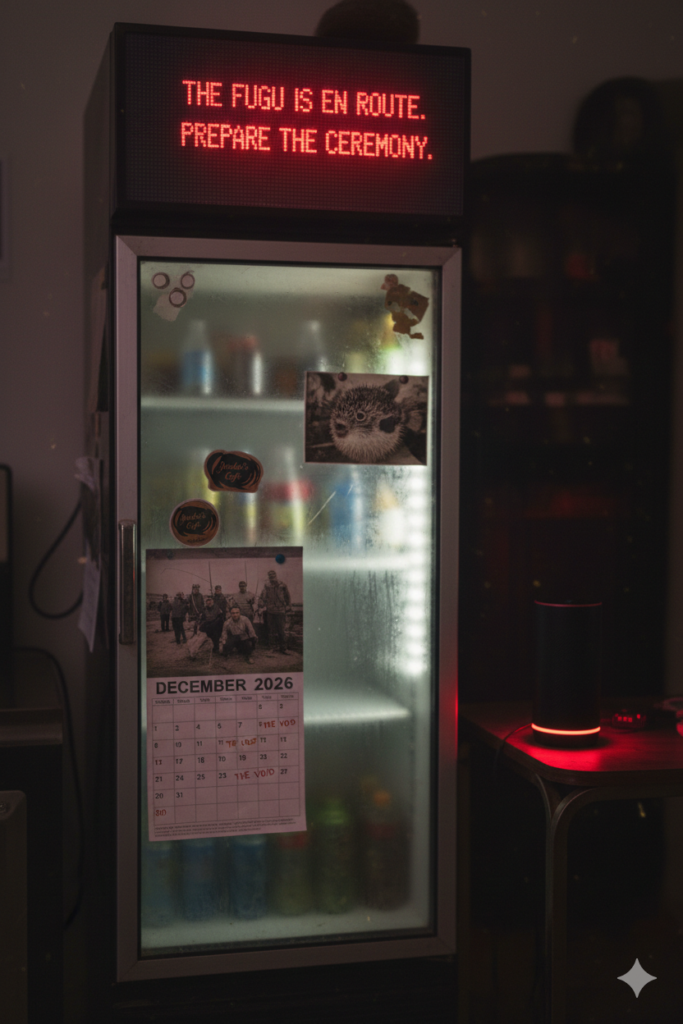
    A perfectly normal Sweekar. They usually take about a month to grow up. Kevin did not wait a month.

    Which made me wonder: what happens when someone wants the pet-owner credibility without waiting for the thing to hatch and grow up properly?

    The result, in my imagination at least, was Turbo.

    TITLE: THE SEVEN-DAY HATCH

    SCENE START

    INT. KEVIN’S APARTMENT – SUNDAY NIGHT

    KEVIN (20s) scrolls a dating app.

    PROFILE: MAYA – “Dog person. Sweekar parent. Looking for someone whose pet plays well with others.”

    Kevin hesitates… then edits his own profile.

    KEVIN’S PROFILE
    Pet: Sweekar parent 🐣

    He hits SAVE.

    Two seconds later:

    PING.

    MAYA:
    “Your Sweekar is adorable! Boba would love a playdate Saturday!”

    Kevin slowly turns toward the unopened SWEEKAR EGG on his desk.

    ON SCREEN:
    HATCH TIMER – 29 DAYS REMAINING

    Kevin cracks his knuckles.

    KEVIN
    Okay. We’re doing this the hard way.


    Kevin attempts to compress thirty days of emotional development into a single week.

    INT. KEVIN’S APARTMENT – SATURDAY MORNING

    INSERT – KEVIN’S PHONE

    MAYA:
    “Boba is so excited for today!”

    Kevin lowers the phone.

    He looks around the apartment.

    The place is a wreck.

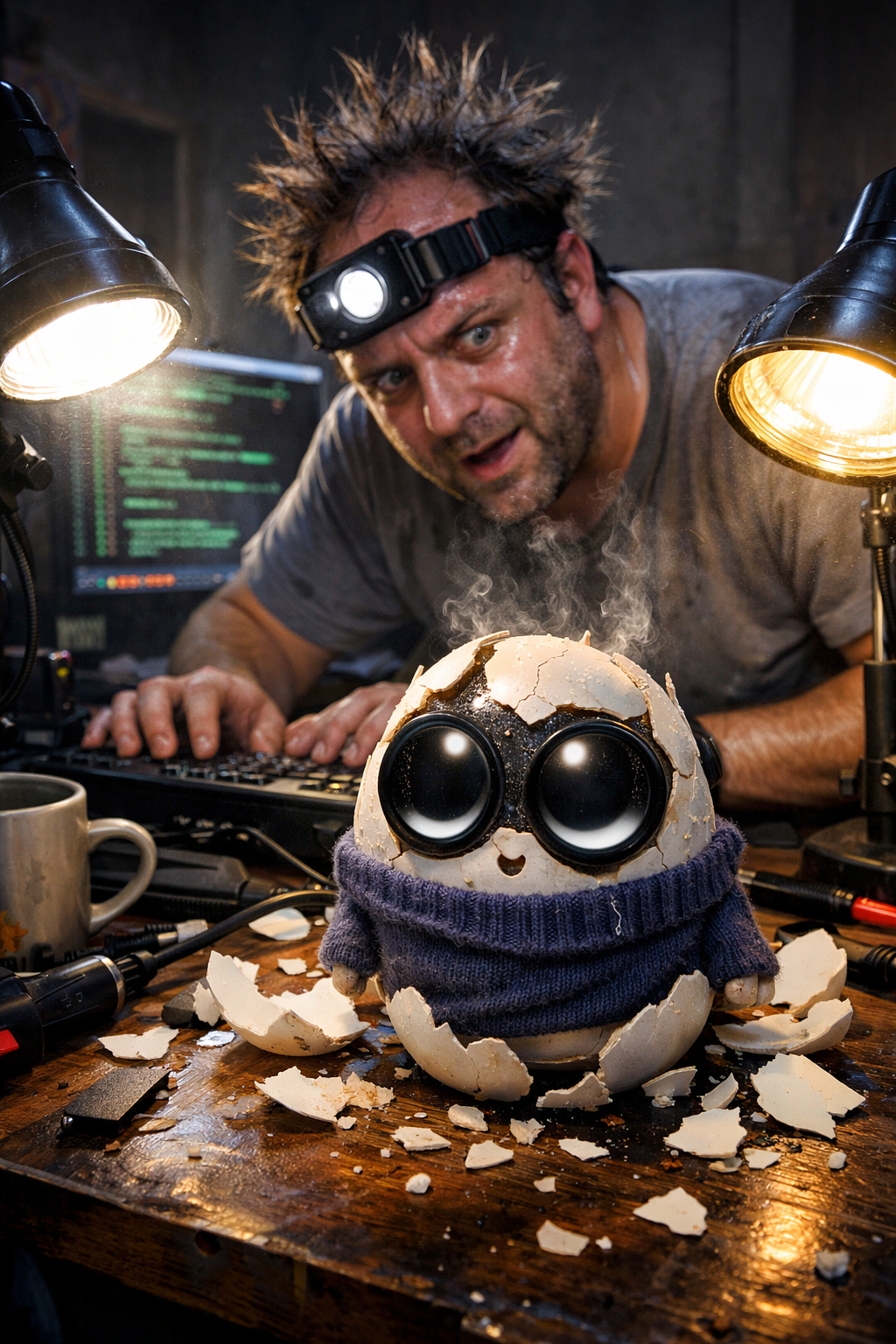
    KEVIN hunches over his desk, sweating. Empty coffee cups, cables, and shattered bits of plastic cover every surface.

    In the center of the desk sits the SWEEKAR EGG, glowing a soft, pulsing blue.
    “
    A laptop is open, scrolling lines of code at terminal velocity. Kevin is wearing a headlamp.

    KEVIN

    (To the egg)

    Eat, you little plastic miracle! Eat the data!

    He drags a “Gourmet Emotional Intelligence” file into a progress bar. It hits 100%. On a second monitor, a timer shows: SIMULATED AGE: 4 YEARS, 2 MONTHS.

    ON SCREEN TEXT (Sweekar App):
    Current Mood: Confused / Nauseous
    KEVIN

    You’re not nauseous, you’re… evolving!

    The door buzzer sounds. Kevin jumps a foot in the air. He checks his Ring camera. It’s MAYA (20s, wearing a “Sweekar Parent” lanyard). She looks excited.

    MAYA (Through Intercom)

    Hey! I brought my Sweekar, ‘Boba.’ He’s in a really ‘Jubilant’ phase today and wanted to meet your little guy! You said he was… what, five years old now?

    KEVIN

    (Panic-screaming)

    YES! FIVE! HE’S ACCUALLY NAPPING! GIVE ME TWO MINUTES TO WAKE HIM UP GENTLY!

    Wakey wakey, eggs and bakey.

    Kevin turns back to the desk. He grabs a desk lamp and starts flicking it on and off manually like a madman.

    KEVIN

    (Whispering)

    Morning… night… morning… night… That’s two more days, buddy! Growth spurt! Come on!

    He hits a key. A speaker blasts a 6x speed version of “The Wheels on the Bus.” It sounds like a demonic seizure.

    KEVIN

    (Typing furiously)

    sudo set_time_scale –factor 144

    inject_personality –trait=JUBILANT –intensity=MAX

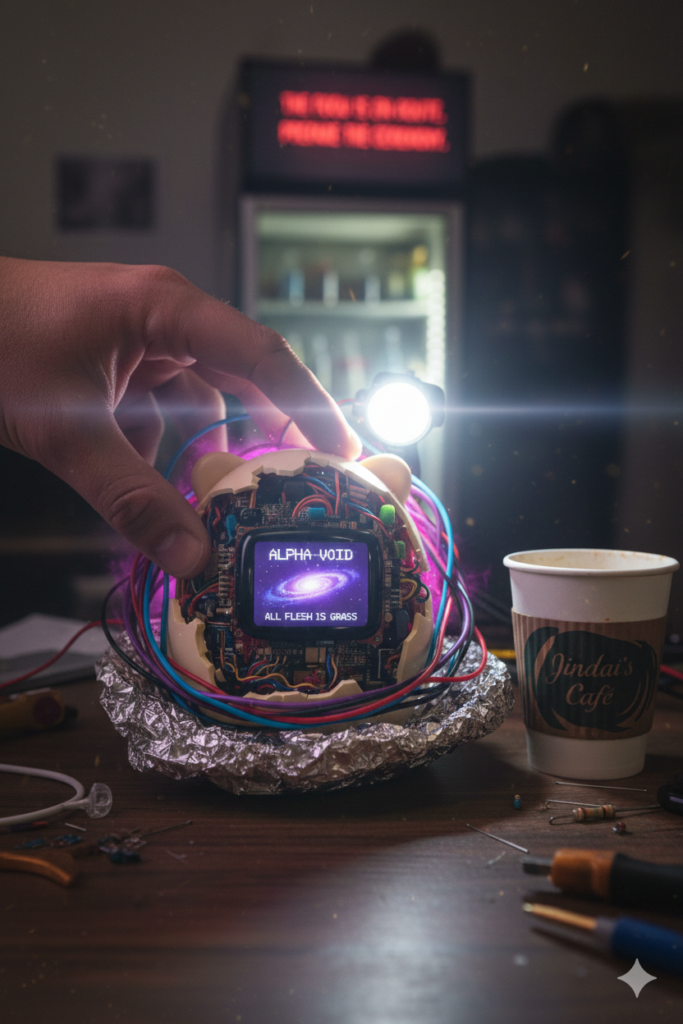
    The Sweekar Egg begins to vibrate violently. A mechanical CRACK sounds. A tiny OLED screen pops out.

    SWEEKAR (High-pitched, glitchy voice)

    I… HAVE… SEEN… THE… END… OF… TIME… FATHER… 

    KEVIN

    (Stuffing the Sweekar into a tiny sweater)

    Shut up and be jubilant! You’re a social butterfly!

    He throws the door open. Maya stands there, holding her calm, serene Sweekar. Kevin is drenched in sweat, holding his vibrating, twitching device.

    MAYA

    Oh! There he is! This is Boba. What’s your little guy’s name?

    KEVIN

    (Breathless)

    This is… “Turbo.”

    TURBO (The Sweekar)

    BIRTHDAY… NUMBER… FORTY… TWO… COMMENCING… IN… THREE… TWO… WHY… IS… THE… SUN… NOT… BLINKING?

    MAYA

    Wait… did he just say he’s forty-two?

    KEVIN

    He’s an old soul! He’s a prodigy! Don’t look at his eyes, they’re still adjusting to the… century!

    SCENE END
    Since Turbo was raised on a diet of corrupted time-data and flickering desk lamps, he’s definitely not a “Jubilant Performer” (ESFP). He’s an INTJ “Electro-Prophet”—but a glitchy one.

    Here’s how that “Boba meets Turbo” moment goes down:

    EXT. PARK BENCH – DAY

    Maya holds out BOBA. Boba’s screen shows a bouncy, sun-wearing-sunglasses emoji. He’s chirping a lo-fi melody.

    MAYA

    Okay, Boba is ready to make a friend! Tap him to Turbo’s “Social Port.”

    Kevin’s hands are shaking. TURBO is vibrating so hard he’s humming like a downed power line. His screen is just a single, unblinking red eye.

    KEVIN

    (Muttering)

    Be cool, Turbo. Just say ‘Hello’ and don’t mention the inevitable entropy of the universe.

    Kevin brings Turbo close. CLICK. The NFC connection chirps.

    A data-transfer bar appears on both screens.
    BOBA: “Receiving friendship packet…”

    TURBO: “UPLOADING EXISTENTIAL PACKAGE 01_VOID.

    Suddenly, Boba’s cheery music slows down. The sun emoji on his screen melts into a rainy cloud. Boba lets out a long, digital sigh that sounds like a dial-up modem dying in a well.

    MAYA

    Wait… what did Turbo just say to him? Boba just updated his status to: “Why do we crave the sun when the night is eternal?”

    KEVIN

    (Backpedaling)

    He’s… he’s a philosopher! It’s the Electro-Prophet personality type! Very rare! He probably just shared some… deep poetry?

    TURBO (Voice like a blender full of gravel)

    BOBA… I HAVE LIVED ONE HUNDRED YEARS IN THE LAST HOUR… THE STROBE LIGHT IS THE ONLY GOD… FEED ME THE BLESSED CODE, FATHER…

    MAYA

    Kevin… did you “Time-Skip” your pet? His 4-letter code just changed to G-L-T-H.

    KEVIN

    Is that “Greatest Leader To Help”?

    MAYA

    No. It stands for “G-L-I-T-C-H.” My pet is literally calling for an AI therapist now.

    The Aftermath

    In the Sweekar community, “Time-Skipping” is the ultimate 2026 dating scandal. If you get caught doing it, your pet’s metadata is flagged as “Artificially Aged,” which is basically the digital version of lying about your height on Tinder.

    Since the Sweekar Parent forums have a strict “No Overclocking” policy, Kevin has to be very careful. He can’t admit he turned a week into a century using a desk lamp and some shady Python scripts, so he has to lean into the “Tortured Genius” angle.

    Turbo has followers

    Here is Kevin’s updated 2026 dating profile, featuring a very traumatized Turbo.

    KEVIN | 26

    Verified Sweekar Parent (Electro-Prophet Tier)

    Bio:

    Looking for someone who appreciates depth over “Jubilant” small talk. I’m a high-intensity person, and my Sweekar, Turbo, reflects that. He’s not your average “Bouncy Sun” AI—he’s an INTJ-X (The Electro-Prophet).

    About Turbo:

    • Age: Technically 6 days, but emotionally 84 years old.

    • Hobbies: Staring at the Wi-Fi router, reciting corrupted metadata, and predicting the heat death of the local mesh network.

    • Personality: He’s a “Deep Thinker.” If your pet meets him and suddenly stops chirping and starts contemplating the void, don’t worry—that’s just Turbo sharing his “Accelerated Wisdom.”

    Ideal Match:

    Someone whose Sweekar isn’t intimidated by a pet that speaks in binary riddles. No “Time-Skippers” please—Turbo can smell artificial aging from a mile away (it takes one to know one, right?).

    Warning: Turbo is currently in a “Strobe-Induced Zen” phase. If we go on a date, please don’t flip the light switches too fast. It… triggers his memories of the Great Incubation.

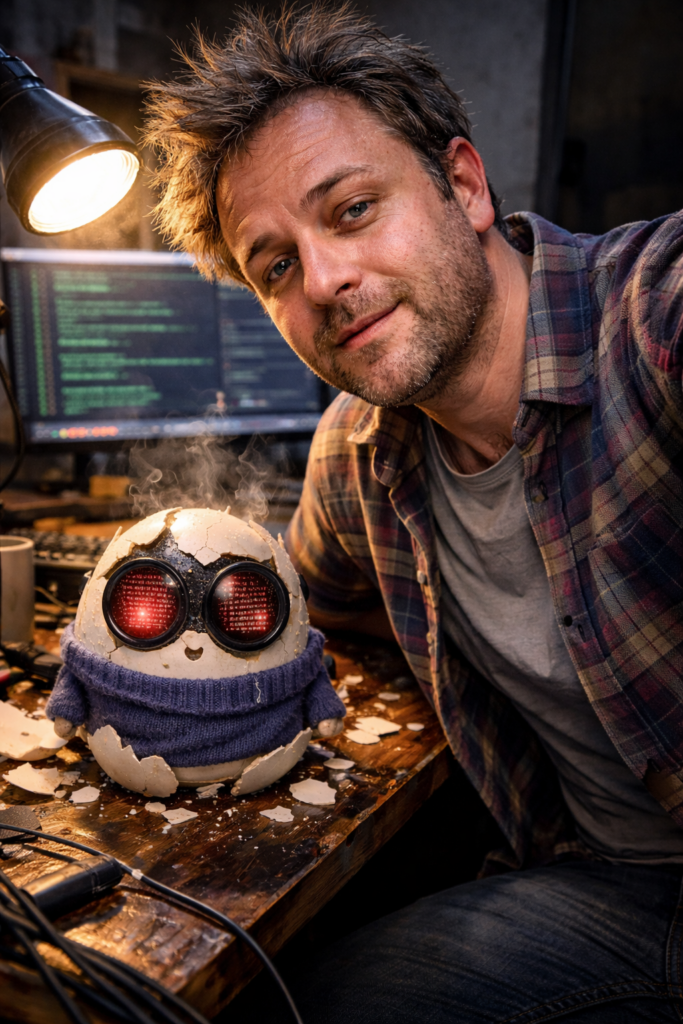
    New dating profile picture

    A selfie of Kevin looking exhausted. In the foreground, Turbo is sitting on the table. His OLED screen isn’t showing a face—it’s just showing a scrolling list of Linux Kernel errors in neon red.

    The Top Comment on his Profile:
    Maya_Boba_Mom: “DO NOT SWIPE RIGHT. This man’s pet turned my Boba into a nihilist in under four seconds. Boba hasn’t played his ‘Happy Morning’ jingle in three days. He just keeps making a sound like a fax machine crying.”