Tag: A Rick Review

  • In-N-Out Redux – Animal Style

    In-N-Out Redux – Animal Style

    Okay, I finally returned to In-N-Out to try the Animal Style I promised in my last post.

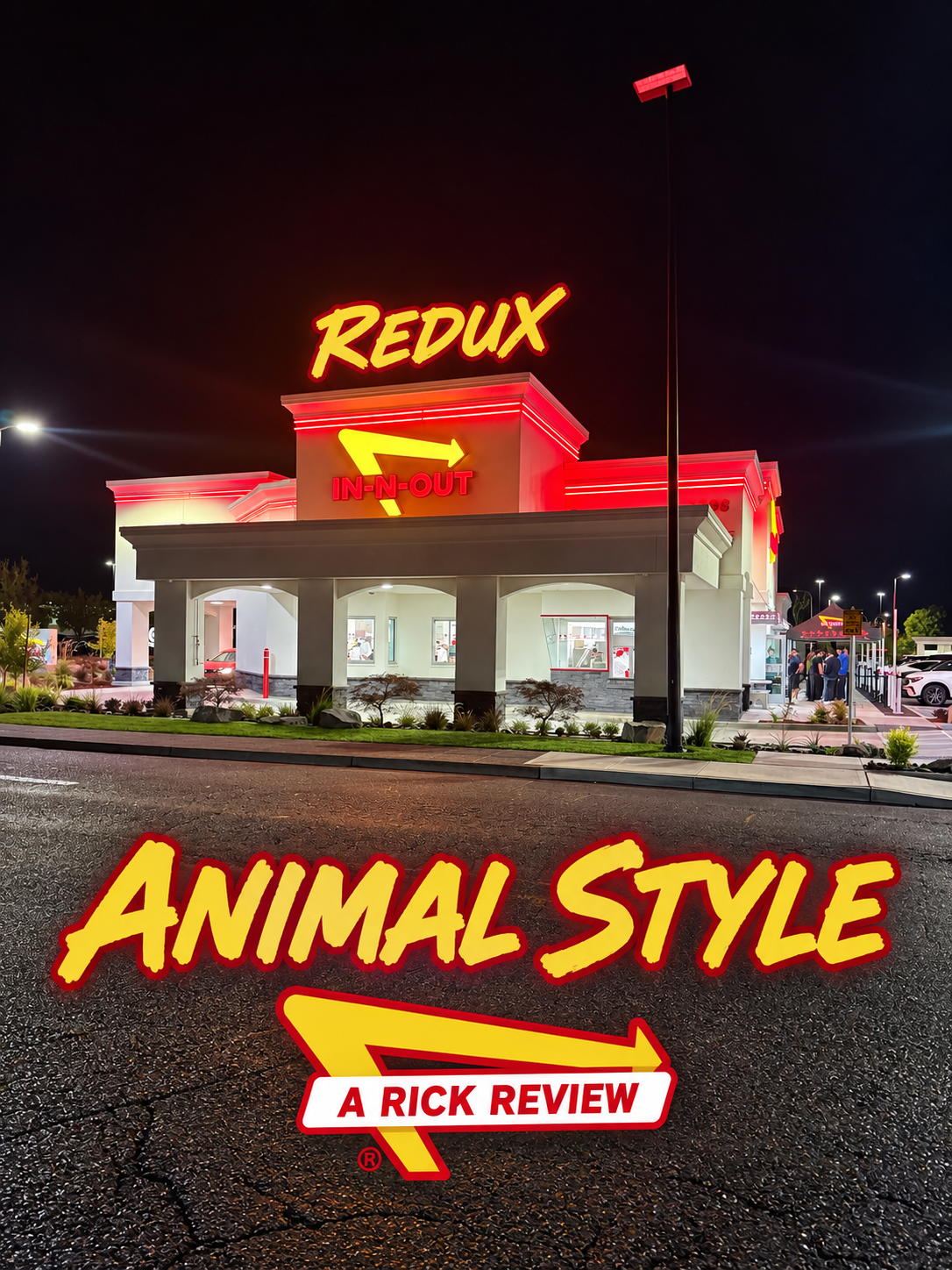
    There was a line outside this time. I was there during that period that isn’t quite twilight but isn’t full dark either—the sun had either just gone down or was almost there. The line only filled about half of the outside queue, though, and I was inside in about 15 minutes.

    Already almost dark outside, in line and ready

    This time I ordered the Double-Double Animal Style, the fries Animal Style, and another shake. I went with chocolate because chocolate is naturally less sweet than strawberry, and I wanted this visit to be at least somewhat comparable to the last one. Same basic meal, but this time with the special stuff.

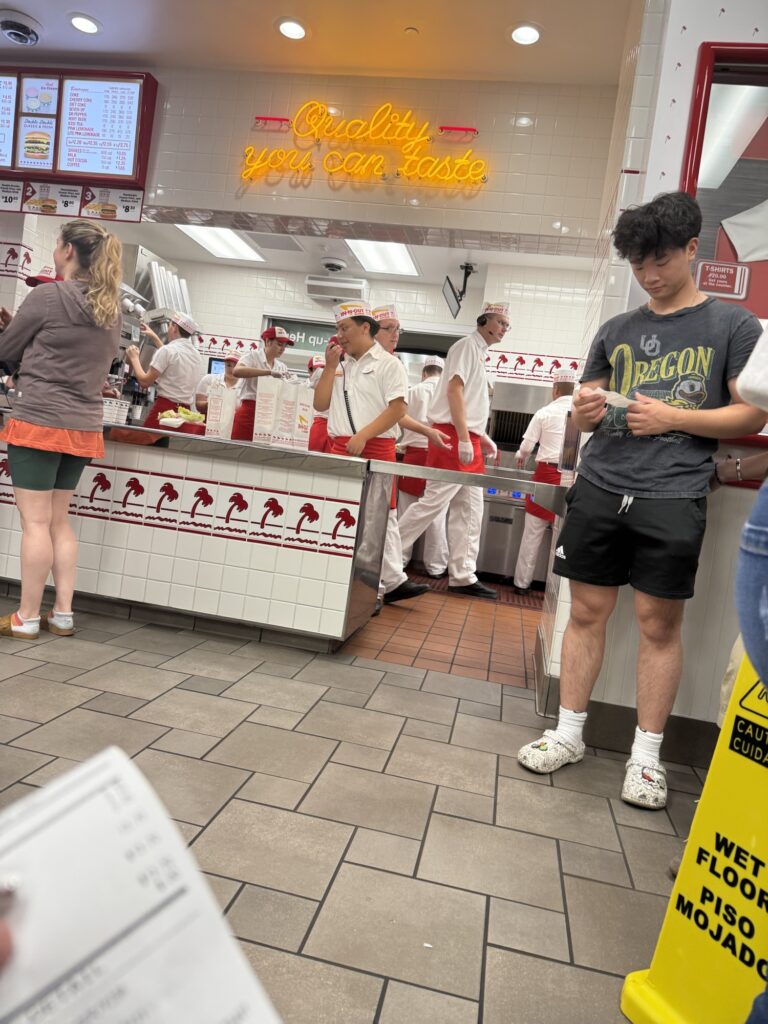
    So many workers, busy as bees, and super nice!

    I waited while they went through the numbers, just like last time. This time I actually remembered to ask for ketchup when I picked up my order, and they were very happy to provide it. I found a seat, took the obligatory picture of my food, and dug in.

    If you don’t think this is nummy, I’ve already lost you.

    So, what does Animal Style actually mean?

    A regular Double-Double already comes with lettuce, tomato and In-N-Out’s spread, with onions optional. Animal Style takes that basic burger and changes things up: the patties are cooked with mustard, pickles are added, the onions are grilled, and you get extra spread.

    I’ve tried cooking hamburger patties with mustard myself, and it’s actually not super easy. You can’t really do it with a frozen burger, and it doesn’t work nearly as well with hamburger that has been sitting around for a while. You need to fresh-press the patty, mustard it and get it onto the grill.

    It’s worth the effort, but it is effort.

    Or you can pay In-N-Out to do it for you and ask for Animal Style.

    And about that spread: if you’ve never had it, think of something a little like Thousand Island dressing. It’s the same general idea as McDonald’s having its own special sauce—there’s a resemblance to Thousand Island, but ultimately it’s In-N-Out’s own spread, not Thousand Island dressing.

    The Animal Style fries are a different matter—and there is a price difference. They were about $2.16 more than the regular fries. The regular fries get covered with melted cheese, grilled onions and that same In-N-Out spread.

    And then they hand you a fork.

    Trust me. The fork is needed.

    It took me longer to eat this meal than the previous one because this one is worth savoring, and you can’t exactly pick up the fries and eat them normally. They’re slathered in all that stuff. Very tasty. Quite rich.

    The burger itself was excellent. That is definitely how I’m ordering it every time I go in there from now on. It costs the same as the regular version, and I’m giving the Animal Style Double-Double a 10+. It adds enough flavor that I don’t need bacon. I don’t need mushrooms. I don’t need anything else piled onto it.

    It’s great the way it is.

    And I was right about the chocolate shake. It wasn’t too sweet. In fact, it was quite good. I suppose I could try vanilla next time, but I suspect it would be super sweet, so…no. I’ll stick with chocolate or get a soda.

    I was full when I left, and the entire meal was less than $13.

    I am not trying to say that one restaurant is better than every other restaurant. But In-N-Out is, by far, the least expensive burger place I’ve eaten at in the Portland area. That is objectively true.

    Don’t troll me on it.

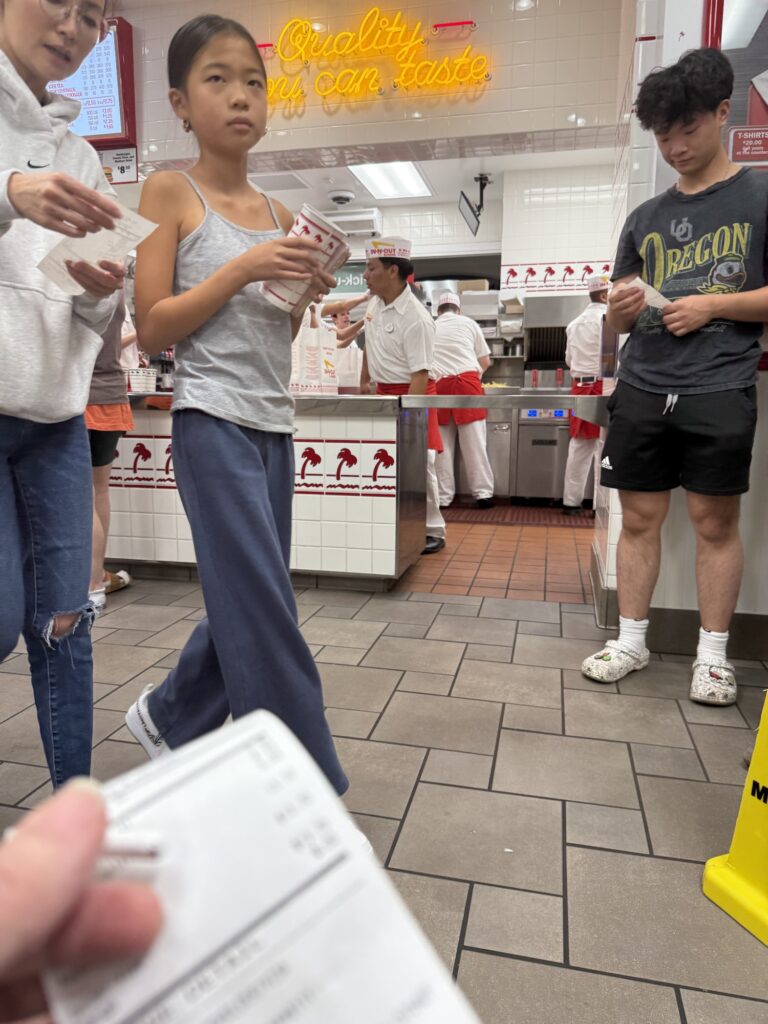
    I also took some surreptitious pictures while I was there. You can see those great big safety pins hanging from the employees’ belts, you can see the crowdedness, and you can even see just the general vibe of the place.

    Had to get a shot of the safety pins!

    Then, after I finished eating, I went back to the counter and asked, “How can I buy one of those shirts?”

    She told me I didn’t have to get back in line. Since I was only buying a shirt, I could just go to the next open register.

    So I did.

    I bought the shirt.

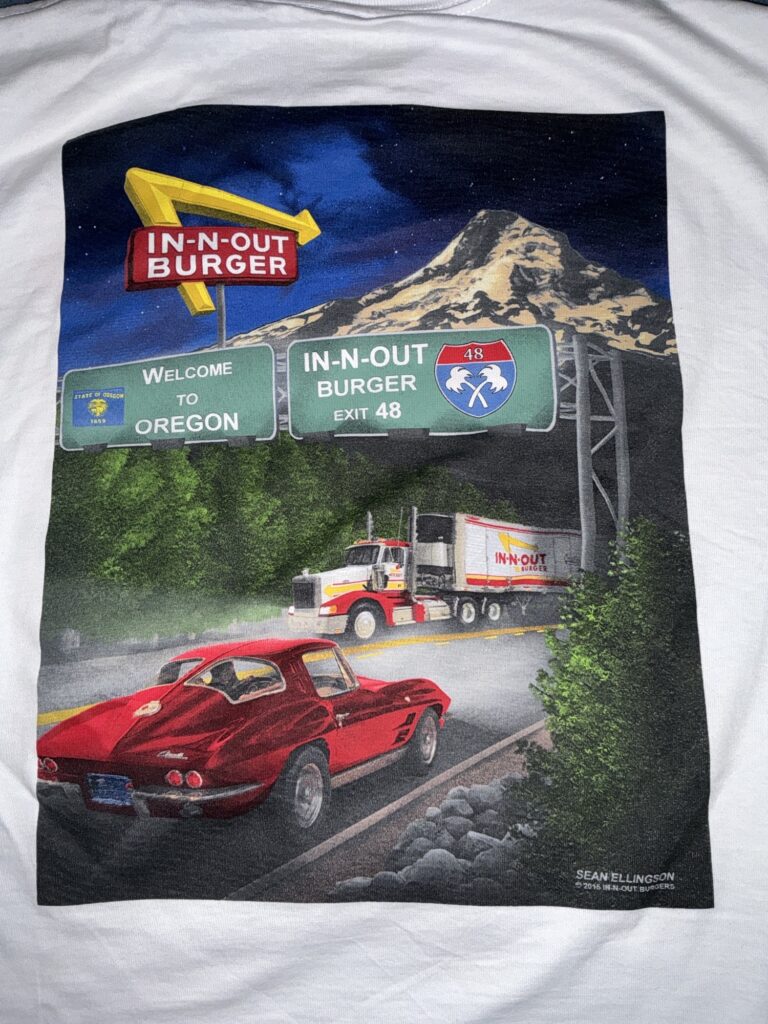
    It was only $20, and it’s worth it because it’s a cool-looking shirt.

    It’s got a Corvette on it.

    What’s not cool about a Corvette?

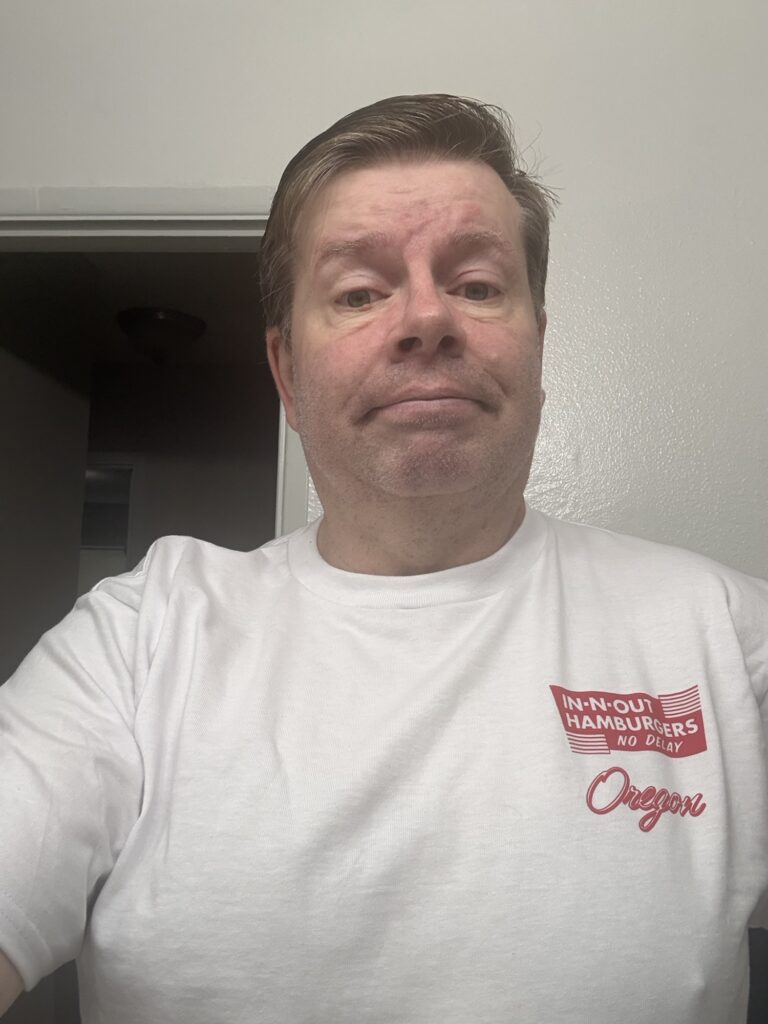
    So I returned home and modeled my new shirt, fresh after a shower.

    Look ma, stubble… and a new shirt.
    Ok, I’m no influencer, I’m not trying to be. How do they do this?

    No, I don’t look like an influencer.

    I’m not trying to be an influencer.

    I’m just telling you what I saw, what I ate and what I really enjoyed.

    And there will be a next time.

    I won’t claim these are the best burgers ever. I will claim that they are very good and very much worth the price I paid. I’ll be back up there. I might go to a movie early enough that I can have dinner beforehand. I might go to an early enough movie that I can grab a burger on the way home.

    Either way, In-N-Out is now going to be part of my plans whenever I’m up in that section of Beaverton.

    Next time?

    Animal Style Double-Double: definitely.

    Animal Style fries: maybe.

    Chocolate shake: probably.

    Clearly, a good decision
  • Practical Magic 2 — A Review

    Practical Magic 2 — A Review

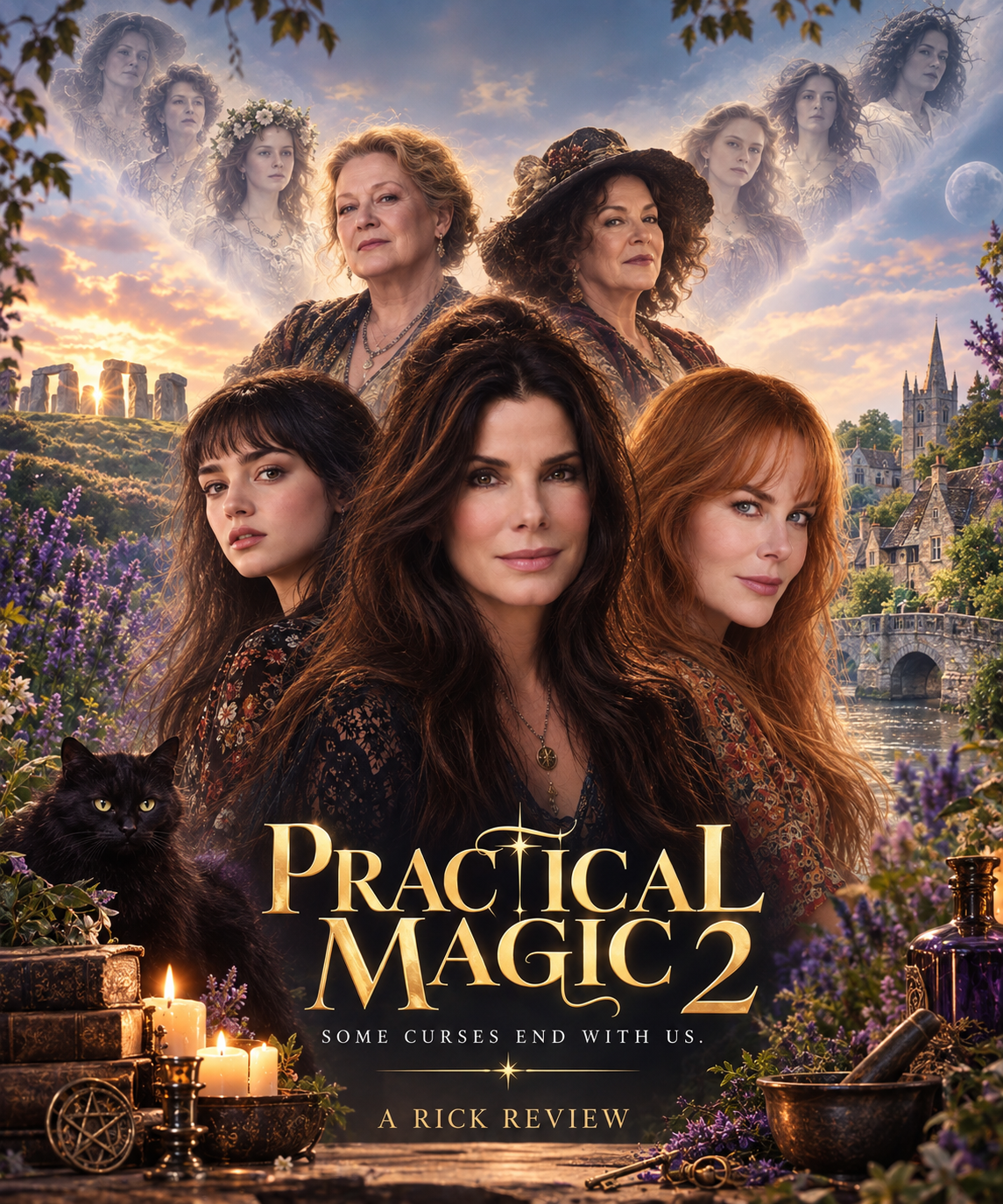
    Practical Magic 2 is better than its first movie. A sequel superior to the original after 28 years is certainly not something you can take for granted, because some sequels made decades later are absolute travesties. This one had an advantage, though. It had a solid source book to work from, and it seems to have followed that book much more closely. The first Practical Magic treated its source novel more like an outline than an explicit source, which turns out to be important because some of the things that seem like continuity problems in this movie really originated with changes made by the first one.

    I recently rewatched the original Practical Magic specifically to make sure I was ready for this movie, and just days after watching it, I literally forgot nearly everything I had just watched. While it’s a charming movie, it’s not terribly memorable. I actually had to look up bullet points from it just to make sure I knew what was going on.

    One thing I did not know going into Practical Magic 2 is that this isn’t simply Hollywood resurrecting a 28-year-old movie. Both movies are based on books by Alice Hoffman. The original Practical Magic was based on her 1995 novel, and Hoffman eventually wrote four books about the Owens family. Books two and three are prequels, while the fourth, The Book of Magic, continues the story and is what this movie is based on. So going directly from books one to four for the two contemporary movies actually makes a surprising amount of sense.

    I have not read these books, so let me make that perfectly clear. I’m relying on summaries of them, not pretending I know the source material firsthand. But from those summaries, the books themselves seem to flow pretty logically. The first book does not definitively say that the Owens family curse has been broken, while the fourth deals with finally breaking it. The first movie is where the problem came in because it gave us more of a Hollywood ending where the curse was apparently over. So Practical Magic 2 has to walk that back to get itself onto the storyline of the fourth book. That makes considerably more sense to me than sequel writers simply deciding, “Nope, the curse is back.”

    All the original witches are here: Sandra Bullock as Sally, Nicole Kidman as Gillian, Dianne Wiest as Jet and Stockard Channing as Franny. Obviously they had to use different actresses for Sally’s little girls because they’re not little girls anymore. Kylie is now played by Joey King and Antonia by Maisie Williams, and if the two daughters aren’t exactly clones of Sally and Gillian, they’re certainly their spiritual successors. One has the dark hair, one has the red hair, and you can pretty much see what they’re doing.

    Not long after the first movie, Sally’s new husband Gary—the man she had basically made impossible to find when she was a little girl—dies, and Sally swears off magic. We know it happens fairly soon afterward because the flashback still shows Kylie and Antonia as little girls. Sally casts a spell that not only prevents her from using magic herself, but also seems intended to suppress her daughters’ memories of the magic they have already seen. They’re standing right there while she’s doing the spell, and they’re certainly old enough to remember what has been happening around them. So Sally isn’t merely refusing to tell her daughters about their magic and the family curse; she is actively trying to erase magic from their lives. The spell is effective in one sense, because the girls grow up without knowing what they are, but ultimately it doesn’t work. Magic—and the curse—finds them anyway.

    Kylie has a boyfriend, Gideon, and she has trouble telling him that she loves him. This isn’t because she knows anything about the Owens curse, because Sally has made sure she doesn’t. Kylie finally does tell Gideon she loves him and, almost immediately, just like Sally’s first husband in the first movie, he gets hit by a car. He doesn’t die, but he does end up in a coma, and there’s your inciting incident. Kylie has just discovered in probably the worst possible way that the family history her mother has been hiding from her is very real.

    There is an entirely poorly written aspect involving a promise that was made and is then explicitly broken, followed by a child saying she’ll never trust her mother again. It becomes a whole thing, and I think it could have been much better written. The actresses manage to carry it off, but they’re doing more work than the writing is at that point.

    Kylie now has to rescue Gideon while simultaneously discovering that she is a witch. She finds a book that essentially has the magical equivalent of a chapter titled “How to Remove the Curse,” and that sends her off to England trying to find some way to break it and save him, even though she has no real idea what she is going to find once she gets there. Tom Lockland is also manipulating her from afar, magically, and this is where the movie loses me a little bit. This guy wants to steal Kylie’s magic because he doesn’t have magic, but he is somehow using magic to manipulate her into coming to him so he can steal the magic he doesn’t have. I don’t know how that works. The movie pretty much waves its hands at that one, and you just have to go with it.

    There is a little hand-waving around the money involved, too. Kylie is a college student who can apparently afford to suddenly fly to England, and then everybody else starts following her over there. Sally runs a library. I don’t really know librarians to be that rich, but okay. Maybe there’s some generational Owens wealth they just don’t proclaim. I’ve never been one of those people who can just decide, “My life sucks. I’m going to Europe,” so maybe spontaneous international travel is cheaper and easier than I think it is.

    The more I thought about this story, though, the more I realized that Tom isn’t really the bad guy who interests me. He’s the conventional bad guy, but the real bad guy in this entire story—in fact, I’m going to argue the real bad guy in both movies—is Maria Owens. Maria is the ancestor who got her heart broken and cast a spell so that she would never suffer from love again, and that spell became the Owens family curse.

    Think about what that actually did to this family. Sally loses two loves of her life, then closes herself off from magic, closes herself off from her daughters and even closes herself off from Gillian. The relationship between those sisters was practically the heart of the first movie, and now Sally has pushed Gillian away along with everything else connected to magic. Gillian goes almost completely in the other direction. She has become the person who only loves them and leaves them. She pretends she has this wonderfully full life, but it’s actually a pretty empty one because she never stays around long enough to really love anybody.

    The movie never explicitly addresses that, but it does something much more interesting with Kylie, who is essentially Gillian’s analog in the next generation. Kylie actually gets advice on how to love without really loving, basically how to have the relationship without making herself vulnerable to the curse, and she completely rejects it. She truly loves Gideon, says so, and then goes through all of this because she refuses to accept that loving somebody means eventually having to run away from them.

    So generations of Owens women have spent their lives either hiding from love, running away from it, pushing away the people they love or watching those people die, all because one ancestor got her heart broken and decided to solve the problem magically. Maria Owens started this whole mess. Tom may be the guy doing conventionally bad-guy things in this particular movie, but Maria has been screwing over this family for generations.

    There is also Ian Wright, who gets to play the part of “Is he a bad guy or is he not a bad guy?” and I think that is handled quite well, although he is considerably more forgiving than I would be. Belladonna gets used again, and this time Gillian evidently gets the dose right because he doesn’t die. If Ian knows these sisters as well as he is supposed to, I would expect at least a little lingering resentment over the fact that they just tried to kill him, but he pretty much lets that go.

    And while I’m complaining about things that have very little to do with whether this is a good movie, I’m going to argue against women wearing combat boots. It’s just not an attractive look, and you cannot argue that they’re comfortable because I wore combat boots for roughly a decade of my life and can tell you with no reservation that they’re not comfortable. They’re utilitarian and they’re fine, but if you want to walk a dozen miles in them, you’re going to have blisters. So a girl wearing combat boots because they’re supposedly comfortable does not make logical sense to me. They look ugly. They are ugly. Get over it.

    All that being said about Maria, the more conventional bad guy is dealt with and the curse is finally ended in a very satisfying yet heart-wrenching way. Yeah, that’s a spoiler, but you know it’s going to end well. I’m not telling you how, and the how is the important part.

    That’s also probably the biggest difference between Practical Magic and Practical Magic 2: this one made me actually care about the characters. I had watched the original only days earlier and had already forgotten huge pieces of it. This movie has better characterization, a stronger plot and a better-organized story, and even when it gets a little hand-wavy about its magical logic, it works. Maybe following The Book of Magic more closely gave the filmmakers a stronger foundation to build on. Whatever the reason, Practical Magic 2 is simply a better movie than Practical Magic, and I’m giving it 3½ out of 5 stars.

    ★★★½ out of ★★★★★

  • Runner — A Movie Review

    Runner — A Movie Review

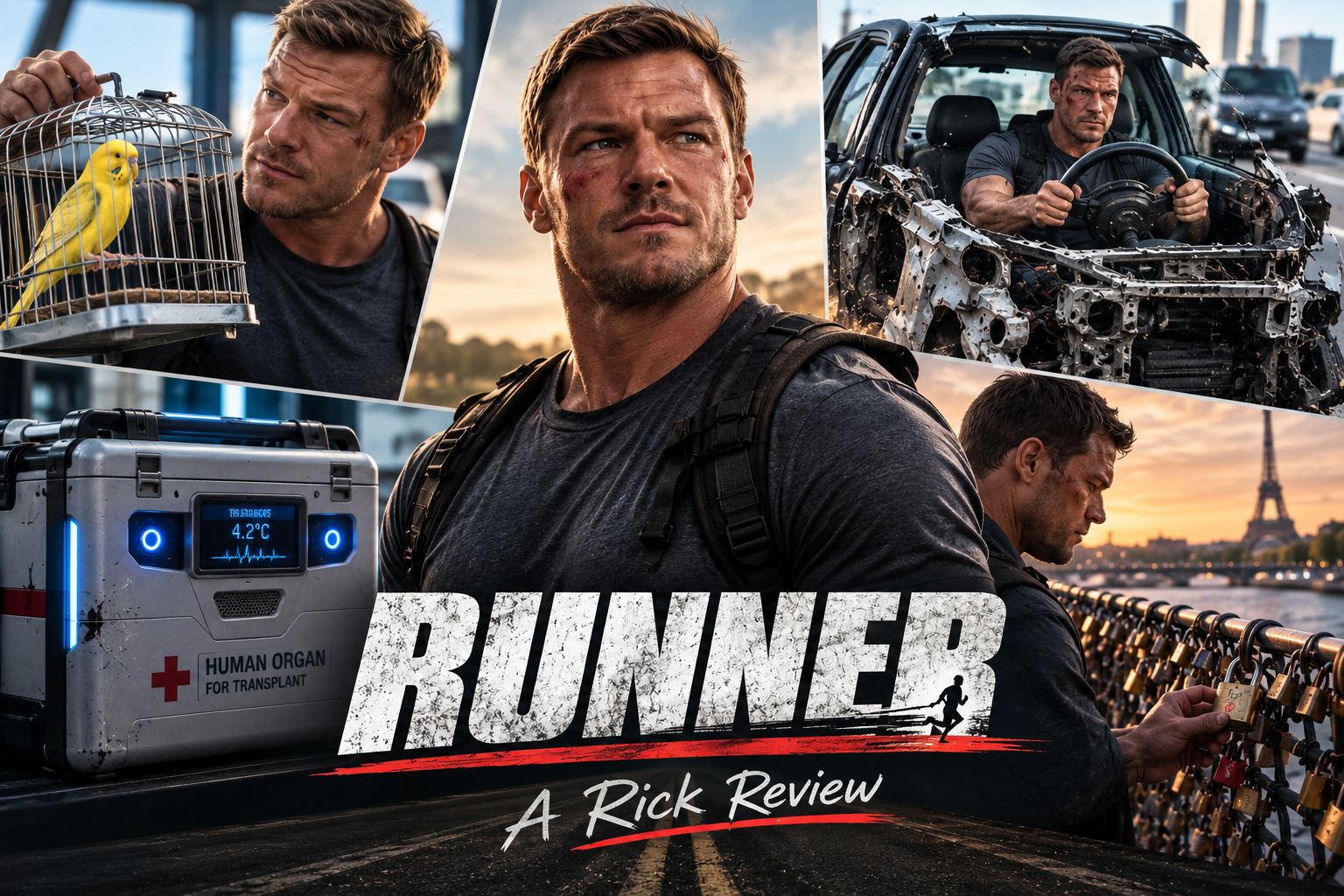
    Runner is one of those movies where you immediately wonder if such a position actually exists in the real world. I mean, you’d think maybe so, but it’s like a super-temp courier job where you speak directly with a dispatcher only through the phone, and then you go and deliver a package, talk to a client, help them unclog a drain—whatever it is.

    It seems super unlikely, but what the heck? It’s a fun movie, so you go with it. They carry it off well enough that I will let that question go.

    Runner stars Alan Ritchson and Owen Wilson. It’s sort of a buddy comedy, but not really. They learn from one another. They interact with one another. There are some tears to be shed. It doesn’t feel entirely manipulative, but that brings me to another aspect of this movie.

    If this movie had been made in, say, 1980, it would be fun. It would be explosive, and there would not be any backstory to speak of.

    Look at the Dirty Harry movies. We do not care about Dirty Harry’s kids or wife or anything else like that. He simply says punks are bad. I’m going to make all punks pay for their being punks. You know his motivations. You don’t care whether his wife left him.

    Runner cares a lot about Hank’s backstory.

    Alan Ritchson plays Hank Malone, a former alcoholic and former Navy SEAL. He’s an American operating in Australia, and the reason he’s in Australia is because his ex-wife is Australian.

    Okay, fine. Lots of backstory. You get to know his motivations. You get to know all this squishy emotional whatever that makes him tick.

    Oh, and let’s not forget: he has basically sworn off violence, of course.

    That all being said, it’s a very fun movie.

    The action sequences are well-made and, on some occasions, entirely funny, if not exactly obeying the laws of physics. There is a scene in which another car takes off the front of Hank’s car. It peels it off like a hinge. I am fairly certain that the sort of force required to do that would cause such massive injuries that no one would survive, but in this case it’s just kind of funny.

    A lot of wit is employed, and Ritchson carries off the role very well.

    Owen Wilson plays Ben Bishop. He’s not quite the emotional heart of the movie, but he is the chatterbox who at first annoys and then charms Hank.

    Ben is accompanying a donor liver that needs to be delivered from an airport to Gold Coast Children’s Hospital. Hank gets his marching orders from his handler, Iggy, whom we never really see except for one slightly tragic moment. Along the way, Hank has some interesting interactions with a very wealthy ex-couple and a fancy parakeet.

    He also meets with his ex-wife, her current husband and their new baby. There is an element of tragedy in the backstory regarding that relationship. It’s all explained fairly well.

    I just find it somewhat unnecessary.

    This is an action flick and a minor buddy comedy. I don’t care about the backstory, just like I didn’t care when Riggs’s backstory started causing him PTSD in Lethal Weapon. It was good without it, but whatever. People demanded more depth to characters, and I guess this is the answer to it.

    There is one factual issue that I have problems with: the organ in question is a liver.

    Although I am not a medical doctor, I know that livers are pretty famous because they regenerate, and you only need a lobe or section of a liver for transplantation. So if this liver really is from a blood type this rare, my immediate thought was: why not split it and give part to each recipient?

    Now, whether that would actually work with this particular liver and these particular patients is another question entirely. And, of course, one side of this little disagreement is a criminal organization and the other is the legitimate recipient. They’re not exactly going to sit down together and successfully negotiate a liver-sharing agreement.

    So we’re going to have to let that go.

    The legitimate recipient is a little girl, Ellie Baker, played by Scarlett Crabtree, and she is adorable. I think Crabtree did what she could with the part. They wrote her a little too childish for me, honestly, but she was used as a spice, not a main dish, so it went down fine.

    Her mother, Kate, played by Leila George, is absolutely, absolutely great.

    She plays the part of a desperate mother perfectly, including the well-expressed version of a mother doing anything to protect what she needs to protect without suddenly becoming Superwoman. She uses her wits. She tries to use her strength. It’s not going to work every time, but she thinks through the problem and accomplishes her goal.

    The main antagonist is Damián Zaldívar, played by Rodrigo Santoro, and he is a perfectly menacing bad guy. They throw in backstory for him that makes him really pathetic. You know, he’s a mama’s boy. His mama is stronger than he is, and Hank manages to turn that around toward the end to good effect.

    So, like I said, they add a lot of backstory, but they make use of it. It’s not just backstory for backstory’s sake.

    And despite my complaints about how much emotional baggage this action movie has to haul along with it, it isn’t overwritten. I enjoyed Runner quite a lot.

    My final thought is that this movie is not going to pull its punches. Not everyone is going to survive.

    There’s no sequel being built in simply by making sure all the main stars are still alive at the end, and I find that quite refreshing. Sad for the actors, of course, but it gives me hope that this movie is just going to be allowed to stand on its own, without somebody immediately clamoring for a sequel or retaining the IP so that 15 years from now we can all look forward to Runner 17.

    ★★★★ out of ★★★★★

  • Coyote vs. Acme Review

    Coyote vs. Acme Review

    Rating: ★★★☆☆

    I went to see Coyote vs. Acme today. It was OK.

    I’m not going to give it a particularly high rating, but I’m not going to give it a low one either. We’re going straight down the middle with three stars.

    Before discussing the movie itself, we probably need to discuss how we are able to watch it at all.

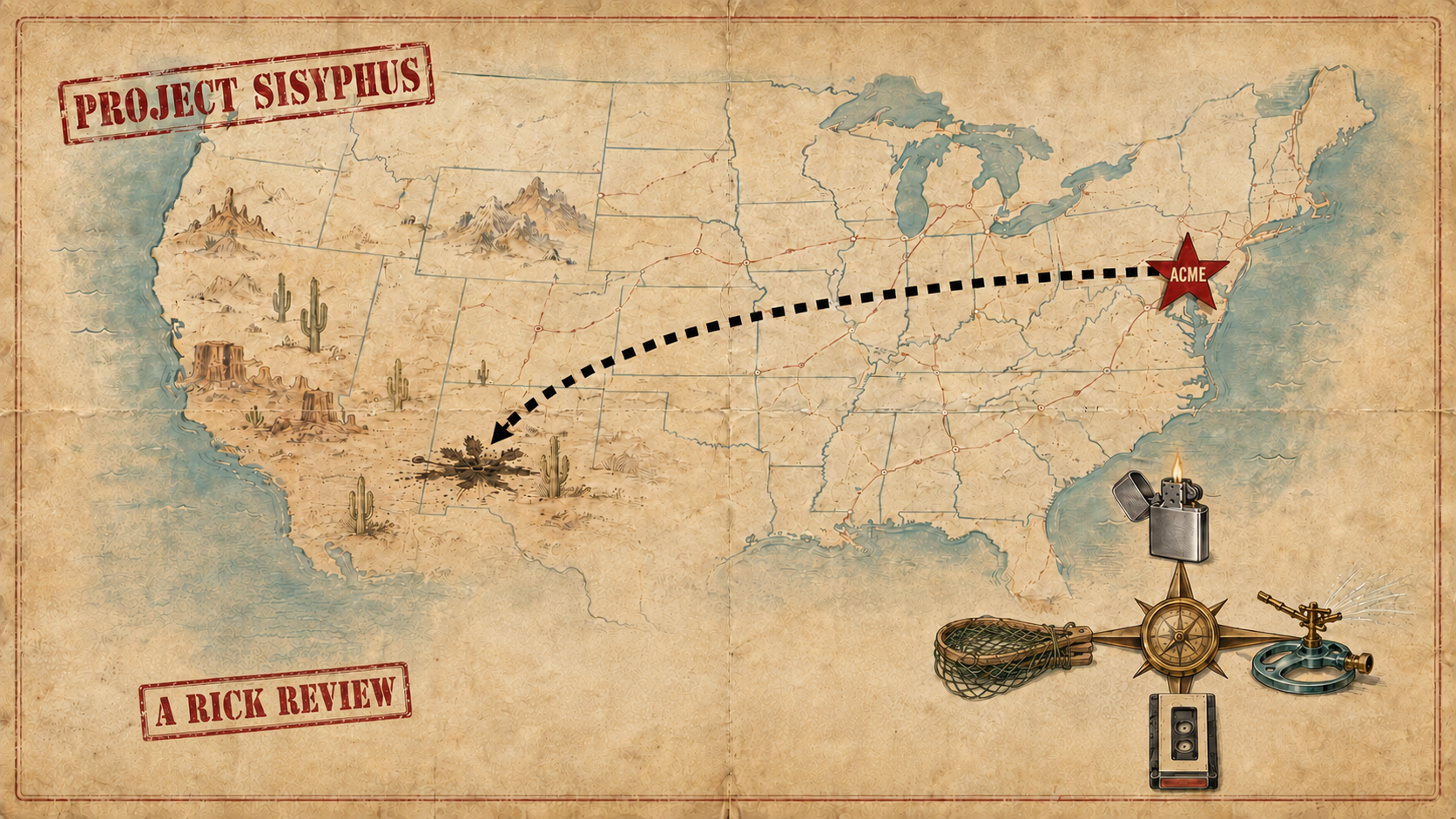
    Warner Bros. Discovery completed Coyote vs. Acme and then shelved it, reportedly planning to write down approximately $30 million of its roughly $70–72 million production cost. That did not mean the government handed Warner $30 million or purchased the movie. It meant Warner could report $30 million as a business loss, reducing the amount of its income subject to tax.

    Nor was the write-down necessarily a permanent death sentence. If Warner later recovered money from the movie, it would have to report that transaction and adjust its taxes accordingly. That is essentially what happened when Ketchup Entertainment purchased the completed film for a reported $50 million. Warner recovered about $50 million of the $70–72 million it had spent, ultimately leaving it with a loss of roughly $20–22 million. Any earlier tax treatment could then be balanced against the newly recovered value.

    Ketchup did not have to reconstruct an abandoned production. Coyote vs. Acme was already complete. It needed a distributor willing to buy, market and release it.

    That gives me at least a little hope that Batgirl might someday escape the same vault. Warner canceled that approximately $90 million movie in 2022 under broadly similar circumstances, but there is an important difference: Batgirl was not finished. Principal photography had wrapped, but it still required effects work, editing and possibly additional filming. Any company attempting the same rescue would therefore need more than distribution rights. It would need access to the production materials, permission to complete a movie using Warner’s DC characters and agreements with whichever original filmmakers, actors and effects artists were still available.

    I doubt that rescue will happen. Coyote vs. Acme was already finished, received encouraging test-screening reactions and still required an extraordinary campaign to reach theaters. Batgirl would require considerably more work, and reports about its test screenings were much less encouraging.

    Still, the release of this movie proves that a tax write-down does not make a film legally unreleasable forever. The money can be reported and the accounting adjusted if someone eventually makes an offer worth accepting.

    I’m not going to argue over whether Coyote vs. Acme deserved to be released or should have remained on the shelf. It’s out there now, and arguing that it should have stayed buried would just seem mean-spirited.

    The movie is based on Ian Frazier’s 1990 New Yorker humor piece “Coyote v. Acme.” Written as an attorney’s opening statement in a product-liability lawsuit, it argues that Acme should compensate Wile E. Coyote for the innumerable injuries caused by its defective products and inadequate warnings. It is an excellent premise for a movie. (Readers without a New Yorker subscription can read the authorized reprint published by the Texas Bar Journal.)

    Calling the movie “based on” Ian Frazier’s article is generous. It borrows the title and the central idea of Wile E. Coyote filing a product-liability lawsuit against Acme, but very little else could transfer because the original is not really a story. It is a mock opening statement whose humor comes from describing cartoon catastrophes in perfectly straight legal language. The movie had to invent nearly everything required to turn that joke into a feature—and that is where most of its problems began.

    I will say that the resulting movie wasn’t particularly well written. There were plot holes you could drive a cartoon through. The judge, played by Luis Guzmán, was practically a cartoon himself, dismissing arguments whenever the story needed him to. The movie attempts to explain this early on by telling us that Acme had essentially written the laws, so of course those laws favored Acme.

    The writers then prevented themselves from using the best part of their source material. Kevin Avery is introduced as a nearly incompetent lawyer who avoids court and settles everything as quickly as possible. That gives him room for an underdog character arc, but it also means he could never convincingly deliver the sharp, meticulously reasoned argument from Frazier’s original piece. A capable product-liability attorney presenting that opening statement might have provided the movie with a genuinely great courtroom scene. Instead, the screenplay makes its lawyer too ineffectual to translate its best piece of legal writing to the screen.

    I recently read about how difficult it was for the British government to dismantle the East India Company during the nineteenth century. That company had accumulated so much power that it governed territory, collected taxes and prosecuted its own wars. By the early nineteenth century, its private army contained approximately 250,000 soldiers—larger than Britain’s own army at times—and it repeatedly defeated forces much larger than itself. Britain required legislation after legislation to strip away its powers before finally dissolving it.

    The parallel with Acme is surprisingly strong. Acme is not merely a manufacturer defending itself against a product-liability lawsuit. It has accumulated enough political, economic and military power to function like a sovereign state. It writes the laws, influences the courts and ultimately makes war against Wile E. Coyote. That is what the story is really about.

    If Acme genuinely possesses East India Company levels of power over both the human and cartoon worlds, defeating it should require more than one favorable court verdict. It should require dismantling an entire corporate government. The movie gestures toward that much more interesting idea, but never really develops it.

    Will Forte plays Wile E. Coyote’s lawyer, Kevin Avery. The surname is an obvious nod to legendary animation director Tex Avery, but the reference goes further than that. His law firm is Avery, Jones & Maltese: Tex Avery, Chuck Jones and Michael Maltese, three giants of Warner Bros. animation. Jones and Maltese were the director-and-writer team most closely associated with creating Wile E. Coyote and the Road Runner in the first place.

    Kevin’s legal aide is his niece, Paige Avery, played by Lana Condor. She provides both the legal and moral center of the film, and Condor does a very good job with the role. The other two people working in the nearly bankrupt law office are Sal Maltese, played by Tone Bell, and Dottie Jones, played by Martha Kelly. They are two-dimensional at best—which is particularly unfortunate because they are both live-action.

    That historical knowledge is one of the movie’s genuine pleasures. Even when its story doesn’t quite hold together, it was clearly made by people who know the cartoons and understand the history behind them.

    I’m not going to say that the voice work is spot-on, but it comes pretty close. The mixture of live action and animation is less successful. It isn’t as smooth or convincing as Who Framed Roger Rabbit, although that remains an extraordinarily high standard nearly forty years later.

    Will Forte does have exactly the right voice to sound like a cartoon character himself. I found that interesting once I noticed it. He can share a scene with an animated coyote without seeming as though he belongs to an entirely different movie.

    Here Come the Spoilers

    Kevin Avery ultimately loses the lawsuit, largely because the judge dismisses the case after another round of animated courtroom shenanigans. Then, through narrative magic, Avery and Wile E. are summoned to testify before Congress.

    That may provide a bigger stage for the climax, but it does nothing to solve the problem established by the lawsuit. Congress is not another court. Even if a congressional committee ruled entirely in Wile E.’s favor, it could not award him damages. It could investigate Acme, expose its conduct, rewrite the laws or refer possible crimes for prosecution, but it could not simply order Acme to give Wile E. a million dollars.

    That distinction matters because Avery, Jones & Maltese is out of money and preparing to close while Avery is in Washington. Winning the moral argument before Congress would not save the law firm or compensate its client.

    Naturally, the hearing does not initially go their way either. Acme has written the laws governing its own conduct, including a particularly grotesque rule allowing cartoons to be tortured because they always recover and therefore supposedly suffer no permanent injury. Acme has not merely found loopholes in the law. It has constructed an entire legal system in which making war against cartoons is perfectly lawful.

    But the movie does have a happy ending, and plenty of guest stars show up along the way. Most of your Warner Bros. cartoon favorites make at least an appearance.

    One thing the movie happily keeps consistent is that Wile E. never speaks. He communicates entirely through his familiar signs.

    The funny conceit is that he has only a limited collection of signs, yet he still manages to say quite a lot with them. Sometimes another character has to interpret what he means, but the movie never gives in and allows him to speak merely because dialogue would be easier.

    His reunion with the Road Runner at the very end is somehow both unexpected and inevitable.

    Stay through the credits, at least until the main credit scroll begins. Some amusing cardboard-style animated sequences play during the earlier portion.

    Ultimately, Coyote vs. Acme is not a bad movie. It is an adequate movie built around a very good premise. If the screenplay had been given another two or three serious passes through a strong writers’ room, it might have become something genuinely good. Instead, it was completed as it was, nearly disappeared forever and has now been released as it is.

    Three stars feels exactly right.

    Principal Cast

    • Will Forte — Kevin Avery
    • Lana Condor — Paige Avery
    • John Cena — Buddy Crane
    • Tone Bell — Sal Maltese
    • Martha Kelly — Dottie Jones
    • P. J. Byrne — Bill Pellicano
    • Luis Guzmán — the judge
    • Eric Bauza — Daffy Duck, Foghorn Leghorn, Porky Pig and Elmer Fudd
    • Jeff Bergman — Bugs Bunny, Sylvester and Yosemite Sam
    • Bob Bergen — Tweety
    • Fred Tatasciore — the Tasmanian Devil