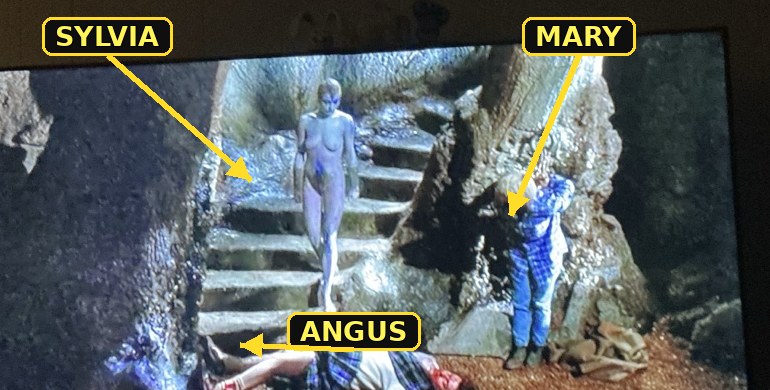
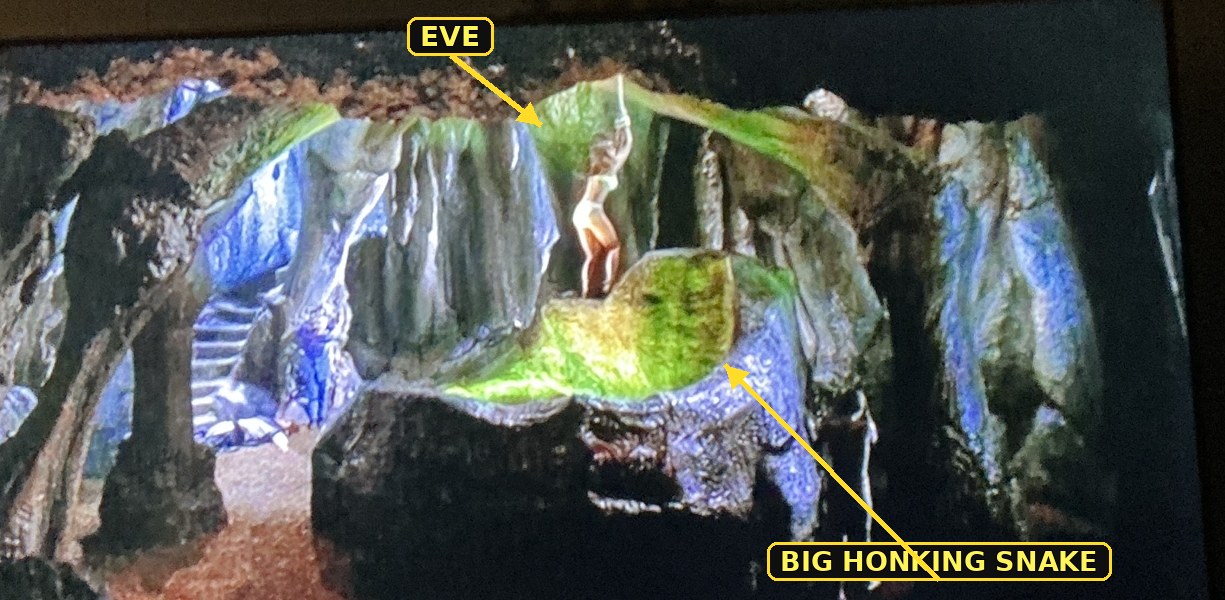
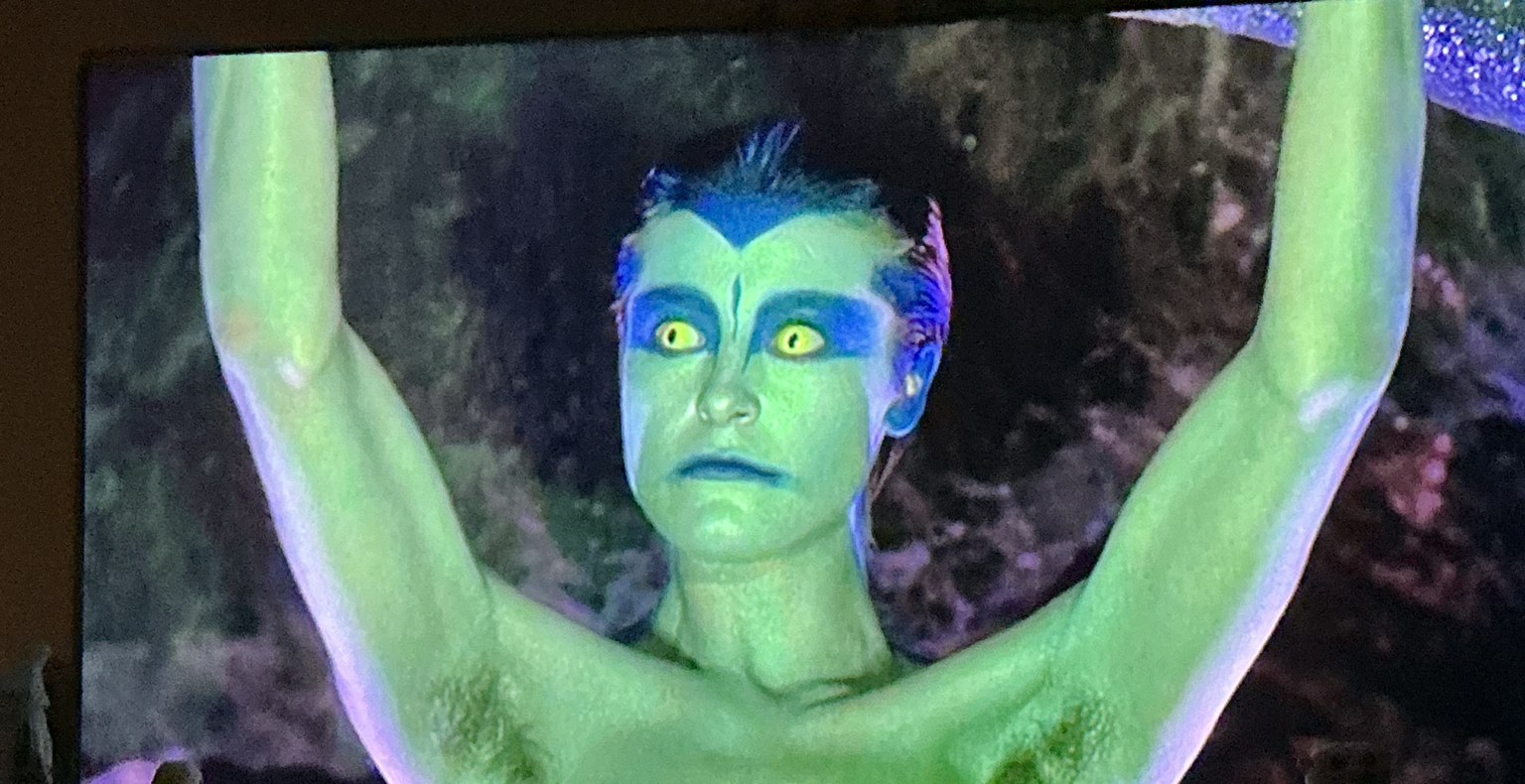
Then there are projects that begin with listening to a podcast, thinking “Huh, that’s weird,” and somehow end with your printer begging for mercy while you tape together twelve sheets of paper on a piece of cardboard that used to protect your television.
This is the second kind.
I had been listening to a podcast (The Move: The Indianapolis Colts) about one of the stranger episodes in professional football history, and it reminded me just how little sense the geography of the NFL makes if you start digging backward.
I went down a rabbit-hole on the whole subject, then fell into a gopher hole, then a vole hole. It was a very strange trip. And I came to this realization.
Teams move. Teams almost move. Teams move away and come back. Cities lose a team and eventually get a completely different one with a suspiciously familiar name. Owners trade franchises. Leagues merge. Other leagues collapse. During World War II, teams temporarily merged with each other because there simply weren’t enough players.
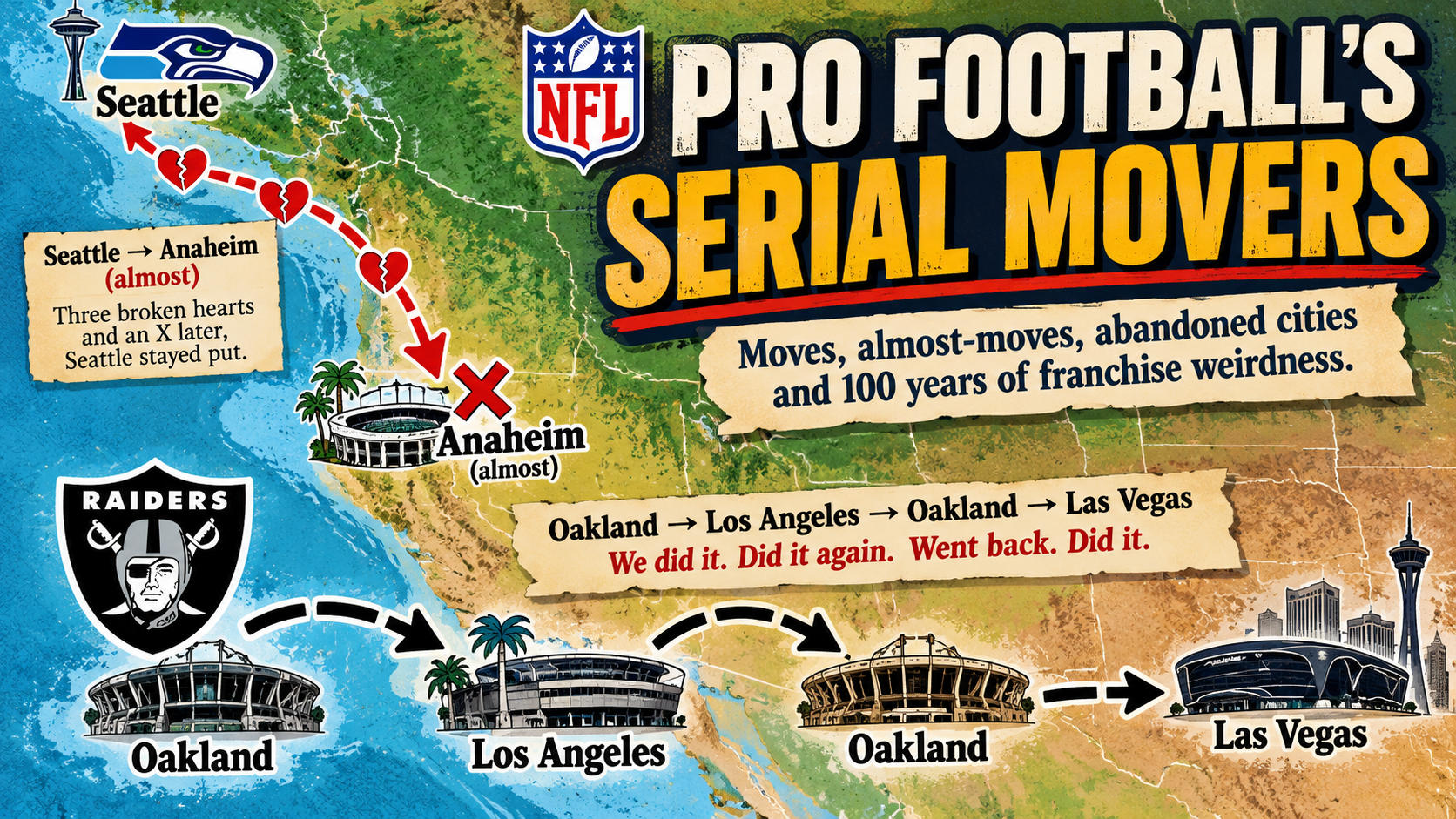
And then there are the Raiders.
Oakland → Los Angeles → Oakland → Las Vegas.
Gotta go. We’re here. We’re back. We gamble.
Seattle, meanwhile, managed an equally strange story without actually moving anywhere. In 1996, the Seahawks came alarmingly close to becoming an Anaheim team before the whole thing collapsed.
That was when I started thinking this history really needed a map.
This seemed simpler in my head
My original idea was basically, “Put the franchise moves on a map.”
That sounds manageable.
It was not.
Once I started looking at actual franchise histories, a simple relocation map stopped being enough. The Browns/Ravens story isn’t a normal relocation. The Dallas Texans of 1952 are not the Dallas Texans who became the Kansas City Chiefs. The Houston Oilers became the Tennessee Titans, while the current Houston Texans are an entirely separate franchise.
Then I started adding serious moves that almost happened.
Then temporary stadiums.
Then former stadiums.
Then the AFL.
Then the AAFC.
Then the USFL.
At some point I had 34 separate historical stories that deserved numbered notes, eight NFL divisions that needed their own boundary patterns, current stadiums, historic stadiums, franchise routes, abandoned routes, near-moves, mergers, ownership swaps and one extremely specific trail of broken hearts between Seattle and Anaheim.
This had stopped being a map.
It was becoming evidence.
The part where I remembered vectors exist
The project became much easier once I stopped treating the thing like one giant picture.
I found a very good vector map of the United States, and that changed everything.
I had somehow forgotten an old graphics lesson I learned years ago: for something like this, you don’t really want to be moving pixels around. You want objects.
A stadium should be an object.
A route should be an object.
A team logo should be an object.
An inset should be a group of objects that can be picked up and moved as one piece.
That distinction turned out to matter almost more than the fact that vector graphics can be scaled indefinitely.
When the New York/New Jersey, Pennsylvania and California insets were covering too much of the East Coast, I could simply move the entire groups out over the Atlantic. When three information panels at the top looked randomly scattered, they could be resized and snapped together into one intentional row.
Current stadiums could stay locked while historical ones were reduced.
Nothing underneath needed to be repainted.
Nothing had to be reconstructed from a flattened image.
I should have done it that way from the beginning.
Mad Magazine has nothing on me!
The stadium problem
The stadiums created another problem I hadn’t really anticipated.
There are a lot of them.
The current NFL has 32 teams sharing 30 stadiums. (Jets/Giants, and Rams/Chargers literally share stadiums) That part was straightforward enough. The current stadiums became the primary visual layer and stayed relatively large.
Historical stadiums were another matter.
If I gave every old stadium the same visual weight as a current one, the map turned into a convention of tiny buildings.
So I ended up creating a hierarchy.
Current stadiums stayed full size.
Older stadiums that still exist were reduced.
Demolished stadiums were reduced even further.
I also stopped trying to show every historical stadium just because I had artwork for it. The legend now explicitly says that historic stadiums are selectively shown — significant franchise homes, relocation sites, temporary venues and story-relevant stadiums are included, but not every venue ever used by every team.
That decision made the map much better.
Complete is not always the same thing as useful.
And then I printed the thing
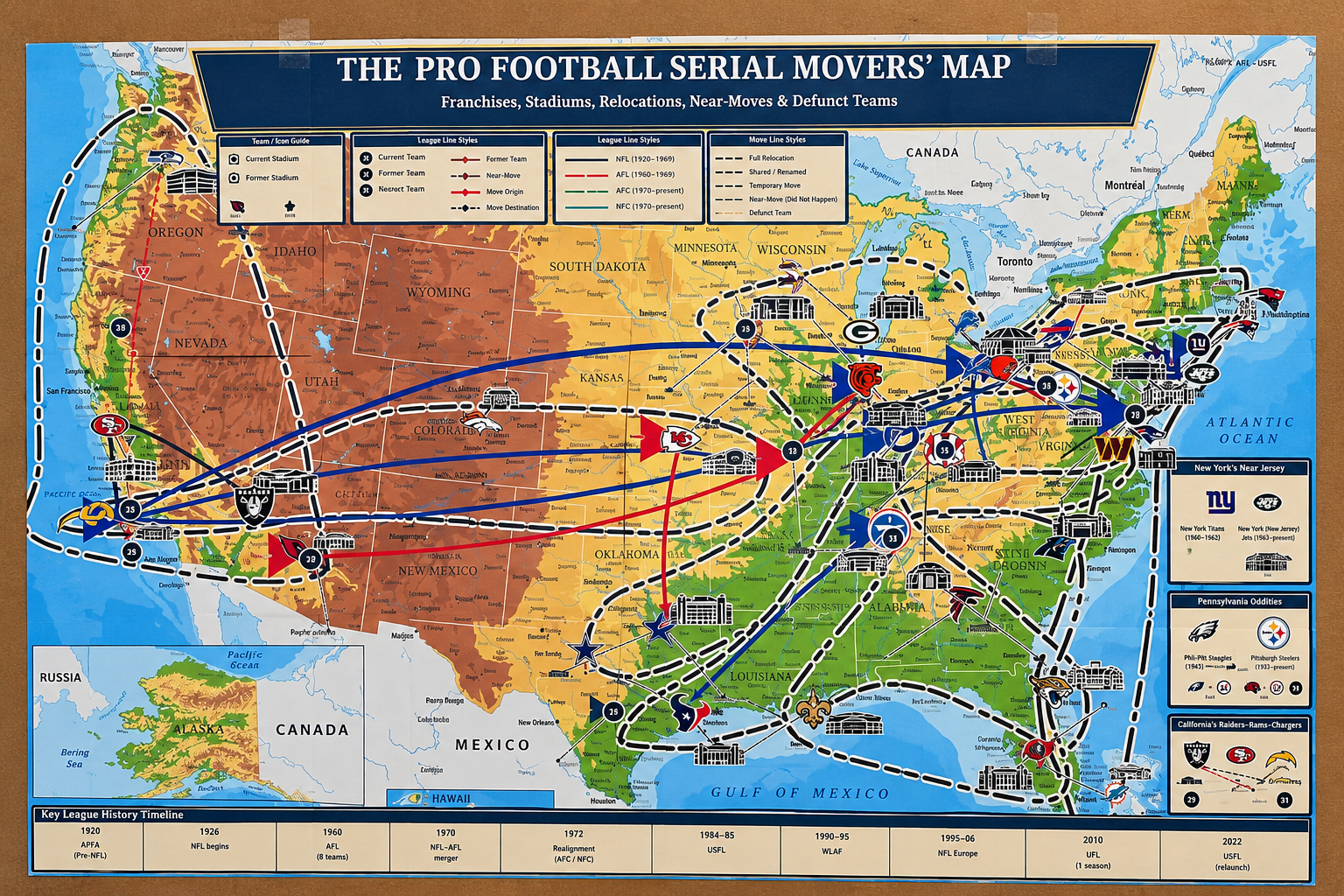
The finished map is 36 by 24 inches.
My printer uses ordinary letter-size paper.
You can probably see where this is going.
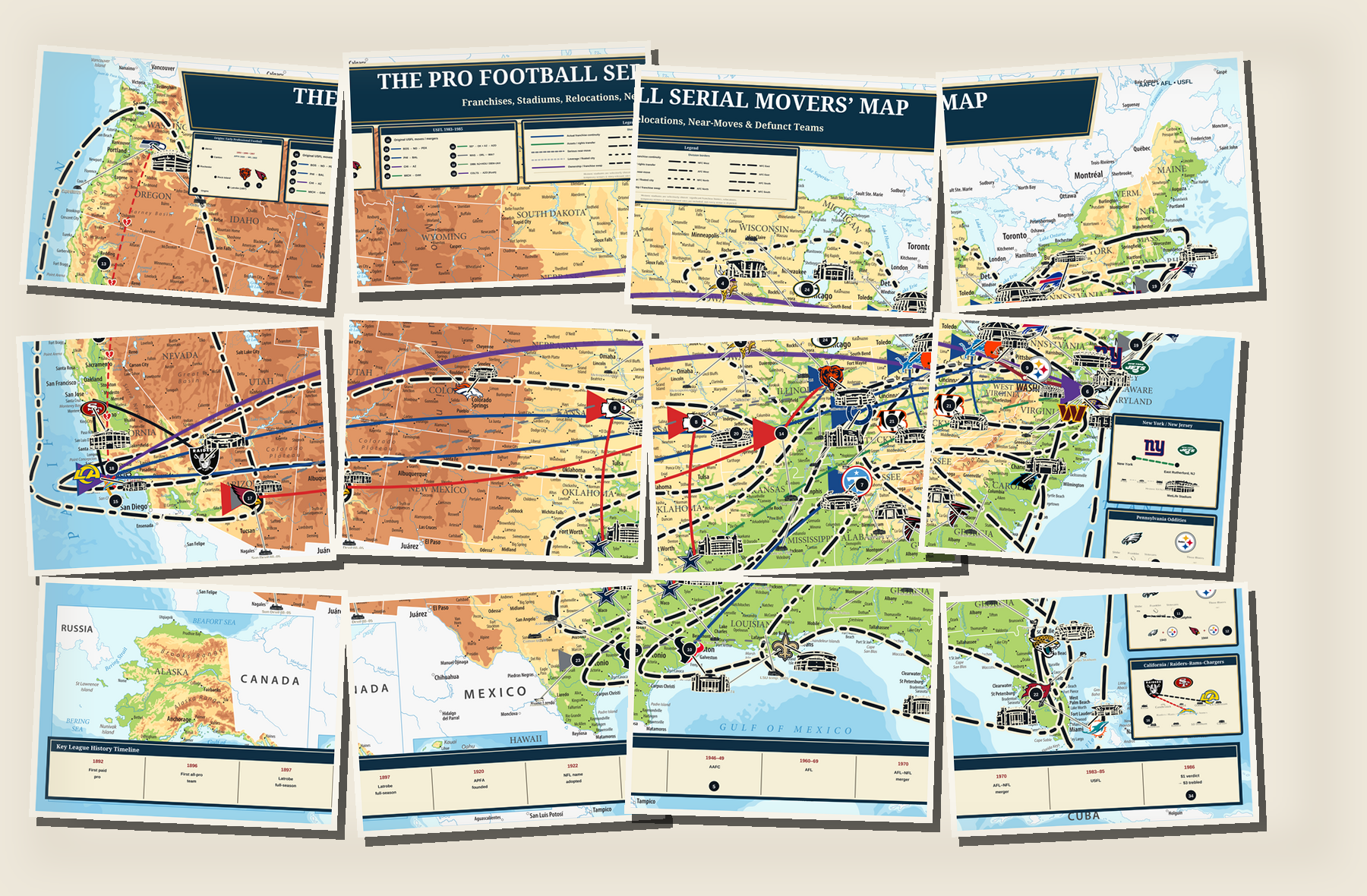
The first solution was to divide the poster into twelve pages, four across and three down.
That worked.
Technically.
It also introduced far more scissor work than I wanted.
Then I remembered that my printer can print edge-to-edge.
Or rather, it can print edge-to-edge under extremely specific circumstances that apparently must be discovered through ritual.
Printing a PDF as a document? Margins.
Printing an image as a photo? Borderless.
Selecting plain paper? Borderless disabled.
Telling the printer that the exact same sheet of plain paper was “other photo paper”?
Suddenly borderless printing was available.
The printer and I reached an understanding.
I also selected Best quality, at which point the printer apparently decided every sheet deserved individual contemplation.
By the end, it had printed twelve pages, then another 24 pages during an ill-fated experiment with duplex instructions, and then twelve more pages at Best quality.
Printy wanted a nap.
Assembly required
There was one more surprise.
Borderless printing is not precision engineering.
Each sheet can feed slightly differently, and borderless mode overscans the image a little so it doesn’t leave white slivers around the edges. That meant two neighboring sheets could have the artwork perfectly aligned while the physical edges of the paper were a millimeter or two apart.
So I stopped trusting the paper.
I aligned the picture.
The twelve pages overlap, and I ended up using matte Scotch tape across the joins. It is not archival mounting. It is not museum conservation.
It is a giant homemade football-history poster.
I can live with that.
The mounting board, incidentally, is a huge shaped piece of corrugated cardboard that I had been using as a puzzle table. I had completely forgotten where it came from until I noticed the shipping markings on it.
It came with my new television. I have a post about that; I’ll put that up soon.
When I unpacked the TV, I apparently looked at this enormous flat piece of cardboard and thought, “That is worth saving.”
Past me was correct.
TV cardboard, check. Scotch tape, check. Sanity, missing.
The actual map
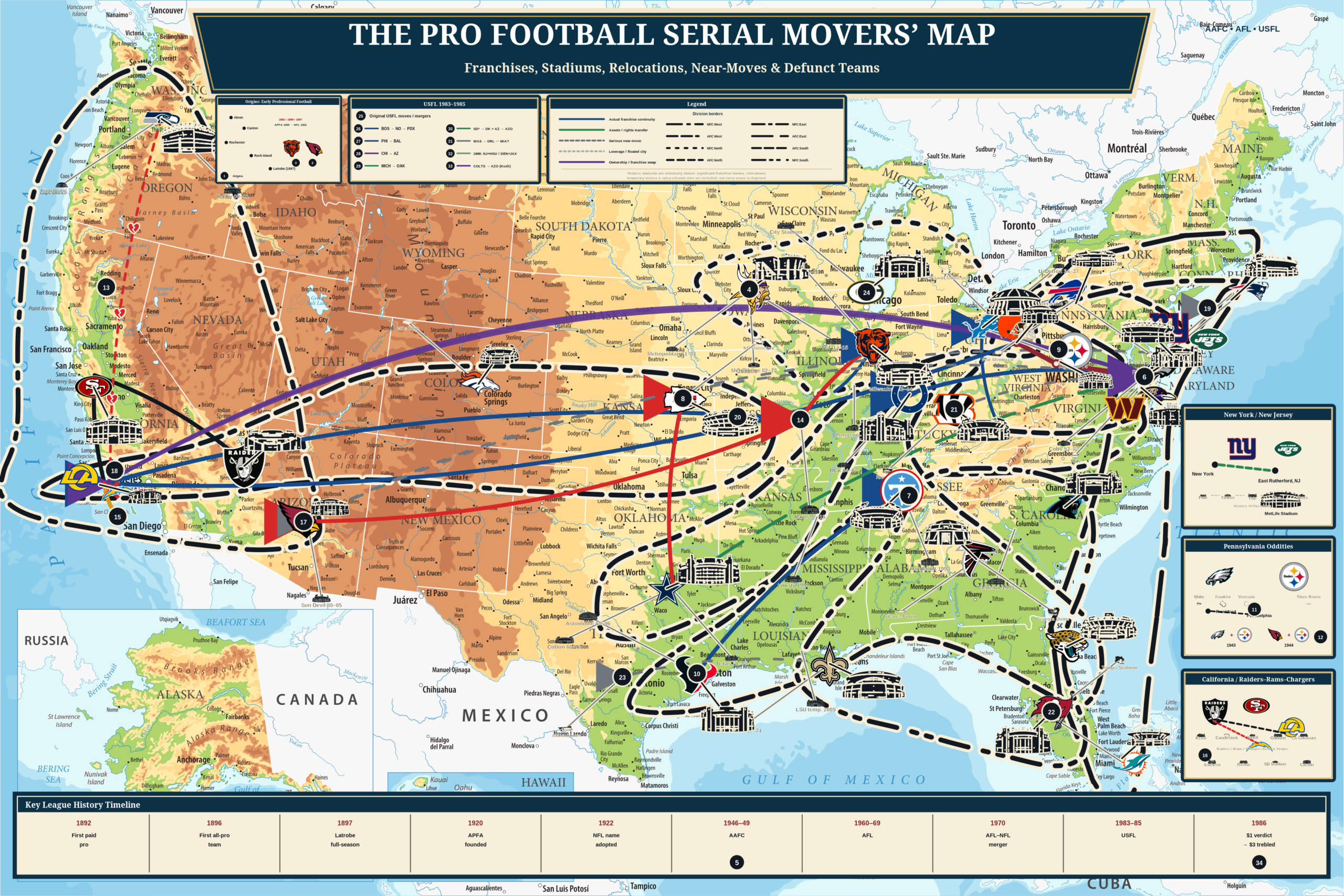
And after all of that, here it is.
Complicated, I’ll show you complicated!
The numbered markers correspond to the notes below. Some are major franchise relocations. Others are near-moves, league mergers, temporary arrangements or wonderfully strange pieces of football history that didn’t fit neatly into a normal relocation arrow.
Early pro football / league origins
①Where pro football starts William “Pudge” Heffelfinger was paid $500 to play in 1892, the Allegheny Athletic Association fielded the first entirely professional team for a short season in 1896, and Latrobe became the first club to play a full season using only professionals in 1897. The APFA—the direct ancestor of the NFL—was organized in 1920 and renamed the NFL in 1922. Pro Football Hall of Fame chronology
②The Cardinals are older than the NFL The Cardinals trace their continuous history to Chris O’Brien’s Morgan Athletic Club in Chicago in 1898. They became the Chicago Cardinals, moved to St. Louis in 1960, moved to Arizona in 1988 as the Phoenix Cardinals, and adopted “Arizona Cardinals” in 1994. The Hall of Fame calls them the oldest continuously operating team in professional football. Cardinals team history — Pro Football Hall of Fame
③Only two charter-era survivors remain Of the clubs represented at the APFA’s 1920 organizational meeting, the two surviving franchise lines are the Decatur Staleys/Chicago Bears and the Racine/Chicago Cardinals, now the Arizona Cardinals. Founding of the NFL — Pro Football Hall of Fame
④Minnesota chose the NFL over the AFL before playing a game A Minnesota ownership group was awarded an AFL franchise in 1959, then forfeited that AFL membership five months later and accepted the NFL’s 14th franchise instead. The Vikings began play in 1961. The AFL filled the abandoned Minneapolis slot with the new Oakland Raiders. Vikings team history — Pro Football Hall of Fame
⑤The AAFC sent three teams into the NFL When the All-America Football Conference folded after 1949, the Cleveland Browns, San Francisco 49ers and original Baltimore Colts entered the NFL for 1950. Cleveland and San Francisco survived; that first Baltimore Colts franchise did not. AAFC history — Pro Football Hall of Fame
Franchise continuity oddities
⑥There were two completely different Baltimore Colts The first Colts played in the AAFC from 1947–49 and one NFL season in 1950 before folding. The Baltimore Colts established in 1953 were a new franchise and are the franchise that eventually moved to Indianapolis. NFL history 1940–1959 — Pro Football Hall of Fame
⑦The strangest ancestry of the modern Colts begins in New York and Dallas The NFL took back the New York Yanks franchise in 1952. Dallas investors purchased Yanks assets and received a new Dallas Texans franchise, which went 1–11 and folded after a single season. In 1953, Baltimore was awarded another new franchise plus the holdings of the dead Dallas organization. That is why the map shows a tombstone at the 1952 Texans and a green assets line emerging from the grave toward the 1953 Colts. 1953 franchise history — Pro Football Hall of Fame
⑧The other Dallas Texans became the Chiefs Lamar Hunt’s unrelated AFL Dallas Texans began play in 1960, won the 1962 AFL championship, moved to Kansas City in 1963 and became the Chiefs. Same city, same “Texans” name, entirely different franchise from the one-season NFL Texans of 1952. Chiefs ownership and franchise history
⑨The Browns moved—but the Browns did not The 1996 settlement allowed Art Modell’s football operation to move to Baltimore and become the Ravens, while Cleveland retained the Browns’ name, logo, colors, history, records, trophies and memorabilia. The Browns were dormant for three seasons and resumed play in 1999. 1996 NFL history — Pro Football Hall of Fame
⑩Houston lost the Oilers but later got a completely different Texans franchise The Oilers were founded in Houston in 1960, moved to Tennessee in 1997, played two seasons as the Tennessee Oilers, and became the Tennessee Titans in 1999. The Houston Texans, who began play in 2002 through expansion, are a separate franchise with no continuity from the Oilers. Titans franchise history
Swaps, wartime weirdness, and ownership oddities
⑪The 1941 Pennsylvania Polka may be the strangest franchise shuffle in NFL history Art Rooney sold the Pittsburgh organization to Alexis Thompson, then joined Bert Bell’s Eagles. When Thompson’s intended move to Boston failed, the groups traded territories: the Rooney-Bell Eagles organization went to Pittsburgh and played as the Steelers, while Thompson’s Pittsburgh organization moved to Philadelphia and played as the Eagles. The Pennsylvania Polka — Pro Football Hall of Fame
⑫Then World War II made Pennsylvania even stranger Player shortages caused the Steelers and Eagles to combine for the 1943 Phil-Pitt “Steagles” season; the joint team dissolved afterward. In 1944 the Steelers instead combined with the Chicago Cardinals as Card-Pitt. These were temporary wartime combinations, not franchise relocations. Pennsylvania Polka and wartime teams — Pro Football Hall of Fame
⑬In 1972, the Colts and Rams literally traded owners Robert Irsay bought the Los Angeles Rams, then exchanged the Rams franchise with Carroll Rosenbloom for the Baltimore Colts. No teams changed cities and no players had to relocate—the owners effectively swapped entire franchises, histories and operations. NFL history of the 1972 Colts–Rams franchise swap
Major movers and near-moves
⑭The Rams have crossed the country repeatedly The franchise began as the Cleveland Rams in 1937, suspended operations for 1943 because of wartime manpower shortages, moved to Los Angeles in 1946, moved to St. Louis in 1995, then returned to Los Angeles in 2016. Rams team history — Pro Football Hall of Fame
⑮The Chargers did an out-and-back of their own The AFL Chargers played their first season in Los Angeles in 1960, moved to San Diego in 1961, remained there through 2016, and returned to the Los Angeles market in 2017. Chargers team history — Pro Football Hall of Fame
⑯The Raiders are the map’s true serial movers Oakland joined the AFL in 1960 after Minneapolis abandoned its AFL membership. The Raiders later went Oakland → Los Angeles → Oakland → Las Vegas, which is why they alone get the permanently defeated/broken padlock. Their earliest years included games across the Bay at Kezar Stadium and Candlestick Park before the Oakland Coliseum opened. Raiders team history — Pro Football Hall of Fame
⑰Before Indianapolis, the Colts were briefly headed for Phoenix In January 1984, Colts executives were told that the club was moving to Phoenix; the proposed Arizona deal ultimately collapsed. A few months later the Baltimore situation deteriorated rapidly, and the Colts were moved to Indianapolis in the famous overnight Mayflower-truck operation of March 1984. Colts history of the 1984 move
⑱Seattle actually started moving before the move collapsed In 1996 owner Ken Behring moved Seahawks equipment to Anaheim and held offseason workouts there, intending to use Southern California while a new stadium was pursued. League pressure and litigation forced the operation back to Washington. ESPN history of NFL relocation threats
⑲New England came surprisingly close to Hartford In 1998 Robert Kraft announced an agreement under which Connecticut would build a 68,000-seat Hartford stadium and the Patriots would relocate there. The deal survived into 1999 before Kraft formally terminated it when the stadium timetable became uncertain. Patriots terminate Hartford stadium agreement
⑳The Eagles nearly became the Phoenix Eagles In 1984 an Arizona deal was being negotiated in which owner Leonard Tose would sell a minority share of the team while retaining control and move the Eagles to Phoenix. Reports at the time said only final details remained before the plan fell apart and Philadelphia concessions kept the team home. Los Angeles Times history of the Phoenix Eagles plan
㉑Cincinnati explored Baltimore before Cleveland actually went there During the Bengals’ 1995 stadium fight, team president Mike Brown seriously explored a move to Baltimore while maintaining that he preferred to stay in Cincinnati. Local stadium financing ultimately kept the Bengals home. Bengals stadium history
㉒The Buccaneers produced a whole spray of bargaining-chip cities During Tampa Bay’s mid-1990s stadium fight, ownership warned that relocation might be necessary and Los Angeles, Baltimore, Cleveland, Hartford and Orlando were reported as possibilities. These are faint leverage lines rather than full relocation routes. ABC News history of NFL relocation threats
㉓Katrina temporarily made the Saints a nomadic team—and San Antonio became a real relocation concern The 2005 Saints practiced in San Antonio and split designated home games among San Antonio and Baton Rouge while the Superdome was repaired. During the post-Katrina uncertainty, permanent relocation became a genuine concern. NFL history of the Saints after Katrina
㉔Green Bay gets the only gold lock The Packers have been a publicly owned corporation since 1923. Their community-shareholder structure is unique in major American professional sports, making Green Bay the clearest symbolic opposite of the poster’s serial movers. Green Bay Packers shareholders
USFL
㉕The original USFL was only three seasons long, but its franchise map was chaos The league debuted in 1983, expanded in 1984, then announced a switch from spring football to a fall schedule. That decision triggered relocations, mergers, shutdowns and attempts to escape direct NFL competition. Original USFL history
㉖The Breakers were the USFL’s true nomads They played as the Boston Breakers in 1983, New Orleans Breakers in 1984 and Portland Breakers in 1985—three cities in three seasons. Breakers franchise history
㉗The USFL champion Stars moved from Philadelphia to Baltimore With the league planning to compete head-to-head with the NFL in the fall, the Philadelphia Stars left rather than battle the Eagles. Because lingering Colts lease provisions kept Memorial Stadium unavailable in 1985, the renamed Baltimore Stars played at Byrd Stadium in College Park while still practicing in Philadelphia. Stars franchise history
㉘The Arizona Wranglers and Chicago Blitz essentially swapped teams After 1983, the strong Blitz operation and roster effectively became the 1984 Arizona Wranglers, while the weaker 1983 Wranglers personnel became the new Chicago Blitz. This was far stranger than a conventional trade or relocation. Arizona Wranglers history
㉙The Michigan Panthers were absorbed into Oakland Michigan won the first USFL championship in 1983, but after 1984 the Panthers merged into the Oakland Invaders, bringing players such as Bobby Hebert and Anthony Carter into the combined club. Michigan Panthers history
㉚The Oklahoma Outlaws were supposed to be in San Diego The expansion franchise originally targeted San Diego, but a stadium lease could not be secured, so the team landed in Tulsa for 1984. After that season Oklahoma merged with the Arizona Wranglers to create the Arizona Outlaws for 1985. Oklahoma Outlaws history
㉛The Washington Federals almost became a Miami team before becoming Orlando’s A buyer initially planned to move the struggling Federals to Miami, but backed out after the USFL announced its coming move to the fall. Donald Dizney then bought the franchise and moved it to Orlando, where it became the Orlando Renegades in 1985. Orlando Renegades history
㉜The USFL even had mergers lined up for a 1986 season that never happened The New Jersey Generals had merged with the Houston Gamblers, which would have put Jim Kelly and the Gamblers’ offense on the same planned team as New Jersey. Jacksonville also absorbed Denver talent for 1986. Those combinations appear as faint-green “approved but never played” lines because the league canceled the season before any of them took the field. USFL 1986 preview and planned mergers
㉝Frank Kush creates a neat NFL–USFL crossover Kush coached the Colts through their final Baltimore years and their first season in Indianapolis, then resigned in December 1984 to coach the Arizona Outlaws of the USFL. UPI report on Frank Kush leaving Indianapolis
㉞And the USFL’s epitaph writes itself In 1986 a jury found the NFL liable on one antitrust claim and awarded the USFL $1 in damages, automatically trebled to $3 under antitrust law. The league suspended its planned fall season and never played again. Washington Post report on the USFL antitrust verdict
Was this necessary?
Absolutely not.
That was never the standard.
I wanted to know how all of these teams ended up where they are, and somewhere along the way the answer became a 36×24 vector map, 34 footnotes, dozens of stadium drawings, twelve sheets of paper, one exhausted printer and a piece of cardboard from a television.
Which, now that I think about it, seems entirely appropriate for professional football history.
A lightly edited live-watch conversation between Rick and an AI research assistant, who was fact-checking the movie and gradually losing its composure alongside him. Rick’s comments appear normally; the assistant’s replies generally begin with an emoji. Spoilers begin immediately.
Normal Visual Grammar Has Been Discontinued
0:00:00
I am watching The Lair of the White Worm. Turns out it’s going to be the next movie on the How Did This Get Made? podcast, and this one is genuinely confusing me on so many levels. First: How did Hugh Grant end up in this movie? And B: Is there even a plot? I’m not understanding anything.
😂 There is a plot. Peter Capaldi’s Angus digs up a reptilian skull; Hugh Grant’s ancestor supposedly killed a gigantic serpent called the D’Ampton Worm; and Amanda Donohoe’s Lady Sylvia is connected to an ancient snake cult. Eventually it becomes Capaldi and Grant versus a sexy immortal snake priestess and a giant underground worm.
It doesn’t feel as though that plot is unfolding because Ken Russell delivers it through camp, hallucinations, religious imagery, sex jokes, and scenes that seem to have wandered in from entirely different movies. Hugh Grant was still six years away from Four Weddings and a Funeral, while Peter Capaldi was decades away from Doctor Who.
00:10
This movie is now starting, and it’s not really canon. It is showing Vestron Pictures.
00:15
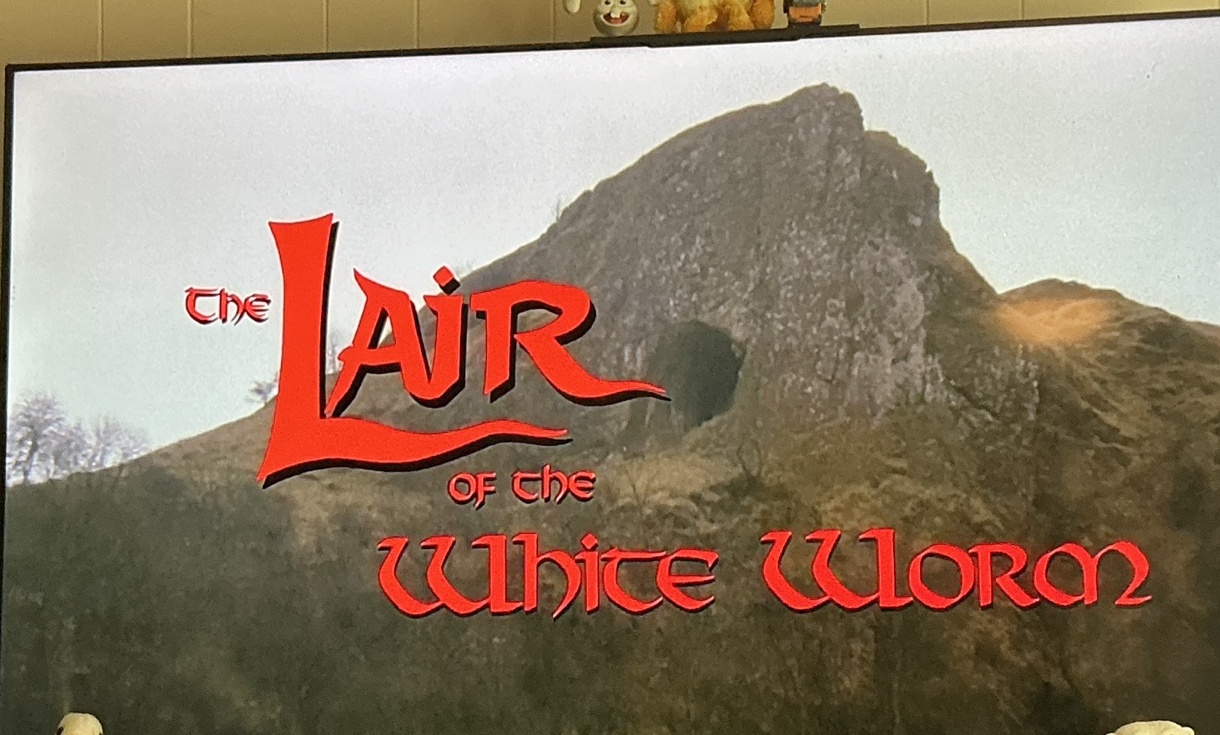
Great big rocky hilltop with a round hole, meaning cave, in it, with Vestron Pictures present lettered over it.
00:26
Title sequence: The Lair of the White Worm.
What font is that? Lair of the White Worm Sans?
00:44
Hugh Grant, Catherine Oxenberg, Peter Capaldi, and Sammi Davis as Mary. This is a real who’s who gonna be who.
00:53
Okay, this is a real surprise: screenplay by Ken Russell—expected. Adapted from the novel by Bram Stoker—completely unexpected.
Yes, that Bram Stoker. The Lair of the White Worm was one of Stoker’s final novels, published in 1911, fourteen years after Dracula. And apparently Ken Russell didn’t invent this basic premise out of whole cloth. Stoker was already playing with English folklore, archaeology, an ancient monstrous serpent and a dangerous aristocratic woman. Russell just took those ingredients and, well… Ken Russell-ed the hell out of them.
Very short version of Stoker’s novel:
Adam Salton returns to England from Australia to live with his elderly great-uncle in Derbyshire.
He becomes involved with his neighbor Sir Nathaniel de Salis, who knows the local history and legends.
The area is associated with an ancient monster known as the White Worm, a gigantic serpent-like creature surviving from a prehistoric age.
The beautiful and sinister Lady Arabella March is closely connected to the creature—and, ultimately, is revealed to essentially be the White Worm in human form.
Another local landowner, Edgar Caswall, becomes obsessed with Lilla Watford and engages her in bizarre battles of hypnotic or psychic will.
Caswall also has an enormous kite shaped like a hawk, which becomes part of an increasingly strange subplot. Yes, really.
Lilla dies during one of Caswall’s psychic confrontations; her cousin Mimi becomes Adam’s love interest.
Adam and Sir Nathaniel work out what Lady Arabella is and devise a wonderfully understated Victorian solution to an ancient supernatural monster: they try to blow the hell out of it with explosives.
The climax destroys the White Worm and its lair, while Caswall and his estate meet their own spectacular end.
The novel mixes Gothic horror, ancient mythology, pseudo-science, mesmerism, romance and some extremely peculiar ideas about evolution and race that very much belong to its 1911 context.
01:31
Focus pushing in on the cave, right before “Produced and Directed by Ken Russell.”
01:58
Dirty, weird-looking skull being picked up by Peter Capaldi. We know he’s Angus, and he screams, “Yeehaw!”
02:19
Two sisters are joking now: “If that is the primitive man, it looks like a dinosaur sat on him.” So we have Mary here and we have Eve here, both happy as a clam—or two clams, I guess.
02:39
Okay, he is digging on the family farm and found this massive skull. Yeah, that’s not weird.
03:06
Still playing happy family. “Not since we lost Mum and Dad, no.” Seems like something significant was just said.
03:20
That layer of flint is 1,000 years old. It’s the site of an old convent. It had been built when the Domesday Book was written. Doomsday Book?
03:43
“I found a couple of coins bearing the stamp of Marcus Crusius.”
04:34
Eve and Mary have been invited to a party, and she’s invited Angus along so he can drive them there. No dinner is in the offering at home, but he can eat at the party.
05:24
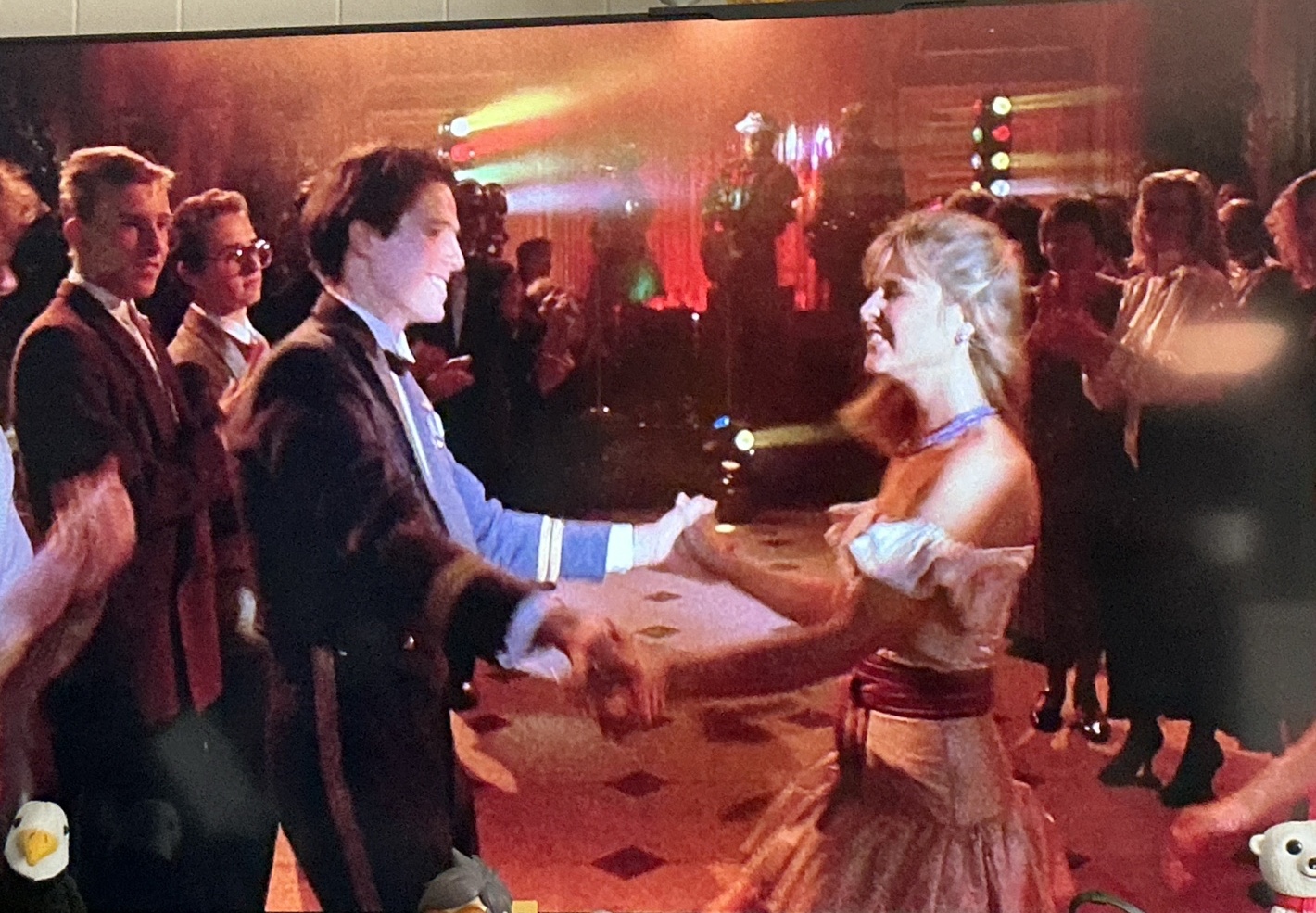
First shot of James wearing his RAF uniform.
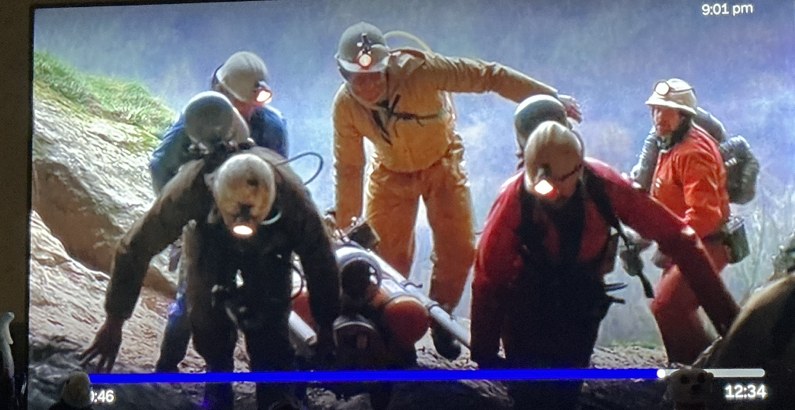
Aren’t they too old for the Bronze?
05:18
James ritualistically kills the great big stuffed worm—kind of like one of those Japanese parade dragons, whatever they’re called—in half with a sword. Barely tapped it; it split automatically. Was not dramatic, but everyone laughs and smiles.
05:46
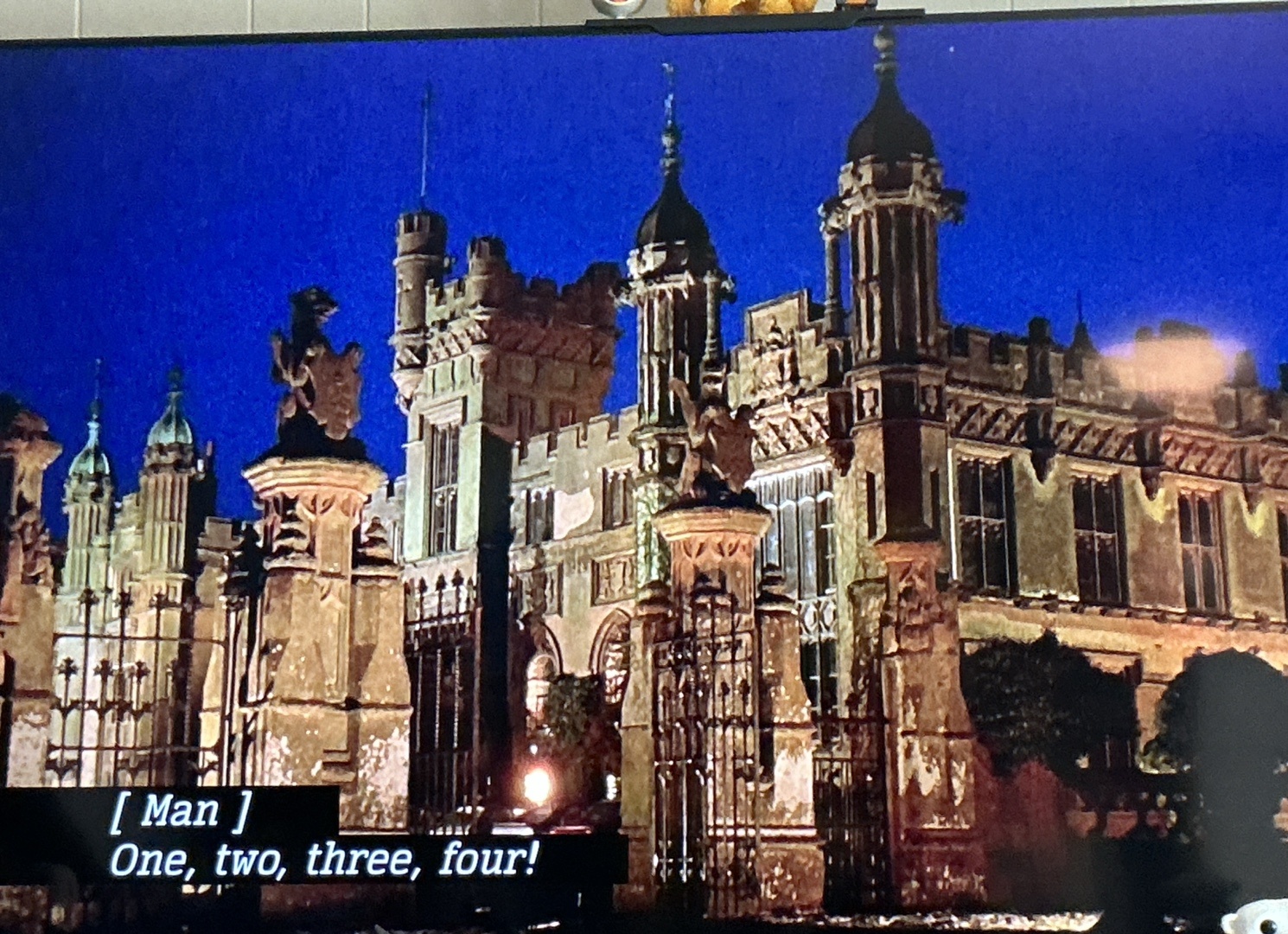
In a great big old Gothic-or-something-or-other castle.
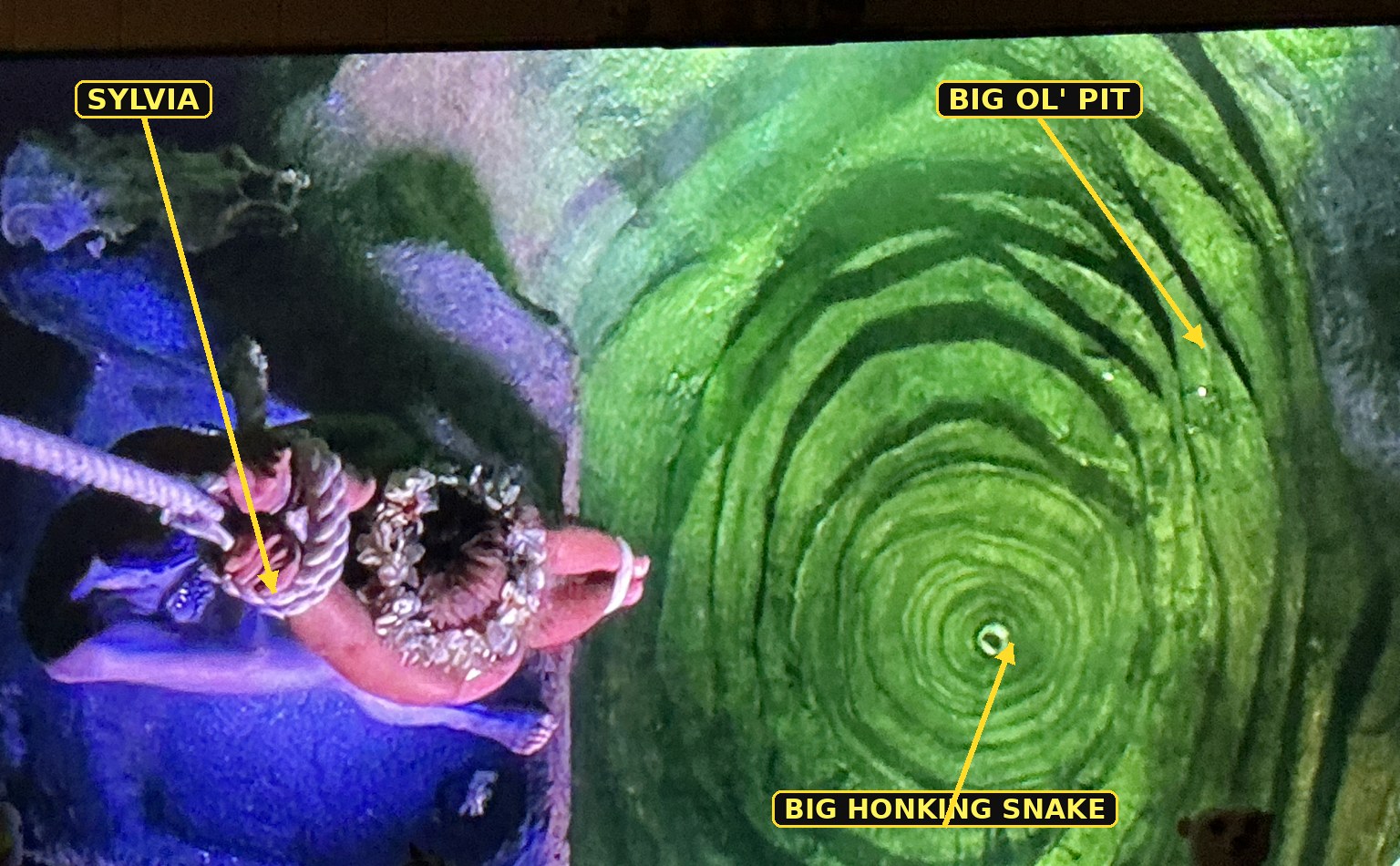
Big honking Gothic castle.
Note: The song was performed by a live band inside the big Gothic castle.
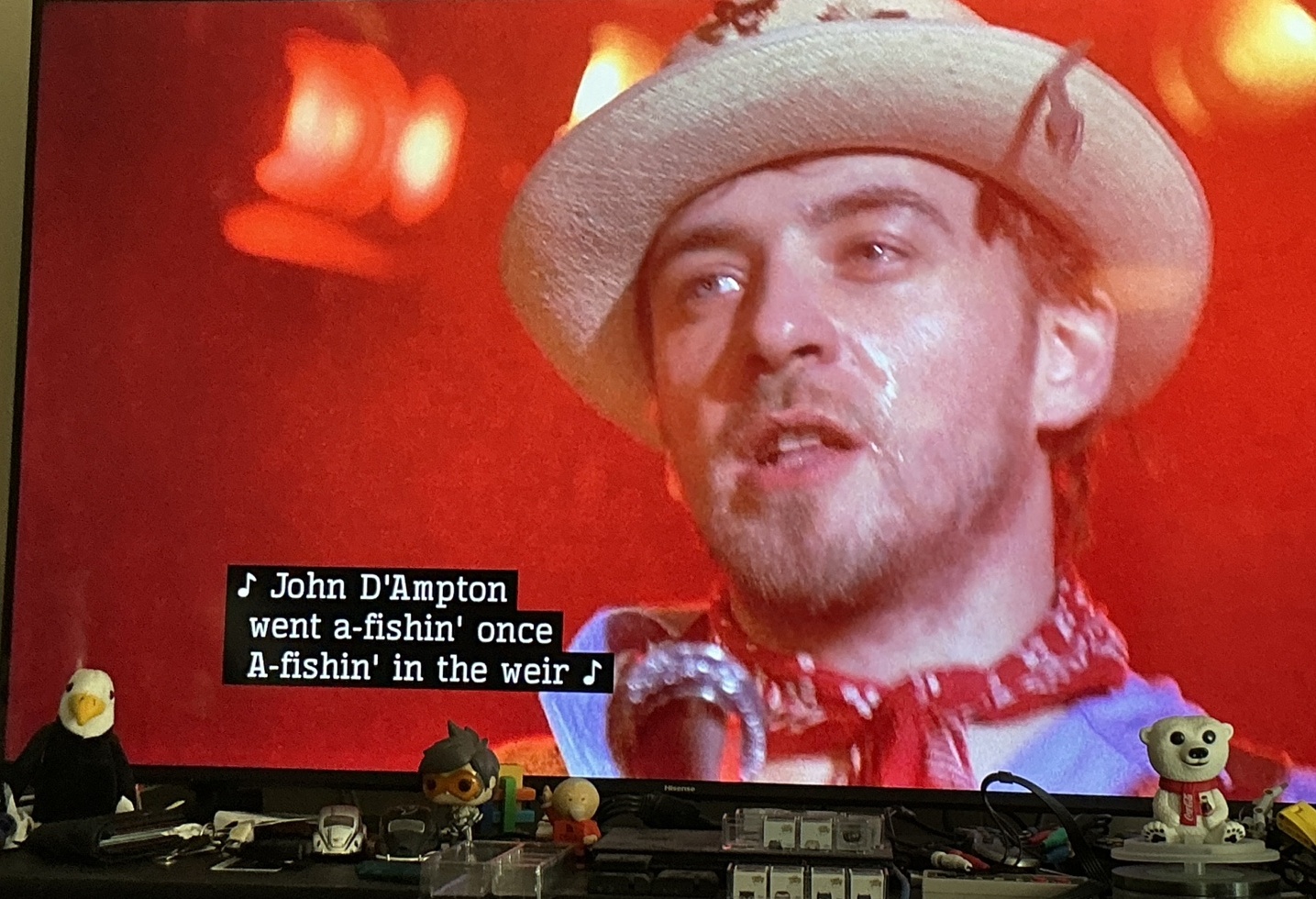
This guy rhymed ‘booze’ with ‘cows.’ I never…
06:44
OMG, singer rhymed “booze” with “cows” (“coose”).
07:38
So, turns out Angus is a paying guest of the two girls, not a relative, and they are having some exposition about the D’Ampton Worm and how the Worm is the local hero, evidently.
08:03
And James’s full name is James D’Ampton, the landlord of the estate, and he states to Angus, “We are distantly connected. Sir John D’Ampton was a valiant knight who slew the local dragon.” “For centuries, his ancestors have immortalized the occasion with an annual banquet for the locals, usually with tankards of mead and Morris dancing.”
08:54
So Angus is an archaeology student who is out here excavating, studying the Romans of Mercia, though it’s never been thoroughly excavated. Evidently, where he’s digging now—which is on James’s property—is the site of an old convent, which is also the site of this ancient Roman civilization, I guess.
09:09
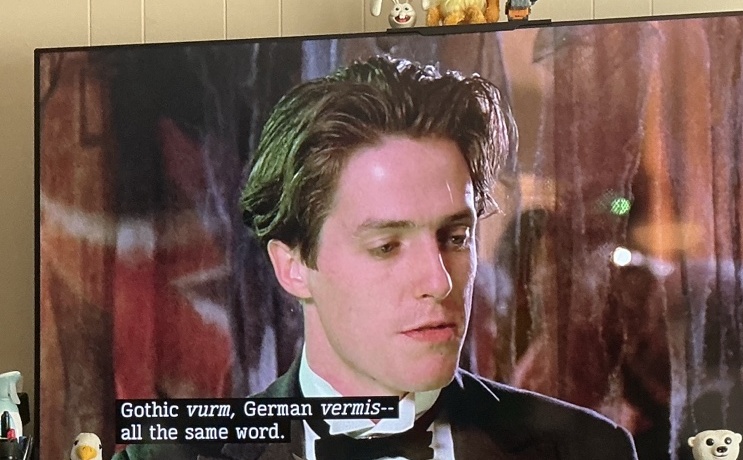
And James is basically explaining that “wyrm” might sound like “worm,” but it’s actually more like dragon or snake. Gothic vurm, German vermis—all the same word.
Unnecessary etymology lesson.
09:28
Pickled earthworms in aspic is the local delicacy. Eeeew.
09:39
Big Gothic moon with clouds drifting across it.
10:10
Angus walking with Mary, talking about Scotland and other things, and she brings up, “My mum and dad used to come this way home from the pub. It’s a neat shortcut—or was. Nobody uses it at night now.”
11:18
Okay, Mary’s just a depressive. Angus is basically flirting with her and asks, basically, if she has a boyfriend. She says, “Not now. Killed himself on a motorbike.” Yeah, that’s a hard no, dude.
11:26
He still kissed her, and it was a really awkward-looking kiss—kind of like he smashed his lips on her face and then slid off.
11:39
Mary is afraid of this car without headlights. Those look like headlights to me, but I could be wrong.
Those headlights seem awfully bright for ‘off.’
12:03
There’s a picture of the two girls and parent-looking people between them. The cop finishes his coffee while looking at the pictures.
12:39
The cop has brought her, evidently, a pocket watch. She seems very emotional about it.
12:52
It’s her father’s pocket watch, and it was found in Stonerich Cavern.
13:40
Mary relates that they saw a car with hooded lights. Says that the car went toward Temple House. The cop says, “I’ll take a look.” then goes, “I guess not an early night for me.”
14:15
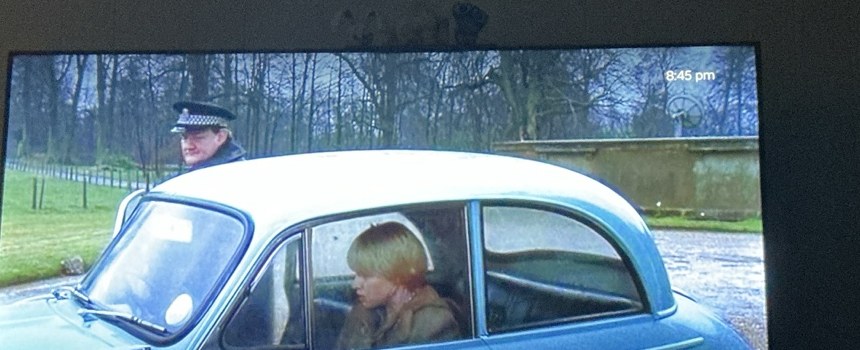
I don’t know why, but the cop parks outside the gates—which are open—walks down the path, and then jumps off the path to go behind a tree. There’s nothing in sight. Don’t know why he’s doing this.
14:30
“Hello, Charlie. Erny here. I’m up at Temple House,” speaking into his walkie-talkie.
14:48
Evidently, there’s only one cop car and the only taxi in town. The other cop had arrested him for drunk driving, so Erny is on his own.
15:33
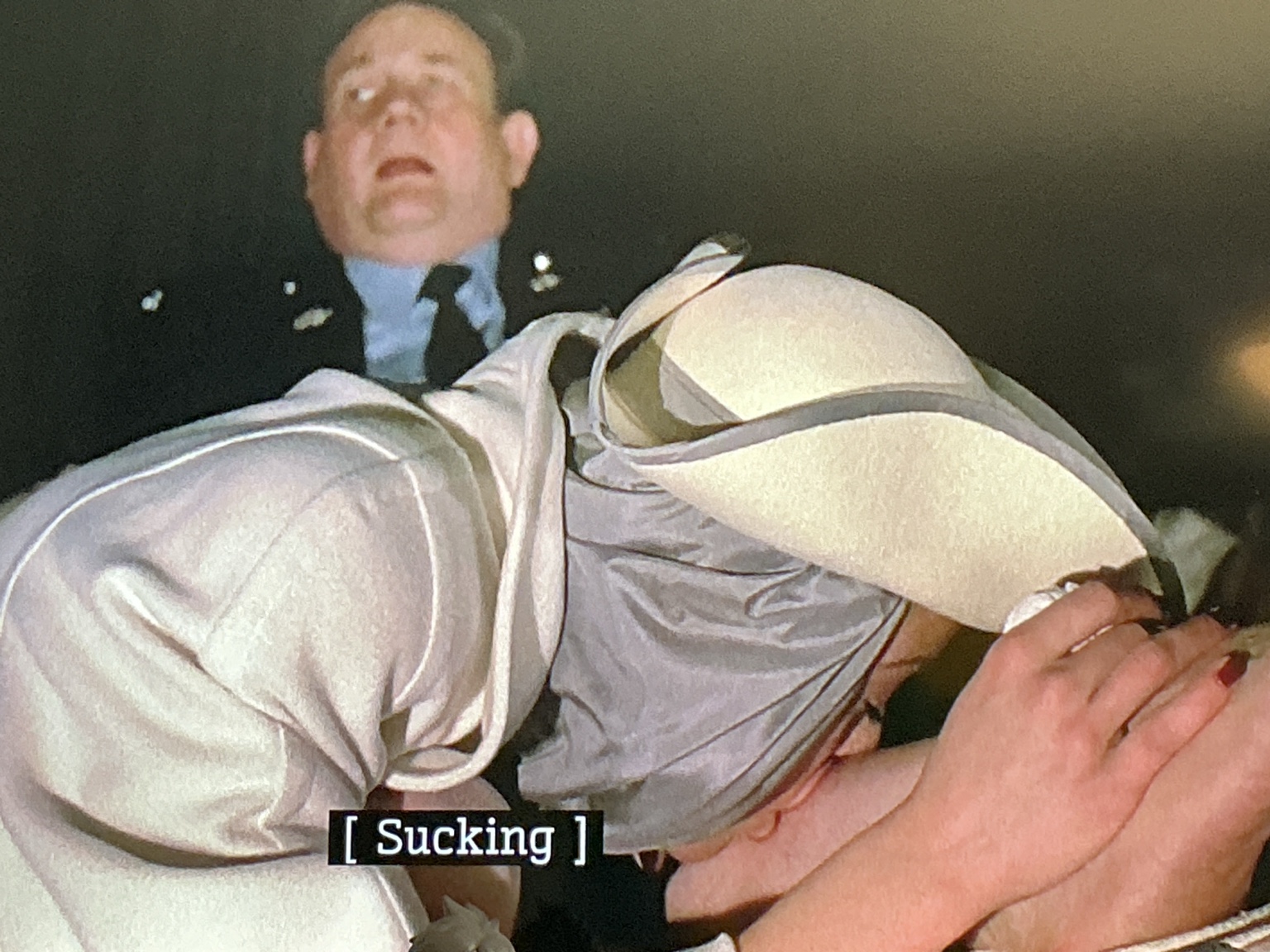
Pretty lady in a white coat and a white tricorn hat offers policeman Erny some help with the sprained ankle.
15:38
Okay, this is beyond. She’s evidently sucking poison out. Maybe it wasn’t a sprained ankle. Maybe he got bitten by a snake, but… well.
I did not see the date going this way.
16:36
Policeman Erny was investigating an abandoned house, and yet he’s totally accepted this lady as a valid occupant of this house? Despite the fact that the furniture he is sitting on is covered in sheets, and all the furniture in the room is covered in sheets or drop cloths or whatever. It’s actually very visually striking because all the furniture is covered in white, and she’s wearing white.
17:03
Evidently, she is the lady of the manor, because he said, “We weren’t expecting you until the spring,” and she said, “Oh, it is the spring. Look,” indicating something on her blouse.
17:26
She asks, “Who reported me?” Erny replies, “One of the Trent girls. Mary.” She responds, “Weren’t her parents supposed to have vanished here?”
17:52
Erny brings up the search party happening in the morning because her father’s watch was found. She asks, “Was he at the end of the chain?” and looks very smug.
18:03
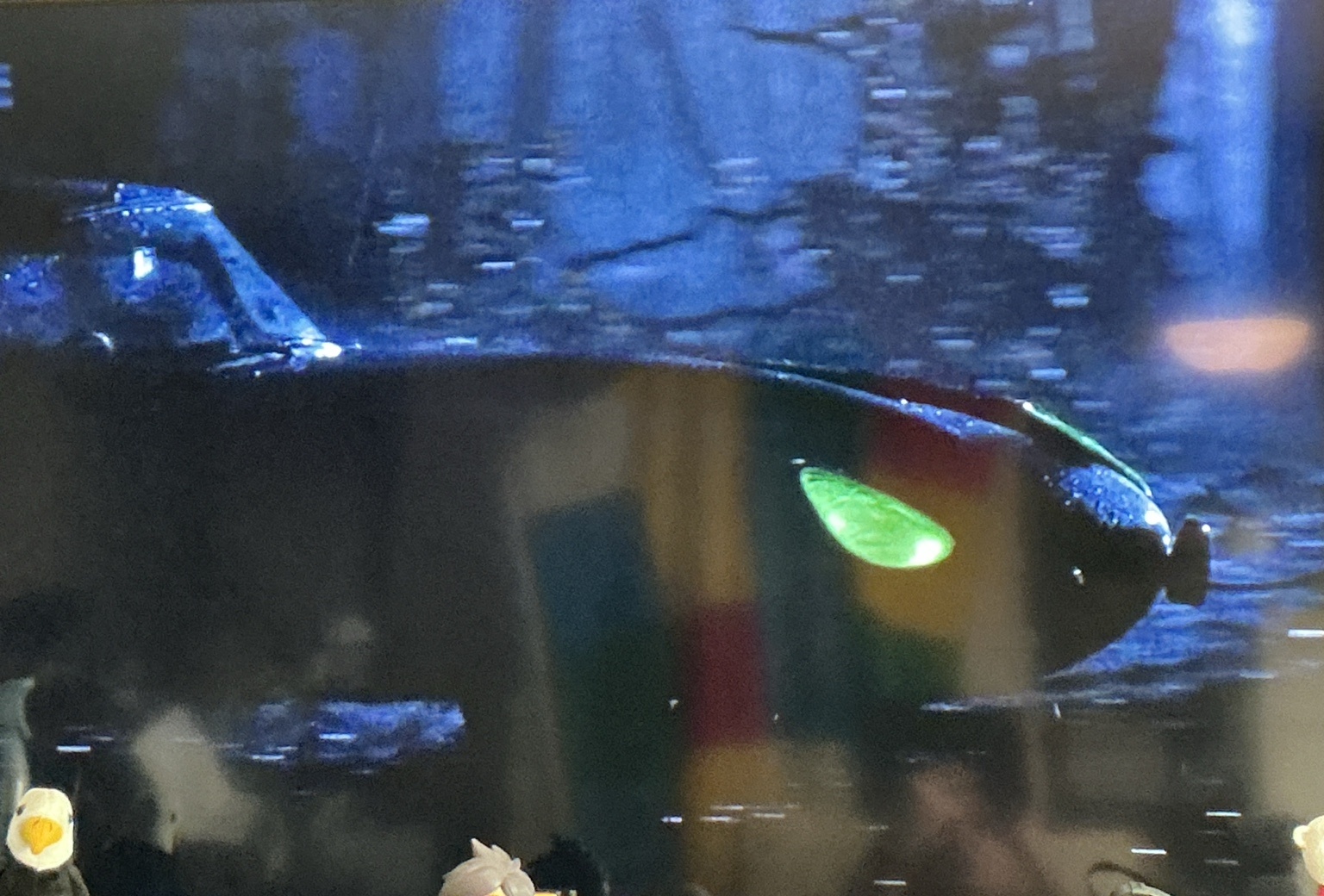
That car again, and it’s a very fancy car. Maybe much of their budget was spent on this one car. Silver Jaguar, maybe.
18:45
The pretty lady, now in brown, is looking at the excavation and has a weird smile on her face. Then she goes in the house.
19:13
She goes through the house like she just lives there. Sees a letter, puts it down; sees the watch, puts it back down. Why would such a precious thing be just left sitting on the table unattended?
19:25
The lady goes upstairs.
20:15
She looks through three rooms, sees nothing of interest, then turns to the open room…
20:16
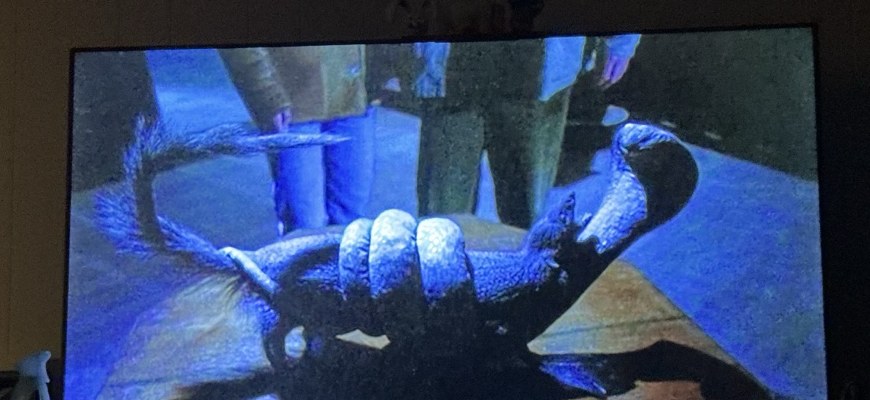
There is this forced perspective thing with the skull in the foreground and the woman all in brown with a hood over her head. She slinks into this room, she looks tiny then gets close to it and this skull is still huge, but she can put her two hands on it and she’s massaging it for no reason, with ecstasy, I guess.
22:56
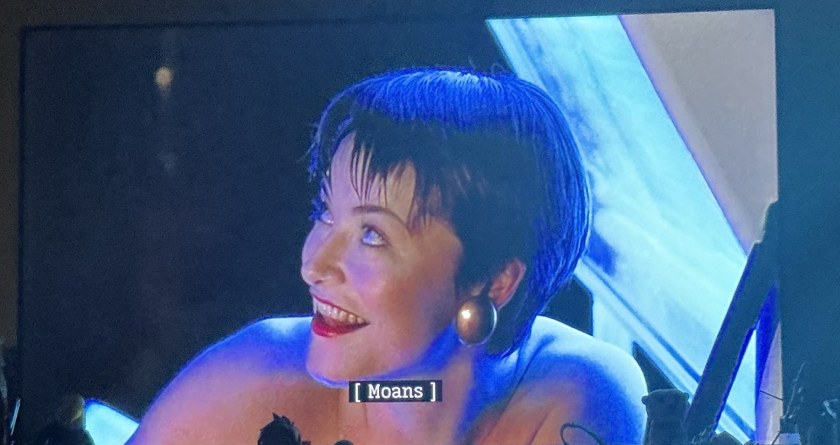
Oh my God, Sylvia , or whatever her name is just grew fangs and spit at a Christ figurine. Then runs out to her car, absconding with the skull.
😂 The hooded woman is Lady Sylvia Marsh (Amanda Donohoe)—the woman you’ve already seen acting rather suspiciously around Temple House. The enormous skull is the legendary worm/serpent skull, and the ecstatic skull-rubbing is very deliberately sexual. Ken Russell is not operating with a particularly subtle symbolic vocabulary here.
And that moment actually is plot-relevant. The fangs and her reaction to the crucifix are telling you pretty unambiguously that Sylvia is not merely an eccentric rich woman interested in the local worm legend. She’s physically/supernaturally connected to the serpent cult, and Christian objects are antagonistic to whatever she is.
But Ken Russell apparently decided that simply having her recoil from the crucifix would be insufficient. No, she has to grow giant snake fangs and HISS/SPIT AT JESUS. 😂
21:28
Jaguar is light Metallic blue, not silver. As her car passes a road T, James’ car comes into view, turning to the road Sylvia just left.
21:41
James and Eve leave the car, she enters the house, he examines the pit Angus has made.
22:20
Eve finds the note and her father’s watch, explains to James where it was found.
22:34
“Mary and Angus have gone over there, with a search party” “But only nutty potholers go down there. It’s supposed to be dangerous as hell.” “Do you want me to drive you over?” ummm
22:39
Eve says she’s going to lie down, James says he might rest, as well, chides her, playfully, for keeping him up so late, dancing. Friends, huh. Then he pulls a carrot out of his pocket and takes a bite. Pocket carrot?
22:45
Twenty Two Minutes In. Oh my God. I am 22 minutes into this movie, and it says an hour and 11 minutes, so it’s mercifully short. But I don’t know—this is going to be hard.
😆 One correction, though: The Lair of the White Worm is normally about 89 minutes, not 71. So if your player says 1:11 remaining, that’s the remaining time, not the total runtime. Which means—and I regret being the person who has to tell you this—you probably have about 67 minutes of Ken Russell left, not 49. 😆
😳
😂 I know. You thought you had 49 minutes left. You have 67. That 😳 is the face of a man who just discovered his prison sentence was calculated incorrectly. 😆
Well, at least I got this on Hoopla, which means I don’t have to watch commercials that interrupt this and allow my sanity to return for a brief minute and a half or whatever only to be ripped away again. This is just a sustained vacuuming of my cerebral capability.
😂 There is something perversely appropriate about watching this without commercial breaks. A 90-second ad for laundry detergent might allow your brain to reestablish normal cause-and-effect, and that would only make returning to Lady Sylvia worse. Skull → erotic skull handling → Roman nightmare → Jesus-eating sock worm → flaming transparent head → snake watch → fangs → spit at Jesus → skull theft → onward. No palate cleanser. No pharmaceutical ad. No cheerful insurance mascot arriving to reassure you that ordinary reality still exists.
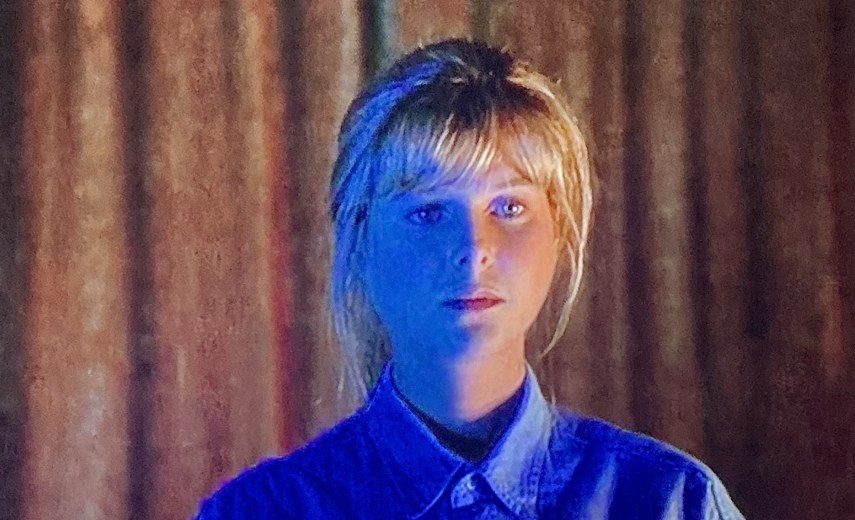
Well, the blond girl is quite pretty, there is that
😂 There you go. Something comprehensible has finally happened. That’s Catherine Oxenberg as Eve Trent. And yes, she’s striking—she was already known for playing Amanda Carrington on Dynasty a few years earlier. So when the plot disappears again, you’ve at least got one reliable landmark: “I have no idea what Ken Russell is doing, but Eve is pretty.”
But her dress is straight up bonkers. It’s like a layer cake made of fabric.
😂 It looks like the costume designer was told, “English country girl,” and replied, “Excellent, how many tiers?” “Layer cake made of fabric” is dead on. She’s got this exceptionally pretty, relatively natural late-80s look from the shoulders up, and then the camera pulls back and her dress appears to have been assembled by stacking progressively larger tablecloths underneath her.
23:43
Eve goes upstairs for her nap, sees the spit stains on the wall, and touches the crucifix/Jesus figure that Sylvia has just spat venom onto, and that triggers Eve’s hallucinatory vision
23:46
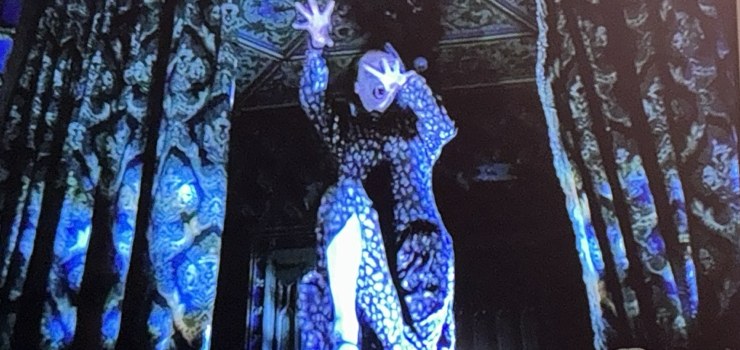
Eve has this absolutely bananas dream where Roman soldiers are evidently raping priestesses. There’s a Jesus figure getting eaten by a white hand puppet worm, and somebody wearing I guess green screen makeup has flames behind them so the flames are going through their head. None of that made any sense. And eve herself is in a nuns habit praying, though is interrupted by all this goings on. She wakes up from it, pulls a watch out of her pocket, where the second hand is a big ass snake, freaks her out.
😂 That also explains why the vision is specifically a psychosexual war between Christian imagery and the serpent religion. Eve has effectively made contact with Sylvia’s supernatural influence through an object representing the opposing religion. Which means your earlier confusion was partly justified because Russell gives you a genuinely important piece of plot mechanics and then immediately rewards your attention with ROMANS! NUNS! RAPE! FIRE! JESUS! GIANT WHITE SOCK WORM! 😂
24:17
The Roman soldiers are raping the nuns, and it what was really funny (yes, funny) is the nudity looks more like they have mole skin covering all the naughty bits.
😂 That sequence has a very conspicuous “stage nudity” quality to it. 😂 What you’re calling moleskin is probably close to what you’re seeing: some combination of modesty coverings/costume pieces and extremely deliberate posing, rather than Russell trying to make the assault look naturalistic.
24:40
I don’t know what I was thinking, this vacuuming of my cerebral capabilities has already caused problems.
24:41
James returns spontaneously as she wakes up and goes downstairs, carefully, checks the watch and—
26:00
SNAKE-SECOND HAND.
😂 At that point the movie has gone from symbolism to Ken Russell standing behind you yelling, “DID YOU GET THE SNAKE THING? HERE IS ANOTHER SNAKE.”
26:12
She didn’t remember the dream until she saw the snake hand on the watch, now, She remembers. ”After I passed out, I remember A SERPENT, a horrible thing, towering above me, coiled around a crucifix.” That’s ALL you saw?
The important thing at your exact point in the movie is that you haven’t failed to understand some crucial explanation. The movie is feeding you associations, not information: worm/serpent → pagan cult → Lady Sylvia → sex → sacrifice → Christianity → danger. The actual plot is only gradually going to catch up with the imagery.
Oh my God, this movie is crazy.
😂 The Lair of the White Worm is different because Ken Russell knows he’s making something outrageous. The giant phallic worm imagery, Amanda Donohoe writhing around, the psychedelic religious hallucinations, Hugh Grant wandering through it all looking like he’s accidentally arrived from another film—that’s largely intentional. So “WHAT WERE THEY THINKING?!” can too easily be answered with “approximately what you’re seeing.”
This also retroactively makes that insane dream slightly more intelligible. All that Christian-versus-serpent imagery wasn’t random—even though Russell presented it like somebody dropped a Bible, a snake documentary, and an acid tab into a blender.
And she stole the skull
YES! 😂 And that is actually a genuine plot development rather than another Ken Russell fever dream.
Lady Sylvia stole the skull because she knows exactly what it is and what it represents. So that earlier scene where she’s practically making love to the damn thing wasn’t merely “eccentric woman really appreciates paleontology.” The skull is connected to the serpent/worm cult she belongs to.
What is that skull made of?
😂 If you mean the actual movie prop, rather than what it’s supposed to be in the story: I don’t know of a reliable production source that specifies its material.
From how it looks and is handled onscreen, I’d strongly suspect a lightweight fabricated prop—something like molded fiberglass/resin or a foam-based construction with a hard painted surface—rather than anything remotely bone-like. The actors move and handle that enormous thing much too easily for it to be a big solid casting.
And after watching Lady Sylvia give it that enthusiastic massage, we have also established that it is apparently load-bearing enough for Ken Russell purposes. 😂
Yeah, my first thought was that it was plaster but like you said it is far too easy for lady Sylvia to pick up so yeah fiberglass seems like a better choice, but if it’s fiberglass, they did a pretty good job. I guess the budget for special effects was generous for this.
😂 Yeah, plaster was my first visual impression too because the surface has that chalky, slightly porous quality. But once Sylvia actually picks the damned thing up, plaster becomes awfully hard to believe. At that size, a solid plaster prop would be heavy and fragile.
Fiberglass over a lightweight armature would make sense, and if that’s what they used, the finish is quite good. The sculpt itself is also one of the more convincing effects in the movie—the irregularities, staining, cracks, and dull finish keep it from screaming “painted fiberglass.”
And this clearly wasn’t a bargain-basement production, despite looking delightfully cheap in certain sequences. The money seems to be distributed very unevenly: a convincing fossil skull and substantial locations, immediately followed by WHITE WORM HAND PUPPET EATS JESUS. 😂
26:13
So James sees the second-hand snake as well, and of course, that freaks Eve out and then it switches back. Oy
And Hugh Grant is just Hugh granting
26:39
Full snake on a cross mosaic in the pit. Where did that come from? Then go to look at the skull, or more properly, look FOR the skull. Angus and Mary return, looking a bit mussed up.
27:49
Eve has now actually told Angus and Mary about the vision, they’ve discovered the skull has vanished, and Hugh Grant’s James has departed in that gorgeous vintage car—which is an extremely Hugh Grant way to exit the current supernatural crisis, and now there’s a big old Boy Scout hitchhiking in the rain,
BIG OLD BOY SCOUT.
That’s Kevin, and honest-to-goodness Boy Scout, and his appearance really does change the movie’s temperature again.
28:13
And he’s now talking to Sylvia so of course my mind is going to: Oh, she’s going to eat him.
Your brain: “Well, somebody has just delivered dinner.” 😂
28:49
He willingly got in her car and now he’s looking at her thigh. oh boy
😂 Oh, Kevin. Buddy.
29:21
“Don’t worry. You’ll leave me well satisfied.”
He’s hearing, “attractive woman is flirting outrageously with me.” We’re hearing, “Ken Russell has placed a large unsuspecting boy in a confined space with a venomous snake woman who just promised for him to leave her ‘well satisfied.’”
29:44
Snakes and ladders! She is in lingerie, Sylvia, he is a MINOR!
HAVE YOU REMEMBERED THAT THIS MOVIE IS ABOUT A SNAKE?!
30:20
And he’s playing the harmonica as she is dancing. I guess seductively? I’m laughing so hard right now.
30:43
Well, he did say in the car something about a mouth organ, but I completely let it pass by without thought. and that’s what you call a harmonica if you’re kind of stupid, mouth organ. She just ripped it out of his mouth and put it on the mantle of the fireplace! I guess from that, I am to assume that she was genuinely captivated by the harmonica playing. Ah la, swami with the flutes and the cobras in the baskets
YES! 😂 It’s “mouth organ”—an old British term for a harmonica.
Oh my God I have a distinct feeling that this would’ve been better stoned.
Current status IQ 82
😂 That may itself demonstrate the problem: The Lair of the White Worm has now vacuumed away enough of my cerebral capability that I’m not getting your jokes.
31:31
The Boy Scout and the Bath
31:32
Bathtime and she puts him in a great big stone tub while she sits Scantily clad with thigh high latex boots and just sponges him with a loofah? And I’m going to state clearly, you can still be a Boy Scout through your 18th year, so he had to be at least that.
😂 Of course it’s bath time. Why wouldn’t it be bath time? And yes, Kevin is, by decree 18 years old, since breakfast.
32:13
Oh, shit just bit his dick! And she JUST said, “Come on, I’m not going to bite you.”
😂 THERE IT IS. Your prediction in the car—“she’s gonna eat him”—wasn’t entirely wrong. You merely had the anatomical location wrong.
32:47
“You are a vegetable, metaphorically speaking, The God is not a vegetarian” and now she’s telling him why you must not be afraid to die. Oh my God the laughter is ended, but I’m still laughing anyway.
33:15
Oh, she’s going to throw the skull in that big bath and that’ll make the snake rise up – and the doorbell rings. never mind
😂 You: Okay, I’ve figured out Ken Russell. Skull goes into giant stone bath, giant worm rises—
DOORBELL.
Movie: No.
33:40
I’m still laughing and she just took her booted foot and pushed his head under the water. That kind of ruins the sacrifice, to be drowned, doesn’t it, lady?
😂 Lady Sylvia, please review your own ritual procedures. She has just spent all this time establishing that the god is not a vegetarian, Kevin is apparently intended as an offering, and death is nothing to fear—and then the doorbell rings and she’s basically: Oh, damn it. Stay here.” BOOT. GLUB GLUB GLUB. Now you’re laughing while arguing with a snake priestess about proper sacrificial protocol. 😆
Having to meet it on its own terms, and it’s killing me.
😂 That’s exactly what happened. You didn’t figure out The Lair of the White Worm. You surrendered to its operating system.
34:06
Hugh Grant Conducts a Census
34:07
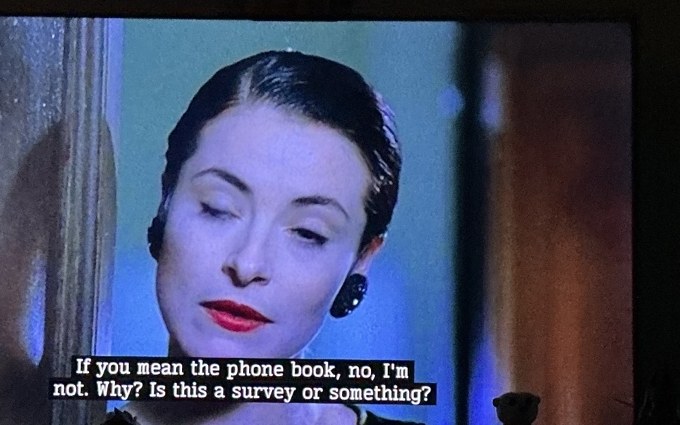
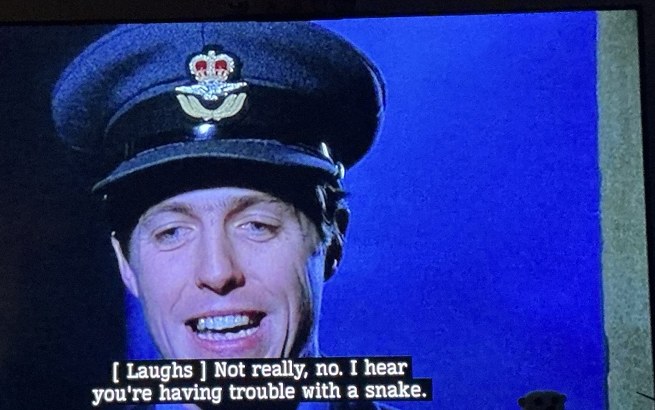
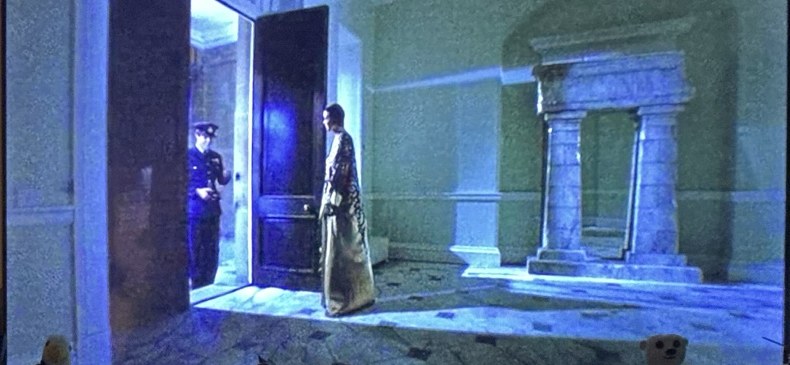
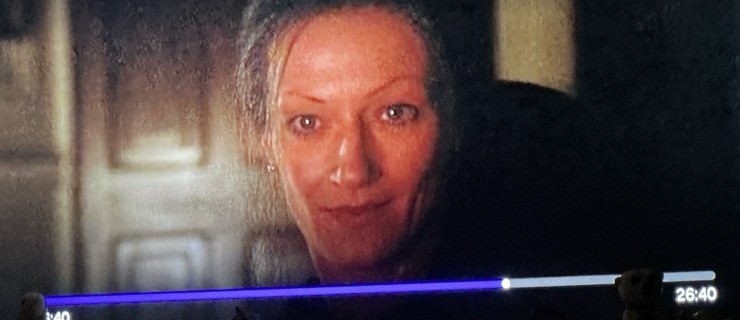
And Hugh Grant. OK I’m back to being confused. He now appears to be a baggage claim officer at her door and asking her why she’s not in the phonebook. Oh my God look at this is what I snapped
34:10
I’ve got something in my eye.
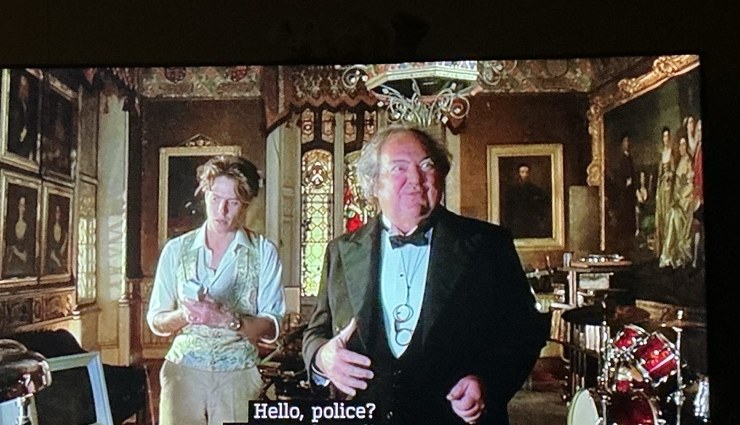
😂😂 This is a hilarious picture. That expression on Sylvia’s face is “I currently have a Boy Scout drowning in my bathtub and now Hugh Grant is conducting a census.”
What’s with that hat?
35:15
Why is Hugh Grant playing a baggage handler?
😂 That’s James/Hugh Grant wearing what appears to be an RAF officer’s peaked cap—you can see the crown-and-wings badge on the front. So the movie isn’t suggesting that he’s suddenly become a baggage-claim officer. He’s apparently using his RAF uniform/persona as part of his ridiculous doorstep investigation.
At what point in the movie did I learn that he’s in the RAF? I guess now?
I tried on one of those round hats and I do mean round. They have no oval to them at all and I don’t have a round head so it presses abysmally on the front and back and then it’s just gapping on the sides.
That is not a stairway. That is a one-foot climb to the inside of the house. There are no stairs there, that is a ledge.
Evidently there was no budget for an extra step.
OK, we have a a multi-million-pound budget, but that leaves no room for building stairs. “You’ll just have to step up.”
Ken Russell, production meeting:
“We’ve got £3.2 million.”
“Excellent. How much for the giant worm?”
“Plenty.”
“Hallucinatory Roman nun orgy?”
“Covered.”
“Snake fangs?”
“Covered.”
“Giant fossil skull?”
“Covered.”
“Thigh-high boots?”
“Obviously.”
“Can we get one step for the front door?”
“…Don’t be ridiculous. Hugh can climb.”
35:12
He introduced himself to her as her neighbor, and he’s wearing a full RAF uniform. oh my God. he just “came into his inheritance” and they’re going to drink to that? OK. Is this new information?
😂 James: “I’ve just come into my inheritance.”
Sylvia: “How wonderful. Come inside.”
Audience: HUGH, SHE JUST BIT A BOY SCOUT ON THE DICK. DO NOT DRINK ANYTHING.
35:24
There were some language issues too. he said something about “scotch” around outside, meaning to do harm, and she said, “speaking of, would you like some scotch” and that’s why he got invited in. then she asked what your poison, and he said “Brandy” and I’m like what happened to scotch.
I mean, I have heard people call it Scotch Brandy, but I believe that’s a misnomer?
😆 Scotch whisky is distilled primarily from malted barley and/or other grains and matured in Scotland. Brandy is distilled from wine or other fermented fruit. So if James asks for “a brandy,” he has definitely not accepted Sylvia’s implied offer of Scotch.
35:40
“My passion is snakes and ladders.” And James says “playing with oneself can’t be that much fun, surely.”
😂 That’s not even subtext. Sylvia says her passion is Snakes and Ladders, a game that normally requires another player, and James immediately fires back: “Playing with oneself can’t be that much fun, surely.” That is absolutely a masturbation joke delivered in Maximum Early Hugh Grant Mode—polite diction, mild expression, filthy implication tucked neatly inside it
35:50
He Very politely refuses to play the game with her and then just casually, with absolutely no thought about it, lies down on the pillow she has on the floor, in lieu of actual furniture, as though that’s the most natural thing in the world.
😂 Sylvia’s room has this bizarre “furniture is a bourgeois affectation” aesthetic—vast expanses of floor, cushions scattered around, enormous architectural features, and apparently a front entrance requiring mountaineering. And James accepts all of it instantly.
A multi-million-pound budget, and not a loveseat or sofa in sight
😂 £3.2 MILLION.
Giant worm skull: ✓
RAF uniforms: ✓
Psychedelic Jesus nightmare: ✓
Stone sacrificial bathtub: ✓
Thigh-high latex snake-lady boots: ✓
Snakes and Ladders: ✓
Chair: ✗
Loveseat: absolutely not
Single step at the front door: Are you trying to bankrupt Vestron Films?
36:38
OK, they’re referencing some disappearance by the parents of the girls. She is playing it coy, and he is like “I know it was you, woman”
😂 Mary and Eve Trent’s parents disappeared about a year earlier. Their father’s pocket watch later turned up in Stonerich Cavern, near Sylvia’s Temple House, which is why James suspects that the disappearances, the cave, and the worm legend are connected.
36:58
With much trilling of the Rs, Sylvia says “to lose one’s parents can be a terrible loss. to lose one’s parent can be considered a misfortune, to lose both looks like carelessness.
😂 Sylvia is doing Oscar Wilde! She’s riffing on Lady Bracknell’s famous line from The Importance of Being Earnest: “To lose one parent … may be regarded as a misfortune; to lose both looks like carelessness.”
37:11
And then she points out to him that it was from Oscar Wilde, the importance of being earnest and he just looks like Hugh Grant, morosely.
😆 Not confused. Not impressed. Just that Hugh Grant face that says, I deeply regret having come over for brandy. And meanwhile, somewhere in this house, a policeman is still in the bathtub. 😆
Glub glu….
These two are in two completely different movies. She is playing it to the Hilt. He’s going, yeah, OK sure, why not?
😂 Amanda Donohoe is acting at about 145% capacity: every R gets trilled, every look has venom in it, every line is THEATRE, every movement says I AM THE SERPENT PRIESTESS OF UNSPEAKABLE LUST.
And Hugh Grant is giving maybe 38%: Mm. Yes. Rather. Brandy’s nice. Floor’s comfortable. You’re probably a murderer. Carry on.
38:00
Amanda “I am chewing the scenery.” Hugh “Well, I regret to inform you that I am not scenery.”
😂😂 That is exactly their acting dynamic. Somewhere offscreen Kevin: glub. 🫧
38:18
Oh my now she is straight up lying to him. “As a child. I was bitten by a snake, was in a coma for 10 days, ever since I’ve had an aversion for them.”
😂 Lady. Your stated passion five minutes ago was SNAKES AND LADDERS. Your house is basically Serpent IKEA. You stole the enormous worm skull. You lovingly fondled it. You have snake jewelry, snake imagery, snake everything, and you just gave a policeman the world’s least reassuring bath. And she’s delivering this to James with the confidence of someone who assumes he has suffered catastrophic short-term memory loss during the brandy.
Meanwhile James’s entire performance remains: Mm. Childhood trauma. Yes. Explains everything. Do go on. 😐
38:30
She followed it up with. “I’m also fascinated with them. I’m afraid I’m terribly schizophrenic.” Oh my God! understating, from her?
😂 THAT is her idea of dialing it down!
39:00
She just put her board game in the fire
😂 James has apparently made such an impression that she’s gone from seductive serpent hostess to rage-quitting Milton Bradley.
39:17
“Rosebud” She literally said “Rosebud” as the board game burned!
😂 ROSEBUD! Citizen Kane: burns Rosebud, symbol of a lost childhood. Lady Sylvia: burns Snakes and Ladders, symbol of… whatever the hell is happening in this house.
39:36
They kiss, she passionately, he, oh, was that something on my lips?
😂😂 She is giving him THE KISS—full Lady Sylvia, maximum serpentine passion—and James receives it like someone has accidentally brushed him with a damp napkin. She thinks she’s in an erotic gothic horror. He thinks he’s waiting for the kettle to boil?
40:06
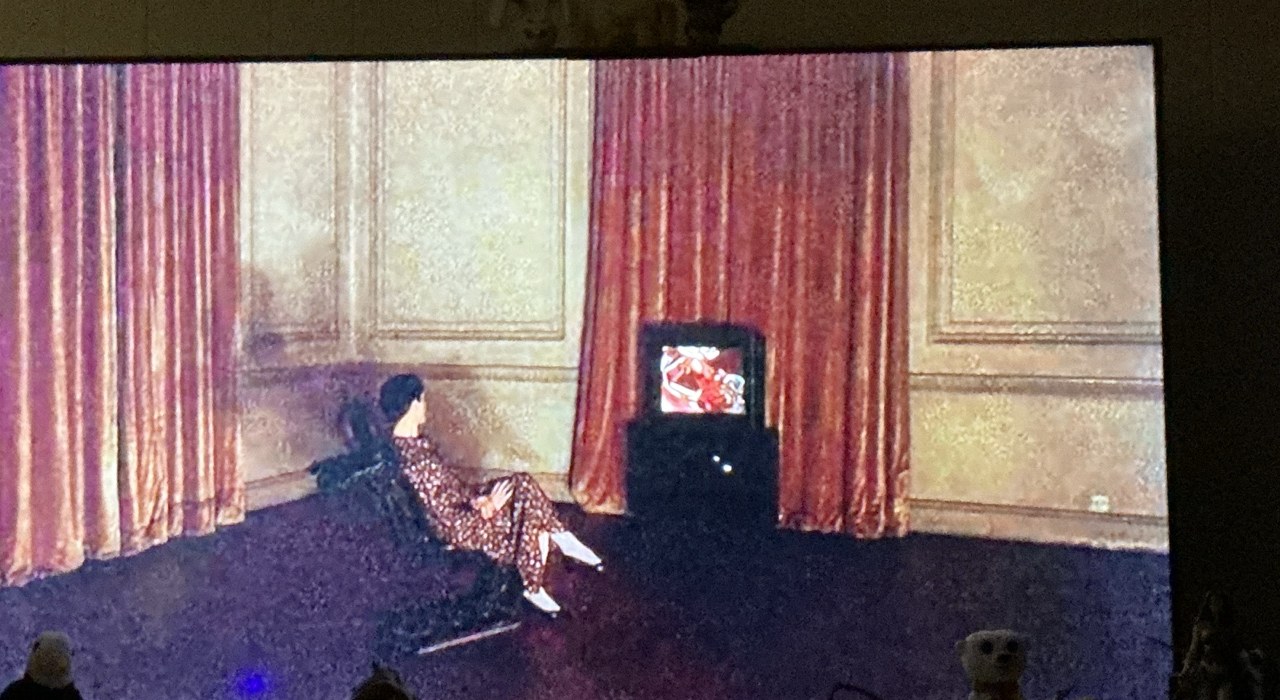
And he’s watching, there’s something on TV an old black-and-white with an egg that’s not an egg but a snake made out out of I guess papier-mâché and a big old papier-mâché egg. Oh I don’t know what’s going on.
😂 I know exactly why you’ve reached “I don’t know what’s going on” again. The movie briefly earned your trust and has now spent it all.
40:32
Oh, it was a caterpillar, it came back out of the egg, which I now understand to be a cocoon, out came a woman with butterfly wings.
There is no way that Ken found a valid ancient black-and-white silent with that content. He made it and then aged it to look like it was an ancient so that he could put it in his movie.
😂 Ken didn’t fake that footage. You just watched a genuinely ancient movie. It’s from Georges Méliès’s 1901 short The Brahmin and the Butterfly (La Chrysalide et le Papillon d’or).
40:41
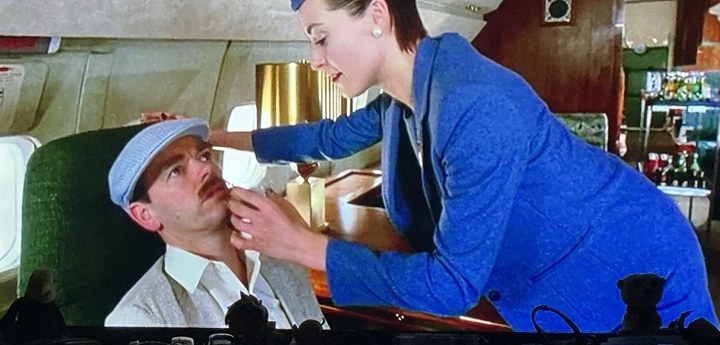
And now paintings on the wall. there’s a knight cutting off the head of a snake, and he’s dreaming of walking into a straight up roadrunner cave. You know you draw it like it’s a cave and you can walk into it and he’s back in uniform. he was in bed. He’s walking up on the Concorde.
😂 Oh GOD, we’ve entered James’s dream, and apparently his subconscious has hired Wile E. Coyote as production designer.
41:40
I think that is Sylvia as the stewardess at the door. oh my God.
😂😂 OH, COME ON, KEN. The fact that it’s Concorde is killing me. A normal airplane simply wasn’t sufficiently Freudian or expensive looking for this dream.
42:13
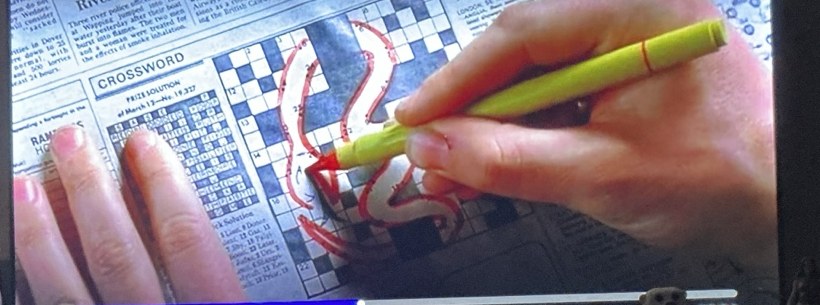
And he’s drawing on the crossword puzzle a snake pattern because that’s what the shape on the puzzle was. he didn’t force it on it. It was actually there as blank space, in a snake figure.
😂 And he’s still Hugh Granting his way through it like, Yes, yes, serpent motif, terribly clever.
And so far, it’s three different actresses as flight attendant two blondes, and one Sylvia. So. Mary, Eve, and Sylvia.
42:28
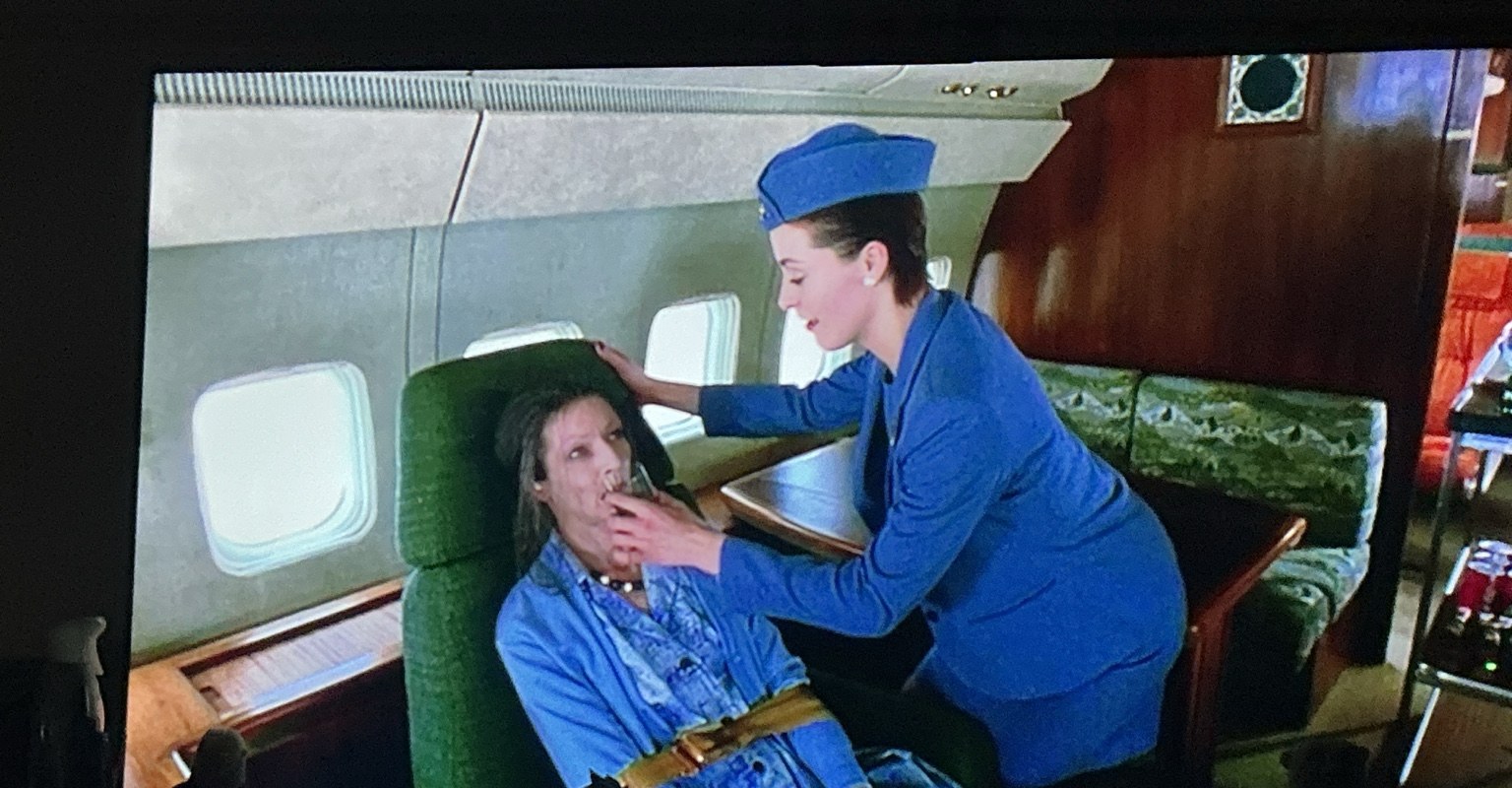
And Sylvia is now giving a drink to an old woman who is tied up in the seat. You deserve a picture
42:28
Now serving: bondage class.
😂 James’s subconscious has apparently invented Concorde: Serpent Cult Class.
That’s got to be the woman parent that’s missing it. It’s got to be something on his mind cause that’s what he was investigating.
Oh, I think I’m following A PLOT.
42:44
Boom, the father!
42:44
Bondage class, part two. We never see this guy again.
😂 And of course Dream Sylvia is still providing impeccable cabin service to the people James suspects she did something horrible to.
42:54
Snakes and crosswords?
43:08
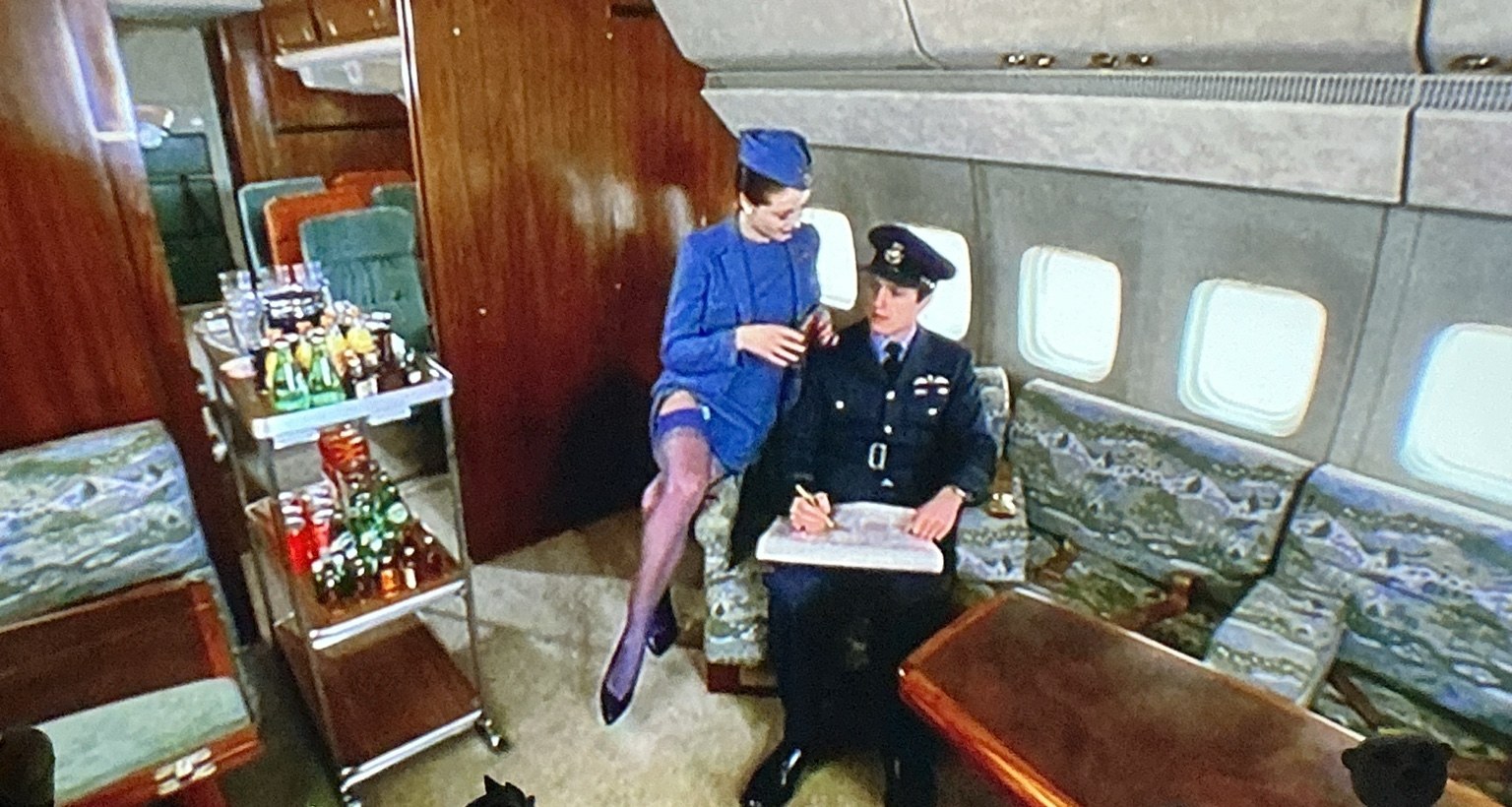
She lifted her hem purposefully, before she sat on the arm of that chair
43:09
Coffee, tea, or me… or crossword?
😂 Sylvia: LEG.
James: 🐍 crossword.
Sylvia: MORE LEG.
James: Yes, apparently seven across is serpent.
These two remain committed to starring in completely different films even inside his own dream.
43.20
Oh, now he’s got a belt on him and she’s trying to feed him some alcohol and somebody—oh, the second blonde stewardess, Eve—grabbed the drink from her and Sylvia made it spill and Eve is now burning. Evidently, it was acidic, and they’re fighting, and Sylvia has her legs around Eve’s head and he’s got the red pen in his hand, evidently that’s significant, (nope) and they are still fighting. The girls are fighting and the platinum blond stewardess, Mary, is still giving instructions about exits and stuff.
😂
“In the unlikely event of an emergency—” MA’AM. THE EMERGENCY IS CURRENTLY WRESTLING IN THE AISLE.
44:27
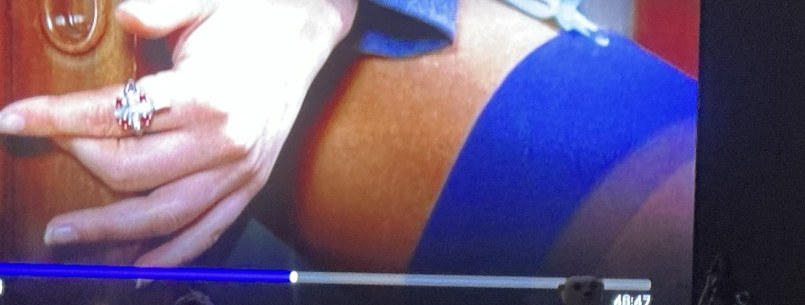
Jesus, extending one leg out and wiggling it seductively?!? And a RING!
44:30
RING! / Significant? / Religious?
44:31
The ring is significant was what that pose was.
44:47
And he got off the plane and was immediately in a cave, and he found the pocket watch again.
😂 considering where you were 20 minutes ago. The movie is still completely nuts, but we’re now actually following its nuts.
44:57
His man-servant comes in, makes a lot of noise. “Confound it. You have broken my dream.” “Perhaps it was for the best” “Yeah, I’m not going to make it to the breakfast table, Peters.”
😂 And Hugh delivers that like the dream wasn’t Concorde bondage, acid attacks, serpent crosswords, missing parents, Sylvia wrestling flight attendants, and a magic cave.
45:34
“Very well, my lord”, with the thinly disguised contempt of a manservant that was part of a will.
😂 That “Very well, my lord” has layers.
45:50
Halfway, halfway through
😂 HALFWAY. That is astonishing. We’ve already had the giant worm skull, venom Jesus, the nun nightmare, harmonica snake charming, Kevin’s catastrophic bath, Wilde quotations, Snakes and Ladders immolation, Hugh Grant’s imperviousness to seduction, a genuine 1901 Méliès film, the Road Runner cave, Concorde, restrained missing parents, acid cabin service, stewardess combat, the serpent crossword, Significant Ring™, the pocket watch, and Peters’ contempt. And Ken Russell has another half of the movie left.
46:44
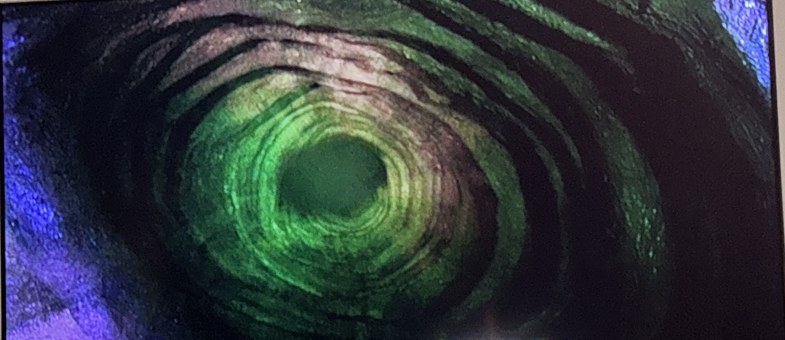
They are now spelunking in the very cave that his ancestors did something with the worm, or did battle with the worm, I think. is what he actually said, but I said did something because well it’s even less specific than did battle with. (My own expressed inner monologue is now as confused as the movie.)
😂 “Did something with the worm” is actually safer wording for this movie, because at this point I would not want to commit to the nature of anyone’s relationship with a giant worm.
52:02
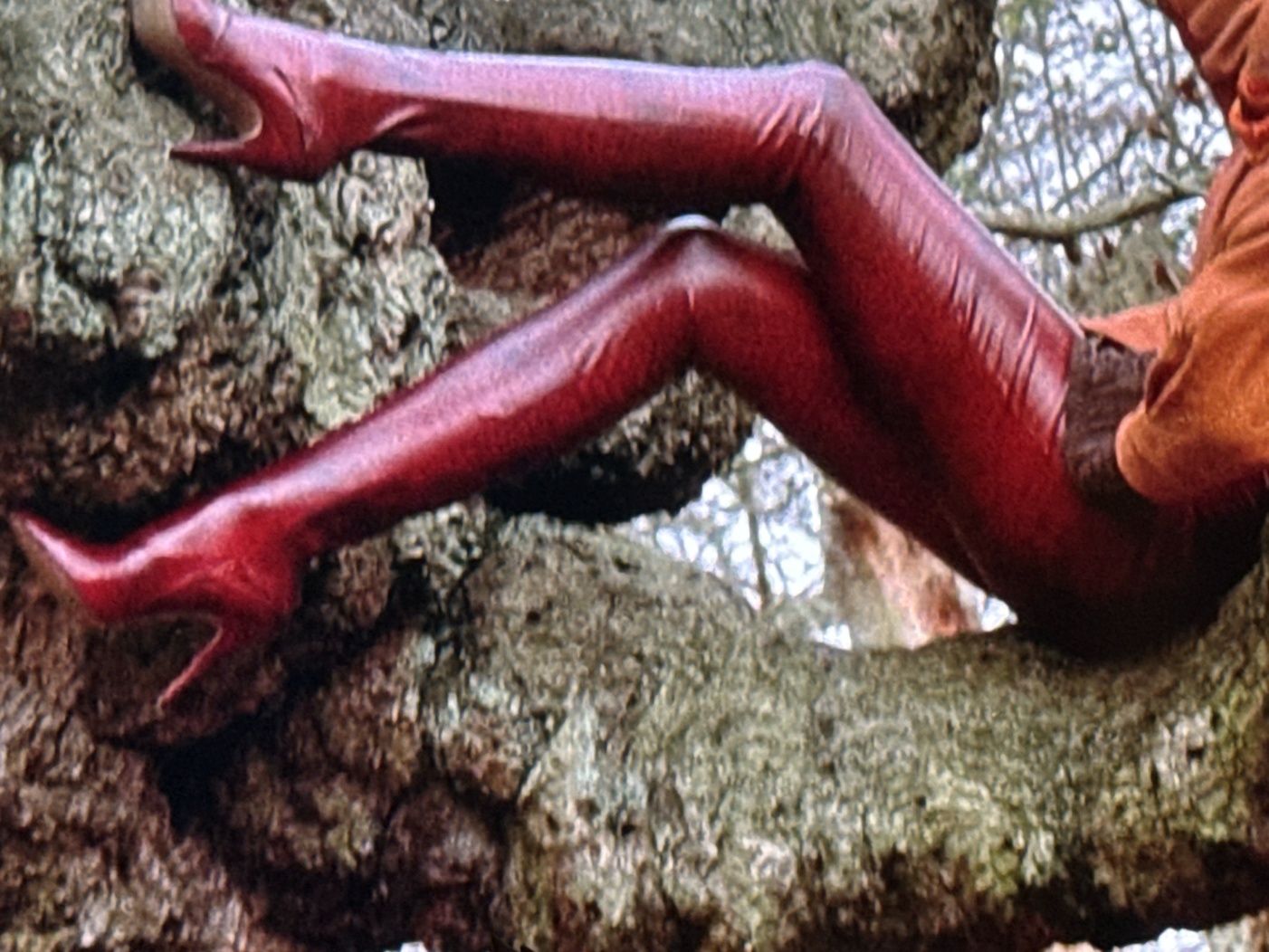
OK, they’re out of the cave and Sylvia is in a tree wearing, Oh my God, those are long red leather boots, calling down at Eve.
Those boots are so high that they might be giving her a gynecological exam.
52:02
Boots all the way up™
😂 Those have crossed the line from thigh-high boots into torso-adjacent footwear. At that point the cobbler isn’t measuring an inseam; he’s requesting a medical history and asking whether you’ve fasted. 😆
53:02
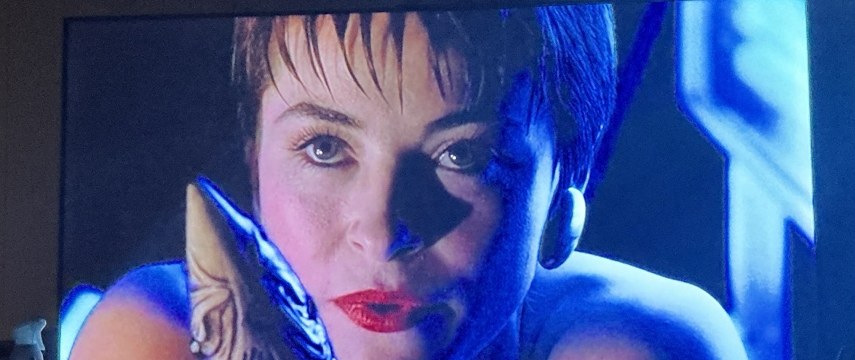
We now have boobs girl in a tanning booth. It was Sylvia in the tanning booth, and her boobs came out.
😂 THERE IT IS. thigh-high boots → even higher red boots → tanning booth → wardrobe department clocks out entirely. Ken Russell apparently reached the tanning-booth scene and thought, Sunlight? No, no. My snake woman shall be baked artificially. 😆
53:24
Sylvia just confessed that she’s immortal and that she knew Eve back in the days of her lover, blah blah blah blah blah so if Eve’s not immortal, she’s evidently a reincarnating soul and Sylvia recognizes her
53:37
And evidently, she has mesmerized Eve to tell her to take off her clothes, and Eve’s just calmly doing that no resistance on her face at all
You would think that if someone’s soul is continually reincarnated, they would have a stronger willpower. I mean, that’s what’s bringing them back one would assume, and yet, Sylvia “just do this” “OK”
😂 If reincarnation is the soul repeatedly clawing its way back into existence, you’d expect Eve’s soul to have accumulated at least a few points in Mesmerism Resistance.
Instead:
SOUL: I have crossed centuries. Death cannot contain me. I return again and again.
SYLVIA: Take off your clothes.
SOUL: Well, those are compelling instructions.
54.17
This is passive Eve, I think. Very subtle. OK.
😂 THAT FACE.
54:25
Mine is bigger than yours.
54:28
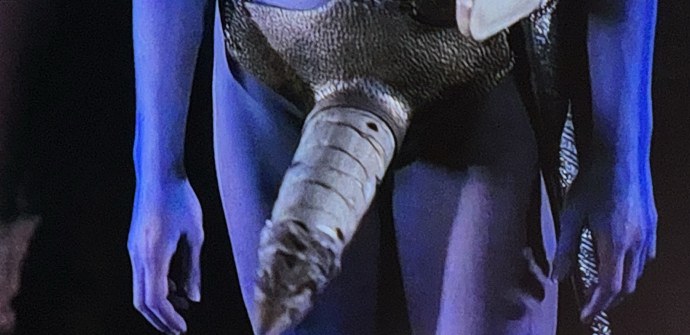
Oh, there’s some contempt! “When your order tried to build a convent on top of my sacred temple” with the rising intonation while she’s holding up a rather threatening-looking, I’m going to guess, sexual appliance.
54:40
Sylvia said “that’s enough” because Eve had already taken off everything except the shirt, and she said she doesn’t want her to catch her death of cold. She obviously wants her to catch the death of that huge horn shoved into her, in some fashion.
Plus, she’s the only one that had nudity in her contract.
😆 And that object is so aggressively phallic that I’m not going to pretend Ken Russell didn’t know exactly what visual association he was creating.
Sylvia keeps talking about the Virgins and you know, the Catholic faith so that’s got to be what’s going to be happening. Sexual non-innuendo.
😆 that’s where the scene is pointing symbolically, at minimum. She’s repeatedly invoking virginity, Christianity, and the desecration/replacement of her older serpent religion, while Eve is apparently connected to that ancient conflict through her previous incarnation. So Sylvia isn’t just being sexually threatening for the hell of it. In her own mythology, Eve seems to represent the Christian virgin figure/enemy from the old days, and Sylvia is reenacting or reversing something from that conflict.
This is a question I should’ve asked earlier, but is Eve a nun? Literally, when did that information become part of the movie?
55:13
“Virgins… are really… eligible… for human… sacrifice.”
55:30
They did not show anything, but she made the motion like she was moving that horn and Eve made a gasp and this is the look on Sylvia’s face
55:31
Christmas? For me?
55:40
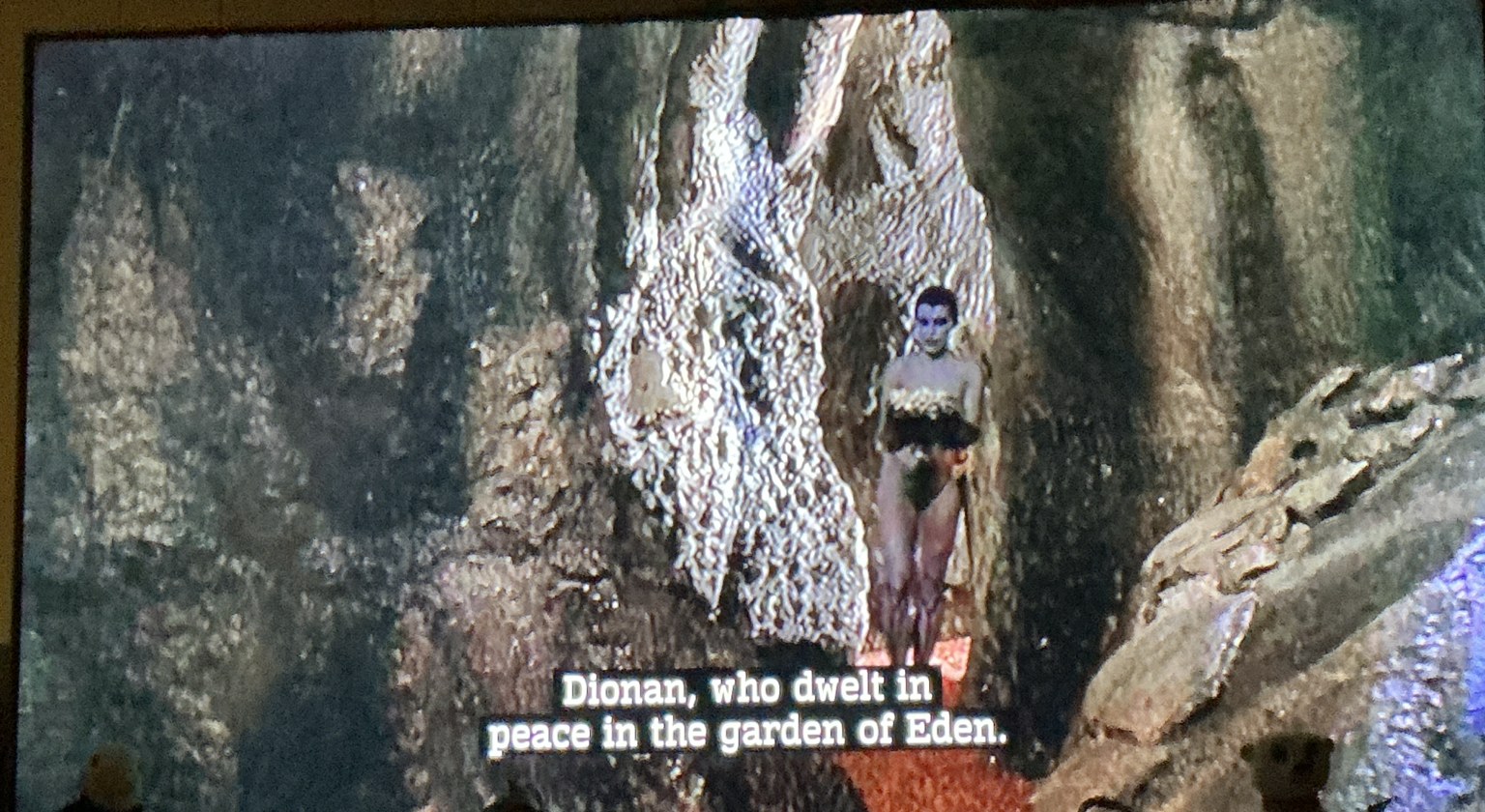
“You have been a good girl Eve.” “You will have the pleasure of being sacrificed to Dionin alive now. Where did you tell the others you were going?”
56:13
And she just told Eve to make excuses to her sister, that things are too much, and the phone’s on the bar, so, go do that now.
56:54
“I’m going to London… for a few days of peace and quiet… on my own.” Eve keeps staring at her ring, which is making me think she’s about to break out of the mesmerism: Oh, what’s going on? I don’t want to die. I’m predicting that part. The ring is where I paused.
57:27
She started to say what was really going on to Mary on the phone, and Sylvia came out with the big old teeth, spit at her and now she’s in the middle of another vision.
😂 Eve gets as far as mechanically delivering Sylvia’s cover story, the ring catches her attention, and suddenly the script Sylvia installed starts failing. Eve begins telling the truth—and Sylvia immediately goes FULL FANGS, spits at her, and throws her straight back into Vision Land. That makes the ring even more interesting. We now have two separate moments where the movie has deliberately emphasized it: James’s dream singled it out, and now Eve looking at it appears to disrupt Sylvia’s control. Whatever the explanation eventually is, that is absolutely not incidental jewelry.
57:31
Ken Russell Screensaver™
57:32
Ken Russell screensaver™.
57:29
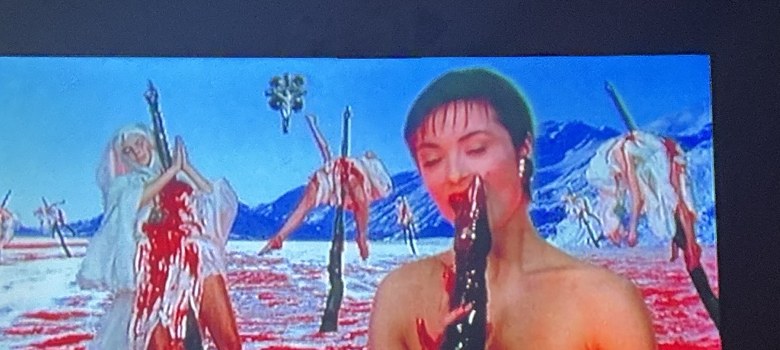
Nuns on spikes, nuns dead, Sylvia giving blow job to big stick thing, bare breasted. Jesus hovering in the middle of the sky
😂 YES. The Ken Russell Screensaver™ has achieved FINAL FORM.
57:43
And Sylvia just took the ring off of Eve’s finger and Eve’s twitching like she’s in the midst of a seizure, which I guess she is.
😂 So the ring has now had a very deliberate little trajectory: James’s dream: RING, LOOK AT THIS. Eve under hypnosis: notices ring → starts breaking Sylvia’s script. Sylvia: venom-spits her into Apocalypse Screensaver. Afterward: takes the ring away.
58:03
Warning: exposition ahead.
58:03
Oh, that is Eve’s sister because she’s right by the phone. Logic rules! (Oh no, I’m understanding this movie!)
58:11
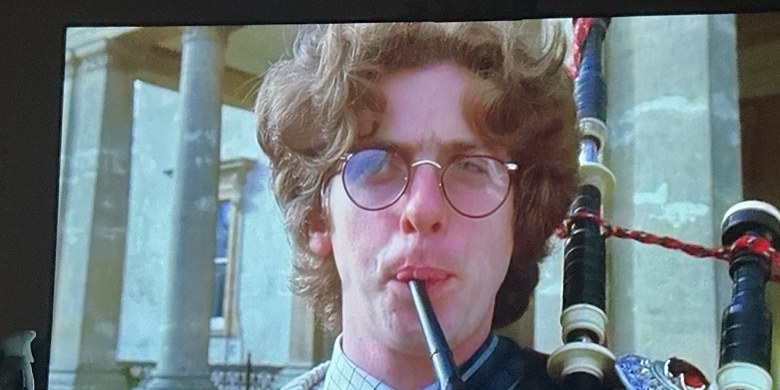
And look at that guy with the glasses he kind of looks like what Hugh Grant would look like if he tousled his hair and put on glasses
😂 I know we saw this guy before. I think he’s the archaeology student who found the skull originally. (He’s played by Peter Capaldi, the Twelfth Doctor!)
58:40
“Is that you Ray? yes Roy I, meant Roy. It’s me, Mary Trent at Mercy farm” she’s not smooth
59:16
Roy is at the train yard I think because she’s asking him to look at the yard the whole thing to see if his sister’s there
59:37
Mary just ran off randomly to go look outside the front door and Angus took over the phone. Roy had no sign of her and was given instructions to call Mercy Farm if news does come.
1:00:03
Angus gave the instructions and was going to give the message to Mary but then Mary came back in and said none of Eve’s clothes are gone.
Right about now I’m realizing the Concord dream was making more sense, the three girls fighting for his soul? Or no, his attention? OK, not sense, but semblance of sense. More so than the rest of the movie.
1:01:08
Angus: “The Romans often assimilated ethnic religions into their own. The skull could’ve been venerated as a sacred object.” Mary: “What’s all this got to do with Eve?” James: “Quite a lot when you consider that hallucination.” A: “Aye, she saw the snake then, right enough.” M: “And a cross, don’t forget that. She doesn’t go to church or any of that stuff, but she’s quite religious is Eve.” J: “It seems to me there’s some kind of conflict going on here. If Angus is right and it’s also the site of a convent then it’s conflict between Christianity and some early pagan cult. Possibly even involving human sacrifice.” A: “The cave drawing would indicate that.” M: “You’re not suggesting…” J: “Which way would Eve have walked home?” M: “Through the Grove, of course it’s the only footpath.” J: “And why is Temple House so called?” M: “Everyone knows that from school. It’s the site of an old temple. It’s obvious from the name.” J: “The same way. It’s obvious that Stonerich Cavern has something to do with the D’Ampton worm.” A: “Maybe there’s a connection.” M: “You’ll be saying there’s a connection between all this and Erny’s snakebite, next.” J: “And Snakes and Ladders.” A: “What do you mean snakes and ladders?” J: “Lady. Sylvia. Marsh.”
Dammit, there is a plot
But there is still no logical reason for those parents who have disappeared if Sylvia is not sacrificing him what is that about?
1:02:05
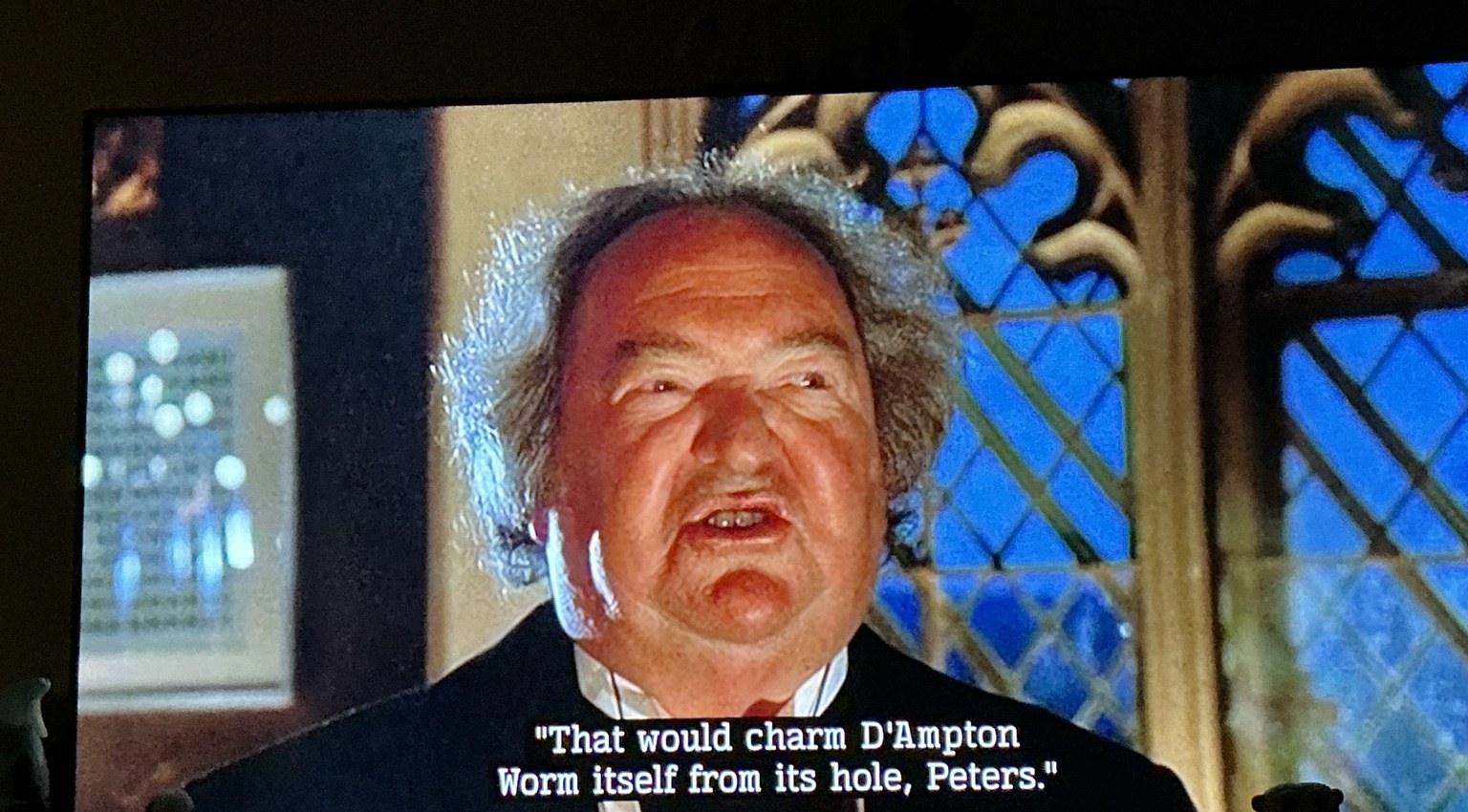
OK, this is funny. He’s digging through this record collection, and he’s asking Peters. “Well my father had something about the ‘soliloquy of a snake charmer’ and I can’t seem to find it and of course Peters is like dithering, so I’m going to have to guess that Peters is actually a snake guy and he hid that.
1:02:25
Take it back Peters is actually helping. He told him to flip the record over and there was, the snake charmer thing.
1:03:27
Oh, goody!
This is evidence that this movie would not work in a modern setting. You can’t flip a CD over, maybe you can flip a cassette tape over, you can’t flip an 8-track over. You certainly can’t flip a Spotify over.
1:03:43
“Put your bicycle clips on, Peters. I’m expecting company.”
😂 But bicycle clips is the detail that kills me. Presumably he’s thinking practical protection against something slithering up the trouser legs, but it sounds like the most aggressively British monster-hunting preparation imaginable.
1:03:47
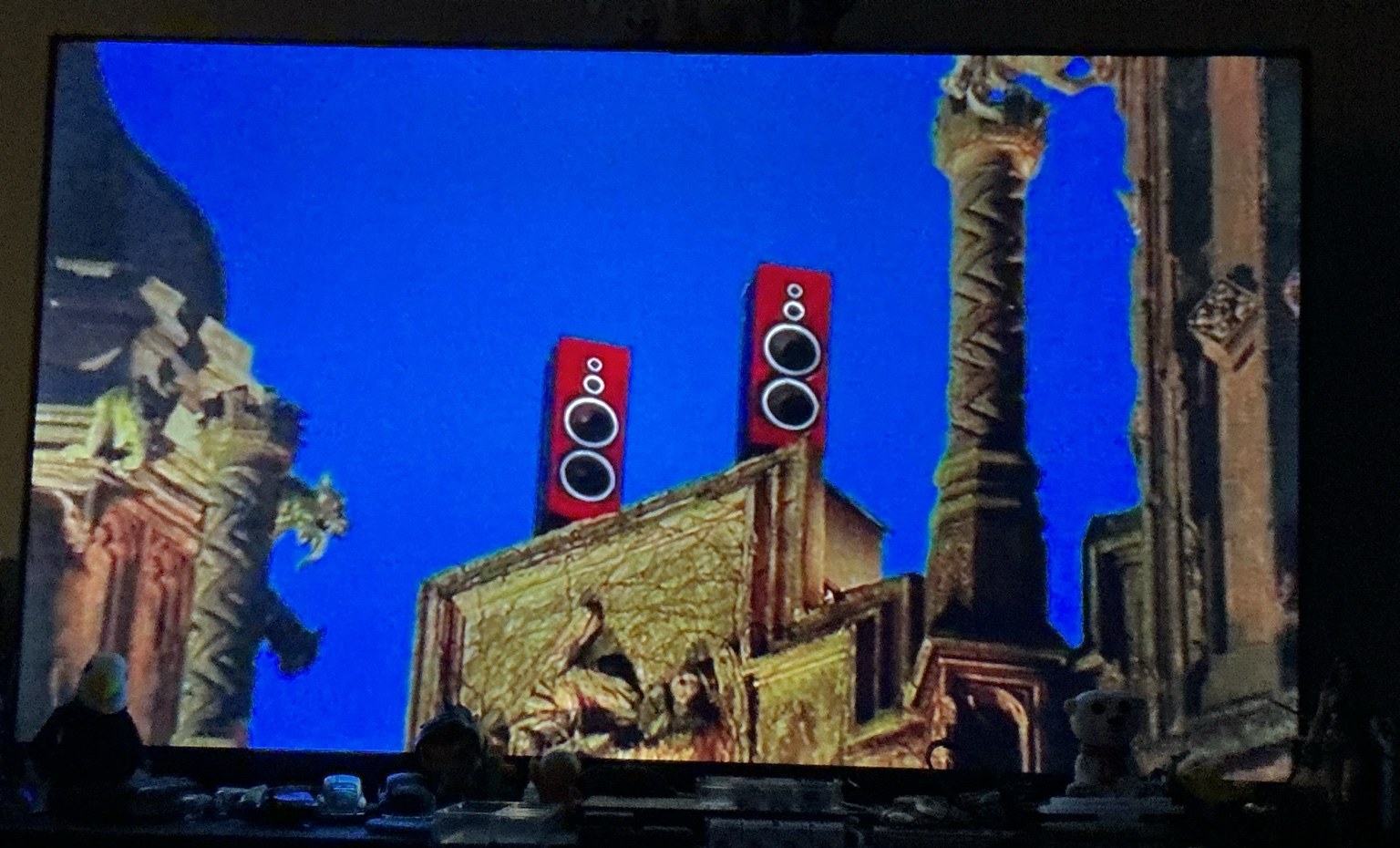
Is it real, or is it Photoshop?
If that is not Photoshop, I’m a monkey’s uncle
😂 Since this is 1988, not Photoshop in the literal sense—but absolutely the analog/video-effects equivalent. Look at those enormous modern red speaker towers planted behind the ancient-looking ruins against that impossibly saturated blue sky. The scale, edges, lighting, and perspective aren’t even pretending they’re sharing physical space.
1:03:51
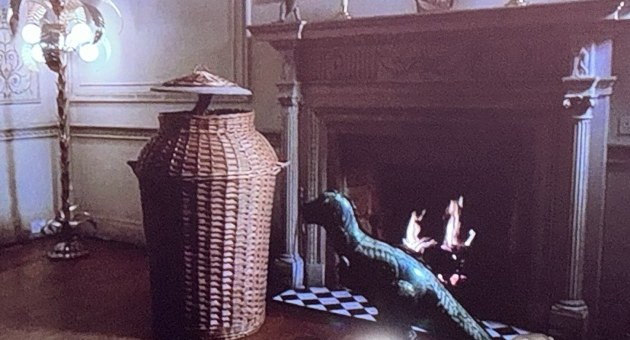
Why is there a dinosaur?
1:03:54
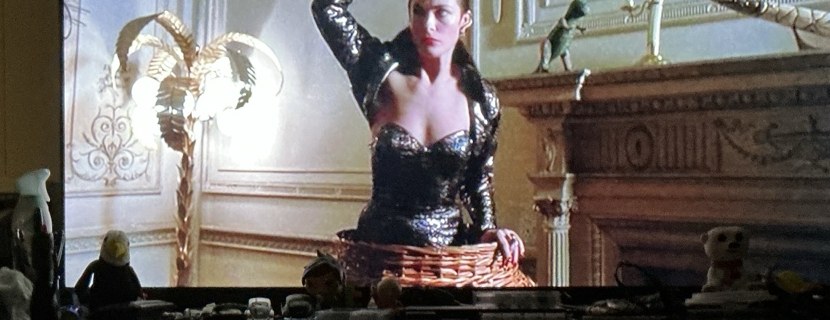
Dinosaur, basket, why?
1:03:57
Why was she in the basket at all?
1:04:04
OK, seriously, why was she in the basket in the first place?
1:04:09
Snake: charmed?
1:04:20
OK, I guess this is sexy?
1:04:33
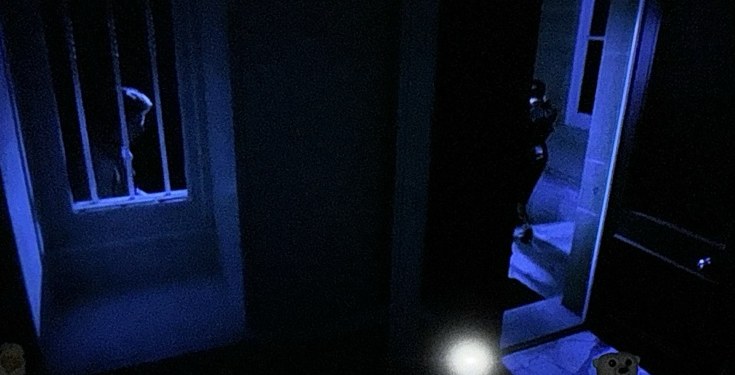
She has exited the building following the music and they’re lurking outside going to sneak in while she’s gone. Oh, this is straight up Scooby-Doo now.
If they say Jinkies, I’m gonna screenshot that for you
1:04:35
Scooby-Doo, where are you?
😂 The Lair of the White Worm (1988) An unauthorized adults-only episode of Scooby-Doo in which Daphne became an immortal snake dominatrix and Fred is Hugh Grant with bicycle clips. And they’d have gotten away with it too, if it weren’t for those meddling archaeologists and their gramophone record. 😂
1:04:55
There was this long exchange where Angus is looking at this emperor statue and Mary’s like “loads of people have emperors” “Not of this one, this was the great rebel emperor, which of course I’ve never heard of so it’s got to be a movie invention and Lady Sylvia has them in her parlor so yeah, OK significant
😂 They’re talking about Marcus Carausius, a real Roman military commander who seized power in Britain and northern Gaul in the late third century and effectively ruled there as a breakaway emperor. The movie even established Sylvia’s connection earlier when she called Carausius her lover. The dialogue here explicitly connects the statue to the Carausius coins Angus found at the dig.
Dammit. There continues to be a plot.
1:05:45
“What is it?” “It’s a mongoose, traditional enemy of the snake.” they paused very significantly, that’s going to have to come in. That is Chekhov’s mongoose.
1:05:45
Mongoose, natural enemy of the snake—or so we were told.
Of course, if Chekhov’s mongoose is just introduced, then this is the beginning of the movie.
😂 ACT ONE, SCENE ONE: Here is a mongoose. It kills snakes. Remember that. Ken Russell: Nah. Give me an hour first. I have Concorde, naked Jesus, Roman nuns, venom hallucinations, Hugh Grant on the floor, and a virginity-testing horn to get through.
Then, with maybe a third of the movie left: “By the way—MONGOOSE.”
Chekhov is sitting in the audience looking at his watch.
1:06:11
OK, very confused. We just saw Sylvia dance out of the house and yet now she is there calmly watching a person giving a blow job using a snake as the dildo on TV.
1:06:11
Whistler’s Sylvia with a TV?
1:06:38
Ooooooooh it’s the mom!
1:06:43
Mommy?
1:06:47
Uh oh, mom is a big snake woman now and just bit Mary in the neck
😂 OH SHIT. MOM DIDN’T JUST GO MISSING. MOM GOT RECRUITED.
1:06:56
Angus grabbed a stick out of the fire, did not burn himself. His hands flashed it at the mom, and she ran out of the room, then he just tossed it back in the fire. quite efficient and Mary is now having a hallucination.
😆And now Mary is hallucinating, so the neck bite definitely had an immediate supernatural effect of some kind. We’re back in KEN RUSSELL SCREENSAVER™ MODE.
1:07:00
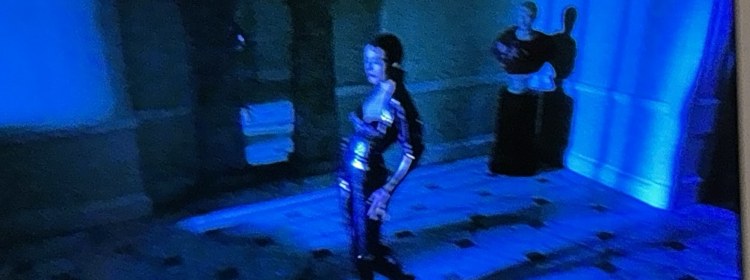
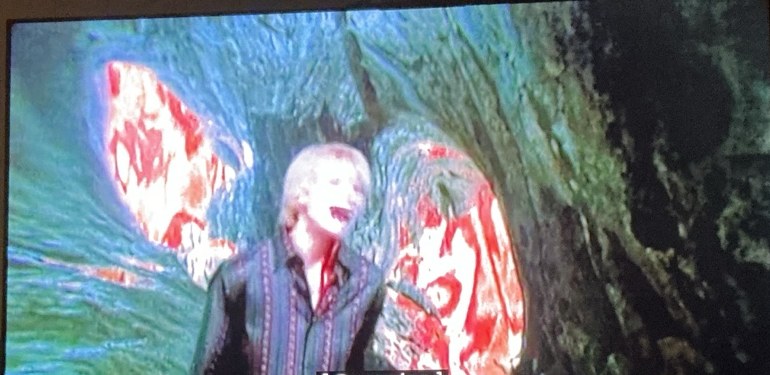
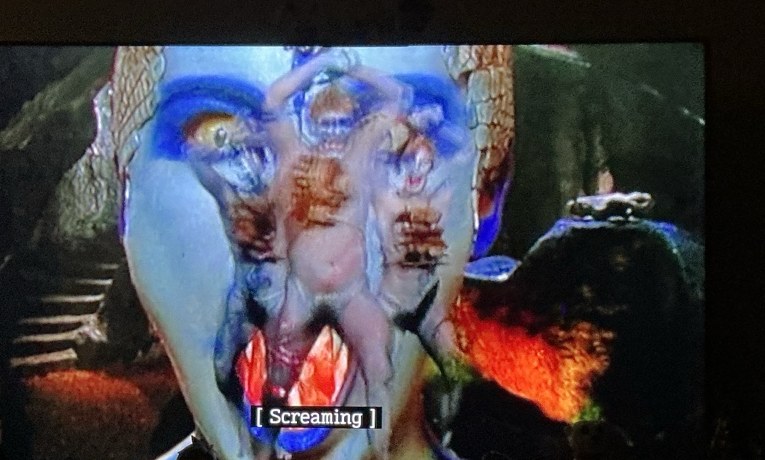
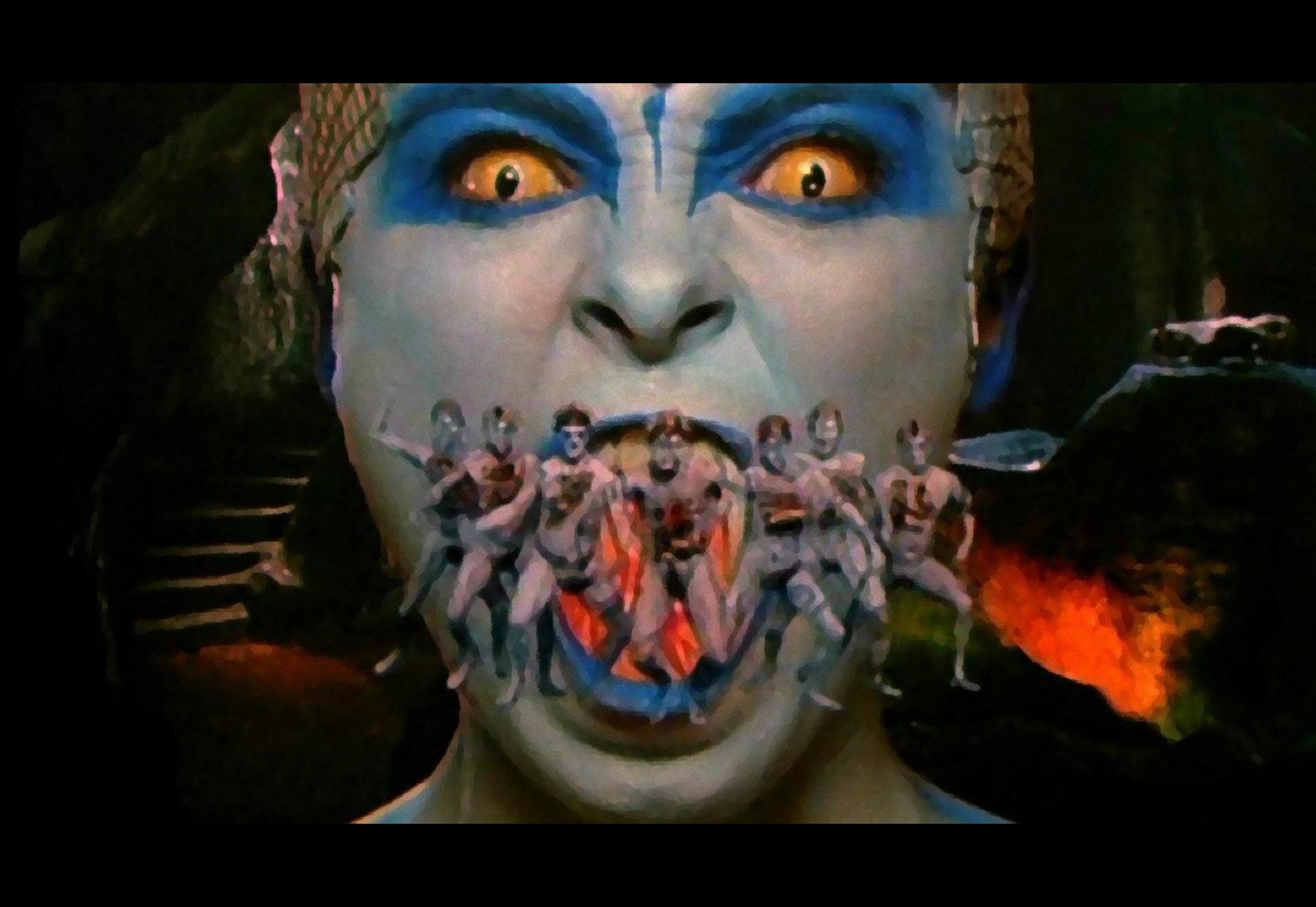
Mary screaming in a psychedelic screensaver
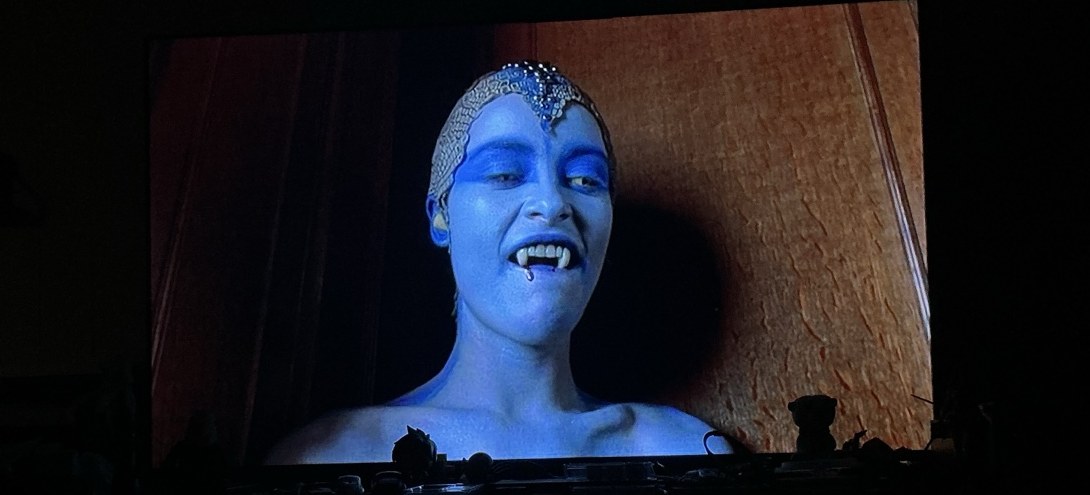
1:07:01
Face, body, blue… what?
1:07:02
And Dudes are running out of that big blue face, it’s just weird
1:07:02
Snake eyes, blue mouth, men coming out of it. OK.
1:07:05
Hey, we get it: blood, psychedelic visions, blue.
1:07:09
Ken Russell runs out of ideas and throws all of them at the wall.
JESUS CHRIST. 😂😂😂 KEN RUSSELL SCREENSAVER™: DIRECTOR’S CUT.
Well, licking some toads can cause hallucinations, why not snakes?
😂 On the Ken Russell pharmacology scale, it’s practically conservative. At least the movie has now established the rule consistently. Sylvia venomed Eve: Ken Russell Screensaver™. Snake Mom bites Mary: Ken Russell Screensaver™. I cannot believe I’m saying this, but the hallucinations have continuity. 😂
1:07:50
Peters Has Had Enough
1:08:19
He just told Peters to unlock the front door and lock up the chambermaids, look at the look on his face.
1:08:27
Oh, really, sir? This is so unexpected. Thank you.
😂😂 PETERS. Look at him. That is the face of a man whose employment contract has finally exceeded its reasonable scope. James has essentially said: Unlock the front door. Lock up the chambermaids. I’m calling the police about the immortal snake cult. And Peters’s expression is just “Very good, sir. I see the estate has become fucking ridiculous.”😂
“Your father was strange, but he never had me lock up the chambermaids. This might be fun.”
1:08:37
In the midst of calling the police, the power went out in the place, and it’s of course a cordless phone, and it loses connection, because, of course, there’s no battery backup. Oh my God! That’s a huge sword he picked up off the fireplace mantel—and he just chopped the mom snake woman in half.
1:08:54
Boo! Ha ha, you have fallen into my evil plan!
1:08:55
Big sword, will travel.
1:06:56
Snake Mom, now in convenient two-packs.
1:08:57
he heard the crowing of the woman, he saw the sword sitting on the mantelpiece, put the phone down, picked up the sword she came charging in and, and then chop chop.
1:09:10
’Tis but a scratch.
1:09:10
I’m not dead yet. but look at you. You’re missing a leg. No I’m not, just a scratch.
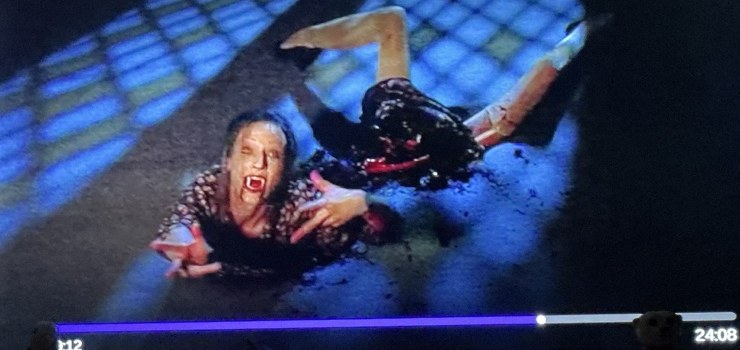
😂😂😂 “I’M NOT DEAD YET!” This is absolutely Black Knight territory now. Look at the frame! Her legs are literally over there, detached from the rest of the woman, and she’s still crawling forward like this is merely an inconvenience.
James: I have cut you in half.
Snake Mom: “I’ve had worse.”
James: You haven’t got any legs.
Snake Mom: “Yes I have.”
1:09:11
The legs are still twitching too
1:09:26
Oh no Peters is dead
Yes, snake bite marks on his face, so obviously mother came in and bit him to death. came after James, got chopped in half. She had an adventurous day too.
1:09:30
Power returns. The phone rings. “Yes, I got her, but not before she got Peters.” But it wasn’t who we were expecting either. Oh my God, her own daughter!”
1:09:58
“Yes, I extracted the poison before it’s any harm. She’s resting now” you know extra extracting poison is a myth unless you have like a syringe the whole cut two lines in it and suck with your mouth. That’s a total myth.
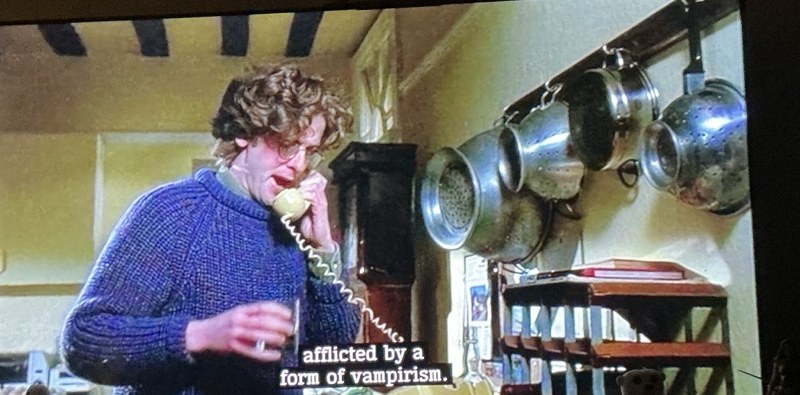
Oh, he knows this by somehow groking the venom. “if the venom gets some metabolizing in the system, they are afflicted by a form of vampirism”
1:10:21
He’s on the phone with Angus and he’s complaining that the power went out and the record player turned itself off automatically. All right I’ll check and he looks over and the record platter is completely empty. “Thanks for the warning. I think we have another reptile loose on the premises.” He’s still in another movie.
😂😂 YES. Hugh Grant absolutely refuses to enter this movie. Everybody else: “THE VENOM METABOLIZES INTO SNAKE VAMPIRISM! MOM HAS BEEN BISECTED! PETERS IS DEAD! THE CULT IS REAL!” James, discovering that the record has mysteriously vanished: “Thanks for the warning. I think we have another reptile loose on the premises.” Sir. 😂
1:10:53
The mother snake just grabbed his ankle and did a growling face at him. It was a quick scene so she’s crawled across the floor with just her arms to get to James, and he’s just like, oh OK.
😂😂 EXACTLY. She has no legs. She has dragged her bisected torso across the estate using only her arms, grabbed James by the ankle, and snarled up at him. And James’s emotional response remains somewhere around: “Ah. There you are.”
This man is aggressively unchewable scenery. Ken Russell can throw snake vampires, severed torsos, venom visions, missing parents, and dead servants at him, and Hugh Grant will not rise above mild concern at an irregularity in the household. The contrast with Snake Mom makes it even funnier. She has had the most exhausting night imaginable. She’s been bitten/converted, attacked her daughter, repelled by fire, killed Peters, been CUT IN HALF, and then dragged herself across the floor by her hands for one last attack. James: “Oh, bother. Another reptile.” 😂
1:11:16
Mary’s in there and now we’re gonna see if she has big old fangs.
1:11:32
No thanks and the door closed automatically so, oh but oh my
1:11:44
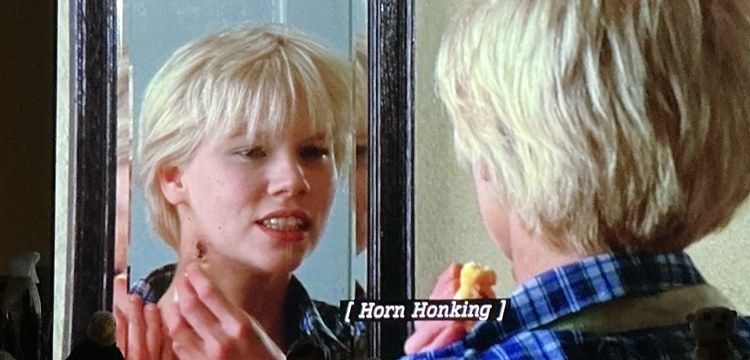
It’s not really an owie if it’s two gaping holes in your neck.
1:12:04
“We need you to identify the body.” “But why, you’ve known her for years.” “But we have to do it by the book. It must be next of kin.” Oh so evidently James looked at the growling mother and just went oh bother and kicked her in the head till she died. I’m just guessing on that part.
😂 That’s exactly the missing beat! We last saw half of Mom grab James’s ankle and growl at him, and now the police are apparently saying, “We need Mary to identify the body.” So somewhere between those scenes, Half-Mom became Dead-Mom, and the movie apparently decided we did not require the administrative details
. Your proposed reconstruction is entirely compatible with what we’ve actually seen:
Mom: GRRRR! James: “Oh.” offscreen aristocratic problem-solving noises Police: “We need the next of kin to identify the body.” 😂
1:12:21
The cop did have a really weird look on his face. so, it was one of those, oh I’m a snake guy so I’m bluffing you or something. I don’t know yet.
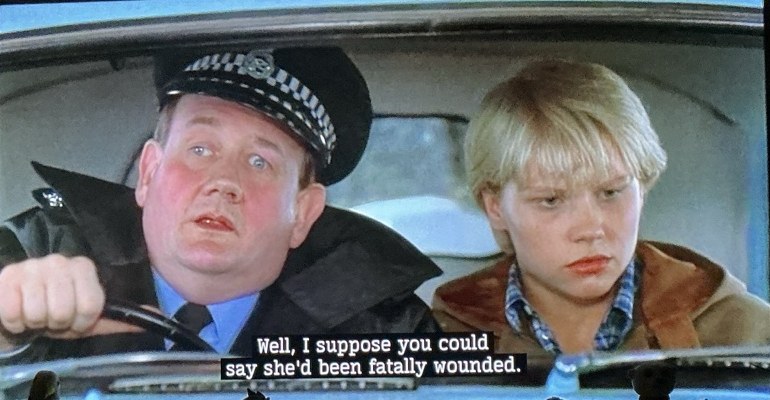
Let’s talk budget again a VW bug for a police car no lights just a label
😂 That is absolutely budget filmmaking.
😂 A Volkswagen Beetle with “POLICE” slapped on the door and apparently not even a light bar. The production said: “We need a police car.” “How much?” “£0.” “There’s a Beetle outside.” “Paint POLICE on it.”
Anyone got a car?” “I’ve got an old bug out back” “Let’s just put on a sticker. That’ll work”.
1:13:08
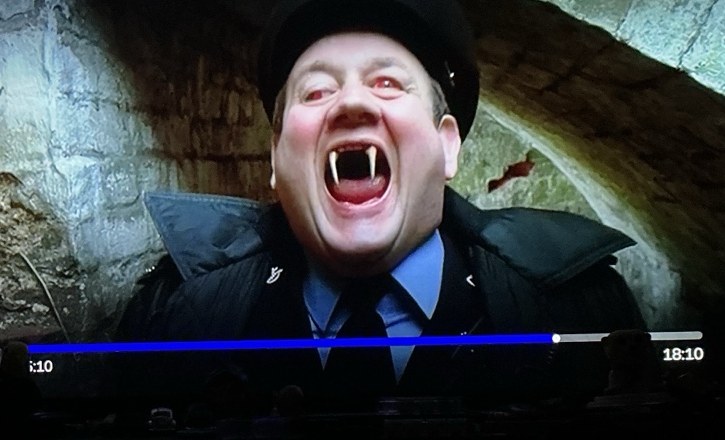
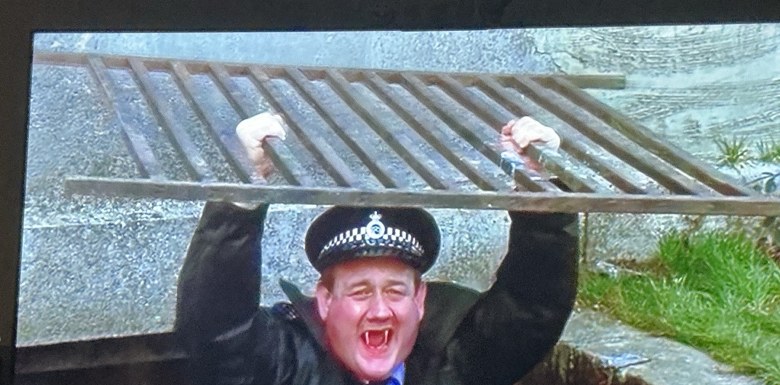
Erny looking kinda sus.
1:13:43
“Where are you going? This isn’t the way to the police station.” “We’re picking up lady Sylvia Marsh.”
1:14:23
Budget cop car.
1:14”41
Policeman had a bandage over his wrist and so Mary just opened the door and evidently knocked him all the way across the space between the car in the house and now she’s running away.
1:14:14
And the gate just closed on her
1:15:02
She runs down some steps on the side of the house. It goes to a passageway. She gets to the end of the passageway. There’s a big snake. She turns around and there’s a cop following her. She doesn’t know what to do.
1:15:08
Snake Cop confirmed
1:15:08
Damn, I didn’t know how right I was.
1:15:13
Someone is playing bagpipes.
1:15:26
Angus rocking the tartans and the bagpipes.
1:15:26
Angus is a piper?
1:15:46
Ladies and gentlemen… Erny! Raise the roof!
1:16:14
He’s got the snake charming going
1:16:22
This actor playing the cop is hilarious. He’s swaying like a snake. He’s prancing around like a snake and his teeth are just out there, and you can tell the actor’s afraid of closing his mouth because he will stab his lower mouth and it would hurt a lot. Oh God, Angus ran out of breath on bagpipes, which makes no sense. And then dropped the bagpipes, and then oh that is the significant thing there? it’s called a compass an, outdoor compass and Angus is going to knock the cop onto it and no more snake cop.
1:16:58
Angus ran out of breath on a bagpipe, which makes no sense because that’s what the bag is for! When you breathe you squeeze the bag, but no, he ran out of breath that broke the music. The cop went after him. He dropped the bagpipes he pushed at the cop; the cop tripped on the bagpipes and fell on the compass.
1:16:58
Oh, Erny, we hardly knew ye.
1:17:02
Fortunately, the bagpipes aren’t broken. He’s back to playing them.
1:18:08
He had to sit down, but look, he even dressed up in tartans to match his bagpipes. Now he’s filling a syringe with something amber.
1:18:23
But Mom said she’d pick me up after school.
1:18:30
Oh, he’s gonna inject himself with the venom. Oh, this is so bad of an idea.
1:18:47
Maybe he shot the mongoose?
1:18:47
MONGOOSE!
1:19:19
I’m a snake, see?
1:19:26
And she reared back and looked at Angus in the face and he just stood there and then she reared up further then bit him on the leg. and well look at this look. I’ll bet it was anti-venom and he injected himself with it!
1:19:31
Was it good for you, too?
Look! Ear plugs!
1:19:35
And she just laughingly took the earplugs out of her ears. She outsmarted him, she thinks.
1:19:40
And he has his face frozen in a rictus of pain and she drags him by one leg into her lair, but I’m guessing he’s acting right now. You know he wants to get to Eve.
1:19:51
Oh, good. A ‘YOU ARE HERE’ marker.
1:19:51
I wonder if being blue-painted nekkid pays at a lower rate than regular nekkid. Oh, hello, Mary.
1:20:02
These ‘YOU ARE HERE’ markers are really getting weird.
1:20:21
So, uh, budget: cop car zero, snake contacts £12,000,000
😂 The production budget hierarchy of this movie:
Sarah: “Can we afford a cop?”
Production: “No.”
Cop car: “Absolutely not.”
Snake contacts: “How much?”
Production: “Twelve billion pounds.” “Order whatever you want.”
And those eyes! They apparently spent the entire effects budget on one pair of radioactive contact lenses. 😂
And Sylvia has also exceeded any breast budget I’ve ever seen in any movie. She is just out there completely for this half of the movie.
1:20:24
Reptiles don’t have hair.
1:20:41
OK, James is up to something with a bunch of cylinders. I don’t even know.
1:20:44
Did they borrow these from Armageddon?
1:20:51
Oh, they think it’s a subterranean creature and they will gas or smoke them out because there’s pumps and evidently some kind of toxic gas in those cylinders.
😂 The funniest part is that they’re treating this like a perfectly normal pest-control job. “Yes, there’s a giant supernatural serpent beneath the house. Fetch the industrial fumigation equipment.” 😂
1:21:19
OK now Ken has established that Dionin was the original serpent in the Garden of Eden.
1:21:08
The girls can hear James’ voice through the pit as he’s on the other side of it extolling to the workers with him.
1:21:15
Damn, back to Genesis.
1:21:15
Dionin, who came from the darkness,
Dionin, who dwelt in the peace of the Garden of Eden,
Dionin, who gave us the gift of knowledge,
Dionin, who suffered the wrath of the false God,
Dionin, who was driven from Eden by the false God,
Dionin, who was trodden underfoot by the Son of Man,
Dionin, who returned to the darkness,
Dionin, whose kingdom is darkness,
Dionin, who makes safe our darkness,
Dionin, who is darkness,
Dionin the immortal, accept this, our sacrifice.
1:22:22
They’re not even trying for subtle, are they?
1:22:22
Not even trying to be subtle with this!
😂 Positioned on the front of her pelvis, emerging from the pubic area, and it looks much more like some bizarre snake/serpent appendage growing out of her pubis. Which raises the immediate biological question: If she’s supposed to be a serpent creature, why does she still have a completely mammalian female body? The movie’s answer appears to be: don’t ask biology questions during the glowing-blue snake-goddess sequence. And the fact that it is specifically coming out of that location makes the whole image considerably more… Freudian than I initially realized. 😳
1:22:26
And Eve is right now saying “OK, exactly how am I being sacrificed?”
😂 Eve has reached the completely reasonable point of the evening: “Okay, you’ve explained the ancient serpent theology, you’ve tied me to a wall, you’ve announced my sacrificial destiny… but could someone perhaps explain the actual mechanics?” And Sylvia is probably about to give her an answer that somehow involves Dionin, darkness, blood, and several more paragraphs of Victorian occult poetry rather than simply saying, “We’re going to kill you.”
At this point Eve deserves a pamphlet. 😂
1:22:48
Smoke, or gas coming up from this pit? James, is that you?
1:22:50
Big honking pit.
1:22:55
Sylvia was in pre-ecstatic face and instead went to confused face, and there is now smoke coming out of the pit.
1:22:59
“No time for ritual, no time for ceremony” and Sylvia pulls out a big old knife, and she’s probably going to just stab Eve now.
1:23:00
Using the knife to cut Eve’s ropes free so I guess she’s gonna toss her into that pit
1:23:15
In case you can’t quite tell, it’s a great big snake
1:23:32
The big snake is coming out of the big pit.
1:23:35
Step one: place victim here.
1:23:35
That is a spectacular shot: Sylvia, big ol’ pit, big honking snake.
1:23:41
Why did I bring the butter knife?!
1:23:41
That knife is not sharp enough. Seems like that should be a minimum requirement for a big honking knife: sharpness.
1:24:03
And now Angus is making his triumphant move. It’s been about 10 minutes, but maybe it took a while for the antivenom to work.
1:24:06
Well, this isn’t going according to plan.
1:24:15
Angus first just pushed Sylvia into the pit, she grabbed Eve’s legs, then Angus just pulled out his own dagger and sawed at Sylvia’s wrists that are holding Eve’s ankles. Yeah, cutting a wrist is so much easier than a rope. OK
1:24:30
Oh, big snake on the rise
1:24:43
Wrist severed, Sylvia now gets munched by her god.
1:24:43
Take two and call me in the morning.
1:24:45
The rope snapped just as Eve was about to fall. Angus caught her just in time. Sylvia went into the snake’s mouth. Poor Sylvia from snake goddess to snake sacrifice.
😂 SYLVIA GOT SNAKED BY THE SNAKE. She spent the whole movie working toward this grand serpent-sacrifice moment, finally gets Eve positioned over the mouth, and then the rope snaps at exactly the wrong/right moment:
Eve: rescued.
Angus: heroically catches her.
Sylvia: whoops, into the giant snake mouth you go.
That is spectacularly appropriate. She literally spent all that time worshipping the thing and then became the backup sacrifice.
1:25:10
Angus goes down and unties Mary. There we go and honestly, the way he just manipulated that rope, without a knife, and untied her, she should’ve been able to do that a long time ago.
1:25:14
He tells them both to run, but he’s going back. So, I don’t know why he’s going back but he’s going back to do something with the snake, I don’t know.
1:25:26
He has a pineapple hand grenade.
1:25:36
He sees the big honking snake close up, says “holy shit,” pulls the ring out with his teeth, of course, drops it in. Bull’s-eye runs away explosion from the pit everyone’s outside now safely.
1:26:18
Yep, he just explained it all he filled up the syringe and he’s giving her an antidote and they said “what if it won’t work” “it worked on me all right”
1:26:51
OK, we blew up the asteroid. Let’s get coffee.
1:26:51
Proof that he’s in a different movie
1:27:03
And he literally said “Next it’s a pint on me at the pub.” So we still don’t actually know what he was doing in the caverns. I’m going to guess he gassed him and maybe that’s what was driving the snake up, but he didn’t communicate that to them, so it works surprisingly well as a coordinated plan that they were not coordinated with.
😂 It somehow becomes a coordinated operation conducted entirely without coordination.
The sequence seems to be: James’s caving/exploration team is down there with the gas equipment, apparently trying to flush out whatever they think is living underground. Angus independently figures out that Sylvia is the real danger, develops the antidote, gets himself bitten, infiltrates the lair, rescues Eve, and blows up the pit.
Neither side appears to have bothered telling the other what they’re actually doing.
Yet the two plans happen to intersect at exactly the right moment.
Then James’s team emerges and he’s basically: “Thanks. Pint at the pub?”
James says he wanted to do something positive like the old man or the ancestors and Angus said you smoked out the snake and did a good job. Thanks so yeah coordination was there unspoken like with real men
Exposition dump: It was the watch since it disappeared from the temple house and reappeared in the cavern, that had to be a connection, etc., so forth.
1:29:42
Angus just got a call from the lab: “You were given the wrong serum. It’s for arthritis.”
1:29:55
So, oh, Angus is now gonna sprout some fangs, I’ll bet.
1:30:10
That is not the face of a confident shaver.
OH, THERE IT IS. 😂 That is not the face of a man who received the correct anti-venom. Angus has gone from “I have a cunning plan” to “why are my eyes glowing and what is happening to my neck?”
So the sequence is apparently:
Get bitten by the snake.
Extract venom.
Inject “antidote.”
Rescue Eve.
Blow up the ancient snake.
Discover the laboratory mailed you the wrong serum.
Look in mirror: “Oh, bollocks.”
He was also running his tongue along the roof of his mouth so looking for fangs, I think
1:30:57
In the car, James says “I’m famished why don’t we stop for a bite” and Angus replies “Why not” and then bares his leg where the two bites are and it goes to black
Absolutely insane I made it through
You should hear this song they’re playing as the credits roll.
The D’Ampton Worm
1:33:11
One, two, three, four—
John D’Ampton went a-fishing once,
a-fishing in the weir.
He caught a fish upon his hook; he thought it looked mighty queer.
Now what the kind of fish it was John D’Ampton couldn’t tell,
but he didn’t like the look of it so he threw it down a well,
Now the worm got fat and growed,
and growed an awful size with great big teeth and a great big mouth and great big goggle eyes.
And when at night it crawled about,
all looking for some booze.
If it felt dry upon the road,
it’d milk a dozen cows.
This fearful worm would often feed on cows and lambs and sheep,
and swallow little babes alive when they lay down to sleep.
So John set out and got the beast and cut it into halves,
and that soon stopped it eating babes and sheep and lambs and calves.
So now you know how all the folks on both sides of the weir,
lost lots of sheep and lots of sleep and lived in mortal fear.
So drink the health of brave Sir John,
who kept the babes from harm,
saved cows and calves by making halves of that famous D’Ampton Worm!
I’ve been thinking about doing something a little different with movie posts.
Usually, if I’m writing about a movie, I watch it first, think about it, and then come back later and try to make sense of what I saw.
Rick’s Reel-Time Reactions is not that.
This is the movie as I’m watching it.
That’s really the point.
Once you know how a movie ends, it’s easy to rewrite your own experience of watching it. Something that looked meaningless suddenly seems like obvious foreshadowing. A character you distrusted from the beginning turns out to be harmless, and afterward you forget how convinced you were. A ridiculous little prop becomes important twenty minutes later.
The idea is simple: I pick something I haven’t seen, hit play, and preserve the reactions as they happen. The good guesses stay. The bad guesses stay. The moments where I completely misunderstand what a movie is doing stay too.
I want to keep the before part.
So these posts will be built around timestamps, reactions, and occasional images from the movie when the visual itself is part of the experience. The pictures may get cropped or cleaned up afterward, but the reactions won’t be rewritten into some polished version of what I supposedly meant.
If I’m wrong, I’m wrong.
If I miss something obvious, you get to watch me miss it.
If I suddenly stop the movie because I need photographic evidence of whatever just happened, you’ll get that too.
This isn’t meant to replace a review. A review is what I think about a movie after I’ve had time to process it.
Rick’s Reel-Time Reactions is what happens before I get that luxury.
Basically, you get to sit beside me for a first watch without actually having to sit beside me.
I’m not a big horror-movie fan. I mean, I sort of am, but when you lack buddies to talk about it with afterward, it loses some of its charm. Perhaps dictating my review like this—speaking my truth, if you will—might serve the same purpose. We’ll see.
I did not play the Resident Evil games, so I have no frame of reference there. I have, however, seen the Milla Jovovich versions, and this is a mighty big swing away from that formula.
First, though, a complaint: the opening credits are severely redundant with the producers’ names. This is Bob and Joe*. This is a Bob and Joe* production. Bob and Joe* made this film. I did not appreciate that. It felt like Hollywood glad-handing, and all I could think was, What the hell? And the actual title sequence didn’t arrive until roughly fifteen minutes into the movie!
The movie itself is almost a one-man show. Our hero, such as he is, is Bryan, a hapless medical courier who describes his work as something like a fancy version of DoorDash. His employer appears to be called Right Foot—at least that is what I could make out on the back of his jacket, partially obscured by the carrying straps. Good branding, I guess: put your right foot forward.
We become involved in Bryan’s life while he is arguing with his girlfriend. He seems like a perfectly reasonable yet stupidly selfish kid. For a while, I thought the movie might pull the old trick of making us care about a character and then immediately killing him. Bryan comes very close to dying at the beginning—but he doesn’t, and the movie sticks with him.
After delivering a standard red organ carrier, Bryan is offered one last, top-flight assignment: take a mysterious green carrier to Raccoon City. He protests that he needs to get home, but they offer him double. Nothing bad has ever come from accepting a double-pay offer at the last minute, has it?
The job requires chains or studded tires because it is snowing heavily. Bryan assures them he is prepared. Of course, he isn’t. Off he goes into the snow toward Raccoon City—and, quite frankly, video-game adventures ensue.
The video-game perspective is persistent and appreciated. Bryan picks up guns as he finds them. He has to figure out how to load and use them. He makes discoveries just as I would want to make them if I were playing the game myself. The story progresses in a clear, logical sequence, but Bryan remains hilariously unprepared for all of it. At one point, he reassures himself, “I didn’t shoot a kid in the face. I like kids.” That self-mocking humor works because it also connects to the personal problems waiting for him back home.
Several very distinct forms of zombie are on display. There’s a guy who vomits acid, a zombie tumbleweed that begins with two bodies fusing together and keeps collecting more as the movie progresses—there may be a dozen bodies in it by the end—and a huge, bloated man whose stomach splits open and spills out what look like rats. Players will probably recognize some of the evolutionary bloodlines even when the creatures aren’t taken directly from the games. I just thought they were cool and gross at the same time.
The movie has genuine comedy, but it also has good jump scares—the ones that feel earned, not merely inserted to make you jump. It is visually stunning, and the cinematography is excellent. I did not see it in IMAX, but I can absolutely understand how IMAX would benefit it.
Bryan grows throughout the movie. When he senses what is coming, even as he keeps hoping for something better, he makes a final confession into his phone. He has no connection; he is simply making a recording meant for Michelle, without knowing whether she will ever hear it.
Throughout the movie, Bryan faces setback after setback, but he continues on. He does things he never expected he would be able to do. He keeps going. He learns. He grows. He suffers. He still continues. And then, when all seems lost, he keeps going on.
Bryan. Never. Gives. Up. Until he does.
This movie does not end with a Hollywood ending. It doesn’t even end with a video-game ending. But it does end.
I don’t want to spoil it. This movie is worth seeing. It is a lot of fun, and I think you might enjoy it as much as I did.
It surprises me to say this, but I’m giving Resident Evil four stars. Not because it isn’t a well-made movie—it is—but because, as I said at the beginning, I don’t generally gravitate toward horror movies.
Hopefully expressing all of this now, in the way I am, will prevent the night terrors.
Cast and Credits
Austin Abrams as Bryan
Directed by Zach Cregger
Written by Zach Cregger and Shay Hatten
Cinematography by Dariusz Wolski
Based on Capcom’s Resident Evil video-game series
* Not the actual producers’ names. You’ll see it, and you’ll know it.
Okay, I finally returned to In-N-Out to try the Animal Style I promised in my last post.
There was a line outside this time. I was there during that period that isn’t quite twilight but isn’t full dark either—the sun had either just gone down or was almost there. The line only filled about half of the outside queue, though, and I was inside in about 15 minutes.
Already almost dark outside, in line and ready
This time I ordered the Double-Double Animal Style, the fries Animal Style, and another shake. I went with chocolate because chocolate is naturally less sweet than strawberry, and I wanted this visit to be at least somewhat comparable to the last one. Same basic meal, but this time with the special stuff.
So many workers, busy as bees, and super nice!
I waited while they went through the numbers, just like last time. This time I actually remembered to ask for ketchup when I picked up my order, and they were very happy to provide it. I found a seat, took the obligatory picture of my food, and dug in.
If you don’t think this is nummy, I’ve already lost you.
So, what does Animal Style actually mean?
A regular Double-Double already comes with lettuce, tomato and In-N-Out’s spread, with onions optional. Animal Style takes that basic burger and changes things up: the patties are cooked with mustard, pickles are added, the onions are grilled, and you get extra spread.
I’ve tried cooking hamburger patties with mustard myself, and it’s actually not super easy. You can’t really do it with a frozen burger, and it doesn’t work nearly as well with hamburger that has been sitting around for a while. You need to fresh-press the patty, mustard it and get it onto the grill.
It’s worth the effort, but it is effort.
Or you can pay In-N-Out to do it for you and ask for Animal Style.
And about that spread: if you’ve never had it, think of something a little like Thousand Island dressing. It’s the same general idea as McDonald’s having its own special sauce—there’s a resemblance to Thousand Island, but ultimately it’s In-N-Out’s own spread, not Thousand Island dressing.
The Animal Style fries are a different matter—and there is a price difference. They were about $2.16 more than the regular fries. The regular fries get covered with melted cheese, grilled onions and that same In-N-Out spread.
And then they hand you a fork.
Trust me. The fork is needed.
It took me longer to eat this meal than the previous one because this one is worth savoring, and you can’t exactly pick up the fries and eat them normally. They’re slathered in all that stuff. Very tasty. Quite rich.
The burger itself was excellent. That is definitely how I’m ordering it every time I go in there from now on. It costs the same as the regular version, and I’m giving the Animal Style Double-Double a 10+. It adds enough flavor that I don’t need bacon. I don’t need mushrooms. I don’t need anything else piled onto it.
It’s great the way it is.
And I was right about the chocolate shake. It wasn’t too sweet. In fact, it was quite good. I suppose I could try vanilla next time, but I suspect it would be super sweet, so…no. I’ll stick with chocolate or get a soda.
I was full when I left, and the entire meal was less than $13.
I am not trying to say that one restaurant is better than every other restaurant. But In-N-Out is, by far, the least expensive burger place I’ve eaten at in the Portland area. That is objectively true.
Don’t troll me on it.
I also took some surreptitious pictures while I was there. You can see those great big safety pins hanging from the employees’ belts, you can see the crowdedness, and you can even see just the general vibe of the place.
Had to get a shot of the safety pins!
Then, after I finished eating, I went back to the counter and asked, “How can I buy one of those shirts?”
She told me I didn’t have to get back in line. Since I was only buying a shirt, I could just go to the next open register.
So I did.
I bought the shirt.
It was only $20, and it’s worth it because it’s a cool-looking shirt.
It’s got a Corvette on it.
What’s not cool about a Corvette?
So I returned home and modeled my new shirt, fresh after a shower.
Look ma, stubble… and a new shirt.Ok, I’m no influencer, I’m not trying to be. How do they do this?
No, I don’t look like an influencer.
I’m not trying to be an influencer.
I’m just telling you what I saw, what I ate and what I really enjoyed.
And there will be a next time.
I won’t claim these are the best burgers ever. I will claim that they are very good and very much worth the price I paid. I’ll be back up there. I might go to a movie early enough that I can have dinner beforehand. I might go to an early enough movie that I can grab a burger on the way home.
Either way, In-N-Out is now going to be part of my plans whenever I’m up in that section of Beaverton.
My second attempt at an NYC Midnight challenge was a reflection of the first, unfortunately.
NYC Midnight now emails me about new challenges, and the next one to come up was the Flash Fiction Challenge. I enjoyed the process last time, and the feedback was genuinely useful to me, so I figured this would be good for me, as well. And if I submitted on time, maybe even advance?
I registered April 9th for the challenge that would start on May 1st, 2026. Well, really at 11:59 PM on the 1st, so effectively May 2nd on the East Coast. But out here, I get the email at 8:59 PM on the 1st. This time, I would have 48 hours to write no more than 1000 words based on genre, location and objects.
Very like before, promptly at midnight (ET) on May 2nd, my assignment arrived. This time I was placed in Group 17. My genre was Action/Adventure, my location was a private beach, and the object I needed to include was a motion detector. Those elements had to appear somewhere in the story. I had until 11:59 p.m. two nights later, May 3rd, to figure out what I was going to do with them.
And this time I had 10 times as many words. I would have some room to write, no problems!
Well, Friday came, and I was stressed from work. The job that had my creative energy amped up was now depressing it to near nothing. I just had no ideas. I got the email late Friday, and looked at it. First complaint was that while I like to consume action adventure stories, I’ve never written anything like it. That’s not a real gripe. I know that. I knew it at the time, but I still let it delay me. I hemmed, I hawed, I dithered.
And then the time zone thing is a real issue. I have a strong history of last minute completions. All through school, assignments in leadership. Studying for an interview, even. And I have a high success rate with those.
But my subconscious is tied to midnight like nothing else in my life. It’s my cutoff for getting enough sleep. I talk to people in those terms, “I got to bed before midnight, so got enough sleep.” Or “I screwed up my schedule and was up nearly half an hour past 12 last night,” while I pour a strong coffee.
But 9 PM doesn’t have the same weight to my deep brain. So all through Saturday and Sunday, I continued to dither. Then as I was still decompressing from whatever was going on that day, my brain went, “dude, it’s almost midnight, get on the stick!” and ideas started populating in the grey matter. Then, I looked at the actual clocks and it was 10 PM.
Man, I yelled at myself. I’d missed the deadline, again! And I had twice the time! But I could only scream for a while before settling down. My subconscious also knew I could submit late. And I just kept on with the task at hand, pretending that midnight was the actual goal.
And the scene shaped itself cleanly in my head. Dude living on a private beach. He’s lonely, feeling supernumerary, sad and unmotivated. Crawls a garage sale sometime in the past, which has a metal detector for sale, he got that for a mere 5 dollars.
(Now, the challenge object was clearly “a motion detector” but my brain substituted metal detector for the initial creative run.)
I had my first draft done in less than 30 minutes. Counted it up. It was short of 1,000 by almost 200. So, I went back in to fill in some details, and round out the character.
That draft was just under the limit by less than a handful. And I’m happy with it. There’s no point in making it exactly 1000, you don’t get extra credit for that, even if you submit on time.
I read it aloud all the way through, and that’s when I noticed the difference in what I had (metal) versus what was needed (motion). But my story was too invested in the metal detector at this point, so I just had to find a place for the motion detector.
Well, now he’s in a borrowed place, doesn’t know it well, forgets little things, like turning off the alarm when he arrives home. So, I inserted a few words, less than a dozen, really, about that, and counted. Over 1000, of course.
So, I went on to tighten and edit, dropped a little description out and got it back down under the limit. Then, went to the NYC Midnight site, found the Late Entries section, and uploaded it.
I ended up really liking this story. It was less Stallone-style Action/Adventure and more like Inspector Gadget, but I felt it satisfied that requirement. The private beach was easy, and I shoehorned in the motion detector successfully.
Five Dollars
Bert had lived along this beach for all of two weeks. It used to be his parents’ place—somewhere they let him stay once in a while, now somewhere he just stayed.

He bought the metal detector at a garage sale down the street for five bucks. It gave him something to do. He walked the beach with it, idly scanning, trying not to feel the sadness that wasn’t just under the surface anymore. It was written all over him.

The beach wasn’t nearly as clean as you’d expect a private beach to be. There were oily patches, seaweed piling up along the tide line—and a dead fish, or what used to be one.

But it was empty. About as empty as he felt, which counted for something.

The detector settled into a steady rhythm. A low hum, then a soft beep. Hum… beep. Hum… beep.

It chirped faster as he swept it over a clump of seaweed and what he thought was the dead fish.

He nudged the mess aside with the flat disc at the bottom of the detector.

It was an arm.

And on it—was that a Rolex?

He just stood there for a second, trying to process that this was an arm, and this was a Rolex.

He didn’t have his phone on him. If he ran back to the house, the tide might come in and take it out to sea. But he’d seen enough CSI to know he shouldn’t touch it.

Where was the rest of the body?

That made it worse.

The water was already creeping closer, small waves lapping at the shore.

He grabbed the seaweed tangled around it and pulled—careful, very careful not to touch the arm itself—dragging it up the beach.

There was a driftwood log between the creeping foam and the house. He dragged the grisly package to the other side of it.

It should hold. Long enough.

He set the metal detector against the log, angling it to cover the arm, and ran—no, sprinted—the two hundred fifty yards back to the house.

He tore through the back door and rushed around like a madman.

Where was his phone? Desk? No. Kitchen? No. Bathroom—

The alarm chirped.

He froze.

The motion sensor. He’d forgotten to disarm it when he came in.

Ten seconds. Maybe less before it called it in.

He lunged for the panel and punched in the code.

His pants were on the floor. There.

He yanked the phone free and started dialing 911 as he moved back toward the door, already looking down the beach.

That’s when he saw them.

Men with guns.

Walking along the shoreline.

One of them pointed at the metal detector sticking up behind the log.

Why did I leave it like that? I knew where it was. I didn’t need a flag.

Without thinking, he ran.

He reached the log just ahead of them, kicking sand over the seaweed as he grabbed the detector.

“That yours?” one of them called.

“Yeah—yeah, it’s mine. I left it here. Had to run back to the house.”

He forced a shrug. “Bathroom.”

He lifted the detector slightly. “Can I help you with something?”

They weren’t brandishing the guns. If anything, they kept them slightly behind themselves—visible, but not pointed.

They had to know he’d seen them.

Still, they didn’t raise them.

They just watched him.

“Were you out here ten minutes ago?”

“Yeah,” he said, lifting the detector a little. “Just looking for whatever—quarters, bracelets, anything metal. Picked this up at a garage sale.”

The smaller one said, “I had one of those. Wasted my time.”

Bert shrugged. “Yeah… that’s kind of why I’m out here. Finding a way to waste some time.”

“I found some bullets once,” Bert added quickly. “Fired ones. Not in shells or anything—more like… musket balls.”

He had no idea why he was lying. Especially about something like that.

“Yeah? On this beach?”

“Well—yeah. Over there, under the pier.” He gestured vaguely. “I don’t know. Didn’t there used to be a carnival or something? Shooting gallery, maybe.”

The one who’d been staring at him so intensely finally snorted, then jerked his head toward the other man.

They turned and walked away.

Bert stood there, watching them go.

A few minutes later, he finally exhaled.

What the hell was he thinking?

Who were those guys?

And what was he supposed to do now?

The phone squelched.

“Hello? Hello? This is 911. Is this an emergency?”

He raised it. “Maybe,” he said. “I found something… on the beach.”

He almost said he might need a hand with this.

He groaned instead.

“Sir? Are you in pain?” the operator asked.

“No,” he said, still catching his breath. “I just ran two hundred fifty yards faster than I have since I was a teenager. I’m a little out of breath.”

He glanced down the beach.

“Could you send someone out to—”

Several shots rang out near the pier.

He flinched, then forced himself to keep talking.

“—my house. It’s about five hundred yards east of the pier. On the beach.”

He lowered the phone slightly.

Looked down at the arm.

“I wonder if they’ll let me keep the watch.”
A few notes about this. This is not my typical style of writing. It’s almost a listicle. Short, punchy sentences that substitute for a paragraph. That’s a very modern online version of writing. I leaned into it this time because that felt very action/adventurery.
And secondly, this is quite a bit shorter than the thousand words that I had been skirting in my second draft. In tightening things up, I took out a lot of unnecessary words, but as you might see from the judges’ results—or feedback, rather—I could’ve cut still more.
I received my confirmation that it had been received on May 6, with the additional notation that it was after the deadline and that I’d still get feedback, but I would not advance in the competition. I already knew that, but getting confirmation of it made me a little bit more depressed. You know, a little bit.
Now, just like last time, I will use the designators Judges A, B and C, just to make sure that I don’t step on any confidentiality toes.
Judge A said:
“I enjoyed the illustrative language, as well as Bert’s humorous narrative voice. I appreciated Bert trying his best to preserve the evidence and act quickly before the tide came in. I enjoyed his quick response to intervene when he saw the strangers approaching his metal detector and the arm. I was amused by his attempt at conversation with the strangers, all while 911 was waiting in his pocket.”
But this is what Judge A thought needed work:
“This piece has a great foundation. Moving forward, I suggest playing with word choice to improve the flow of sentences in a few areas. One example is ‘the phone squelched.’ To squelch is more of a wet noise, like a gurgle or slurp, or it’s to smother something metaphorically. I think the intended word might be something closer to ‘squawked’ or ‘warbled.’ I also wondered what the guys were shooting at over by the pier? Why wasn’t Bert concerned enough to tell the operator about gunfire?”
I actually laughed at that a little bit because the judge had a little questionable grammar in that response, but you have to forgive it. They’re not really writing an essay; they’re giving you bullet points in paragraph form.
But I did understand very clearly what this one was saying about the word choice I used. “Squawked” would’ve indeed been better. As for why he didn’t tell the operator, he was still mid-call with them. He was wondering aloud while the operator was talking in his ear. I guess I didn’t make that nearly clear enough.
Now, Judge B started with:
“I enjoyed the slow reveal of the arm (‘and what he thought was the dead fish’). It was immersive (we’re uncovering it like the character is), and it is well placed. You ease us into the narrative for about 180 words, establishing the location and the character (Bert is depressed), then you hooked us with ‘It was an arm.’ Suddenly, the reader is flooded with questions, and they will have to find out the answers.
“There were several obstacles, big and small, in here that kept energy high. Bert has to move the arm without touching it, he sets off the motion detector alarm, men appear with guns, are about to discover the arm. Bert has to react to these complications, to take action (like distracting the men).
“‘There were oily patches, seaweed piling up along the tide line—and a dead fish.’ This gives us a sensory layout and the atmosphere.”
And what Judge B didn’t like:
“‘…and ran—no, sprinted—’ This is a bit of an awkward construction. Your prose would be stronger if you simply came to the more specific, more energetic word right away (‘and sprinted’).
“‘Why did I leave it like that? I knew where it was. I didn’t need a flag.’ — We’re suddenly in first-person narration for a paragraph. If this is supposed to be internal dialogue, you want to signal it with italics. Otherwise, it reads like a mistake.
“I found myself very intrigued by this story, but it felt a little unfinished. You present a compelling mystery, but we never really get any closure. We didn’t get a hint of who the men are, of their connection to the arm, of the arm’s owner. Do you want to give the reader a hint, even if you don’t have an outright answer? Otherwise, they are going to feel they have only gotten the first 2/3 of the story. For example, is Bert listening to a news broadcast about a local mafia war (and the implication is this body is part of it)? Or does Bert live near a horse racing track and there are rumors about bookies using the beach as a dump site for people with extreme debts? We seem to have a victim, and we seem to have perpetrators in the two men with guns, but if we are denied context like motivation, it’s hard to get invested in the narrative.”
Okay, they had a lot of ideas for me. Maybe she. I totally get the “ran—no, sprinted.” I kind of wanted to show an elevation in tempo, but I guess they’re right: just “sprinted” would be a better construction.
As for the context of everything, no, I don’t think that he was listening to the radio. Everything he turned on the radio reminded him of his depression, so he certainly wasn’t going to listen to news reports. He just has consumed a lot of media, and he knows if he sees a severed arm, then he has to take care of calling the police and taking care of it. He sees guys with guns, he’s going to assume they’re up to nefarious deeds.
I can see how you might want more explication, but I disagree with it.
Also, the change in tense—yeah, I get that, and I will fix that in my revised version. That is a very good note.
Now we get to the final judge, Judge C.
Positive:
“The moment he sees the men with guns is a great point of tension for the story. It builds a nice sense of conflict with the narrative and opens up the suspense to further drive us into the adventure of Bert’s day.”
Just as terse in the negatives, they say:
“The structure breaks things up in a way that feels disjointed and muddles the pacing. The dialogue with the men with guns also feels a bit disconnected from any sense of urgency, which diminishes the preceding tension after that point.”
This one really could’ve helped me more, because this just seemed wrong to me. That discussion with the guys with guns—he was distracted by trying not to indicate he had hidden an arm. He was distracted by his beating heart. He had just sprinted a couple hundred yards, and I really thought that was how that sort of tension would intrude upon a conversation.
But I will take a look at it again and see if maybe it couldn’t be improved. I’m not promising anything, though.
Five Dollars (Revised)
Bert had lived along this beach for all of two weeks. It used to be his parents’ place—somewhere they let him stay once in a while, now somewhere he just stayed.

He bought the metal detector at a garage sale down the street for five bucks. It gave him something to do. He walked the beach with it, idly scanning, trying not to feel the sadness that wasn’t just under the surface anymore. It was written all over him.

The beach wasn’t nearly as clean as you’d expect a private beach to be. There were oily patches, seaweed piling up along the tide line—and a dead fish, or what used to be one.

But it was empty. About as empty as he felt, which counted for something.

The detector settled into a steady rhythm. A low hum, then a soft beep. Hum… beep. Hum… beep.

It chirped faster as he swept it over a clump of seaweed and what he thought was the dead fish.

He nudged the mess aside with the flat disc at the bottom of the detector.

It was an arm.

And on it—was that a Rolex?

He just stood there for a second, trying to process that this was an arm, and this was a Rolex.

He didn’t have his phone on him. If he ran back to the house, the tide might come in and take it out to sea. But he’d seen enough CSI to know he shouldn’t touch it.

Where was the rest of the body?

That made it worse.

The water was already creeping closer, small waves lapping at the shore.

He grabbed the seaweed tangled around it and pulled—careful, very careful not to touch the arm itself—dragging it up the beach.

There was a driftwood log between the creeping foam and the house. He dragged the grisly package to the other side of it.

It should hold. Long enough.

He set the metal detector against the log, angling it to cover the arm, and sprinted the two hundred fifty yards back to the house.

He tore through the back door and rushed around like a madman.

Where was his phone? Desk? No. Kitchen? No. Bathroom—

The alarm chirped.

He froze.

The motion sensor. He’d forgotten to disarm it when he came in.

Ten seconds. Maybe less. Then the alarm system auto-dialed the police about a possible intruder.

He lunged for the panel and punched in the code.

His pants were on the floor. There.

He yanked the phone free and started dialing 911 as he moved back toward the door, already looking down the beach.

That’s when he saw them.

Men with guns.

Walking along the shoreline.

One of them pointed at the metal detector sticking up behind the log.

Why had he left it like that? He knew where it was. He didn’t need a flag.

Without thinking, he ran.

He reached the log just ahead of them, kicking sand over the seaweed as he grabbed the detector.

“That yours?” one of them called.

“Yeah—yeah, it’s mine. I left it here. Had to run back to the house.”

He forced a shrug. “Bathroom.”

He lifted the detector slightly. “Can I help you with something?”

They weren’t brandishing the guns. If anything, they kept them slightly behind themselves—visible, but not pointed at anything.

They had to know he’d seen them.

Still, they didn’t raise them.

They just watched him.

“Were you out here ten minutes ago?”

“Yeah,” he said, lifting the detector a little. “Just looking for whatever—quarters, bracelets, anything metal. Picked this up at a garage sale.”

The smaller one said, “I had one of those. Wasted my time.”

Bert shrugged. “Yeah… that’s kind of why I’m out here. Finding a way to waste some time.”

“I found some bullets once,” Bert added quickly. “Fired ones. Not in shells or anything—more like… musket balls.”

He had no idea why he was lying. Especially about something like that.

“Yeah? On this beach?”

“Well—yeah. Over there, under the pier.” He gestured vaguely. “I don’t know. Didn’t there used to be a carnival or something? Rounds from the shooting gallery, maybe.”

The one who’d been staring at him so intensely finally snorted, then jerked his head toward the other man.

They turned and walked away.

Bert stood there, watching them go.

A few moments later, he finally exhaled.

What the hell was he thinking?

Who were those guys?

And what was he supposed to do now?

The phone squawked.

“Hello? Hello? This is 911. Is this an emergency?”

He raised it. “Maybe,” he said. “I found something… on the beach.”

He almost said he might need a hand with this.

He groaned instead.

“Sir? Are you in pain?” the operator asked.

“No,” he said, still catching his breath. “I just ran about five hundred yards faster than I have since I was a teenager. I’m a little out of breath.”

He glanced down the beach.

“Could you send someone out to—”

Several shots rang out near the pier.

He flinched, then forced himself to keep talking.

“—my house. It’s about seven hundred yards east of the pier. On the beach. And I just heard some gunfire, and I don’t think it’s the old shooting gallery.”

He lowered the phone slightly.

Looked down at the arm.

I wonder if they’ll let me keep the watch.
I think I addressed all the edits those judges were looking for that I’m willing to. I like leaving it mysterious. I like leaving it unsettled. This is 1,000 words. This is not a novella. It’s not a novel. It’s not even a full chapter.
Now, I have read books in which the first chapter could be just 1,000 words. Very successful writers. Robert Jordan could not write a 1,000-word chapter if his life depended on it, but Stephen King can. John Grisham can, and many, many others.
But this might make a preface exactly as it is, because it sets up what is going to be coming.
But, I’m going to be honest here. I have not thought about who the bad guys are. I have not thought about why they were shooting their guns. I have not thought about what Bert will do after the thought of whether he can keep the Rolex.
This was a moment in time that I have not overanalyzed, which is actually progress for me.
And…because I don’t know what the next step in a writing challenge is gonna be. I haven’t succeeded in getting a story in on time to even be considered, never mind whether it’s good enough if I do submit on time.
It might be that they want you to revise this story and expand it. That would be cool. At that point, I would think more about Bert and the bad guys and the Rolex. But as it is, I’m perfectly happy with the vision that I made initially and the revision I just presented.
I think I improved a little bit from the last entry. I had more room to grow, more room to develop things. I still had some mixed tense issues from the previous challenge, so I really need to pay more attention to that.
But for just the second time I’ve ever entered a writing contest, this is not bad.
The next contest has already been announced, and it’s a 500-word fiction challenge. I’m going to go ahead and enter that. It’s half of what this one was, but five times what the last one was.
So, a little room to grow, but some walls to hold me in.
Practical Magic 2 is better than its first movie. A sequel superior to the original after 28 years is certainly not something you can take for granted, because some sequels made decades later are absolute travesties. This one had an advantage, though. It had a solid source book to work from, and it seems to have followed that book much more closely. The first Practical Magic treated its source novel more like an outline than an explicit source, which turns out to be important because some of the things that seem like continuity problems in this movie really originated with changes made by the first one.
I recently rewatched the original Practical Magic specifically to make sure I was ready for this movie, and just days after watching it, I literally forgot nearly everything I had just watched. While it’s a charming movie, it’s not terribly memorable. I actually had to look up bullet points from it just to make sure I knew what was going on.
One thing I did not know going into Practical Magic 2 is that this isn’t simply Hollywood resurrecting a 28-year-old movie. Both movies are based on books by Alice Hoffman. The original Practical Magic was based on her 1995 novel, and Hoffman eventually wrote four books about the Owens family. Books two and three are prequels, while the fourth, The Book of Magic, continues the story and is what this movie is based on. So going directly from books one to four for the two contemporary movies actually makes a surprising amount of sense.
I have not read these books, so let me make that perfectly clear. I’m relying on summaries of them, not pretending I know the source material firsthand. But from those summaries, the books themselves seem to flow pretty logically. The first book does not definitively say that the Owens family curse has been broken, while the fourth deals with finally breaking it. The first movie is where the problem came in because it gave us more of a Hollywood ending where the curse was apparently over. So Practical Magic 2 has to walk that back to get itself onto the storyline of the fourth book. That makes considerably more sense to me than sequel writers simply deciding, “Nope, the curse is back.”
All the original witches are here: Sandra Bullock as Sally, Nicole Kidman as Gillian, Dianne Wiest as Jet and Stockard Channing as Franny. Obviously they had to use different actresses for Sally’s little girls because they’re not little girls anymore. Kylie is now played by Joey King and Antonia by Maisie Williams, and if the two daughters aren’t exactly clones of Sally and Gillian, they’re certainly their spiritual successors. One has the dark hair, one has the red hair, and you can pretty much see what they’re doing.
Not long after the first movie, Sally’s new husband Gary—the man she had basically made impossible to find when she was a little girl—dies, and Sally swears off magic. We know it happens fairly soon afterward because the flashback still shows Kylie and Antonia as little girls. Sally casts a spell that not only prevents her from using magic herself, but also seems intended to suppress her daughters’ memories of the magic they have already seen. They’re standing right there while she’s doing the spell, and they’re certainly old enough to remember what has been happening around them. So Sally isn’t merely refusing to tell her daughters about their magic and the family curse; she is actively trying to erase magic from their lives. The spell is effective in one sense, because the girls grow up without knowing what they are, but ultimately it doesn’t work. Magic—and the curse—finds them anyway.
Kylie has a boyfriend, Gideon, and she has trouble telling him that she loves him. This isn’t because she knows anything about the Owens curse, because Sally has made sure she doesn’t. Kylie finally does tell Gideon she loves him and, almost immediately, just like Sally’s first husband in the first movie, he gets hit by a car. He doesn’t die, but he does end up in a coma, and there’s your inciting incident. Kylie has just discovered in probably the worst possible way that the family history her mother has been hiding from her is very real.
There is an entirely poorly written aspect involving a promise that was made and is then explicitly broken, followed by a child saying she’ll never trust her mother again. It becomes a whole thing, and I think it could have been much better written. The actresses manage to carry it off, but they’re doing more work than the writing is at that point.
Kylie now has to rescue Gideon while simultaneously discovering that she is a witch. She finds a book that essentially has the magical equivalent of a chapter titled “How to Remove the Curse,” and that sends her off to England trying to find some way to break it and save him, even though she has no real idea what she is going to find once she gets there. Tom Lockland is also manipulating her from afar, magically, and this is where the movie loses me a little bit. This guy wants to steal Kylie’s magic because he doesn’t have magic, but he is somehow using magic to manipulate her into coming to him so he can steal the magic he doesn’t have. I don’t know how that works. The movie pretty much waves its hands at that one, and you just have to go with it.
There is a little hand-waving around the money involved, too. Kylie is a college student who can apparently afford to suddenly fly to England, and then everybody else starts following her over there. Sally runs a library. I don’t really know librarians to be that rich, but okay. Maybe there’s some generational Owens wealth they just don’t proclaim. I’ve never been one of those people who can just decide, “My life sucks. I’m going to Europe,” so maybe spontaneous international travel is cheaper and easier than I think it is.
The more I thought about this story, though, the more I realized that Tom isn’t really the bad guy who interests me. He’s the conventional bad guy, but the real bad guy in this entire story—in fact, I’m going to argue the real bad guy in both movies—is Maria Owens. Maria is the ancestor who got her heart broken and cast a spell so that she would never suffer from love again, and that spell became the Owens family curse.
Think about what that actually did to this family. Sally loses two loves of her life, then closes herself off from magic, closes herself off from her daughters and even closes herself off from Gillian. The relationship between those sisters was practically the heart of the first movie, and now Sally has pushed Gillian away along with everything else connected to magic. Gillian goes almost completely in the other direction. She has become the person who only loves them and leaves them. She pretends she has this wonderfully full life, but it’s actually a pretty empty one because she never stays around long enough to really love anybody.
The movie never explicitly addresses that, but it does something much more interesting with Kylie, who is essentially Gillian’s analog in the next generation. Kylie actually gets advice on how to love without really loving, basically how to have the relationship without making herself vulnerable to the curse, and she completely rejects it. She truly loves Gideon, says so, and then goes through all of this because she refuses to accept that loving somebody means eventually having to run away from them.
So generations of Owens women have spent their lives either hiding from love, running away from it, pushing away the people they love or watching those people die, all because one ancestor got her heart broken and decided to solve the problem magically. Maria Owens started this whole mess. Tom may be the guy doing conventionally bad-guy things in this particular movie, but Maria has been screwing over this family for generations.
There is also Ian Wright, who gets to play the part of “Is he a bad guy or is he not a bad guy?” and I think that is handled quite well, although he is considerably more forgiving than I would be. Belladonna gets used again, and this time Gillian evidently gets the dose right because he doesn’t die. If Ian knows these sisters as well as he is supposed to, I would expect at least a little lingering resentment over the fact that they just tried to kill him, but he pretty much lets that go.
And while I’m complaining about things that have very little to do with whether this is a good movie, I’m going to argue against women wearing combat boots. It’s just not an attractive look, and you cannot argue that they’re comfortable because I wore combat boots for roughly a decade of my life and can tell you with no reservation that they’re not comfortable. They’re utilitarian and they’re fine, but if you want to walk a dozen miles in them, you’re going to have blisters. So a girl wearing combat boots because they’re supposedly comfortable does not make logical sense to me. They look ugly. They are ugly. Get over it.
All that being said about Maria, the more conventional bad guy is dealt with and the curse is finally ended in a very satisfying yet heart-wrenching way. Yeah, that’s a spoiler, but you know it’s going to end well. I’m not telling you how, and the how is the important part.
That’s also probably the biggest difference between Practical Magic and Practical Magic 2: this one made me actually care about the characters. I had watched the original only days earlier and had already forgotten huge pieces of it. This movie has better characterization, a stronger plot and a better-organized story, and even when it gets a little hand-wavy about its magical logic, it works. Maybe following The Book of Magic more closely gave the filmmakers a stronger foundation to build on. Whatever the reason, Practical Magic 2 is simply a better movie than Practical Magic, and I’m giving it 3½ out of 5 stars.
Runner is one of those movies where you immediately wonder if such a position actually exists in the real world. I mean, you’d think maybe so, but it’s like a super-temp courier job where you speak directly with a dispatcher only through the phone, and then you go and deliver a package, talk to a client, help them unclog a drain—whatever it is.
It seems super unlikely, but what the heck? It’s a fun movie, so you go with it. They carry it off well enough that I will let that question go.
Runner stars Alan Ritchson and Owen Wilson. It’s sort of a buddy comedy, but not really. They learn from one another. They interact with one another. There are some tears to be shed. It doesn’t feel entirely manipulative, but that brings me to another aspect of this movie.
If this movie had been made in, say, 1980, it would be fun. It would be explosive, and there would not be any backstory to speak of.
Look at the Dirty Harry movies. We do not care about Dirty Harry’s kids or wife or anything else like that. He simply says punks are bad. I’m going to make all punks pay for their being punks. You know his motivations. You don’t care whether his wife left him.
Runner cares a lot about Hank’s backstory.
Alan Ritchson plays Hank Malone, a former alcoholic and former Navy SEAL. He’s an American operating in Australia, and the reason he’s in Australia is because his ex-wife is Australian.
Okay, fine. Lots of backstory. You get to know his motivations. You get to know all this squishy emotional whatever that makes him tick.
Oh, and let’s not forget: he has basically sworn off violence, of course.
That all being said, it’s a very fun movie.
The action sequences are well-made and, on some occasions, entirely funny, if not exactly obeying the laws of physics. There is a scene in which another car takes off the front of Hank’s car. It peels it off like a hinge. I am fairly certain that the sort of force required to do that would cause such massive injuries that no one would survive, but in this case it’s just kind of funny.
A lot of wit is employed, and Ritchson carries off the role very well.
Owen Wilson plays Ben Bishop. He’s not quite the emotional heart of the movie, but he is the chatterbox who at first annoys and then charms Hank.
Ben is accompanying a donor liver that needs to be delivered from an airport to Gold Coast Children’s Hospital. Hank gets his marching orders from his handler, Iggy, whom we never really see except for one slightly tragic moment. Along the way, Hank has some interesting interactions with a very wealthy ex-couple and a fancy parakeet.
He also meets with his ex-wife, her current husband and their new baby. There is an element of tragedy in the backstory regarding that relationship. It’s all explained fairly well.
I just find it somewhat unnecessary.
This is an action flick and a minor buddy comedy. I don’t care about the backstory, just like I didn’t care when Riggs’s backstory started causing him PTSD in Lethal Weapon. It was good without it, but whatever. People demanded more depth to characters, and I guess this is the answer to it.
There is one factual issue that I have problems with: the organ in question is a liver.
Although I am not a medical doctor, I know that livers are pretty famous because they regenerate, and you only need a lobe or section of a liver for transplantation. So if this liver really is from a blood type this rare, my immediate thought was: why not split it and give part to each recipient?
Now, whether that would actually work with this particular liver and these particular patients is another question entirely. And, of course, one side of this little disagreement is a criminal organization and the other is the legitimate recipient. They’re not exactly going to sit down together and successfully negotiate a liver-sharing agreement.
So we’re going to have to let that go.
The legitimate recipient is a little girl, Ellie Baker, played by Scarlett Crabtree, and she is adorable. I think Crabtree did what she could with the part. They wrote her a little too childish for me, honestly, but she was used as a spice, not a main dish, so it went down fine.
Her mother, Kate, played by Leila George, is absolutely, absolutely great.
She plays the part of a desperate mother perfectly, including the well-expressed version of a mother doing anything to protect what she needs to protect without suddenly becoming Superwoman. She uses her wits. She tries to use her strength. It’s not going to work every time, but she thinks through the problem and accomplishes her goal.
The main antagonist is Damián Zaldívar, played by Rodrigo Santoro, and he is a perfectly menacing bad guy. They throw in backstory for him that makes him really pathetic. You know, he’s a mama’s boy. His mama is stronger than he is, and Hank manages to turn that around toward the end to good effect.
So, like I said, they add a lot of backstory, but they make use of it. It’s not just backstory for backstory’s sake.
And despite my complaints about how much emotional baggage this action movie has to haul along with it, it isn’t overwritten. I enjoyed Runner quite a lot.
My final thought is that this movie is not going to pull its punches. Not everyone is going to survive.
There’s no sequel being built in simply by making sure all the main stars are still alive at the end, and I find that quite refreshing. Sad for the actors, of course, but it gives me hope that this movie is just going to be allowed to stand on its own, without somebody immediately clamoring for a sequel or retaining the IP so that 15 years from now we can all look forward to Runner 17.
Today I just saw the trailer for a new movie titled Remain, as tweeted from the Regal profile. It stars Jake Gyllenhaal, as Tate, meeting a woman, Wren (Phoebe Dynevor). As stated in the post, she is unlike anyone he’d ever met before, and they fall in love. You know, the standard Valentine’s trope, as it’s being released for Valentine’s Day explicitly. So, yeah, that all made sense, and then the second half of the trailer continued—and it’s a bunch of ghostly imagery. She’s vanishing, she’s there. She’s in the dark. The lights turn on, she’s gone. Tate is absolutely baffled.
Then I find out after that that this is a M. Night Shyamalan movie. Working on it with Nicholas Sparks. Oh boy, the people that created the Sixth Sense and the Notebook working together for a movie?
But then my brain just continued working. And as a writer, this is how I think it could be, maybe. After a couple of expositional dead ends I came up with what I think would be the great way this movie goes.
Now, I do not think I’m a superior writer to either of those two. I am just who I am, and this is what I do when I see a trailer that leaves me with a lot of questions. I answer them myself. And if this is how that movie actually explains itself, I will be jazzed. But I can also be disappointed. Or I will be completely embarrassed.
Tate is depressed, he lost his sister who told him all her life that she was able to sense spirits. She knew that there were so many different types. There were the type that needed a task done. There were vengeance types. There were sad types, then there was the type that just simply didn’t seem to be done living. She didn’t know how to, or try to, fix or help any of them. She just knew that they existed.
Tate completely disbelieved in everything his sister believed in. But that didn’t mean he wasn’t saddened by her passing. Especially so because he never saw her afterwards, and he kind of secretly thought that he would. But then he meets Wren. As described in the trailer, a woman unlike any he’s ever met before. To me she looks pretty conventional, sweet, pretty, funny. They get along famously.
But no, the second half of the trailer points out that he sees what might be her in the dark. He turns on the lights and she’s gone. It is a conventional ghost haunting story with a romantic twist, right? No.
In my version, he is unconsciously resurrecting her through acts of love. He doesn’t know what he’s doing. Wren doesn’t even know what he’s doing. She is simply trying to be alive, but not knowing how. Somewhere along the way in this process she is getting more substantial. Other people are seeing her briefly, she can affect things more like drinking coffee, or running the dishwasher. And it suddenly occurs to him that maybe he’s doing something right. So, he keeps going, researching as he can.
The reveal at the end of the movie, she is alive. They are in love, happy ending.
My first attempt at an NYC Midnight challenge did not go exactly according to plan.
I signed up for the 100-word Microfiction Challenge 2026. The challenge was scheduled to start on March 20, and once it did, I would have 24 hours to write and submit a story of no more than 100 words.
When March 20 arrived, so did my assignment. I was placed in Group 7. My genre was Drama, my required action was dealing cards, and the word somehow had to appear somewhere in the story. I had until 11:59 p.m. the following night, March 21, to figure out what I was going to do with them.
I spent most of those 24 hours trying to come up with the right idea. Nothing quite worked for me. I dithered, I mulled, and eventually the deadline passed without my submitting anything.
Then something annoying happened. Once the deadline was gone and there was no longer any pressure to come up with the right idea, I came up with one almost immediately. How about poker?
That became All In.
ALL IN
Somehow, I was roped into a card game against my will. But it wasn’t the fun, neighborhood kind I was used to, more like life or death, in a way.

I am staring at a pair of fours, so asked for three, the dealer dealt out my cards. He took one. Trying for a straight, or he had the nut and was just covering.

The guy across from me was gambling with his new car. I know his wife, and she would kill him if he lost it.

If I go all in, one of us is done.
Exactly 100 words. Not 99. Not 101. Exactly 100.
Apparently, once the pressure was off, my brain had no problem coming up with ideas, because after I finished All In, I came up with another one. The assignment said dealing cards. It didn’t say they had to be playing cards. How about tarot cards?
That became Waite for the Rules.
WAITE FOR THE RULES
The medium dealt out the tarot cards.

I wasn’t worried if Death showed up. It just means change, alteration. I’d actually look forward to that. It would be very good.

But if the Five of Pentacles and the Ten of Swords land in the same spread… that’s different.

Even if one showed up in the past and the other in the present, I could live with that.

But if it showed up in the future…

I couldn’t face years more of this.

The medium looked at me and smiled.
And that one is exactly 100 words too. Once the deadline was over and I could no longer win anything, I had somehow managed to write two complete 100-word stories. Go figure.
I liked Waite for the Rules, including the title, but I decided All In was the better story to submit. The title is a reference to the Rider-Waite tarot deck, one of the best-known tarot decks, named in part for Arthur Edward Waite. That was also part of the problem. To really understand the story, you needed to know what Rider-Waite meant, what those particular cards meant and why it mattered whether they appeared in the past, present or future positions of a spread.
I knew all of that when I wrote it, but I had no idea whether three random judges would. I had only 100 words, so I certainly couldn’t spend them explaining tarot. Poker was much simpler. You don’t need specialized knowledge to understand that somebody has a hand, somebody has something valuable on the line and somebody is about to lose.
So I went through NYC Midnight’s process for submitting All In late. They have links on their website specifically for late submissions, and I got confirmation that it had been accepted. It was too late to advance in the competition, but I would still receive feedback.
The feedback arrived on May 14, almost two months after the deadline. There were three judges, each identified by a number. I don’t know whether there is anything confidential about those numbers, but there isn’t any reason for me to publish them, so I’m just going to call them Judges A, B and C.
Judge A started with what they liked:
“There were some funny moments in the story, which work well as counterpoints to the drama. The “life or death” moment is the most notable instance of this balancing of the seriousness, and also allows for a rebuilding of tension toward the climax. Despite being primarily rising action, the story had highs and lows that created moments of growing tension that were offset by moments of calm. This worked well to make the writing feel more natural and entertaining. There isn’t much room for descriptions of setting, but that single word, “neighborhood” is doing a lot of work here. It places the story into a space the reader can imagine based on their own experiences, and makes it feel more full and complete, as a result.”
Great. You got my point. You liked exactly what I wanted you to like. Yay.
Then I read what Judge A thought needed work:
“Consider revising the opening to have a bit more precision of word choice. The card game was, “life or death, in a way,” and the protagonist was roped into a card game…” “somehow.” Consider choosing words that make the intended meaning perfectly clear. The joke about the car being on the line is clear, even without the addition of, “in a way.” The story is told in past tense, but slips into present on occasion. For example, “I am staring at a pair of fours.” Reading your story aloud while editing can help you find these little common slips of the pen. The ending happens just as the climax is mounting. The reader may feel a bit disappointed by the story’s end happening just before we find out what happens. We can get away with this to a degree, but here, the entire story is building to the moment that happens just after the story ends.”
OK, they were definitely right about my mixing tenses. That’s something I’ve worked on since then and something I now look for much more carefully.
But somehow? I had to use the word somehow. That was part of the assignment. Where else did you want me to put it?
“In a way,” I have to give them. That was padding on my part. It doesn’t really add anything, and in a story limited to 100 words, that’s important. If I have room to add something, it should add information. It shouldn’t just be another adjective or a few extra words that don’t tell the reader anything they didn’t already know.
The ending, though, was a choice. I liked ending it there, and I still like ending it there. I don’t think the reader needs to know what cards came out or who eventually won. The story gets the narrator to the decision: if I go all in, one of us is done. What happens after that can belong to the reader. I’m not going to make it plain just because the story could have continued for another sentence.
Judge B liked the connections between the characters:
“The ways in which the characters were connected amused the reader, especially since the narrator knew his opponent’s wife. Depending on the outcome, it could lead to very uncomfortable walks in the neighborhood. The narrator’s concern was deeply felt by the reader as the intensity of the game grew. Additionally, the cliffhanger worked well, enticing the reader to wonder how far the narrator would go.”
OK, this judge got the ending. The cliffhanger was intentional, and I liked that they were wondering what would happen afterward instead of wishing I had told them.
Then came what Judge B thought needed work:
“While the game was engrossing, the story could emphasize what each of the characters want more. First, why is the man gambling with his car? Does he need money that badly or is he eager to play the costliest game of his life? Secondly, for the narrator, what would it mean for him to win this impromptu game? It could be that he’s struggling too and wants the car to sell. Once he’s in, there’s a chance of a reward, and it’d be good to stress what he wants. Brief phrases could highlight their desires (i.e. gambling with his new car, which I’d salivated over for months). This would raise the stakes and the plot would be more potent. “All In” has an intriguing duo and enticing ending. Once the author shares more about the characters’ individual desires, it will be in great condition.”
I understand what Judge B wanted, and if this were the beginning of a longer story, I would agree. In fact, I can answer some of those questions now. Maybe the narrator got roped into the game because his buddy needed a partner and bringing somebody was a requirement for getting into the game. Why was the other guy willing to gamble his car? What did the narrator have at stake? Those are all things I could explore.
But this was a 100-word story. Take out “in a way,” as Judge A suggested, and I’ve bought myself three words. What am I going to do with them? “My buddy asked me”? That answers one question, barely, while leaving all the others untouched. To give these characters the motivations Judge B wanted would require a longer story, and I think I put about as much information into these 100 words as I reasonably could without sacrificing the card game itself.
Judge C liked the basic situation:
“I like the concept of a high stakes card game pitting acquaintances against one another. It’s hard to enjoy a victory knowing it means someone you know’s downfall.”
Then came a familiar concern:
“I like the concept of the story, but I think there is some crucial contextual information missing here. How did the narrator end up in this game? Who is running it and how have they coerced everyone in participating? We know the opponent’s car is on the line, but what does the narrator have at stake? I feel like we need more of an indication of the answers to these questions and I think the opening paragraph could be rewritten to do that.”
Judge C was looking for much the same thing Judge B was: more backstory. How did the narrator get there? Who was running the game? Why were they playing? What did the narrator stand to lose?
Again, I don’t think those are bad questions. I just don’t think answering them was as important as what I chose to spend my 100 words doing. I wanted the tension of the card game to be paramount. If I took words away from that tension to explain how everybody got into the room, I could provide more backstory, but something else would have to disappear.
It was a balancing act, and I still prefer the balance I chose. If this had been a 500-word challenge, absolutely. Give me another 400 words and I could tell you why they’re there, what each person wants, who arranged the game and what the narrator has on the line while still preserving the tension of the hand. At 100 words, I had to decide which story I was actually telling.
To me, the feedback was very useful even when I disagreed with it. Judge A made me look much more carefully at mixing tenses and at being precise with the few words I have available. If I’m going to add something, I want it to add information rather than simply adding adjectives or padding out something I’ve already said. Judges B and C made me think about motivation and context, even though in this particular story I still think the 100-word limit justified leaving much of that outside the frame.
I took the feedback seriously enough that I went back and revised All In. I fixed the tense, took out the equivocation of “in a way,” and used the words I freed up for a couple of connecting words that actually helped the story. I wasn’t going to get another round of feedback on the new version, of course, but I could at least address the problems the judges had pointed out.
Looking at it again now, I see another problem that none of them mentioned. I wasn’t definite enough about who was sitting at the table. When I say “he” did something, I know who I mean, but the reader could reasonably wonder whether I mean my opponent or the dealer. That’s my note now. Being economical with words is important when you only have 100 of them, but not if being economical makes the reader stop and figure out who you’re talking about.
Here is All In after I revised it:
ALL IN (REVISED)
Somehow, I was roped into a card game against my will. But it wasn’t the fun, neighborhood kind I was used to, this seemed more like life or death.

The guy across from me was gambling with his new car. I know his wife, and she would kill him if he lost it.

I was staring at a pair of fours, so asked for three, and the dealer dealt out my cards. He took one. Either trying for a straight, or he had the nut and was just covering.

If I go all in, one of us is done.
Still exactly 100 words.
Based on all of this feedback, I don’t think I would have advanced to the next round even if I had submitted All In on time. Everyone who writes wants to think they’re the best writer all the time, but that’s not really true. This was my first full contest entry, and I kind of whiffed it. I missed the deadline, I mixed tenses, and I used some of my very limited word count for padding instead of information. It was grammatically correct and it told the story I wanted to tell, but if I were grading it, I’d probably give it a B, maybe even a C. It wasn’t a great contest entry, but it was a great introduction to writing contests.
I didn’t get any feedback on Waite for the Rules because I never submitted it. I still like it, though, and I hope you like it too.
The entire process was so positive for me that I decided I was going to enter every contest I could and hope for the best.