This morning I woke up with another song stuck in my head.
You know the kind—what people call earworms. The little fragments that loop just enough to be recognizable, but not enough to actually identify. I get them all the time, to the point that I’ve made an official playlist out of it: Stuck in My Head.
And the worst part? You don’t even have to like the song. Your brain just latches onto some little looping fragment—usually something repetitive, something that doesn’t quite resolve—and decides, “Yep, this lives here now.” And not even paying rent.
Today’s was different, though.
All I had was this rising beat. No lyrics, no hook—just that feeling of I know this song. Normally, this is where I start the usual ritual: humming into Shazam, trying SoundHound, maybe Midori—maybe not butchering it so badly they actually have a chance.
But this time I tried something else.
Logic.
Where have I heard music recently?
I ran through the usual suspects and landed on the obvious one: the Oscars. They’d played a ton of songs this year. Problem was, the audio mix was… not great. Everything sounded muddy, like it had been filtered through a wall. Rewatching it wasn’t going to help—besides, it was way over three hours. I’m not going to sit through that again… though Conan did have a few good zingers.
So I kept going.
Not where did I hear it—but what did I hear?
And then it clicked.
Oh. Right.
K-Pop Demon Hunters. The one with the song that won “Golden.” I didn’t see it when it first came out, but I caught it a month or two later. I liked it well enough at the time, but none of the music really stayed with me. It’s that driving, high-energy style that works in the moment—but it’s not something I carry with me afterward. I’m not a teenager anymore.
Still, it was something.
So I glanced over at my Echo Show and said, “Alexa, play ‘Golden.’”
I spent 9th grade in a boarding school in Beaverdam, Wisconsin. I had gotten straight As in 8th grade by the very unpopular method of acing all my tests and turning in all homework. This turned the grading curve most kids counted on into a straight line, and several of my classmates resented their resultant summer school assignments and put their ire on me directly. I had not been trying to ruin their lives. I was just trying to prove to my mother that I could do what she wanted me to do that year. (In 7th grade I received a couple of Bs, and she had disappointed-mom-face all that summer).
It’s not like they had been nice to me all year, anyway. I was bumped into regularly, stuffed in my locker once, and tripped so many times I actually became quite adept at staying upright with my feet swept out from under me. But after final grades were handed out, I received death threats. Not the assassin-grade moody speeches about the how or when, just the angry teenage “If I see you again, I’m gonna kill you” kind of thing. But that was said in front of a teacher, which meant they were taken to the office, and my mother was called.
So I spent that summer looking through Boy’s Life magazine classifieds for a different school. There were military academies, boys-only schools, but I found Wayland Academy in there. Those As had a much different effect with that school than my previous one. They offered me a scholarship.
That school was a prep school in the grand tradition. It operated much like a college, preparing students socially as well as academically. You didn’t fill every hour with a class. As a scholarship recipient, I was automatically in the Honors program, so I had five classes to schedule in the seven-hour day. Halfway through the first semester, I dropped my bio class. It was just too much on my plate. I went down to four classes but had to attend a study session in the time block biology had occupied.
In the study session, I had to be doing something “productive” in regard to school. So yo-yo was not allowed, or hacky sack, or even banjo practice. I could study with textbooks or library books, do homework, or even write letters home. After a few days, I discovered that I could also just read a book of just about any type if I wanted.
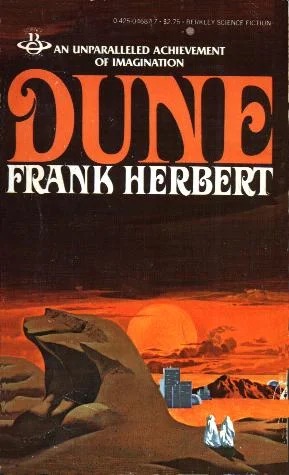
I’m not sure how I ended up with Dune, by Frank Herbert. It might have been my roommates, or some girl I knew (meaning I had a crush on her) who said something about it, or even a teacher who recommended it. But that was the book I chose to read then. A massive paperback book with an orangey binding and what looked like a picture of a sun rising halfway over the horizon, a cliff, and folks dwarfed by the cliff, all in white.
The sun, the cliff, the folks in white. I had no idea what I was getting into.
This was not a book a 14-year-old should be starting his science fiction journey with. It’s huge, like 400-plus pages, a good 50 of which were a glossary explaining all the terms used in the book, and it was so very confusing. I was turning to the glossary every single page, sometimes multiple times on the same page, and it took me months to finish it.
That could have turned me off science fiction forever, but it didn’t. That world was so rich and so well described that it lived inside me and made me seek out other stories that could evoke that immersion again.
I didn’t move on through the series very far. In 1980, there were three novels in the series that I knew of.
I did read Dune Messiah, but it was beginning to pall on me. All the politics, backstabbing, poisoning. It was just too heavy. I think that’s when I decided I disliked anything to do with politics, and since those books were so full of it, it was easy to put them down and move on.
Years later, I had decided to get back into them. The new movie version of Dune had been announced, and it brought back good memories of those early days with that novel. So I looked into it and was amazed at how deep that bench had gotten. Frank himself wrote two more novels. Then his son, Brian Herbert, took up the mantle and teamed up with Kevin J. Anderson and wrote a lot more, prequels and sequels.
I had thought, “Hey, I could start with the prequels, and that’d be fun.” But I’m a traditional kind of guy with book series, so I decided to start with the original again, both to reacquaint myself with the world and to see if I could survive reading it without constantly referring to the glossary. (I couldn’t.)
But something nagged me in the reread. Where was the heart plug, or cork as my brain keeps calling it, thing? Baron Harkonnen had these things installed in all his staff, his nephews, and even himself to control them and bind their loyalty in a very visceral way. (Why he did it to himself, I can only assume it was to convince them it was an “all of us” thing.) But I didn’t see it.
I read the book a third time, this time focused on that missing detail, and did not find it. I was perplexed. Did Frank face enough feedback that he excised it from his book after decades? Did I find an early edition, by happenstance, that had the cork, and all versions after that were edited without it? I got several versions of the book from various sources. They were thinner than the one I held in memory, barely 350 pages in one of them. But none of them said “condensed” or “edited” or anything like that. Yet still, nothing about a heart cork.
What occurred to me is that the media landscape had changed a lot since I was a kid.
Way back, I had loved Star Wars, long before “A New Hope” was tacked on. So much that I saw it seven and a half times in the theater when it came out. (The half time was when I was convinced to take a neighbor kid along with the very parent-reasonable argument of “You can go again if you take Scottie along,” but this kid had to use the bathroom a lot, so I missed, easily, half the movie.) Soon after that, I was haranguing my small-town bookstore for more of “From The Adventures of Luke Skywalker,” which was a subtitle in the novelization.
This guy was game, and he used his sources to order what he could find. Turns out it was just several more copies of that same book. One was a hardcover with a golden dust jacket, and I did buy that because why not. But there weren’t any more in those “adventures.” That was basically a promise, not a historical archive notice.
Then things changed. On the Death Star, the captain shouting at the Stormtroopers inspecting the Millennium Falcon after it had been captured said, “THX-1138, why aren’t you at your post?” (Or at least that’s how I remember it. It might have been the novelization infecting the movie in my head.) But when we upgraded to the DVD, I heard “TK-421, why aren’t you at your post?” and my brain broke. Plus now Greedo shot first. Heresy!
In E.T. the Extra-Terrestrial the government agents who had guns now had walkie-talkies, and then later went back to guns. Digital technology allowed directors to ignore that old adage that you had to release your babies eventually. Now they could basically gene-edit a teenager between theatrical release and home release, or from one format to another.
And this happened in books too. I had basically devoured The Chronicles of Thomas Covenant the Unbeliever and moved on to The Second Chronicles of Thomas Covenant. In an author’s note, Stephen R. Donaldson said there was a story about Seahome his editors had made him remove before publishing it, but that he would include it in Daughter of Regals & Other Stories.
I then learned how very useful editors can be. I’m sorry, Stephen, but they were right. That story would have pulled focus, slowed everything down, and taken several chapters to get a reader back.
He got his revenge, though. His success with the first Chronicles made him able to get whatever he wanted in the Second, but that sucker dragged. Just sayin’.
And the new digital landscape allows books to be edited basically on the fly. I have one that I read through, a reference book about Moonlighting, and when I opened it recently there was new content. That’s only one example I know of for sure, but I had suspected it was happening for years and never really could verify it.
So, in my head, folks could now kill their darlings after they published them. Historical volumes change between editions all the time. Fiction could too. Only they don’t stamp “Revised” on the cover. They bury it in printing numbers that look like a secret code.
So obviously Big Publishing had edited Dune and took that uber-gross cork out of it, changing whole swaths of text and all references to something more benign. Yeah, that made more sense than I was wrong, right?
But I’m nothing if not thorough, so I looked on the internet. Google searches, Reddit threads, Yahoo Answers, everything. And you know what I found? Not a single whisper that there was editing shenanigans with Dune. And my brain could not contain for long the thought that there was a massive conspiracy to keep such an edit secret.
But it still was firmly in my memory. I was sure I had read it. So I interrogated my memory more thoroughly and you know what I discovered? I could picture the corks completely. Like the old rubber stoppers for bathtubs: sloping sides, a rim ring, a looped hole in the top where you ran a chain through. But I could not, for the life of me, think of the text that gave me such a clear image.
So I googled some more and guess what I found? There was this movie from 1984, Dune, directed by David Lynch, and I can assure you I saw it when it came out. I can also assure you that I have very little memory of watching it. I can’t even say I thought it was odd or not Frank’s vision, though that seems to be the popular view of it.
But that version was full of body horror, long before that became a genre of its own. And one of those concepts was the heart plug, or cork, and though my memory told me that was how the Baron died, his own cork getting pulled out, that was not true. An underling is killed by the Baron, and there is a deleted scene where Thufir Hawat pulls out his own.
I guess what I had done is read a book at fourteen, then saw the movie a few years later, and mixed them into a single memory locker. Not exactly conflating, but close. I just attributed the cork as if it had been written there and then chased the facts into a different reality. I guess I did the same thing in reverse with the Star Wars memory.
Yes, immediate editing is a fact. People can edit things now in ways that go beyond the old model of fire and forget. I don’t think it’s always justified, but it’s not always bad. One of the movies I own digitally had features added long after I bought it: a new trailer for a sequel and a behind-the-scenes feature for that new movie. So not really a content addition, but not offensive either.
It’s kind of my thing now to have the digital copies and the physical media as well. One provides easy access and maybe extra content sometimes, and the other provides archival status. (Seriously, did you know the DVD of Barb Wire has a strip scene with Pamela Anderson that is not in the digital version or the Blu-ray? I have all three now.)
And now it’s not a roadblock in my head. I can read Dune and the rest of the oeuvre without the cork that never was. I just have to face the dense story structure and all those glossary references.
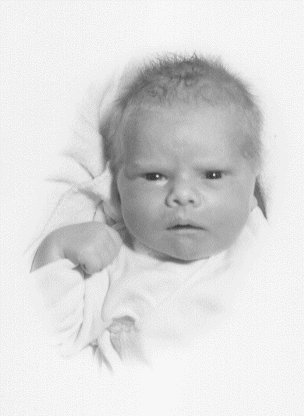
Born into a quiet that a child feels when he discovers he can walk on his own, but doesn’t feel ready.
Not literally blue. Not technically poor. But in the way that a child can be poor even in a house with food, and blue even in a room full of laughter.
I was born into that kind of quiet.
It’s hard to explain to people who grew up inside a steady world. People who grew up with parents that were… consistent. People who grew up with rules that made sense. People who grew up with love that didn’t have conditions attached like price tags.
Because when you grow up in a world that shifts under your feet, you become a person who is always bracing for impact.
You become a person who listens more than you speak.
You become a person who watches faces for weather.
You become a person who learns early that silence can be safer than honesty.
I was a child who learned to read a room like a map.
I learned what footsteps meant.
I learned what a door closing meant.
I learned what a sigh meant.
I learned what the tone of a voice meant.
I learned what it meant when the TV got turned up loud.
I learned what it meant when the house got too quiet.
I learned what it meant when someone was cleaning something that didn’t need cleaning.
I learned what it meant when someone was suddenly being nice.
I learned what it meant when someone was suddenly not.
And I learned that I could not change any of it.
So I adapted.
I became a kid who could disappear while still being present.
I became a kid who could be in trouble without knowing why.
I became a kid who could feel guilty without being guilty.
I became a kid who could feel like I owed something, even when I didn’t know what the debt was.
I became a kid who learned to make himself smaller.
Because small is less noticeable.
Small is less target.
Small is less… problem.
I didn’t have language for any of this at the time, of course.
At the time, it was just… life.
At the time, it was just… normal.
At the time, my feelings didn’t feel like feelings. They felt like facts.
I didn’t think “I am anxious.”
I thought “This is how the world is.”
I didn’t think “I am lonely.”
I thought “This is what it means to be me.”
I didn’t think “I am sad.”
I thought “This is the baseline.”
And when sadness is baseline, you don’t notice it as sadness.
You notice it as gravity.
That’s what I mean by poor.
Poor isn’t just money. Poor is absence.
Poor is what you don’t have and don’t even realize you’re missing, because no one ever showed it to you.
Poor is safety. Poor is stability. Poor is being able to relax. Poor is knowing that the rules will be the same tomorrow as they are today.
Poor is knowing that love isn’t a bargaining chip.
And blue…
Blue is the color of looking out a window too long.
Blue is the color of being awake when you shouldn’t be.
Blue is the color of knowing things you didn’t ask to know.
Blue is the color of a child who learns too early that adults are not always safe.
Blue is the color of learning to laugh at things you don’t find funny, because laughter is camouflage.
Blue is the color of becoming “mature” too young, which is just a polite way of saying “damaged in an efficient way.”
I was born a poor blue child.
And I grew up into a poor blue teenager.
And then a poor blue adult.
And I carried that blueness into places where it didn’t belong.
I carried it into friendships.
I carried it into relationships.
I carried it into jobs.
I carried it into rooms where everyone else seemed to be living with their feet flat on the ground, while I was still balanced on the edge of a cliff.
Because when you grow up braced for impact, peace feels suspicious.
Calm feels like the moment before something breaks.
Kindness feels like a setup.
Compliments feel like a trick.
Love feels like a test.
And you don’t even notice you’re doing it.
You just… react.
You pull away.
You make jokes.
You get defensive.
You get cold.
You get loud.
You self-sabotage.
You leave first.
Because leaving first feels like control.
And control feels like safety.
And safety feels like…
Well.
Safety feels like something you never had enough of.
So you try to build it out of the materials you have.
And sometimes the materials you have are not good.
Sometimes they are fear.
Sometimes they are anger.
Sometimes they are pride.
Sometimes they are numbness.
Sometimes they are distance.
Sometimes they are addiction.
Sometimes they are avoidance.
And you build a life out of that, and it kind of works.
Until it doesn’t.
Until something happens that makes you realize you’ve been living inside your own defense mechanisms.
Until something happens that makes you realize you’ve been surviving, not living.
And then you have a choice.
You can keep being the person who learned all those patterns, or you can become the person who unlearns them.
And unlearning is harder than learning, because learning is addition.
Unlearning is removal.
Unlearning is telling your nervous system that it doesn’t have to live at red alert.
Unlearning is telling your brain that it doesn’t have to scan for threats that aren’t there.
Unlearning is telling your heart that it can stop flinching.
Unlearning is teaching yourself what safety actually feels like.
And the hardest part is that safety feels boring at first.
Safety feels empty.
Safety feels like a room without noise.
Safety feels like standing still.
And if you grew up running, standing still feels like death.
So you create drama, not because you want drama, but because drama feels familiar.
Drama feels like home.
Pain feels like home.
And it takes a long time to make peace feel like home.
I was born a poor blue child.
And I am trying, even now, to stop being poor and blue.
Not in the sense of money.
Not in the sense of sadness.
But in the sense of what those things really mean.
Absence.
Gravity.
The weight of old weather.
I am trying to learn that I can exist without bracing.
I am trying to learn that I can be loved without earning it.
I am trying to learn that I can relax without being punished for it.
I am trying to learn that I can be safe.
And if that sounds simple, it’s because you didn’t grow up poor and blue.
If it sounds dramatic, it’s because you didn’t have to build your whole personality out of adaptation.
If it sounds familiar…
Then maybe you did.
And maybe you’re still trying, too.
The lived version of this story appears in the book chapter here.