The internet existed in 1998, but it wasn’t something you just used. It was something you went to, built a little corner of, and then logged out of when you were done.
It’s honestly hard to understand this, even for myself, but back in 1998 the Internet, for most people, was not continuous. If you had a single phone line you would make sure no one else is on the phone, dial-in, (if you had a second cord for your phone line, if not, you had to unplug the phone and then plug in your modem), then dial into your Internet service provider. Then you get to listen to that squawking sound coming from it while it connected, and then you had your Internet.
When you were done doing what you had to do, checking email, searching for a connection, or maybe something for sale, you logged off and you went about your day.
Now, if you were fancy, or really nerdy, (which was becoming fancy in popular culture, but not quite just yet), you would have two lines, one for the Voice and one for your Internet. You still wouldn’t stay dialed in all the time however, you go to bed and disconnect and then you logged back in in the morning, perhaps, but you’re very rarely connected the entire time because the phone company would drop the call, which might “corrupt” the local node. Then you’d be calling them, and they’d be calling you back, and it’s just be a mess. So you still basically dialed in, did your business, dialed out.
And sometimes in the middle of your email somebody, not paying any attention to your Very Important Work, would pick up the phone line and that would break your connection, or they would scream at you because of the squawking coming out of the earpiece, and you would scream back that, “Hey I was checking my email!” They would scream back, “Nobody writes you anyway!” It was a whole thing.
This was all landline. If you wanted to talk to someone, you actually called them. No texting, no quiet back-and-forth, you picked up the phone and you hoped they answered, or at least you got an answering machine (cue dorky skits with people alternating words in funny voices on the OGM.) The new Internet operated over the same lines and sometimes they would get in the way of each other.
Then, websites started becoming a commodity for people, not just businesses, but individual enthusiasts that were interested in staking a claim out there. The unclaimed Wild West of dial-up internet.
You could buy a website, or more properly, a domain name, then make a website with that address. ICANN (Internet Corporation for Assigned Names and Numbers) was the rule maker, the new sheriff in that Wild West, and Network Solutions was the main registrar, the place you actually went to buy a domain. GoDaddy wasn’t really a player yet.
I used EarthLink as my dial-up provider, and they also provided hosting if you had a domain of your own. Other providers that did the same thing were AOL and Prodigy, but I really didn’t have much experience with them. (We’ll talk about the constant influx of AOL CDs that turned into coasters, frisbees, and even artwork, another time.) The pricing for all these services varied wildly, but the benefit of using them was that even if your dial-up wasn’t active, your website still was, because it was hosted on their servers, which normally had a T1 or even a T3, which were really fast constant connections for the ‘90s.
To avoid those extra charges, or to just stay independent, many times you could host your site from your own home. (You still can, actually.) You’d make your own server out of your computer (a second computer if you could.) That one would have to stay connected all the time. That meant you probably had to have a special connection with your phone company in order to make sure the phone line didn’t disconnect randomly, and keep them from screaming at you. It took a lot of sweet talking, let me tell you, just to keep that one line connected 24/7.
Around this time, I was in full denial of my tech nerdom. I was studying Theater, which is just a different form of nerd. Debi, on the other hand, was the real thing. She lived on IRC, or Internet Relay Chat, and had real Internet street cred and through her, I got pulled deeper into that world.
And once you’re in that world, just using Internet doesn’t feel like enough anymore. So I looked into buying my own domain. It was a process, let me tell you. After a lot of research, fees, and everything that was involved back then, I finally had my very own shiny domain. And then I had to make a website out of it.
Debi, well I kind of was in competition with her. She didn’t have her own website. I mean, she did maintain one for someone else, but she didn’t have her own. So making my own website kind of seemed like proof that I belonged there, in our relationship. (I was young, forgive me.)
But let’s be honest I really had no idea what I was gonna do with this website. I wasn’t a diary, keeper I wasn’t a person that wrote stories, back then. I was just a student at a college. But I wanted a website, so I came up with a name I thought was catchy.
Long ago, I gained the name Jindai Hideo, when I was in Japan. Long story short I was out with some buddies in the 6th Division Japanese Ground Self-Defense Forces. (They’re actually not allowed to call it an army, it’s a World War II thing, look it up.) anyway on one particularly heavily drinking episode we got to talking about what our names meant and I happen to know what Richard DavId both mean, and one of them a more poetic member of that group translated that into Jindai Hideo. And that really really stuck with me throughout my life as you might imagine.
So I thought I’d take that name and make it a website. And then I thought OK what is gonna be the name of this site. And I got really alliterative and cutesy, and called it Jindai’s Just Another Jumbled Joint. I was at theater student, so of course it was somewhat theater themed. Klieg lights along the side lighting up the WordArt logo that Debi made for me. A little artsy thing because there were tools back then to help you design websites and they put their own little watermark in your code. A little dividing line made of blinking LEDs (simulated) and it was ready to launch. It was just a spare 19 or so lines of code padded to like 29 or 34 depending on how and when I put extra spacing into it. And when I say I, it’s all Debi. She was an expert in WordArt, and she was better with HTML than I was. So she helped me launch that site in a very significant way.
I didn’t really do anything with the site. I would just look at it every now and then and go cool. I have this, but it wasn’t a diary keeper. I wasn’t someone who wrote stories back then, even. It wasn’t a blog and I wasn’t selling anything. (I did come up with an idea to sell things later, but that’s an entirely different story, just know that I’m very good at cooking omelettes and thought that I could make that a product.)
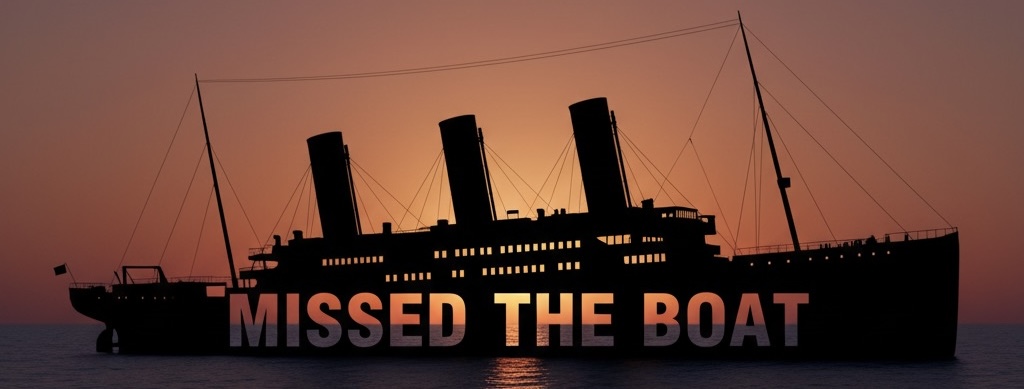
Around that time, the movie Titanic was in the complete Zeitgeist. In this incipient Internet culture memes, and Twitter were not things, but this movie took all the air out of any room it was in. Debbie and I were opposed to the Zeitgeist and Debi was personally opposed to something in that movie so she would not see it. I would not see it. So we made a webring, because that’s what you did back then. Missed the Boat.
A webring was an early Internet phenomenon that arrived to fill a need before search engines existed. People with common interests would form a webring, so that you could click on that webring, (either left side or right side), to go to the next (or previous) website in that ring. They had knitting webrings, and they had dog webrings, and they had cat webrings, and they had car webrings. There were webrings for everything. If you found one thing you liked, you could keep going. Before search engines took over, that’s how you discovered things.
it wasn’t the most popular webring, we had a dozen member sites, maybe fourteen tops, but it was my little webring. I added that badge to my website so folks could go to the next site in the chain. And even though people would click to mine and see just the landing page, no articles or anything, they still clicked on it. Saw what was there, (heard it!) Then clicked for the next one. That was just what it was for.
The Internet Archive was established in 1996, long before the Internet was anything close to common place. It was started by people who believed the web was worth preserving, which still amazes me to this day. Founded by Brewster Kahle, is something genuinely unique in the history of the Internet.
You might know it better as the Wayback Machine, but that actually didn’t become public until 2001. However, the Internet Archive was already crawling and taking snapshots of all websites pretty much from the beginning. They must have had a very fast and stable Internet connection to do that. Even in 1998 there were hundreds of thousands of websites, some connected all the time, most were connected intermittently. And it was the Archive’s job to capture each one when it could, which wouldn’t have been possible without speed and reliability behind it.
Well, the archive captured my old site several times before that site vanished forever. And it did vanish. Somewhere around 2001 or so my domain came up for renewal and I was unavailable to renew it. Some Internet speculator saw it was available and took it immediately. I’m still hoping to get it back someday, but this current environment of Internet Domain Investors, you might call them, generally that means thousands of dollars and I’m just not willing to pay for that much for just nostalgia.
But my site still existed courtesy of the Wayback Machine. Somewhat broken of course, because none of the resources were available – the images or the midi file. (More on that later.)
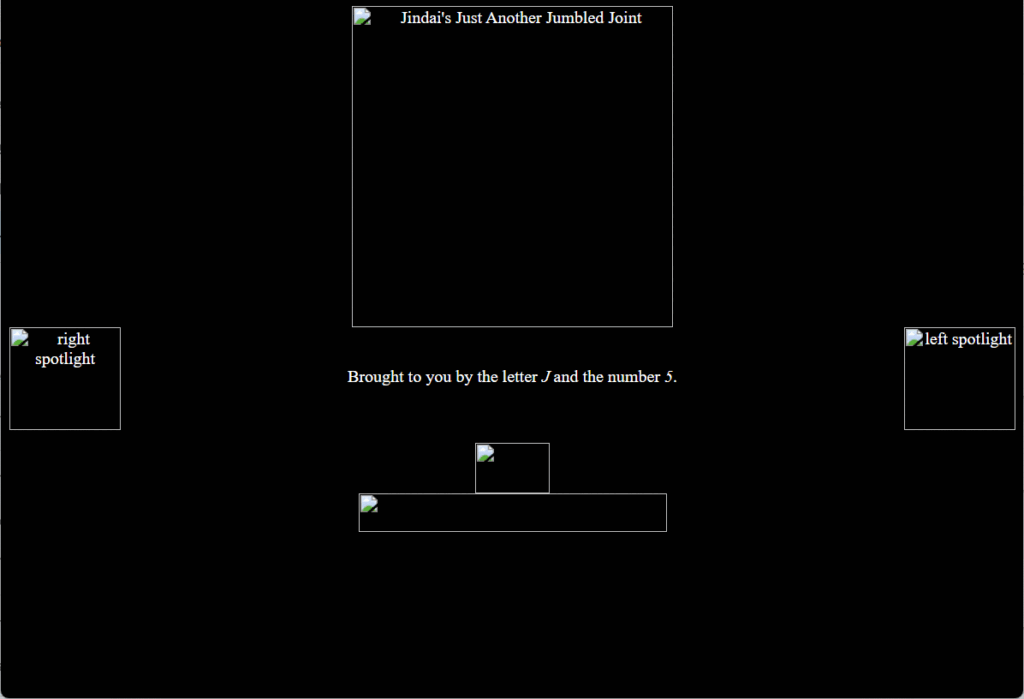
Now, this might be new to you, but if you hit CTRL-U on most websites, it’ll let you see the source code. (Only most, some use what amounts to magic to prevent that.) and I did this with what the Wayback Machine displayed of my old site. I saw, and counted about 134 lines of code, and after stripping out all the lines Archive.org injected as part of their process, I was left with the 19 lines, maybe a few more with padding.
<html>
<head>
<title>Jindai's Just Another Jumbled Joint</title>
</head>
<body bgcolor="#000000" text="#ffffff">
<center>
<img src="jj2.gif" width="300" height="300" alt="Jindai's Just Another Jumbled Joint">
<br>
<img src="Rightspots.gif" width="104" height="96" alt="right spotlight" align="left">
<img src="Leftspots.gif" width="104" height="96" alt="left spotlight" align="right">
<br><br>
Brought to you by the letter <i>J</i> and the number <i>5</i>.
<p><br><br>
<img src="webpaint.gif" width="70" height="47" alt="">
<br>
<img src="ledunder.gif" width="288" height="36" alt="">
<p>
<embed src="default.mid" height="2" width="0"></embed>
<bgsound src="default.mid">
</center>
</body>
</html>
As mentioned before, I didn’t write most of this code, Debi did. She was the website guru; I was the guy trying to prove himself, but not really great at it.
Right now, of course, I’m a bit more seasoned and knowledgeable, and looking at this, I said “OK this is just a landing page.” There’s nothing else to it.
And… what is default.mid?
Well, to break it down a bit, bgcolor of all zeroes? As Nigel said, “None more black.”
Now, on to the resources. jj2.gif, obviously a logo–and the Second of its Name.
While my memory was hazy, I’d set my brain into 1998 mode successfully, and I knew that that logo was likely a WordArt construction that Debi made, probably a second attempt.
Rightspots.gif and Leftspots.gif, clearly meaning spot lights, (theater student) and align=left for right, meaning it was Stage Right, and the reverse for the left. 1998-me said these were likely animated with little sparkly lights moving away from the source toward the logo.
Then we have webpaint.gif, that was the little watermark from the helper software I must have used. And ledunder.gif, that must have been little blinking LED lights, the page-bottom indicator.
These last two centered.
Default.mid. This is when real memory had to be relied on and I dug into my memory to try to figure this out. It took a lot of prodding and a lot of patience, but I did remember a bit, and was pretty sure that we pulled this music from a PC game that we had been playing and I just renamed it to default to hide it in obscurity.
Which, of course, does not help me now.
My first thought was Monopoly, and I looked on the internet to find an old games site and downloaded it. I didn’t find it. Star Wars Monopoly was one I do remember well, but after digging into its guts, I found five midi files, and they were all were clearly John William’s pieces, and there was no way I’d pick those.
Then I thought You Don’t Know Jack, a great game, but no midi files, they were all .siff files, which might have a .mid inside, but I lacked the tools to crack them, both now, and very likely back then.
So, now, I just googled a bit, Monopoly was still the one dominating my brain, despite the initial negative result. And I found a site that listed all the songs in every monopoly version out there. And…
You ever hear of Frank Klepacki? He got famous for the Command & Conquer games, the one you probably actually know him from, but he also did the music for Monopoly back in 1995.
Which is not something I would’ve guessed in a million years, but once I started digging, it started to make a lot more sense. I found the site that listed all of the midi files in all of the games he wrote them for, and I could play them, so I did.
As I played through all of those, I got to Monopoly 1995, things started to sound familiar, and then I hit song number seven: myhotel.mid.
That was my little Eureka moment. That was the song that I knew had been on my site.
1998-me and 2026-me both rejoiced.
OK, I found the song. Now, as for those images, the same resources that were available in 1998, the free gif sites and other places? Well, the same ones were just not available.
The files might have been available if I really, really dug, but I’d been doing this for several hours at this point and I just had to admit that that would be a quest not served by continuing.
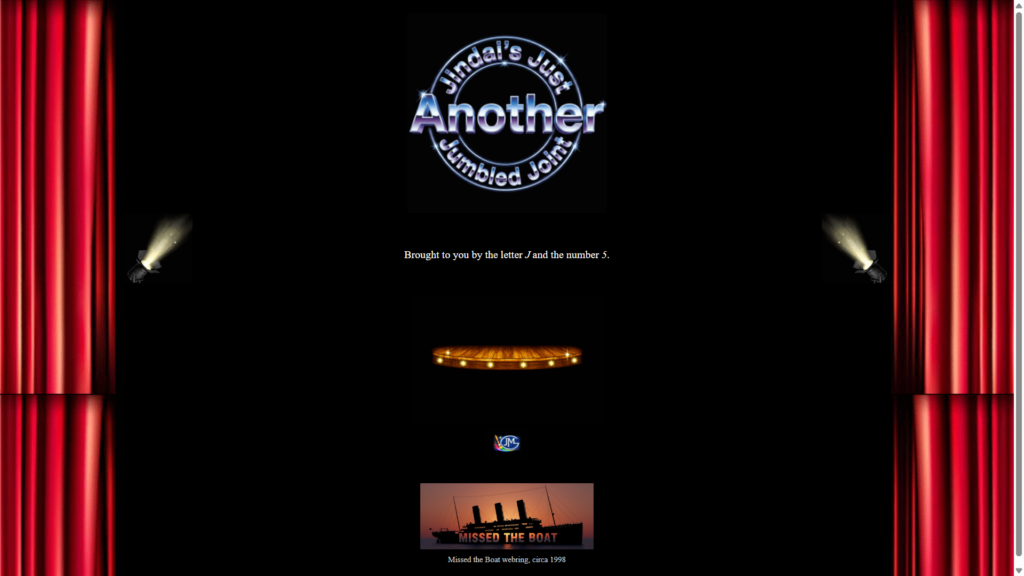
I decided that recreating in the spirit of what had been in place would be the best choice. So I worked up that logo again and I do believe it’s very close to the original. I spoke with Debi and she even said, “I think it’s okay. The colors are better.“
Then the klieg lights. I found one, oriented it right, copied it and reversed it, and I had my left- and right-spots. (Leftspots.gif and Rightspots.gif, keeping the filenames to match the code as much as possible)
Then webpaint.gif, which I didn’t even try to faithfully recreate. No hidden corner of my brain told me what company or software I’d had used back then.
I what it was for, so I just took my own modern logo, put a paintbrush on it, then shrunk down.
The last resource was ledunder.gif. And I tweaked that a bit to lean even further into the theater idea, a stage edge with lights. Works for me.
Then I had a thought. Back in 1998, monitors were basically 4:3. Modern screens come in all kinds of sizes, but the most common is 16:9.
If I wanted a 1998 site to display correctly now, I had to account for that.
So, leaning into the theater motif, I found some curtains and just edited them into wings that sit on the sides of the screen. On a true 4:3 display, you won’t see them at all. On wider screens, they start to appear. On something like an iPad in landscape you get a little bit of curtain. On a full 16:9 display, you get a lot.
One aspect of it that surprised me is that on some screens the curtains repeat and look scalloped. I could’ve fixed that, but I decided not to, because that’s just such a 1998 thing to do anyway.
The final thing that wasn’t in the Wayback Machine reveal was my webring banner. And I decided to add that because I knew it was there, even if they didn’t capture it. So that ended up at the bottom, where it belongs.
Then I loaded the page and it looked pretty good. I tweaked a little bit here and there, but by the time I thought I was finished, I realized that no music had ever been playing.
In fact, when I got it right, my browser just wanted me to download myhotel.mid.
Looking into it, I discovered that MIDI music had kind of lost its purpose on the Internet.
Back in the dial up era, MIDI was really necessary. It was very small so could go over dial-up without any trouble. But MIDI is just a set of instructions for a music device to execute.
Back then we all had sound cards. I had fancy ones because I liked my music to sound great. I had an Ensoniq, I had Sound Blaster. I kept upgrading. At one point I even had a Harmon Kardan sound card.
But, broadband Internet brought an end to that. Full mp3s could load in seconds, even large files. So internet culture just stopped supporting MIDI.
When was the last time you bought a sound card for your computer? I know it’s been ages for me. All of the sound processing is handled by onboard hardware now. There’s nothing truly musical about modern setups, unless you are in the industry.
Plus, browser behavior had changed in the intervening 20 years. Back in 1998, the Wild West, you visited my site and that song started playing. Immediately. No permission needed. It was just there.
Now, if you have sound loaded to play, someone has to interact with the page. One click and it plays. Nothing ever plays automatically anymore (unless you’re in the pop-up ad business, they still get away with murder.)
So when I finally got the MIDI to load, my browser just wanted to download it, because it had no idea what it was supposed to do with it.
I had to compromise. I converted the MIDI file to an MP3 and loaded that instead. I left the MIDI play instructions in the code, but commented them out, because I don’t need you visiting my site and downloading a midi file.
Now, if you CTRL-U this, you’re gonna see considerably more than the original 19 lines. 2026 demands this kind of structure to display 1998 technologies. CSS to add the wings, to control the spacing, to frame it all. But they are all there, if a bit overshadowed by the other lines.
I’m not going to add to this landing page. It is what it is.
Well… I might add a second click to stop the music once you start it.
But other than that, I like it as it is, a piece of my history, resurrected from the grave.
If I ever get my original domain back… who knows?
But for now, you can see what I’ve become: a diary keeper, a blogger, a writer.
That’s what this site, the current one, is all about. Taking the screaming voices in my head and pushing them out into the world.
Hopefully in a coherent, constructive way… with a side order of entertainment.
That will never change.